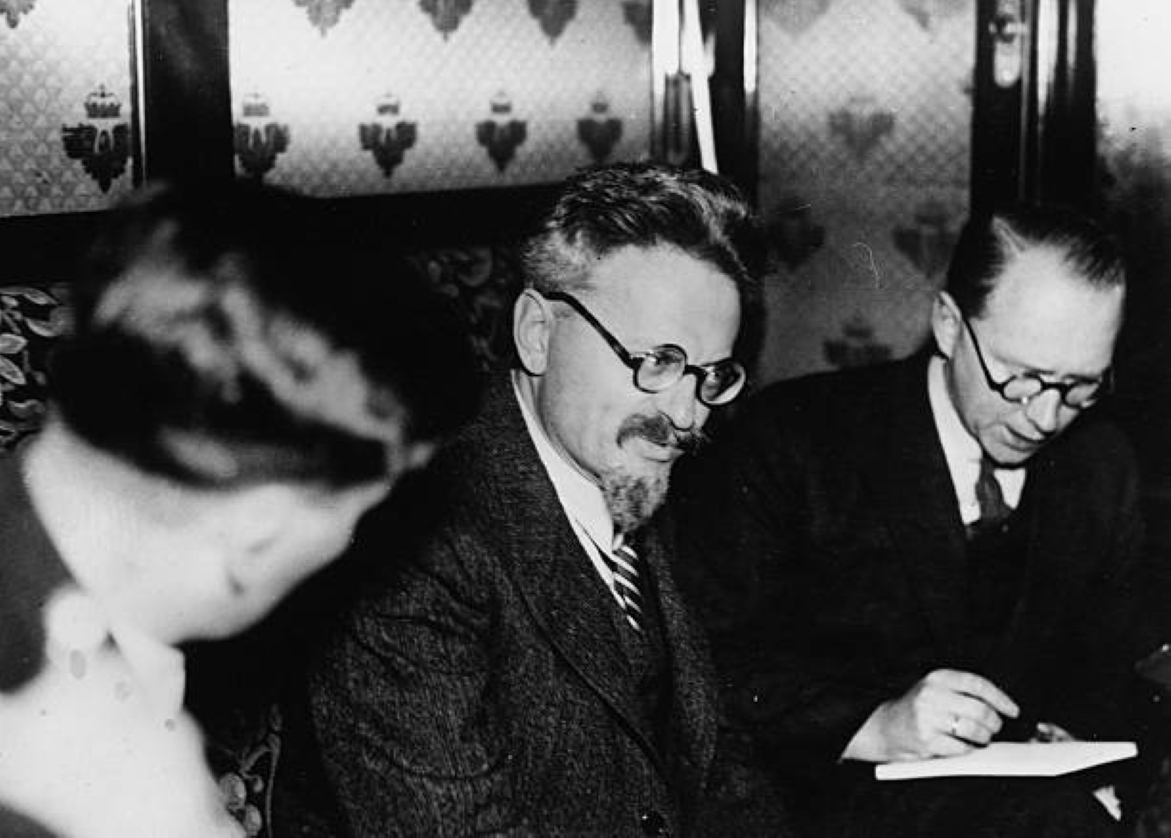
Starting activism in the Y.P.S.L., he quickly became National Director in 1921, but left the Socialist Party for the Communist Party over the S.P.’s relations with the LaFollette movement. In the later-20s, Weisbord was a leading face of the U.S. Communist movement, heading the Party’s work in textiles and the important Passaic strike of 1926. On the left of issues in the Party but not a part of the Party’s traditional factions, Weisbord would be nevertheless be expelled with his partner Vera Buch and their supporters in 1929. In 1931, they formed the Communist League of Struggle publishing Class Struggle and aligned themselves with Trotsky’s International Left Opposition, though hostile to Cannon’s Communist League. As part of an extensive European tour in 1932 meeting many dissident Communists, Weisbord traveled to Instanbul to spend time Trotsky on Prinkipo and wrote this report on his return. Weisbord and the C.L.S. would break politically from Trotsky and the Fourth Internationalists shortly, in late 1934 over policies around the so-called ‘French Turn.’
‘Three Weeks with Leon Trotsky in Turkey’ by Albert Weisbord from Class Struggle (C.L.S.). Vol. 3 No. 5. May, 1933.
It was my good fortune to spend three weeks with Leon Davidovic Trotsky. For this privilege I was quite willing to travel the six thousand or so miles by sea and rail from New York City to Istanbul. Once in Istanbul, only a narrow strip of water separated me from the goal, and I made the last lap of the long journey in a little steamer that sailed out of the Golden Horn to the island of Buyuk Ada (Prinkij) in the Sea of Marmora.
It was May. The clear limpid light so characteristic of the Mediterranean region heightened the colors of the blue sea, of the green pines fringing the shores, of the deep purplish hills that stretched all along the coast. Anticipation leaped ahead much faster than the little ship, as the many mosques of Istanbul, glittering in the bright morning sun, gradually diminished behind me.
I was travelling to the modern St. Helena on which was exiled the greatest revolutionary figure since the death of Lenin. By a peculiar turn of fortune, Trotsky the veritable organizer of the Russian Revolution, first acting President of the St. Petersburg Soviet in 1905, leader and organizer of the Red Army, had been exiled from his own country and deported to this distant out of the way place off the coast of Asia. Curiously enough, it was in the name of that very Russian Revolution that the deportation had been accomplished by Stalin with the direct aid of Kemal Pasha and other Turkish dictators to whom Communism was anathema!
The parallel with Napoleon was obvious, but would it hold good in this case? Would Trotsky in exile strut and pose in Napoleonic fashion with flashing eyes and tossing head, or would exile leave him brooding and morose? Certainly as Commander of the Red Army, Trotsky had played a remarkable role, not only as revolutionist but as military commander. It was through his concrete clear analysis of problems, his disciplined audacity and organizational power, that he had been able to form the steeled Red Army from the raw band of recruits that were his, to inspire them with the necessary courage to break the ring which two million white guardists and interventionists, captained by a most able and experienced general staff, had set around the heart of Bolshevist Russia.
All historical parallels limp, but certainly, within well defined limits of course, the parallel between Trotsky and Napoleon can be drawn. Napoleon was the representative, the brilliant sword, so to speak, of a new class that was coming to power–the bourgeoisie of France. Already dominant in the economic sphere, the capitalist class felt compelled to break the social and political relationships that feudalism and the ancien regime had encrusted on the structure of society. But the uprooting of feudal anachronisms and the destructions of the ancien regime in France could only mean war against the entire ancien regime of Europe. Not otherwise could the new class hope to survive. Napoleon’s invasions were bourgeois crusades in which the rising bourgeoisie felt the call of God (or “Reason”) to construct a new world, a bourgeois world, in their own image. The whole army of Napoleon breathed the idealism and morale that only the consciousness of fighting for the progress of the whole human race could bring to the soldiers. What through Napoleon was finally defeated and exiled, was not feudal dominance overthrown and did not capitalism triumph?
So with Trotsky, although matters indeed stand upon an entirely different plane of events. The proletariat had broken the chain of capitalism at its weakest link. A new class was coming to power, building a new system of society. But the working class of Russia knew very well that it was a question of life or death to them–that either world capitalism must go under or the Soviet Union. Necessity breeds the men. Trotsky became the cutting arm of the proletariat, an arm that cut through and broke to pieces the ring of enemies in Russia, an arm that moved on Warsaw and proudly raised aloft the banner “COMMUNISM KNOWS NO BOUNDARIES.” And today Trotsky still stands as an intransigent internationalist struggling vigorously with all his might against all narrow merely nationalist tendencies. However, let us not push the parallel too far lest we say too much and thus too little. We must never forget what Leon Trotsky himself would stress, that the French victories were the victories of NAPOLEON, while in Russia they were the victories of the BOLSHEVIK PARTY organized and trained by Lenin.
The modern St. Helena was not far off and soon the steamer approached Buyuk Ada. Here was the place–a pleasant island so small that two hours walk would take one all around it. In the center was a large hill with thick clusters of pines. The shores were studded with hotels and villas each with a large garden overflowing with the richly colored and fragrant flowers and trees of all descriptions. Around the dock clustered a small village. The island, where formerly were detained exiled Turkish noblemen, was now a popular summer resort. What charming consideration, I thought, the protagonist of the “Permanent Revolution” has been given a “permanent vacation”!
I hailed a carriage: “A la maison de Trotski,” I said, and with a crack of the whip the horses were off. It was not long before the vehicle stopped at the entrance of a moss-grown, cobble-stoned street leading directly to the sea. There, facing the sea, surrounded by a high wall, was the house and garden of Trotsky. I went to the gate. At once a swarthy Turkish special officer barred my way. The illusion of “vacation” at once evaporated. This was not “vacation” but exile, and not only exile but jail. The prisoner could walk about, he could take his boat and fish, but only at the greatest personal risk–and always with the officers at his side. Stalin’s will and Turkish officers obeying it–what a combination! “I am from America. I want to see Leon Trotsky,” I said in English. He called another officer who went to the house. Soon some one came running out. I was welcome. The guards stepped aside, the gates were unlocked, the dogs stopped barking, the gates clanged behind–I too was a prisoner!
Trotsky lives in a large pleasant two storied house, formerly inhabited by a Turkish business man, which now Trotsky rents from its Turkish owner after his former house was burned down by a fire of unknown origin. On the ground floor are the living quarters of those comrades who aid him, and of the cook, a pleasant Greek woman, and above are the quarters of his immediate family (including his wife and grandson), and his office, library and study.
Order and discipline are apparent everywhere. The library is neatly arranged, the papers carefully filed, every document in its place. Everyone knows his task and quietly and efficiently goes about doing it. Everything seemed peaceful and secure, only the automatic pistols and various small arms now and then to be seen in the house gave an inkling that there was the possibility of danger and that here were men determined to fight for their lives at all costs. Before I left I was to see the efficiency of the watch in action.
Trotsky lives with his immediate family and with several comrades who help him in his work. I found his wife, Natalia, an extremely cultured woman, in the forties, who, a revolutionary in her own right, had willingly and understandingly suffered all the privations of her husband and actively helped him in his tasks. It is as the head of this little intimate group that Trotsky reveals his considerate and gentle character. He would press one to eat and to feel at home, and watched solicitously over the health and welfare of his companions. Simple, generous, considerate, Trotsky displays these characteristics in all his personal relations–in fact the little group lived in a noble plane of relationships entirely unaffected. Between the “Old Man” as he is affectionately called, and those around him, has been built up a great warmth and tenderness of feeling.
Upon my arrival, I was taken into the study where Trotsky was working on the second volume of his “History of the Russian Revolution.” He greeted me warmly, inquired after my health, insisted that I come immediately to stay at his house, and worked out a program of discussions. Here I was able to observe intimately what kind of man was this Trotsky.
What I saw before me was a strongly built, stocky, medium-sized figure of 53 years or so. Handsome features, delicately etched, have been touched by the cares of the revolution. His familiar thick mane of hair, formerly jet black, is now streaked with grey, but his eyes still snap behind the thick glasses, and his firm features still hold all their aggressiveness. The strong, well-shaped hands, broad back, graceful carriage, healthy, glowing tanned skin, the brilliant smile that illumines at once all his features, everything about Trotsky suggests the combination of grace and strength, of brilliance and reserve, of biting humor and relentless determination, that have characterized him in everything he has done.
This disciplined yet abounding vitality was apparent in his sincere courteous manner. A patient listener, he knows how to make one feel that he is steadily absorbing all information. But, at the same time, Trotsky never wastes time: and at any undue encroachment on his working hours, his eyes snap impatiently and one feels at once that one is holding up the mighty forces of destiny. It was the same with his speech. In a clear tenor voice, he speaks slowly and decisively, each word spoken as though carefully calculated, but like his written style, compact with thought, and scintillating with striking phrases. “The style is the man” indeed.
It might be expected that the fall from power would have left Trotsky broken or morose or pessimistic. Far from it. The exile and imprisonment have apparently not put him on the defensive nor withered away his strength, even though the climate has given him malaria from which he suffers intensely in hot weather, and though he is on a diet due to stomach troubles. In spite of these physical handicaps and political reverses, he seems to preserve an admirable philosophic calm, a deep confidence in the correctness and ultimate victory of his views. The final triumph of the proletariat and of the Left Opposition is to him absolutely assured. A contagious optimism pervades all his thoughts.
And these things came out in all our conversations. Trotsky showed a tremendous catholicity of views. We talked of China, India, Germany, Italy, Spain, America, Russia, the Negro question, the Labor Party question in America, the world economic crisis, the personal traits of the leading actors on the European political stage today, literature, military tactics; on all these questions Trotsky showed himself a broadly informed man with unusual penetration.
I asked him: “What do you think of the German situation–Suppose the Hitlerites seize power?” “To me,” Trotsky replied, “Germany is the key to the international situation. Let us look at the East–Japan will not attack Russia immediately. In Asia things go more slowly. Japan will have her hands full for a while with Manchuria, which can well become for her what Morocco was to the Spanish dynasty. Besides, Japan has far too much respect for the new Red Army of Russia to try war without a guaranty from the West. The West is decisive. If the world is to turn Communist, and the Revolution made permanent and enduring throughout the world, it must come from the contradictions in the West. And the key to the West, to Europe, lies in Germany.”
“In Germany,” he continued, “all the conditions are ripe for a Communist Revolution. On the one hand, Germany is the European country par excellence of large scale industry, welded into monopolies and trusts and fused with the State itself. On the other hand, of all the great industrial countries, Germany is the only one where the masses of people have suffered so much and been reduced to such a low standard of living. Here too the mass of workers, already socialistically minded, have seen the Socialist Party take power and yet fail to bring Socialism.”
“In the face of these conditions, it is disturbing to find that all working class revolutions in Germany have been defeated, that the Socialist Party is still able to keep its influence, the Communist Party does not grow to any extent, and to cap it all, a great growth of Fascism is taking place under the direction of Hitler’s Nazis.”
“What do you consider the reason for this growth of Fascism?” I asked, “And what will become of it?”
Trotsky found one of the principal reasons in the blunders of the Communist International which, he considers, under Stalin’s direction, has become nationalistic and opportunistic.
“Chiefly due to the blunders of the Communists,” he stated, “Hitler may be able to take power. And Hitler in power signifies the actual massacre of the Communists and their virtual elimination together with the destruction of the German Trade Unions. Such developments would cut down the Communist Parties everywhere. They would remove the greatest obstacle to a world war against Soviet Russia, namely, the resistance of the energized international working class. Soviet Russia cannot remain indefinitely Communist if the workers elsewhere cannot aid it, despite the internal strength of Russia, fortified by the Five Year Plan.”
Trotsky strongly implied that a Communist International that could commit such blunders as to lose the decisive German revolution and thus the Russian Revolution could no more be a worthy instrument. If these revolutions were to be lost, the Communist International, as now constituted, would be declared useless and a new International, really following Marx and Lenin, established. And the groundwork of this task must be laid now. The deportation and exile of Leon Trotsky, far from disarming him, only gave a greater opportunity for him to meet his foreign comrades who came to him from all parts of the world. Already an International Left Opposition has been built up with sections in all principal countries. Today these sections strive to reform the Communist Parties; tomorrow, with the possible death of the Communist International, they may become the kernel of a new International.
Our discussion on Revolution brought me to ask the question: “What was the relation of Revolution to Evolution, of the Dictatorship of the Proletariat to Democracy? To Trotsky, Revolution is not only a break of the gradual evolutionary process but a part of it. There is always a moment when the gradual accumulation of forces eventually leads to the next “step” in evolution, the “jump.” The Dictatorship of the Proletariat is not only a break from “Democracy” as we in the United States understand the term, but also a development of it.
For this reason, in backward countries, as in Russia, and now in China, India, or even in countries such as Italy today and perhaps Germany tomorrow, where Democracy may be non-existent or destroyed, the Communists must advance, at a given moment, democratic slogans, as for example in China, Ireland, Italy, India, the slogan of “Democratic Republic.” But, as the history of Europe has shown since the war, only the movement of the workers can allow Democracy to triumph (republics to be permanently established, people to have votes, feudal remnants eliminated, etc.), but by that time the workers push the Revolution forward and turn it into a Socialist one. The Democratic Revolution can triumph only under the Dictatorship of the Proletariat, but the Dictatorship of the Proletariat pushes forward the Democracy into Socialism. This is the essence of Trotsky’s brilliant exposition of “Permanent Revolution” which Lenin and he carried out so successfully in Russia in 1917.
Of course I questioned Trotsky as to his opinions on America. They were in line with his views of the development of World Revolution. “America,” he said, “is the great reserve of world capitalism. The United States is the very antithesis of the Soviet Union and sooner or later these two titans must come to life and death grips. This, of course, does not prevent them from having many things temporarily in common, as the hostility to Japan’s Manchurian adventure, the absence of both the United States and the Soviet Union from the League of Nations, and the trade and technical relations between America and Russia showed. For America has to fight not only Russia, but the British Empire and the attempt to organize a united states of Europe against the power of America. As capitalist Europe had striven to “Americanize” itself industrially, so America will become “Europeanized” politically.
“And what chance is there for a strong Communist Party in the U.S.A,” I queried. “There is no doubt in my mind,” was his answer, “that now in the United States class lines will have to be openly recognized and a mass workers party emerge. Whether such a party will take the form of a Labor Party, in the English sense, or the mass growth of a Socialist or Communist Party or some unique combination, it is difficult to say, but it is quite certain that whether in the worst period of the crisis, or when a possible upturn takes place, such a class politics will arise.”
“But your Socialist and Communist movements are the worst of any!” he exclaimed. “There is no Socialist Party so corrupt as the American one, no Communist Party so crude as the Communist Party of the U.S.A., and no “Right Wing” group of Communists so crassly opportunist as the American. But the leaders of these elements will be pushed aside by the virile working class movements that are bound to arise. Should a Labor Party be organized by such a spontaneously arising working class movement, it is the duty of the Communists, even if they have to join it, constantly to criticize it and expose its limitedness. On no account must the Communists help to organize a Labor Party but must build a Communist Party in opposition to it.”
Such were some of the more important views of Leon Trotsky on the world political situation. It is evident that his years of exile and imprisonment have not impaired him in the least. He is a terrific worker. I have seen him at work from early morning till late at night. We have gone fishing together at three in the morning and I have seen him retire the same evening only at eleven or twelve o’clock.
For Trotsky, sport is the only recreation possible. And Trotsky goes in for sport as he goes in for everything else, planfully, thoughtfully, enthusiastically. Fishing now is his great hobby. Early in the morning he would be up, and woe to him who came late–he would be left stranded on the shore. And to fish with Trotsky is in itself great sport. To watch him cunningly creep up on the places where he thought fish might abound and deftly spread the nets around, to see him then seize the rocks previously collected in the boat and hurl them in the water, driving the fish into the nets; to see his eyes sparkle and his enthusiasm grow as the nets would be brought up literally loaded with beautiful silver, gold, red, blue, and green specimens of the deep; to partake of his humor as the fish were picked from the net and collected, and to enjoy with him the fish caught that day at the dinner table–for Trotsky fares very simply–this was a pleasure indeed. Sometimes the fishing was not so good. Then Trotsky’s face would reflect this great failure of man against nature. Instead of coming in, we would stay out all morning. Natalia would grow anxious and soon send the outboard motor boat (of American make) after us with breakfast and sometimes even with dinner. Then we would eat bread and cheese and perhaps an egg or two on the boat and go on with the serious work of fishing. Trotsky indeed is an inveterate fisherman, going out in all kinds of weather much to the worry of all of us and to the discomfort of the police guards, especially once, when a storm coming up on the Sea of Marmora drove the little row boat on the rocks where Trotsky was stranded and drenched all night.
However, fishing can not quite take the place of hunting, a sport which Trotsky misses very much. He is a very good shot. Once, laughingly he pointed out how difficult it was to shoot wild ducks with a pistol, and then seeing one riding the waves about 250 yards from us, tried to get it with his automatic. At my own attempts the duck merely grinned (as only ducks can grin) and I consoled myself with the thought that with the little boat violently tossing on the waves and with the duck tossing at the same time, how could one, with a pistol, hit a duck at that range? But the duck stopped grinning and started ducking when Trotsky began to shoot and the bullets began zipping all around its little head.
It is well that Trotsky knows how to shoot, for there is no question that he may be called upon to use that art sometime. Tens of thousands of old Russian White Guards reside in Istanbul, many of whom frequent Buyuk Ada. As we go fishing, anxiously we scan the shores, without letting the “Old Man” know of it, to see if there is some one lurking in the woods to take a shot. As we eat some one patrols the grounds; a guard is kept all night watching the place; but even these precautions can not be very effective. What could a little guard of three men do if a real attack were made?
Even while I was there someone burst through the gate, began to beat the police guard, attacked the personal secretary of Trotsky, and started to move toward the house. One of the comrades was forced to pull his pistol and as the intruder stopped, another felled him to the ground and with some difficulty we tied him hand and foot. Only then were the police “guards” on hand. They carried him to the police station and as I left the island they were still questioning the man. So it goes. There is no question, as even the secret service police of the Soviet Union had to point out, that Trotsky’s life is daily in danger of attack. And there is no question that with his death a truly great man would leave the scene.
(Editor’s note: This article has been published in part in the New York Sunday American of April 16, 1933).
The Communist League of Struggle was formed in March, 1931 by C.P. veterans Albert Weisbord, Vera Buch, Sam Fisher and co-thinkers after briefly being members of the Communist League of America led by James P. Cannon. In addition to leaflets and pamphlets, the C.L.S. had a mostly monthly magazine, Class Struggle, and issued a shipyard workers shop paper,The Red Dreadnaught. Always a small organization, the C.L.S. did not grow in the 1930s and disbanded in 1937.
PDF of original issue: https://archive.org/download/the-class-struggle_1933-05_3_5/the-class-struggle_1933-05_3_5.pdf
 Revolution's Newsstand