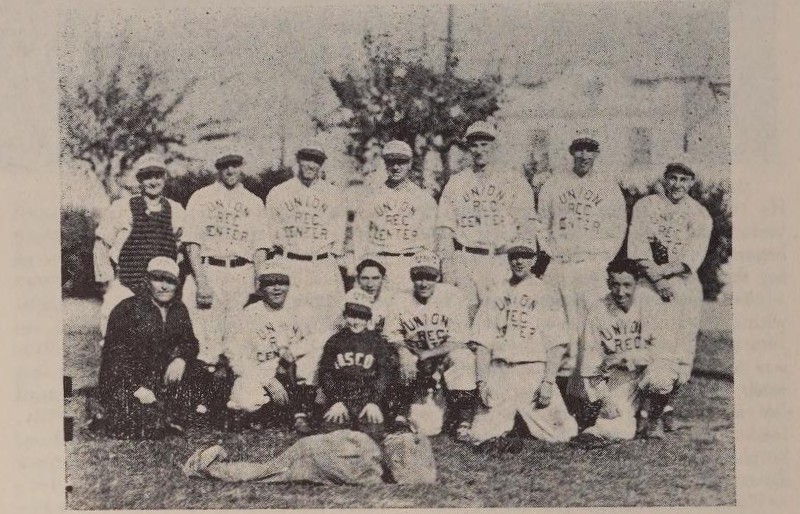
The story of the Pacific Maritime Federation’s Union Recreation Center in San Francisco.
‘Sports for All’ by G.O. Smith from Champion of Youth. Vol. 2 No. 9. March, 1937.
Out in San Francisco the Maritime Workers Got Together and Established Their Own Recreation Center and Games
“For the first time in the history of economic struggles in the United States, recreation was considered a major part of the relief set-up during a strike. A distinct contribution and impetus has been given to the independent sports and educational movement in trade unions by the splendid activities of our Union Recreation Center.”–HARRY BRIDGES
No you’re not in a swanky athletic Club. This is the Union Recreation Center of the Pacific Maritime Federation in San Francisco, and that guy who just intercepted a pass and rang up two points is not a “tired business man” trying to keep his waist line. That’s one of the waterfront boys, fresh from a day on the picket line, showing ’em that a star in union activity can be a star on the basketball floor in his spare time.
It’s a typical scene from the recent Pacific Coast Maritime Strike, during which the newly-built Recreation Center served 2,000 men daily, and was no small factor in keeping up the spirits of the men—most of whom were out of work and on the picket line for weeks at a time. The gymnasium, boxing ring and handball courts were crowded day and night. Outside competition was fostered by basketball players and indoor baseball fans. Eight basketball teams were formed from the various maritime unions, and from this a varsity team was selected to play in the San Francisco Recreation League, and at the present time is leading in its division. Two baseball teams were entered in the winter League competition, one of the teams finishing second. In addition, there is a soccer team showing of what waterfront boys are made.
There was no lag in social activity during the strike, if the Recreation Center had anything to say about it. Biweekly social affairs offering three-hour shows of boxing, movies and entertainment. provided both by professionals and our own talent, were free to the strikers. The men, their families and sweethearts; filled the capacious gymnasium to the rafters listening to volunteer singers and dancers from night clubs, yelling when their favorite union brother banged the ears of a brother from another union.
As for less strenuous forms of relaxation—the library, which is furnished completely with donated books, was so crowded that an additional room had to be taken over. Books are always in demand, and current novels and classics get no time to cool off on the shelves.
The Center played a serious role as well, housing many all-important subcommittees of the Joint Strike Committee, such as the Central Relief Committee which handled relief and ran a kitchen for seventeen thousand men. The Joint Publicity Committee used the Center for its important function which qualified this strike on a publicity battlefield. Making their headquarters at the Center were the Entertainment Committee, Joint Picketing Committee, and the First Aid Hospital. Daily meetings of the strike committees of the Warehousemen, Marine Cooks and Stewards, and I.L.A. Local 38-124, were housed at the Center.
The Recreation Center didn’t spring out of the ground, and it wasn’t donated by Rockfeller. It started first in the minds of a group of far-sighted trade-unionists whose interests in sports amounted to something more active than collecting Dizzy Dean’s autograph. They had visions of boxing rings and basketball courts, and dreams in which their union brothers appeared swinging baseball bats, until finally in November, 1935, they convinced two unions of their sanity and received a loan of $200. With money in their pockets, a visionary ideal, and plenty of courage, they sat down and planned the building of a “sports center,” the first of its kind in the United States. Eight months later, on June 1st, the results of the dream and activity of longshoremen, sailors, warehousemen, and scalers was presented to the Maritime Federation workers in San Francisco and to the world, as the Union Recreation Center—two floors of freshly painted gymnasium with showers, lockers, steam room and hand ball court.

As reality emerged from the dream, the small original committee had snow-balled into a membership of 590, who continued campaigning for more members, and conducted the activities of the Center in spite of obstacles placed in its path.
Many of the hurdles to be surmounted were valid objections—finances, the possibility of the approaching strike, fear of undertaking new ventures, but all were overcome. The Center was made self-supporting from its inception, with no financial responsibility to the Maritime Federation. Through transactions with interested business men, the owner of the building was persuaded to invest $10,000 in necessary renovations and the installation of the gymnasium floor, courts, club rooms, and shower plumbing. He received as a consideration two leases, one from the Center, paying a small monthly rent, and one from a restaurant which carries the burden of the cost.
Activities, though slow in getting under way, were in full blast in December, 1936, the height of the Pacific Coast Maritime Strike. During the financial crisis of the strike, realizing the tremendous value of the Union Recreation Center, the Federation revoked its step-child status and took it unto its bosom. It was the role the Center played during the strike which permanently and irrevocably endeared it to the hearts and minds of thousands of members in the Federation, proving beyond doubt, the foresight and vision of the Center’s supporters.
Strike or no strike, the activities of the Center continue and broaden their scope. In the educational field, classes are functioning in parliamentary law, public speaking, citizenship, English, current events, and trade union problems, and are well attended. The parliamentary law class conducts mock trade union meetings, the members participating wholeheartedly and providing much of the instruction from their experience on the San Francisco waterfront. No little part of the educational program are the lectures held periodically, one series on workers’ health and sex hygiene proving particularly popular. Political symposiums and lectures by prominent trade-union leaders have met with remarkable response.
The success of the Union Recreation Center has resulted not alone in tremendous immediate benefits to the San Francisco District of the Maritime Federation, but has provided an inspiration to the entire Pacific Coast and to the East as well, and is a challenge to continue building trade union centers along the path which has been blazed.
Champion of Youth and Champion Labor Monthly were the Popular Front-era publications of the Young Communist League published from 1936-1939 and as such played down its Communist affiliations and included many writers from Socialist, liberal, and radical traditions as well as the Communist Party. It ceased with the Soviet-German Non-aggression Pact.
PDF of full issue: https://www.marxists.org/history/usa/pubs/champion-of-youth/v02n09-mar-1937-Champion.pdf
 Revolution's Newsstand