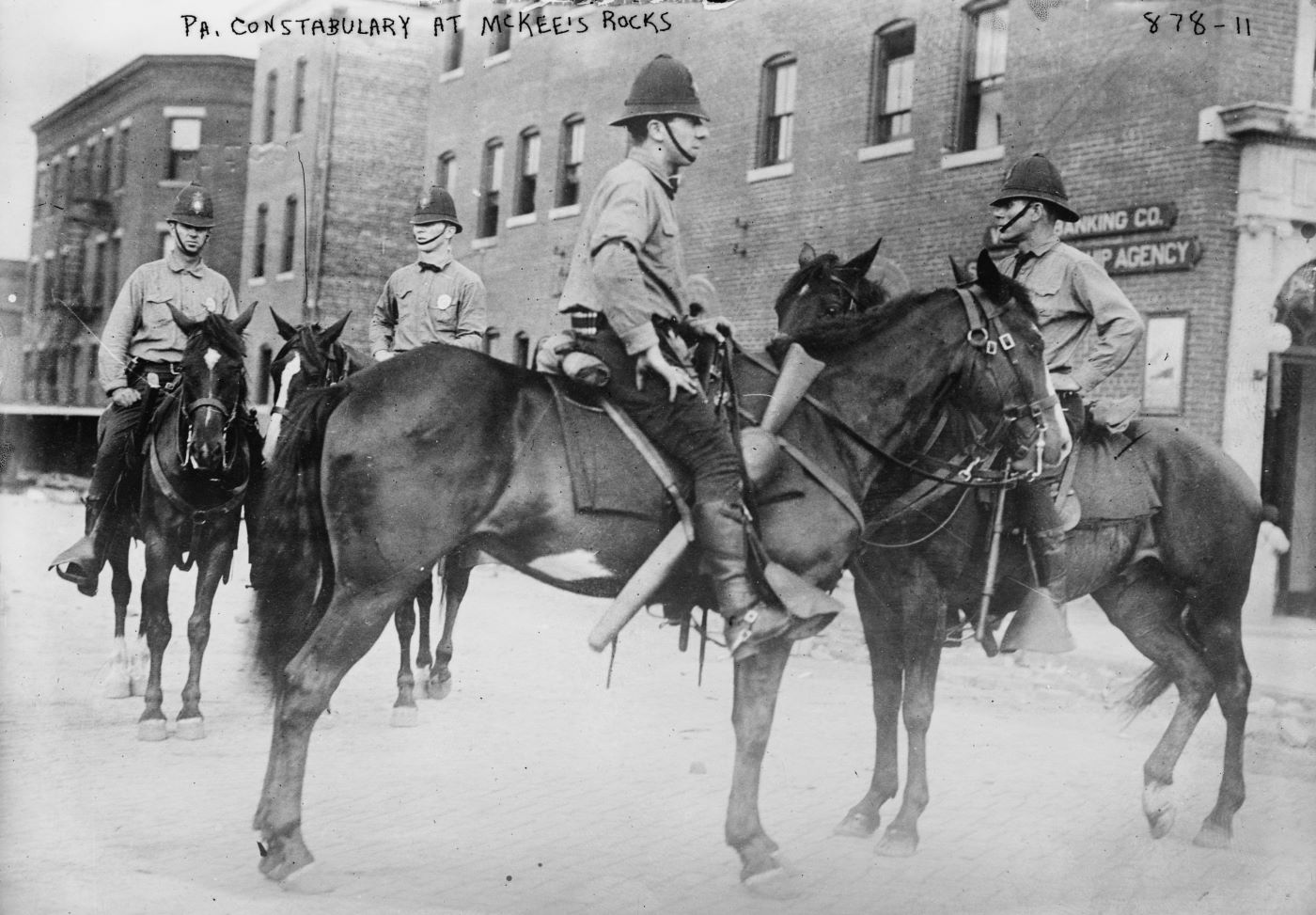
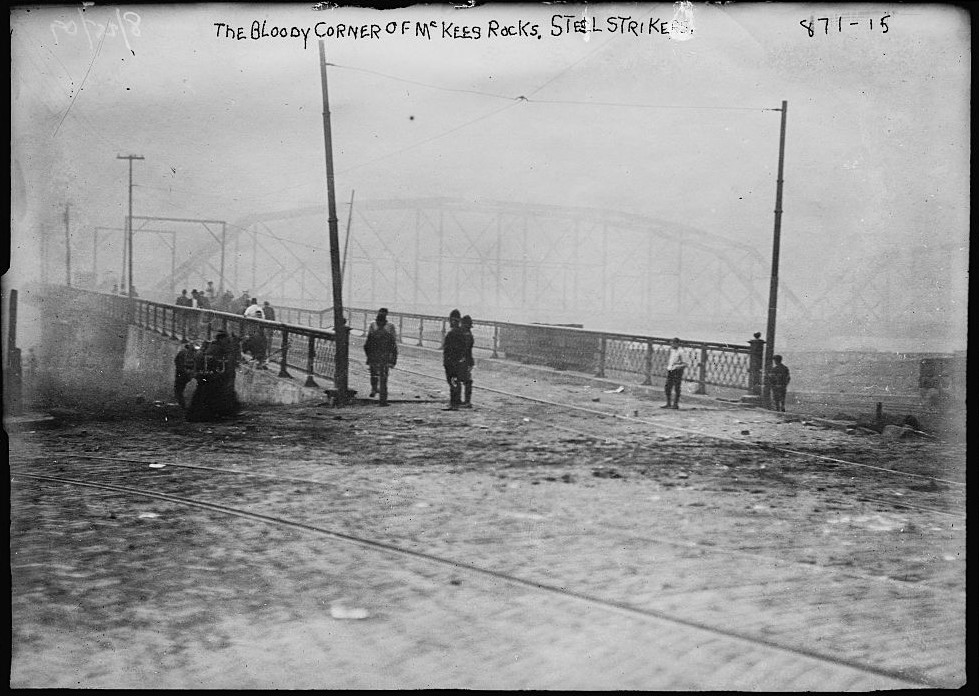
In 1909, strikes convulsed the Pittsburgh area towns of McKees Rocks, Butler, New Castle, and Presston as thousands of largely unorganized, immigrant workers took on the mighty Pressed Steel Corporation in a bloody fight for union recognition, better working conditions, wage increases, an end to inhuman housing conditions, and dignity. The I.W.W. would come to lead this heroic strike, perhaps its most prominent to that moment, to victory. Those victories brought the wobblies to prominence and the attention of many Eastern workers. In one of the most violent incidents in an extremely violent strike, Pressed Steel workers attempting to prevent the arrival of scabs get revenge on a hated sheriff with eight men dying on August 24, 1909. Ettor on the trials os some of the workers involved.
‘The Law at McKees Rocks’ by Joseph J. Ettor from Solidarity. Vol. 1 No. 32. July 23, 1910.
Pressed Steel Car Police Foment Riot, and the Court Punishes Workingmen For Same.
During the I.W.W. strike at McKees Rocks last April a so-called “riot” took place at the end of O’Donovan’s bridge, near the entrance to the Pressed Steel Car plant. A large crowd of strikers were returning from a meeting in their hall, and upon reaching the end of the bridge were about to go their several ways towards their homes, when they were met by a squad, of police from Stowe township (where the car works are located) who had crossed the line into McKees Rocks. Although outside of their jurisdiction, the police undertook to disperse the crowd, and roughly ordered them to move on. The strikers started to obey, when, in the excitement, some one fired a shot and Officer McDaniels was wounded. The subsequent testimony in court showed that the police were unable to determine who fired the shot. Nevertheless, Metro Solack and five other workers were afterwards arrested, charged with “riot and unlawful assemblage.” The six men were convicted on this trumped up charge by the testimony of the officers who at the same time used every means in their power to intimidate witnesses for the defense. The judge refused to allow the introduction of testimony tending to show that the police really caused the trouble, and said: “Even if we were to grant that the police of Stowe township went out of their way in molesting peaceful gatherings it would not argue that the defendants had any right to take the law into their own hands.” The attorneys for the defense filed a motion for a new trial, which was argued before. Judge Fraser in the Allegheny county court two weeks ago, and the motion for a new trial was denied by the court. The six workingmen were sentenced each to 60 days in the workhouse.
The following review of the case is by Organizer Joseph J. Ettor of the I.W.W., and was written for the McKees Rocks Leader.
Infamy Crowned and Blessed.
Two weeks ago last Tuesday Judge Fraser refused the plea of the six workingmen who asked for a new trial that they might introduce evidence which, if allowed, would have proven that the real fomenters of “disorder” and “riot last April were the gentlemen servants of the law, who are wont to call citizens who may disagree with them “s.o.b.’s,” and, “if you don’t shut up I will smash your face for you.”
The petition for a new trial, which is very often granted to the lowest of felons, was denied these men whose only crime is loyalty to their fellow workers, if that constitutes a crime.
The law had to be satisfied. So last Saturday they were called into court to have sentence imposed upon them.
It has become quite the practice in courts nowadays, when capitalists, and prominent citizens have been found guilty on overwhelming evidence either of having been caught red-handed robbing the people, or conducting “an honest speculation, or even committing such a trivial offense as buying lawmakers, to show them the error of their ways by a “suspended sentence.”
And so, last Saturday, Attorneys Eckles and Conrad, believing that justice is blind, unable to distinguish the difference between worker and master, asked that sentence be suspended for these six men.
Perish the thought! Justice was firm and stern; in spite of her bandages she could tell the clothes those men wore. Shylock was there and demanded his “pound of flesh” at all costs “that others may learn a lesson.”
Before the days of Lincoln, the masters of the slaves had dogs, bloodhounds, to bring back to their chains the rebel slaves.” They were ever faithful to their breeding, but it is not recorded that any of the dogs ever did any Pinkerton service. But evolution not only works wonders in industry. but also in everything else. Our courts are evolving. So are the attorneys and the police, until now they fill the functions of the hounds, the whip and the slave drivers.
In reply to the plea of Attorney Eckles that sentence be suspended the prince the forum, who struts and blusters about the court like a prize fighter, addressed the judge in substance:
“I don’t want to be too hard on these men, but I believe they should not be let, off free. These men are connected with a labor organization that for a year has been stirring up trouble down in McKees Rocks. In one year there have been no less than four men killed there, all officers of the law. These men are being stirred up to mischief by agitators who sit out of distance themselves and are safe. Every week their leader writes in their paper, the McKees Rocks Leader, denouncing the courts, criticising your Honor, and I creating distrust in the law and its agents” And with his index finger pointing out in the court room: “They are written by Mr. Ettor of the Industrial Workers of the World, the agitator; there he sits, your Honor, the trouble breeder.”
His Honor, after having remarked that “you men must understand that in this country we have laws that protect the foreigner as well as the native,” and after graciously granting the right of citizens to publicly disagree with the court, sentenced four men to 60 days in the workhouse, while the other two, who had already spent months in jail, were given respectively 10 and 20 days in the county jail. In addition he saddled the costs on them.
A braver set of men never went to jail before in Allegheny county! It is not they who are disgraced by the sentence; the jail is honored by their presence!
These men will be remembered by their fellow workers long after the McElroys, and his kind are gone. The name of Metro Solack and his brave companions, in spite of the fact that some may call them “Hunkies,” will be mentioned with love and enthusiasm by all those that are struggling for a chance to live the lives of human beings and not mere “beasts of burden;” while that of the “Honors” and the police thugs will have only the remembrance that decent men have for the hangman and the Judases.
The Reply of the Union.
Determined that lawyers and courts with all their attendants that stand like hungry dogs barking until they are fed, shall not feed out of workers’ money any more than we can possibly help–the Industrial Workers of the World has decided that rather than spend any more money taking chances with courts that are completely in the hands of our enemies, it will put aside the money that would be required to carry the case to a higher court, and when these men are at liberty that money will be given to them. Meanwhile, their wives and children will be taken care of, not by the county, but by the union of the workers.
The potents of the earth, the sires of the bread, see themselves menaced by the logic of truth. They have replied to us with Cossacks’ maces, with policemen’s clubs, with militiamen’s guns and soldiers’ lead. They have replied to our plea for justice with prisons and chains as in the days of old. With the instruments of death they hope to exterminate us, but they will fail and fail miserably. Men who bravely struggled for an opportunity to live have gone to jail and even to the scaffold before this, and the labor movement lives just the same.”
No, sir, the ideal for which we battle does not fear your horrors. We are rebels against system that requires that we shall give our life energies and blood to the few, that they may revel in the good things of life, while the world’s useful toilers must rest contented with mere We are crumbs, on pain of jail or death, rebels, and we are many, the terror, the eternal nightmare of the oppressors.
No Difference Between Blood.
Lawyer McElroy mentioned to the court that law officers, were killed in McKees Rocks. The gentleman must have had in mind the days of the big strike. Well, let us ask the question: How many workingmen did the Pressed Steel Car Co. kill? How many were maimed and butchered, dragged to their death unmercifully by unguarded machines (unguarded because human lives were cheaper to the corporation than safety appliances) before these so-called agents of the law came down to beat back to slavery the workers? And pray, answer, how many workingmen were killed in that strike by these same so- called law officers or their companions in arms, who were more interested in protecting scabs and the interests of the corporation than they were of human lives?
Or, please answer, Mr. Attorney, were not the lives of the workers as dear to them and their loved ones as those of the “law officers?”
Like the Days of Old
It is to-day as in the days of the Frankish Seigneurs. The lord of the manor and the noble knight could arm themselves cap-a-pie, but the slave could only fight a duel with them with his own breast naked and himself armed with a crooked stick.
To kill the slave was not only law, morality, and religion, but very patriotic.
For the slave to even scratch his master was otherwise. So it is to-day. The hired strong men of the master can start trouble in order to make a little money on the side;” beat and kill the worker; that is “law and order,” and is endorsed by the scribes and pillars of society. For a workingman to hit a scab with a brick–that’s “riot and bloodshed.”
Law! Law! Law! The law, the holy mask for oppressors’ crimes, must be respected by all means and at all cost!
Let us speak plain; there is more
force in names
Than most men dream of; and a lie
may keep
Its throne a whole day longer, if it
skulk
Behind the shield of some fair
seeming name.
JOSEPH J. ETTOR,
Organizer I.W.W.
McKees Rocks July 15.
The most widely read of I.W.W. newspapers, Solidarity was published by the Industrial Workers of the World from 1909 until 1917. First produced in New Castle, Pennsylvania, and born during the McKees Rocks strike, Solidarity later moved to Cleveland, Ohio until 1917 then spent its last months in Chicago. With a circulation of around 12,000 and a readership many times that, Solidarity was instrumental in defining the Wobbly world-view at the height of their influence in the working class. It was edited over its life by A.M. Stirton, H.A. Goff, Ben H. Williams, Ralph Chaplin who also provided much of the paper’s color, and others. Like nearly all the left press it fell victim to federal repression in 1917.
PDF of full issue: https://www.marxists.org/history/usa/pubs/solidarity-iww/1909-1910/v01n32-jul-23-1910-Solidarity.pdf
 Revolution's Newsstand