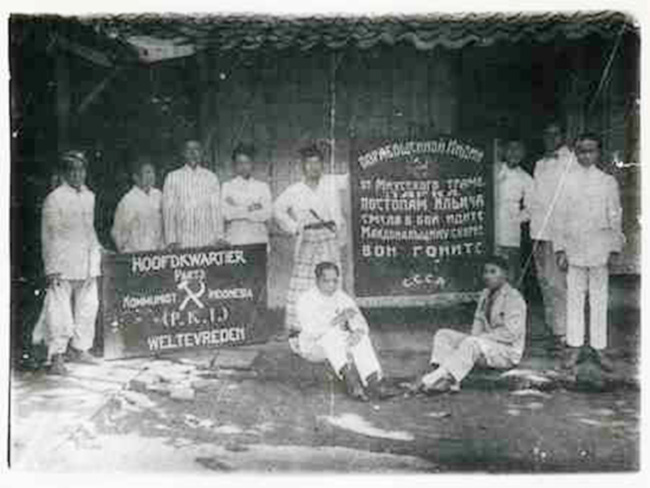
Valuable background to the rebellions against Dutch imperialism of the 1920s in Indonesia. The PKI was among the most vital and influential of the early Communist Parties in a colonial country. As the first Asian Communist Party to join the Comintern it was, in the first half of the 1920s, also the largest Comintern section in Asia. Working in, and partially leading, the popular Islamic party Sarekat Rakyat, the PKI played a central role in the mass rebellion that broke out against Dutch imperialism the year following this article.
‘The Revolutionary Movement in the Dutch East Indies’ by P. Bergsma from International Press Correspondence. Vol. 5 No. 7. January 22, 1925.
The revolutionary movement in the island of Java has assumed such a form that the bourgeoisie and the government regard it as the greatest present danger for the colonial power. In the “Volksraad” a surrogate parliament a great part of the time at its disposal was devoted to the discussion of measures for the bridling of communist activity. Despite the brutal persecutions on the part of the authorities, communism in Java has made real progress. The political life of the suppressed masses is dominated by the communists. This was made possible by the shameful treatment of the interests of the population at the hands of the government.
Apart from this, the Right leaders of the white Sarekat Islam have so often betrayed the workers that the masses have now only confidence in the leadership of the communists. In the years 1917 and 1918, the people’s League Sarekat Islam numbered hundreds of thousands of members. With the exception of the Europeans all communists were members of this league and formed their nuclei within it. The general leadership was in the hands of Tjokro Aminoto of Java and August Salim, a priest of Sumatra. Despite the great mistakes of these leaders, our comrades have often attempted to work together with them. However, when the decision was adopted at a congress of the Sarekat Islam in February 1923 to expel the communists, a mutual struggle commenced. Our comrades succeeding in building up a rather strong Red Sarekat Islam, and the best elements from the old Sarekat Islam went with the communists. Tjokro and Salim fought the communists with the assertion that the communists wished to destroy the religion of Islam.
Tjokro wished to give the Sarekat Islam a democratic-religious character and to isolate it completely from other tendencies. The League was at the same time changed into a Party. Even before the split, the Sarekat Islam had become internally weaker, so that the blow which the leaders Tjokro and Salim directed against their own organisation made this people’s organisation for a long time, perhaps permanently, an unimportant factor in the struggle against Dutch imperialists.
Because the government is conscious of the fact that the Left elements are becoming ever stronger and the Right ever weaker, it is doing its utmost to make it possible for Tjokro and Salim to struggle against the communists, and for this reason it supports the old and broken Sarekat Islam with money for a newspaper, the chief aim of which is to persuade the masses that the communists are anti-Islamites.
Up to the moment the government has achieved nothing by this. On the contrary, the formation of a Red Sarekat Islam took place at the correct moment. In a very few months it was possible to oust completely the organisation of Tjokro in the most important towns and villages and to bring the leadership of the people’s movement into the hands of the communists.
This fact became most clear on the 31st of August 1924, the birthday of the Queen of Holland, when in many towns and villages there were great demonstrations in which, in a few towns, six to seven thousand workers and peasants took part. Later the communists gave the Red Sarekat Islam the name “Sarekat Raja’t” (People’s League). It remained, however, organisationally connected with the Communist Party. The Organisation was improved in a communist spirit and a stronger discipline was also introduced. With this the Communist Party and the Sarekat Raja’t became the only militant mass organisation in the Dutch colonies. In recent times the people’s movement has come completely under the lead of the communists, a fact which even the bourgeoisie must admit.
In the Dutch East Indies there are several political parties, for instance, “Boedi Oetomo”, “Persarekat Ambon”, “Persarekat Minahasa”, “Indo-Europeesch Verbond”, “Sociaal Democratische Partei”. The “National indische Partei” has voluntarily disbanded as its leaders were of the opinion that no parliamentary action was possible under the present reaction, and the semi-bourgeois leadership only wanted parliamentary action.
The “Politik-ökonomische Bund” consists only of Europeans and was opposed to the communists. In the same way, the social democrats whose influence amongst the population is of no importance (they are only a few imported European intellectuals), only employ their time in criticising the communists. The other parties have all a more or less bourgeois character with nationalist tendencies. These parties will not be successful in winning any considerable sympathy amongst the masses.
“Boedi Oetomo”, which chiefly represents the interests of the native intellectuals, has in the last period been undermined by internal differences.
Many of those who were members of the before-mentioned parties have gone over to the Communist Party, after recognising that it alone worked with the masses in their daily struggle.
In this way the other parties lost good leaders while the Communist Party was strengthened. For instance, Hadji Misbah, a priest of the National-indische party, came over to us and constituted a counterpoise to the religious propaganda of the White Sarekat Islam. The government also recognised this and Hadji Misbah was therefore deported to the island of New Guinea, being falsely accused of having taken part in the bomb attempts which took place in Java in 1923.
The bourgeois press is carrying on a campaign against the “Asiatic-bolshevist” danger. The government disperses our meetings with armed force, and arrests and persecutes our active comrades.
The government attributes the growth of communist influence to the fact that on the occasion of the unsuccessful railway strike, the deportation and arrest of the leaders, and the increase of economic pressure upon the population bound up with the helplessness and disintegration of the other parties, the communists were regarded as the only honest fighters and martyrs for the cause of the people.
That the economic pressure upon the population, in particular upon the native population, has increased, is certain. We only need point to the reduction of the sliding scale of wages, the increase of taxation, the decline in trade and manufacture, by which the possibilities of work and income were reduced, whilst at the same time the school fees, railway tariff and other expenses increased.
As many thousands of children received no education, the communists have themselves established schools, and in this way they have won great sympathy amongst the population which willingly sends its children to these schools. The government wishes to destroy that which the communists construct. This is also the case with these schools. The communist schools receive no money from the government. Despite this, however, they are controlled by the government in order to ascertain if communist propaganda is carried on in them. Many of the teachers have been deprived of the right to teach. By this it is hoped that the schools will close on account of the lack of teachers. Although this educational work is being rendered difficult for us, we have always been able to continue it.
Apart from the island of Java, communist groups have been formed in the islands of Sumatra, Borneo and Celebes, which are fought as strongly by the government as those on the island of Java. Many comrades are under arrest or have been deported to other islands.
The communists and revolutionary nationalists have to carry on a heavy struggle with the Dutch bourgeoisie which conducts a policy of terror. Nevertheless, the revolutionary movement is advancing step by step. The reaction has not discouraged our comrades. On the contrary, after the police barbarously attacked a meeting in Preanger a few weeks ago, our comrades answered by holding on one day–1st January 1925–fifty meetings at the same time in the town of Bandoeng, so that the police with the forces at their disposal were not able to disperse them. The Chinese in the Islands (of these in 1921 there were 513,355 men and 291,292 women there), amongst whom there are many industrial workers, are very sympathetic to the communists and there are Chinese newspapers which sharply criticise the Dutch government.
The revolutionary movement, above all the communist movement, has made progress in the Dutch colonies, and the depression in trade, the reduction in wages, the unemployment and the reactionary policy of the government, suggest that the struggle between the population and the Dutch bourgeoisie will take on ever sharpening forms.
And to this must be added that the population must bear heavy financial burdens for the strengthening of the fleet. The government is undertaking preparations for this under the pressure of the great imperialist states, Great Britain and America, which long ago commenced to strengthen their naval bases in the Pacific ocean in order to be able to continue their imperialist policy.
On the one hand we see, therefore, the danger of war, and on the other the growing and approaching revolution amongst the Eastern peoples.
International Press Correspondence, widely known as”Inprecorr” was published by the Executive Committee of the Communist International (ECCI) regularly in German and English, occasionally in many other languages, beginning in 1921 and lasting in English until 1938. Inprecorr’s role was to supply translated articles to the English-speaking press of the International from the Comintern’s different sections, as well as news and statements from the ECCI. Many ‘Daily Worker’ and ‘Communist’ articles originated in Inprecorr, and it also published articles by American comrades for use in other countries. It was published at least weekly, and often thrice weekly. A major contributor to the Communist press in the U.S., Inprecorr is an invaluable English-language source on the history of the Communist International and its sections.
PDF of full issue: https://www.marxists.org/history/international/comintern/inprecor/1925/v05n07-jan-22-1925-inprecor.pdf
 Revolution's Newsstand