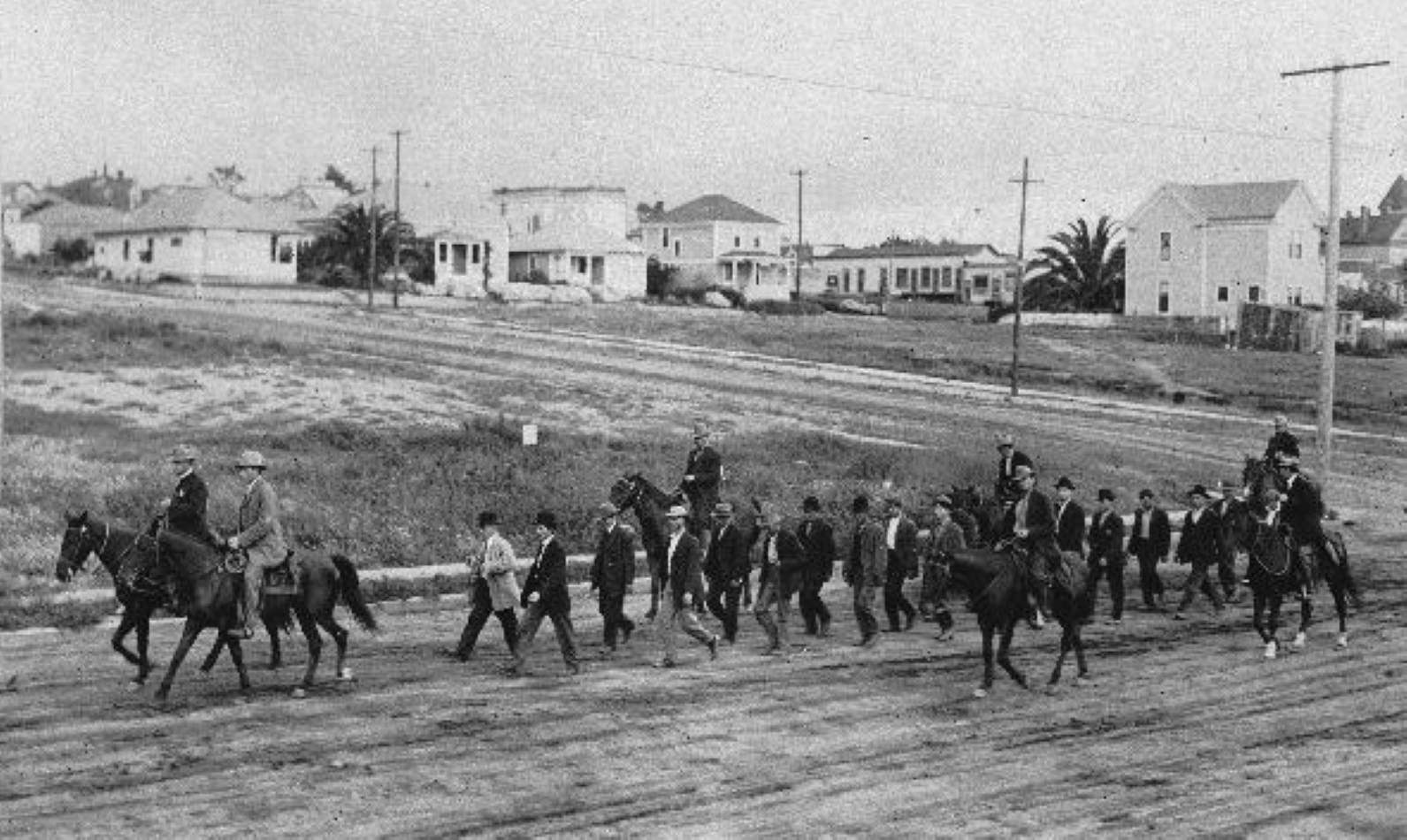
Based in Los Angeles, Georgia Kotsch, left wing California Socialist and chair of that State’s Women’s Socialist Committee, tells of an event in that city in solidarity with San Diego epic free speech campaign which would cost several lives.
‘San Diego’s Shame’ by Georgia Kotsch from Revolt. Vol. 3 No. 48. March 30, 1912.
DARK DEEDS OF LAW AND ORDER BRIGANDS.
Under the right appeal the old revolutionary fire blazed out at the Socialist meeting at Los Angeles Sunday night. Advertised as a free speech meeting, the Labor Temple auditorium was packed with a typical working-class crowd. It was not a noisy demonstration; the feeling was too deep for that. As we listened to one of the most sickening and grewsome recitals of brutality that we had ever heard and such as we have only read of happening in Mexico or far Russia, the people groaned. “What are we coming to?” was the question on white lips as we passed out.
Quietly, without attempt to stir passion by oratory, J. Edward Morgan told the shameful story, unbelievable except that it came from an eye-witness. Of the visit of Otis and Zeehandelaar to San Diego which set the fight going, the unreasonable and unconstitutional ordinance against free speech, aimed obviously as the first shot in a campaign to extend up the coast and break the back of labor and establish the open shop. Leaving the martyrs to their suffering, those in jail sleeping on the cement floor without a blanket under them, others sleeping on the wire top of the cage, crowded, stifled, vermin-infested, the men on the outside, sick, hungry, with no place to sleep, giving their bodies to the burning of capitalist wrath, with only $15 in the treasury of the Free Speech Committee with which to prosecute the fight, Morgan and Kasper Bauer came north to make a plea for funds. It was not a moneyed crowd, but one man gave $100, and his name was Wilson, and Stanley Wilson, after a splendid burst of poetic oratory, eulogizing the soap-box as the cornerstone of the temple of freedom and the agitator as its sacred prophet, said of his distant relative and old-time friend, Keno Wilson, chief of police of San Diego: “I will go, to San Diego and I will tell him if there is a drop of his blood in me I will let it out.” Los Angeles realizes that if the fight is lost in San Diego its turn will come next and it gave liberally. Morgan gave details and corrected the statement designedly circulated that this is an I.W.W. fight alone. They are there, taking the brunt as they always do, unflinching, uncompromising, but united with them are the Socialists, the labor unions, single taxers, Salvation Army, Daughters of the American Revolution and non-attached liberty-loving people. The working class is presenting a solid front and that is what enrages their persecutors.
Platform profanity is an admission of a speaker’s inability to express himself, but Morgan did not use profanity of his own and it was well that we should know what insults, threats and vile cursings our comrades on the firing line fighting our battle are subjected to by the foul-mouthed ruffians of law and order. Morgan himself was told with an oath by Wilson that if he came back he would be hung to a lamp post.
Mrs. Wightman, an evangelist preacher, who has won the good will of the people of San Diego in the six months she has been preaching on the streets, and who is one of the grittiest fighters in the free speech ranks, said when she took the floor:
“In the twenty years that I have traveled and talked I have never looked upon such scenes as I have in San Diego the past six weeks. Words cannot tell it, pen cannot portray it.” She is neither a Socialist nor a member of any labor organization but she was given an ovation for her splendid stand for free speech. Morgan said the first thing he saw when he reached San Diego was a banner of the D.A.R. He supposed they were headed for a pink tea, but saw them march to labor headquarters and fall in with the free speech parade.
Not only street meetings have been attacked but hall meetings invaded. Here are some of the indignities of which we were told by these participants in the struggle and if you can read them without wanting to have a share in the fight you deserve the slavery that is being. The fire hose was turned prepared for you. full on Mrs. Wightman, knocking her backward from the soap box and knocking her little daughter to the pavement. Laura Payne Emerson was drenched and stood and talked for an hour in her dripping garments just outside the restricted area. The hose was turned on the crowd and they pressed close together and stood it as long as they could. A mother with a babe in her arms was drenched and it is reported the baby died and the parents cannot be found since and there is deep suspicion as to what has become of them. Most dastardly indeed was the evident attempt to create a panic in a crowded hall where women and children must have been trampled to death. The fire engine was heard puffing noisily in front and it was with the greatest difficulty a stampede was averted. There was no fire.
A young man of the I.W.W. folded his arms and began a sentence. when three policemen dashed him from the box to the ground on his face. A woman onlooker, seeing men’s heads cut open cried to the police, “For shame.” One of them turned and knocked her senseless with a blow in the stomach. with his club. Her husband running to the rescue was knocked down, dragged to jail and given thirty days. Three men were taken in an automobile ten miles out of town and beaten terribly. Comrades went out to bring them back and their clothes were stuck to their skins with blood. A committee inspected the (un) sanitary condition of the jail and found 68 men so packed in a cage that one who was trying to eat from a tin box could scarcely raise the food to his mouth. One small window supplied the ventilation. Kasper Bauer, who was bailed out Friday, said two men fainted from lack of air while he was in. Stifled and starved, the men began to smash things and in revenge the water was shut off and they were forced to drink from the toilet. Then a charge of jail-breaking, a penitentiary offense, was lodged against them. The police go down the streets swinging their clubs right and left among the people and shouting: “Go home; it’s time you were in bed.”
We were told of the great-souled Donaldson. Morgan said to him, “You must not go to jail. If you do I will. It will kill you.” “No,” said I Donaldson, “you are useful on the outside. have nothing to give but my sick body,” and he gave it. Of the I.W.W. comrade who had his teeth knocked out at Aberdeen and then went back to Aberdeen and, the fight won there, on to San Diego. I.W.W. BUMS! Rather they are like those agitators of old who “had mockings, scourgings, imprisonment, who were stoned and killed, who were destitute and wandered in the caves of the earth and of whom the world was not worthy. These, our substitutes in the class war, have been denied everything by society, everything but the quality of greatness–the high courage, the selfishness, the patience, the burning in their hearts of a great ideal, that someone must have to make this world a fit place to live in.
Bauer said: “I never asked for money before, but I feel like holding you up with a gun and taking every cent you’ve got for this. Where the men sleep or get anything to eat God knows.”
The San Diego jail being as full as possible, prisoners are sent to other nearby towns.
Comrades all over the country should respond to the appeal for funds. Never will they be given in a greater cause.
Send money to Kasper Bauer, treasurer Free Speech League, 335 Union Building, San Diego, California.
Revolt ‘The Voice Of The Militant Worker’ was a short-lived revolutionary weekly newspaper published by Left Wingers in the Socialist Party in 1911 and 1912 and closely associated with Tom Mooney. The legendary activists and political prisoner Thomas J. Mooney had recently left the I.W.W. and settled in the Bay. He would join with the SP Left in the Bay Area, like Austin Lewis, William McDevitt, Nathan Greist, and Cloudseley Johns to produce The Revolt. The paper ran around 1500 copies weekly, but financial problems ended its run after one year. Mooney was also embroiled in constant legal battles for his role in the Pacific Gas and Electric Strike of the time. The paper epitomizes the revolutionary Left of the SP before World War One with its mix of Marxist orthodoxy, industrial unionism, and counter-cultural attitude. To that it adds some of the best writers in the movement; it deserved a much longer run.
PDF of full issue: https://www.marxists.org/history/usa/pubs/revolt/v3-w48-mar-30-1912-Revolt.pdf
 Revolution's Newsstand