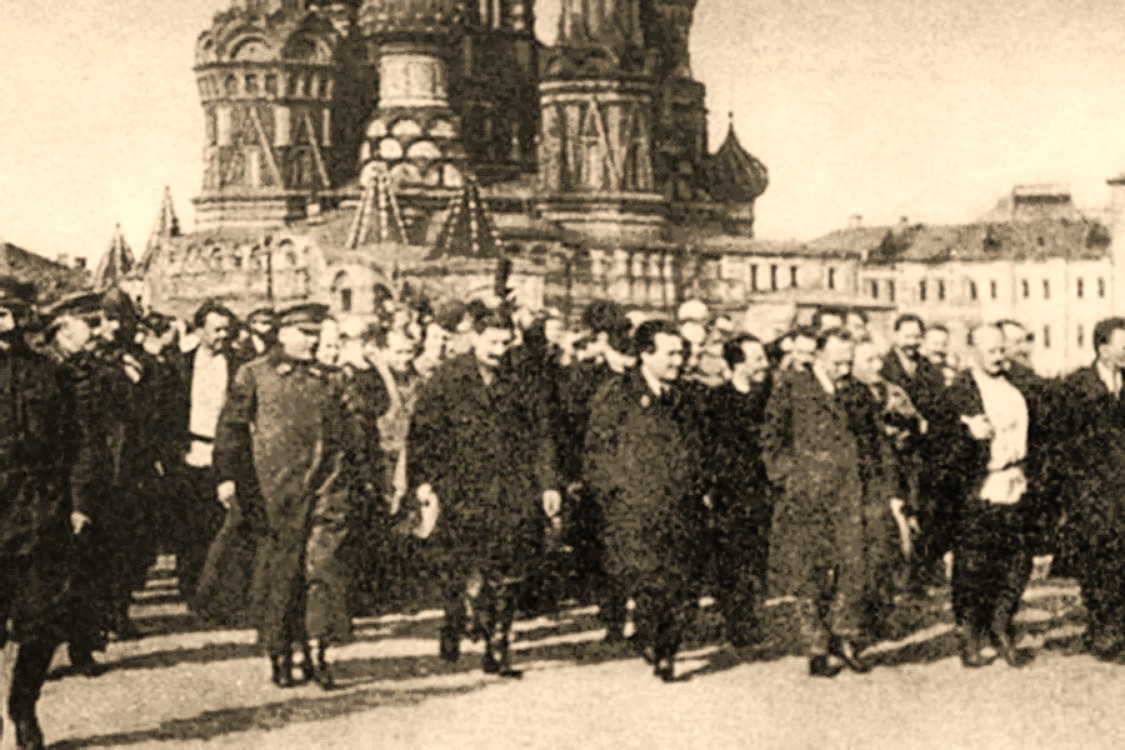
Official public report of the 13th Bolshevik Congress held in May, 1924. The first to be held since Lenin’s death, the Congress saw the ‘Triumvirate’ of Stalin, Kamanev, and Zinoviev decisively defeat Trotsky and the original Left Opposition. 1923 had seen increasing tension within the Party’s leadership over the New Economic Policy, international events, as well as the Party’s own future in Lenin’s absence, and soon death. In the Political Committee, the ‘Troika’ came to dominate and increasingly sought to isolate Trotsky and his supporters. Zinoviev, then at the zenith of his power, led the Congress, while Bukharin rose to become a member of the Politburo. The aftermath of the congress saw the intense ‘Literary Debate’ in which nearly every major leader of the Party wrote on the meaning of the newly coined-termed ‘Leninism’ in a conflict over the Revolution’s meaning and future. The report below paraphrases interventions from Zinoviev, Stalin, Krassin, Trotsky, Preobrashensky, Kamanev, Krupskaya, Kuybyshev, Bukharin, Radek, Manuilsky, Souvarine, Molotov, and others. This public accounting leaves some major items out, including Lenin’s ‘Testament’ that Krupskaya insisted be brought to the meeting.
‘The XIIIth Congress of the Communist Party of Russia’ from International Press Correspondence. Vol. 4 Nos. 32 & 33. June 5 & 12, 1924.
I. Opening Session.
The 13th Congress of the Communist Party of Russia was opened on the 24th May by Comrade Kamenev. In eulogising on the merits of Comrade Lenin and in emphasising the importance of the 13th Congress of the RCP, the speaker declared:
Comrade Lenin is the creator of the CP. of Russia and of the Communist International. He was the best party comrade and guide of the workers of the whole world along the road of struggle to a better future.
Among others there were unanimously elected to the Presidium: comrades Kamenev, Stalin, Zinoviev, Rykov, Bucharin, Trotzky, Tomsky and Molotov.
After tribute was paid to our late Bulgarian comrade Blagoev the Congress addressed a telegram of condolence to the CP. of Bulgaria.
Thereupon the Congress decided to send a telegram conveying greetings to the V. World Congress of the Communist International: “The death of Comrade Lenin has induced the Communist Parties of the whole world to draw their ranks still closer together. It is the greatest pride of the Russian CP. to be in a position to aid the Comintern and to be one of the most faithful sections of the Comintern. A new wave of revolution is gradually rising. The recent elections in several countries show a rapid growth of the forces of the Comintern which also give rise to new complicated problems for the Comintern. The Party Congress is happy to be able to inform the Comintern that its Russian section is emerging from its crisis more firmly united than ever. The proletarian dictatorship within the Soviet Union has consolidated itself, the economic situation has improved, the RCP. remains ever true to the World Revolution!”
The Congress further decided to send telegrams to the Communist Parties of Germany and France.
Comrade Rykov spoke some words to the memory of our late comrades Nogin and Lutovinov.
Comrade Kolaroff welcomed the Congress in the name of the ECCI.; in addition, greetings were delivered to the Congress by representatives of the Communist Parties of Germany, France, England and Japan while comrade Clara Zetkin greeted the Congress in the name of the International Communist Women’s Secretariat.
Second Day of Congress.
Speech of Comrade Zinoviev on the Political Report of the CC.
In the political report of the CC., comrade Zinoviev pointed out that the Party had reason for judging the international and inner situation of the Soviet Union in an optimistic sense. The period covered by the report, which had begun with Lord Curzon’s ultimatum had ended with the de jure recognition of the Soviet Union by England. As regards the London negotiations, their result will depend upon MacDonald. On the side of the Soviet Union there prevails the most determined desire to arrive at an agreement. The foreign policy of a number of European states, particularly of England, is closely interwoven with the policy of the 2nd International. The profound fundamental disagreements between the 2nd and the 3rd Internationals can have nothing to do with the business negotiations between the Soviet Union and England.
As regards the conflict with Germany it must be said that the raid upon Russian Trade Mission in Berlin was an attempt on the part of German Social Democracy to get into the good with the Soviet Union. In the sphere of the policy of concessions, the caution and restraint exercised up to now remain necessary.
The inner situation of the Soviet Union is characterised by the successful solution of the national question, by the considerable economic successes, by the strengthening of the alliance between the proletariat and the peasantry and by the enrolment of more than two hundred thousand workers in the Communist Party. At present agriculture has reached 78 per cent, industry 48 per cent, foreign trade 20 per cent and wages 62 per cent of their respective pre-war levels. The market crisis has been overcome.
Our chief tasks consist at present in the raising of heavy industry and in the solution of the questions of trade. 36 per cent of the home trade is in the hands of the state and 64 per cent is in the hands of private enterprise. The New Economic Policy does not by any means mean the restoration of capitalism. Nobody wants to abolish the NEP. The freedom of interior trade will be maintained. A new co-operative policy and a new commercial policy will, however, be introduced. Still more attention will be devoted to the villages.
The Central Committee, with the support of the Party, will realise the heritage bequeathed by comrade Lenin and lead the Russia of the New Economic Policy to the Socialist Russia.
Speech of Comrade Stalin on the Organizatory Report of the Central Committee.
Comrade Stalin described in detail the growing influence of the Russian CP. on the trade unions, on the state apparatus, on the economic organs and on the co-operatives.
At the time of the 12th, Party Congress the Party had 485,000 members, which up to the present had increased to 600,000 members. The proportion of members of the Russian CP. who are employed as workers in the workshops has increased during this period from 17 to 35 per cent.
The inner life of the Party has definitely improved. The transference of the centre of gravity from the sittings of the Political and of the Organizatory Bureaus to the Plenary sittings of the CC. constitutes an important innovation. The sittings of the Plenum of the CC. and the Plenary sittings of the gouvernment committees are developing into powerful schools for Party work. The inner Party life has become essentially more active and the mass recruitment after the death of Lenin proves that the Party, according to its spirit, has become an organ elected by the working class. The Russian CP. is at present a real organ possessing the confidence of the working class.
The most important task of the Party at the present time consists in attracting the non-party workers into collaboration in the Soviet organs, in the political education of the broad masses, in the publication of special popular journals for the new masses gained over by the Lenin recruitment, in raising the party work in the villages, in adequately supplying the industrial districts with functionaries, in the careful and increased selection of functionaries and in the increased attraction to Party work of the masses won for the Party by the Lenin recruitment.
Third Day of Congress.
Discussion on the Speech of Comrade Zinoviev: Political Report of the CC.
Comrade Krassin the Peoples Commissioner for Foreign Trade
declared that the raid upon the Berlin Trade Mission exceeds in importance the notorious note from Lord Curzon. The exterritorial right of the Berlin Trade Mission is secured by the treaty of 6th May 1921 and is even recognized in German law. The raid was directed against the foreign trade monopoly. The Soviet Union cannot carry on trade without exterritorial right since foreign trade is the business of the state. Negotiations over a trade agreement with Germany are impossible so long as our rights are not restored and our demands fulfilled. The Soviet Union cannot make any concessions and must insist upon its minimum demands. If Wilhelmstrasse reckons upon rapprochement between Germany and France, we declare: the Soviet Union, if it desires, can find its way to Paris easier than Germany can!
Comrade Trotzky:
The Central Committee itself considered it necessary to modify the inner course of the Party in the sense of democracy graces of France at the price of a worsening of the relations within the Party. Even the Central in its December theses, emphasised the danger threatening the Party apparatus from bureaucratization whereby the Party could be estranged from the proletarian masses, for this reason the December theses laid down the introduction of workers’ democracy and the increasing of the proletarian core. I was never at any time in favour of the freedom to form fractions and groups. I am of the opinion, however, that the bureaucratising of the Party apparatus could promote and bring about the formation of fractions. The speaker further declared, he would himself fulfil his duty as a disciplined Party member even in regard to decisions which he felt to be wrong. The devotion to, the discipline, the unity and the solidarity of the Party will be preserved!
Comrade Preobrashensky
defended the economic theses of the opposition and emphasised that the Central Committee was behindhand. with the modification of the course of the Party. This had given rise to the discussion. The demand for the extension of planned economy and the fight against capitalist accumulation are no petty bourgeois deviations.
Comrade Kamenev:
The policy of the Party will be orientated towards the working masses and not towards the Youth. The Central charged the opposition with petty bourgeois deviations for its anarchist criticism against the Party apparatus, for its opposition of the young guard against the old guard and for the empty chatter over planned economics.
Comrade Lenin-Krupskaya:
The Party has grown and become strong. It is true that the Congress must set forth the events of the past; the chief task however consisted in tracing out the tasks for the future. Therefore the repetition and stirring up of the Party discussion is not desirable, as this would only lead to aggravation which in turn would only be injurious to the Party. The opposition must proceed with the Party in a disciplined manner.
Conclusion of the discussion over the political report of the CC.
Fourth Day of Congress.
Concluding words of Comrade Stalin on the Organizatory Report of the CC.
Whoever considers the old guard as a section possessing exclusive privileges is seeking to create a breach between the two generations. The essence of Party democracy is represented by the linking up of the Party with the class. It would constitute the greatest danger were the Party to detach itself from the class. The assertion of comrade Trotzky that the Party is never in the wrong is incorrect. The Party learns from its own mistakes. The core of the Party is formed by admitting and rectifying its own faults. The speaker pointed out the necessity of a united continuance of the work in the Party and said that the CC. could not imagine carrying on its work without the collaboration of comrade Trotzky. He did not doubt that the resolution of the 13th Party Conference on petty bourgeois deviations would be confirmed by the 13th Party Congress.
Concluding Words of Comrade Zinoviev on the Political Report of the CC.
We will strengthen the Party work among the members of the Red Army and among the women, by which means the collaboration with the village will become more intimate. The question of wages and unemployment must be solved by the raising of the economy. The rights granted to the national minorities must everywhere be realised. The fact that the present Congress consists up to 63 per cent of workers and 83 per cent of Party members of the old generation proves that the Party must not be orientated towards the Youth but towards the working class. The speaker declared the absolute preparedness for friendly and common work in the Central and in the Political Bureau, but only on the basis of Leninism. There are things in which concessions are impossible. The Bolshevist-Leninian fundamental line of the Party must be retained. The Central is prepared to admit its own faults a hundred times and to make concessions in personal questions but the way of the Party must remain Bolshevist. The Central demands guarantees that the Party during difficult days remains 100 per cent a united Bolshevist party.
Resolution of the XIIIth Congress of the Russian Communist Party on the Report of the Central Committee.
The 13th Congress entirely approves of the correct political line and the organizatory work of the Central Committee which have secured to the Party the highest degree of success in all spheres of work under difficult and complicated conditions. The Conference notes with satisfaction the correctness of the work of the Central Committee during the period under review, which was the first year of work of the Central Committee during which the Central Committee and the whole Party were deprived of the direct leadership of comrade Lenin.
The Congress wholly and entirely confirms the resolutions of the 13th. Party Conference of the Soviet Union “Concerning the Party Structure”1) and “On the Results of the Discussion and on Petty Bourgeois Tendencies”2) and includes these resolutions in the decisions of the 13th. Congress of the RCP. The Congress expresses its full approval of the Central Committee of the Party for the firmness and Bolshevik intransigence which it showed during the discussions in safeguarding the fundamentals of Leninism against petty bourgeois deviations.
The Congress approves of the international policy carried out by the Central Committee which led to the de jure recognition of the Union of Socialist Soviet Republics by a number of the most important bourgeois states.
The Congress instructs the Central Committee to exercise also in the future the maximum amount of caution in the granting of concessions, to defend with all determination the monopoly of foreign trade, to develop the export of grain and endeavour to augment the favourable balance of our foreign trade.
In view of the newly arisen international situation and in particular in view of the obstinacy which is shown by the international bourgeoisie in all its sections in the attempts to compel the Soviet Union to pay compensation for the Tsarist debts and for the nationalised property of the big foreign capitalists, the Congress regards it as particularly necessary to inform more carefully and more systematically the working population of the Soviet Union, and especially the rural population, regarding all important decisions of the Party and of the Soviet power concerning questions of international policy.
The Congress notes with pleasure that the work of forming the Union of Socialist Soviet Republics has been concluded with success and that thereby a firm basis has been created for the fraternal and peaceful common life of all nationalities living within the Soviet Union.
The Congress instructs the Central Committee of the Party to keep a careful watch in order to preserve the rights of all nationalities of the Soviet Union, without exception, according to the decisions of the 12th. Congress of the RCP. concerning the national question.
The Congress states that the New Economic Policy carried out by the Party has proved the appropriateness of the tasks which the Party had set itself.
Upon the basis of this New Economic Policy a general economic revival has become distinctly visible: agriculture is undoubtedly on the upgrade, the state industry is growing and its concentration is going ahead, wages are gradually increasing and certain successes have been achieved in raising the working capacity.
Against the disparity between the prices of agricultural and industrial products, the Party has been and is conducting a successful campaign. Upon this basis the confidence of the working class in the RCP. is growing and is becoming continually more firm and unshakeable.
The Party sees no reason for a revision of the New Economic Policy and regards the systematic work for the strengthening of the socialist elements in the national economy as being the immediate task on the basis of the New Economic Policy.
An unaltered task of the Party, remains as heretofore the strengthening and consolidating of the confidence of the peasantry in the proletarian state by means of the realization of a number of effective measures for the economic collaboration (Smytchka) of town and village, for the promotion of peasant economy (agricultural credits etc.) and by raising the cultural level of the countryside.
The Congress states that the CC. of the Party has carried out at an opportune time a far-reaching currency reform which has considerable importance for the whole economic construction work of the socialist proletariat. The firm carrying out of this most weighty reform will serve as a basis for the recovery of the whole economic life of the Union of Socialist Soviet Republics. The Congress states with satisfaction the successes achieved in this sphere and instructs all organizations to secure the most precise and strict carrying out of all decisions of the central organs regarding the currency reform, having regard to the fact that difficulties in this sphere are not excluded and that they can only be avoided by the exercise of a maximum of discipline.
The Congress notes with approval the timely initiative of the CC. of the Party in such fundamental questions as those of interior trade and co-operatives. These questions will become the central ones for a considerable period of time. Upon the correct policy of the Party in these questions will depend the further successes of the economic construction work of the Soviet Union. The Congress states that the CC. of the Party clearly perceives the growth of a new bourgeoisie (unavoidable in the present epoch of the Nep) and is carrying out all appropriate economic and political measures which this fact requires.
The Congress notes with particular satisfaction the political initiative and the work of the CC. on the occasion of the Lenin Recruiting Campaign for new Party members. After a halt had been made in the process of declassing of the proletariat, after the Soviet power hat attained the first considerable successes on the economic front, it became possible to attract into the ranks of the Party hundreds of thousands of new members
workers from the bench. The RCP. was and remains a workers’ party. The connection of the Party with the great mass of non-party workers is growing and strengthening. The time is approaching when the whole fundamental mass of the proletariat of our Union will enter the Party. The Congress instructs the CC. to carry on its whole work in this direction so that the overwhelming majority of the Party members will in the near future consist of workers immediately engaged in production.
The Congress calls the special attention of the whole Party to the necessity of increasing the work among the female workers and peasants and to elect them to all elected Party and Soviet organs. The Congress approves of the special attention which the CC. devotes to the Communist Youth League and to the whole work among the Worker and Peasant Youth.
The increase of the political activity of the working masses confronts the Party with the serious task of drawing the broad masses into the active work of the Soviet, the trade unions and co-operatives.
The Congress instructs all organizations of the Party to pay increased attention to getting into closer touch with the better portion of the country and town teachers, the agricultural experts and other strata of the working rural intelligenzia. For this purpose the Party must, in the first place, devote serious attention to the bettering of the material situation of these strata. With a correct line in this question the Party will soon be able to render these strata the intermediaries of the fundamental ideas of the Party and of the Soviet power for the broad masses of the peasantry. In particular all Party organizations must devote sufficient attention to the preparation of the First Soviet Union Teachers’ Congress, and thereby strive to secure at this congress the attendance of an overwhelming majority of rural teachers from the various localities so that the congress shall fulfil in fact the formidable task which is imposed on it by the whole situation.
As regards the revival of state industry, the most important task of the coming period is the raising of the metallurgical industry. Now that the fuel supply has been secured, now that the transport has been improved and now that the currency reform has been instituted, it is the turn of the metallurgical industry. To further the production of the means of production within the Union means to create a real solid basis for Socialist Economy and to free oneself to a considerable extent from the necessity of sending large orders abroad. The Congress instructs the CC. to devote serious attention to this problem.
The Congress instructs the CC. to devote still more attention than hitherto to the work of the electrification of the Soviet Union in order that everything possible may be done for the realization of the whole scheme of electrification work, which is of such considerable importance for the consolidation of our economy and thereby for the consolidation of Socialism.
The Congress welcomes the steps taken by the CC. for the carrying out of the fully matured reform in the War Office and the further strengthening of this Office with Party workers. In connection with the role of the territorial formations for the defence of the country, the Congress calls the attention of the Party to the necessity of a most energetic work for strengthening the Communist influences in these formations. The Congress instructs the CC. to take a number of measures for increasing the number of Communists among the Red Soldiers and Sailors. The Congress notes the regular fruitful work of the Plenum of the CC. and of the joint sittings of the Plenums of the CC. and the CCC. Experience has proved that the enlarging of the CC. by nominating to it Party workers who are most in contact with the masses, has rendered great service to the cause. The Congress considers a further augmentation of the CC. and of the CCC. to be necessary.
The Congress is of the opinion that the work of reduction and simplification of the state apparatus must be given special attention by the CC.
The Congress regards as an immediate task of the Party the improvement of the work of the organs of Co-operation, of the trade and of the credit institutions, as well as their being staffed more by Communist workers.
The Congress considers it necessary that the Communist High Schools shall be given still more all-round support by the Party than hitherto. The Congress instructs the CC. to pay full attention to the work of improving the High Schools. By serious work, by propaganda of Leninism and by enlightenment over questions in dispute, the Party will be able to secure for itself the best elements among the studying youth.
The Congress is of the opinion that the supervision of the membership of certain groups of Party nuclei is opportune and will be of great use to the Party.
The Congress instructs the CC. to safeguard the Party unity and the line of Bolshevism pursued up to now from any deviation in such a determined and firm manner as hitherto. Now that the Party has lost comrade Lenin, the securing of the full Party unity has become a thing of still greater importance and necessity than ever before. The least tendency to fractionism must be combatted in the most severe manner. The firmness and the homogeneity of the RCP. on the basis of the unshakeable principles of Leninism appear to be the most important precondition for the further success of the Revolution.
***
Upon the question being put: who is for the resolution? All hands were raised. On the questions being put: who is against it, or who is abstaining from voting? No hand was raised. The Chairman declared the resolution to be adopted unanimously, whereupon there was an outburst of applause, the delegates rising from their seats and singing “The International”.
Fourth Day of Congress (Continued).
Speech of Comrade Kuybyshev on the Activity of the Central Control Commission.
The Central Commission has supported the Central Committee in the struggle for Party unity and for the maintenance of a strict Bolshevist line of policy. The Lenin recruitment offered us the possibility of a large-scale work for the improvement of the state economic apparatus. The Provincial Control Commissions consist up to 75 per cent of workers. The task of the Congress is to enlarge the Commission by nominating workers to it.
Speech of Comrade Bucharin on the Activity of the Delegation of the RCP. in the ECCI.
The world economic position reveals three fundamental new phenomena: first the end of the boom period in America; secondly an improvement, a certain stabilisation of the economic position in Central and Western Europe, and thirdly an agrarian crisis on a world-scale connected with the “shears”, i.e. the disparity between the prices of food stuffs and industrial products.
The agrarian crisis promotes the revolutionising of the peasant masses against financial capital. The stabilisation has been achieved by means of expropriating the middle classes and a portion of the peasantry, by means of increased pressure upon the working class whose wages were reduced and whose working hours have been increased. It is a new phenomenon that the economic revival synchronises with the greatest political difficulties. Thus in England one witnesses the centrifugal efforts of the colonies, social unrest and labour struggles. In France there is an increase in the state debt, in the taxes and in the cost of living. The bourgeoisie needs a breathing space, therefore on its part it employs the tactics of the united front in order to win over the petty bourgeoisie. Where the class antagonisms are aggravated, the united front of the bourgeoisie is represented by Fascism, where they are less aggravated, this is achieved by a coalition with the Social Democracy.
Against the “Restoration” offensive of the bourgeoisie, the proletariat attempted to break through the front of the bourgeoisie. The autumn events in Germany, Poland and Bulgaria resulted everywhere in defeat, as a result of which crises arose in the sections of the Comintern. The general cause of the crises consists in that the Communist Parties in the West still retain remnants of Social Democracy and the Communist Parties by reason of the tactics of the united front are compelled to work among the petty bourgeoisie, a fact which however, proves nothing against the tactics of the united front. The essence of the crises was the Bolshevisation of the Parties in the West.
The Delegation of the RCP. in the ECCI. was charged by the opposition of the RCP. with having caused a split in the CP. of Germany. After a detailed description of the October crisis Bucharin declared that the Political Bureau of the RCP. regarded the Saxon policy as an opportunist application of the united front tactics. The united front tactics in Germany must be adapted to the concrete situation and can only be employed from below.
The Communist Party of Bulgaria during the Zankov Coup d’Etat had misunderstood the relations to the peasantry, a fact which facilitated the victory of the counter-revolution. The September insurrection, however, proved that the CP., although late, recognised the importance of the peasantry.
The relations to the peasantry provoked also a crisis in the Workers Party of America. The agrarian crisis and the expropriation of the middle classes stimulated the formation of a third great party, which a group of comrades wanted to support. It is true that that error is easily to be accounted for in view of the extremely complicated situation, the ECCI. however has swung the helm to the left.
The Communist Party of England had, at the beginning, afforded too much support to MacDonald, which had to be rectified by the Communist International.
The Communist Party of Poland at first supported the opposition in the RCP., but changed its attitude when seeing the success of the Central Committee.
The election victories in France, Germany, Italy and Bulgaria, the intensifying of the labour struggles prove that the proletariat is once more in the fight after the autumn defeats.
Fifth Day of Congress.
Discussion on the Report of Comrade Bucharin on the Activity of the Delegation of the RCP. in the ECCI.
Comrade Radek:
The past year brought a rising revolutionary wave and then the autumn defeats. The CP. of Bulgaria committed errors in the employment of the united front tactics, a fact which however is to be understood.
In the October defeat of the German proletariat, it was a main fault of the ECCI. that it perceived the revolutionary situation too late. The retreat in Germany was absolutely necessary as the German proletariat was unarmed, as there existed no mass organization, and as the Party was too weak to organize the revolution. While the comrades of the Brandler group consist of the oldest functionaries of the movement, some of the left comrades in Germany have not been in the Party for any great length of time.
The present leadership of the CPG. has committed the gravest faults in the trade union question as well as in the question of the united front tactics and even comrade Zinoviev had been obliged to oppose them in this. The electoral victories of the German and French Communists are indeed great, but nevertheless the Social Democratic parties in France and Germany are still the strongest parties of the workers.
Dangers threaten from the right but also from the left. I am prepared to fight against the right, if the left is also opposed. The main task is the creation of mass organizations and the capturing of the trade unions.
Comrade Manuilsky:
Three main questions are engaging the attention of the Comintern: The discussion in the RCP., the German question and the question of the MacDonald government. The fact that the coming to power of the MacDonald government created illusions proves that on a world-scale a right wing in the Comintern is consolidating itself and that opportunist deviations are again being galvanised. In Holland even a Communist declared that it was a question as to whether the Russian October revolution or the MacDonald government was more important from the world-historic point of view.
The CP. of France has fulfilled its duty in the question of the Ruhr occupation. This is proved by the arrest of the Central and of many youth comrades.
Comrade Souvarine
attempted to defend the attitude of the opposition in the CPF. and declared that the CPF. had not supported the opposition in the RCP., but had only been opposed to the sharp tone of the discussion. Comrade Trotzky symbolises the revolution and therefore we defended him.
Concluding Words of Comrade Bucharin on the Report on the Activity of the RCP. Delegation in the ECCI.
Comrade Radek had declared that it had been a main fault in the German question that the ECCI. had perceived the revolutionary situation too late. At that time it was comrade Radek alone who protested against a revolutionary transformation of the Party. Comrade Radek had directed criticism against the fixing of a term, but the Executive had not forced the question of a term.
The present leadership of the CPG. committed errors, which must be made good. But the Party has now a united and firm leadership, while the Central of Brandler was in a chronic crisis.
I do not overestimate the electoral victories of the German Communists. I only claim that the situation in the Communist Party of Germany is relatively good.
May the Congress approve the policy of the majority of the RCP. delegation in the ECCI.
The organisations of the RCP. of Moscow and Leningrad proposed the following.
Resolution on the Report on the Activity of the Delegation of the RCP in the ECCI.
The 13th Congress of the RCP. fully approves of the work of the RCP. representation in the ECCI. and declares its entire solidarity with the tactics of the Executive of the Comintern.
The Congress further declares that the right deviations which Comrade Radek against the decisions of the RCP. defends, have nothing in common with the political line of the RCP.
The Congress gives expression to its full solidarity with the political line which the Comintern has adopted in the German, in the French and in the English questions.
The resolution was adopted unanimously.
Speech of Comrade Kamenev on Home Trade and Co-operation.
The Autumn crisis of the year 1923 has been followed by a considerable increase in the turn-over of goods, which is to be attributed to the currency reform. The total amount of money circulating within the Union in January 1923 amounted to 117 million gold roubles, while it now amounts to 445 million gold roubles. The currency reform has been successfully realised, but there is the possibility of further difficulties which can be overcome by means of a further reduction in the price of industrial products and by means of the most stringent economy in the expenditure by the state in all spheres. The Soviet power will not revert to a policy of inflation.
The chief task of the Soviet government in the sphere of home trade is the strengthening of the co-operatives by all possible means, the state regulation of the market, as well as the supplying of the peasants with cheap goods. It is only by these measures that the state and co-operative capital will fight against private capital which is prevailing in the retail trade. The legal conditions regarding private capital will not be altered.
The Autumn crisis arose from the disparity between the pace of development of the nationalised industry and of the peasant economy, but not from a lack of system as the opposition thinks. There exists the possibility of crises also in the future. In such cases our chief task will consist in ameliorating these crises as far as possible.
The development of big industry must be adapted to the purchasing power of the peasant market. For industry, mass consumption must be brought about. By the reduction of the deficit of our budget we have in spite of the hopes of our enemies been able to realise the currency reform. The circulation of money has doubled within five months. This fact proves the rise of our economy and the increase in the turn-over of goods.
The present budget of two milliards does not meet all requirements.
We can claim what many capitalist states cannot claim: In the Soviet Union sudden turns in the interior policy are impossible.
The Soviet power must maintain its commanding position in the sphere of trade. And this is possible by the state monopoly of foreign trade, as well as by means of a predominating position of the nationalised industry in the home trade. The Soviet will lead the Soviet Union to economic prosperity.
Speech of Comrade Krichanovsky on the Turn-over of Goods and Planned Economy.
The planned economy is the bridge by means of which we are to pass from Capitalism to Socialism. The organization of trade and co-operation are the decisive links in the unfolding of the new economic policy. The commanding heights must be fortified. As keystones there must be set up the stabilisation of the currency and the laying down of a correct line between industry and agriculture.
Speech of Comrade Andreyev on Co-operation.
The Co-operative work must be placed on a fresh basis. Co-operition must be decentralised, the local co-operative organizations must be linked up with the productive organs, the role of the local organizations must be increased, the passing over to the voluntary principle must be achieved more rapidly, while the co-operatives must sell cheaper than the private dealer. The interests of the consumer must come first! More interest and more initiative! Thousands of the best Party workers into the Co-operatives! Co-operative construction work is our fundamental task.
Sixth Day of Congress.
Speech of Comrade Kalinin on the Work in the Villages.
The ideas of Comrade Lenin on the work in the villages form for us the starting point in our further work among the peasantry. The Party organizations must adopt a serious attitude towards the village communes which are capable of functioning, and must render them the fullest assistance. Our task must be to increase the turn-over of goods in the villages. The co-operatives form our chief weapon in our fight against private capital in the villages. The Committees for Mutual Aid must serve as a means of help for those in the villages possessing the least property. The agricultural experts must be given a large role in the daily life of the peasants. The “Shefstvo” (the assumption of a protective role on the part of certain factories and enterprises) is strengthening the connection between the working masses and the peasantry. A good administration plays a deciding role, which determines the attitude of the peasanty towards the Soviets. The alliance between workers and peasants must become continually stronger.
Speech of Comrade Krupskaya on the Work of Enlightenment in the Villages.
A means must be found for uniting the poor and the middle peasants against the large farmer. The movement among the teachers, their striving after knowledge, appear to be a reflection of that which is proceeding in the village. Investigations in the villages have revealed a terrible picture of the condition of public instruction in the various localities. The Party must help the village to emerge from the wild primitive state. The Party must give to the villages the functionaries they require. The Lenin recruitment has shown that there exists a conduit between the Party and the working class. It is now necessary to work at the establishment of another conduit between the Party and the peasantry. The common reading room is the fighting centre for enlightenment in the villages. It is necessary to redistribute the means provided by the budget in such a way as to provide more means for the work in the villages.
Speech of Comrade Molotov on Party Organizatiory Questions.
The Lenin recruitment is a new epoch in the development of our Party, is a new course in our Party policy. In the first period of the NEP. the Party has purged itself of unsuitable elements, has strengthened the leading Party core, has achieved a great work of Party education and culture which has given positive results. Along with the purging of the state apparatus, special measures are required for the fight against the influence of the remaining bourgeois elements upon the communists working in the state apparatus. Attention to the political education work in the Party! Instead of RCP. (B)—CP. (B) of the Soviet Union. We were, are and remain Bolshevists!
Speech of Comrade Bucharin on the Work among the Youth.
The question of the education of the rising generation determines the issue of the fight between Capitalism and Socialism. The younger the elements we get into our ranks the more must we bring under our influence broader social circles. We must attract into the Youth organizations the most active elements of the village youth which are most devoted to the Soviet and which are most susceptible to communist training, in order to secure their influence and, through them, the influence of the Party on the whole work in the villages. A considerable portion of the student-youth constitutes a declassed student-youth; the Party runs the risk, instead of receiving reinforcements of receiving unhealthy declassed elements.
Seventh day of Congress.
This day was devoted to the sittings of the Sections and Committees elected by the Congress for the consideration and elaboration of resolutions on the items dealt with in the speeches delivered on the two previous days.
Eighth Day of Congress.
The Marx-Engels Institute and the Lenin Institute.
After a speech by Comrade Ryasanov on the Marx-Engels Institute, it was decided to publish the works of Marx and Engels in all important languages, in co-operation with the Communist International. Comrade Kamenev gave a report on the Lenin Institute, whereupon it was decided to publish a collection of Lenin’s works in all important languages.
The Congress then proceeded to adopt the resolutions submitted to it by the various committees.
It was decided to hold the next Party Congress in Leningrad.
Election of the Central Committee.
The election of the Central Committee, consisting of fifty members, resulted in the re-election of all known Party leaders with the exception of Comrade Radek among them being Comrades Stalin, Zinoviev, Kamenev, Bucharin, Rykov and Trotzky. Among the newly elected are to be found Comrades Krassin and Krichanovsky.
Concluding Speech of Comrade Zinoviev.
In his concluding speech Comrade Zinoviev stated that the Party Congress had shown the complete unity and profound understanding of the Party for the questions constituting the central points of the discussion, especially for the very important peasant question.
The Congress concluded with cheers for the Communist Party and the Communist International and the singing of “The International”.
1. See International Press Correspondence Special Number Russian Party Discussions I. Vol. 4, Nr. 7 January 29th. page 37.
2. See International Press Correspondence Special Number Russian Party Discussions V, Vol. 4, Nr. 20, March 14th, page 167.
International Press Correspondence, widely known as”Inprecor” was published by the Executive Committee of the Communist International (ECCI) regularly in German and English, occasionally in many other languages, beginning in 1921 and lasting in English until 1938. Inprecor’s role was to supply translated articles to the English-speaking press of the International from the Comintern’s different sections, as well as news and statements from the ECCI. Many ‘Daily Worker’ and ‘Communist’ articles originated in Inprecor, and it also published articles by American comrades for use in other countries. It was published at least weekly, and often thrice weekly.
PDF of full issue: https://www.marxists.org/history/international/comintern/inprecor/1924/v04n32-jun-05-1924-inprecor.pdf
PDF of full issue 2: https://www.marxists.org/history/international/comintern/inprecor/1924/v04n33-jun-12-1924-inprecor.pdf
 Revolution's Newsstand