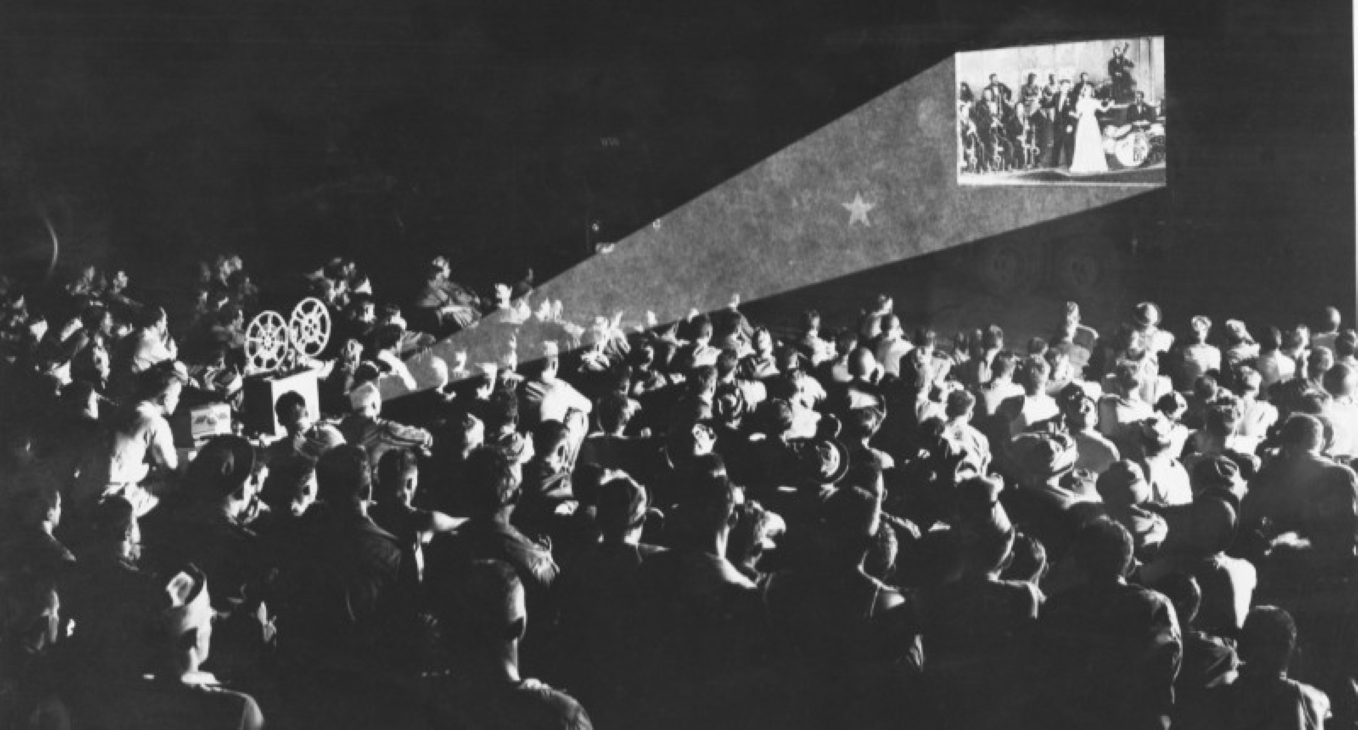
Inspired by the pioneering work of Soviet kino, the international Left became obsessed with the possibilities of film in the 1920s.
‘Workers Conquest of the Film’ by William F. Kruse from Workers Monthly. Vol. 4 No. 11. September, 1925.
“OF all the arts, the motion picture is for us the most important,–these words of Nicolai Lenin are quoted in an interesting illustrated pamphlet, “Conquer the Film!” by Willi Muenzenberg, head of the International Workers’ Aid, and one of the most expert propagandists in the world today. Many other authorities are quoted in support of his thesis: that the film is today an avenue to the mass mind comparable only to the press and worthy of the same intense support by the workers. Zinoviev, Lunacharsky, Clara Zetkin and many others give their testimonials, and the author cites the decision of the Enlarged Executive of the Communist International, held in March of this year, that all Communist Parties are to devote much more attention than heretofore to the problem of placing the cinema into the arsenal of Communist weapons for propaganda and enlightenment.
Muenzenberg points out that in Western countries the film already reaches perhaps greater masses, numerically, than do the daily papers–that it reaches them in a peculiarly effective and convincing manner–and that precisely those basic elements to whom we must appeal, the politically primitive, unorganized, poorly schooled worker and peasant masses, these are the ones most readily and most effectively approachable by a working class cinema.
Soviet Russia Workers’ Film Base.
That difficulties beset the way of adequate use of the film by our movement is fully recognized, and the author grants that only the victorious Revolution in Soviet Russia gives the world proletariat an economic and ideological base for film production. Russia, with its 120 millions on one-sixth of the earth, itself furnishes an economically self-sufficient film market that can more than cover the costs of production, precisely as the United States furnishes a self-sufficient market for capitalist film production. Both countries can do without foreign sales; these are only extra receipts, “velvet,” which in the United States represents less than 20 per cent of the income.
The problem of production being largely solved through the Russian Revolution, we next face the serious problem of bringing these films to the masses. The difficulties are quite correctly listed under three heads:
1. Political restrictions. 2. Economic conditions. 3. Organizational difficulties.
A Thorny Path.
The first includes customs duties and regulations, censorship (which is our worst bugbear), and building and fire-code restrictions and license requirements. Some of these figure also as economic obstacles.
The second embraces the costs of import, and of retitling and adaptation. After the film is ready for showing the problem of distribution must be solved: most of the film exchanges and theatres are trust-controlled and closed against us, so there remain only the expensive roads of direct theater rental or else itinerant road shows with our own mended in the pamphlet as the result equipment. The last form is recommended in the pamphlet as the result of experience in Germany, France and Czecho-Slovakia, as well as on the basis of lessons from other countries. This method is projected for use in the near future in the United States also.
The third difficulty is found within the movement. Motion picture work is hard, involves an unending burden of tedious detail work. Its importance is not as yet recognized by the movement, hence it is difficult to attract the required interest and co-operation of able comrades. It is new to the movement and, while it borrows much from our experience with old media of propaganda, it requires the learning of some new lessons that are hard to our settled workers.
The pamphlet is loaded with apt examples out of the European proletarian film experience, with which the author was most closely in touch, and the American experiences are used only as incidental illustrations. But precisely because in this country the bourgeois film has reached its greatest development, the workers use of the film must be most strongly fostered here. Ours is one of the few movements that with very small means, have attempted a widespread film campaign, and our achievements in this field are considerable, as the German pamphlet recognizes. It will be well to follow Comrade Muenzenberg’s outline and add our American experiences to those so excellently set forth by him on an international scale.
American Experiences.
Every argument cited to prove the importance of the film is doubly true in the United States. The film speaks a universal language and has bridged all racial differences in bringing to the masses the truth about Soviet Russia and about the international movement to extend its principles to every quarter of the globe. The film gives greater inspiration and draws a more constant stream of agreement (as shown for instance in applause) than any ten speakers. It delivers a message of equal excellence in the tiniest mine town or backwoods farming village, and hence will go far to solve some of the problems of rural activity in which our movement thus far is pitifully backward. In about 250 cities of all sizes and compositions we have shown anywhere from one to seven film programs, to average total audiences of 100,000 for each film. On the first handsome profits were realized, on the others the costs were more than covered. Can this be called a success? If we compare our record with the failures of other branches of the labor movement on this field of the bankrupt “Labor Film Service,” backed by yellow Socialists and Gompersites, it would seem an excellent result. But this would be sectarian gloating, and foreign to Communist reasoning. Our comparisons must be made against the achievements of our capitalist enemy. Our enemy shows his films in 20,000 houses, we show in about 200. Our record receipts for one night were about $4,000 in collections and admissions, but in the same city the “Auditorium” record for its 3,600 seats for one week was $55,000–this for the vicious anti-Negro film, “The Birth of a Nation.” Our enemy produces about 700 feature films a year, several thousand short features, and a couple of hundred more are imported, few of which reach the American screen. Against this we put out two or three features at most, and a few short subjects. Our enemy reaches fifty million people a week, according to the “Wall Street Journal,” which says of film that it “Meets a human need at a price within the reach of almost all.” We reached ten thousand a week, once.
Our weakness in comparison with the tremendously powerful Film Trust is an argument for more film activity, not less. Our press seems at a similar disadvantage; yet we know that its power is far greater than its comparatively limited number of readers would indicate. So also with our film. Our enemy knows this too and overlooks no obstacle that can be put into our way. Let us consider a few of them.
The “Sense” of Censorship.
The first of these is Censorship. If any doubt is entertained as to the true function of the State, let the limping liberal but consider the case of movie censorship. In the flush of bourgeois revolutionary romanticism this country’s “Fathers” legalized, on paper, the revolutionary weapons which had helped them overthrow the British ruling class. Thus, “free” conscience, speech, press and assemblage were sanctified in the form of constitutional amendments–which, like the 18th, are more noted in the breach than in the observance. But the movies have not even this figment of legality to protect them–there is, legalistically, no such thing as “freedom of the films.” They did not exist in 1776, hence were not listed among the approved methods of political persuasion.
The State function is revealed frankly in the Censorship Board. In Maryland the “standards” forbid: “Inflammatory scenes and titles calculated to stir up racial hatred or antagonistic relations between capital and labor.” Other items taboo include: “Doubtful characters exalted to heroes,” “Advocacy of the doctrine of free love,” “Birth control,” “Irreverent treatment of religious observances and beliefs.”
In Ohio standards forbid “Scenes which ridicule or deprecate public officials, officers of the law, the United States Army or Navy, or which tend to weaken the authority of the law.” Pennsylvania prohibits: “What reflects upon national fame, patriotism, self-respect, or adversely affects international relations, attacks or ridicules public institutions or organizations…what may produce riots, mob violence defiance of proper exercise of authority, or suggest action tending to the same.” Also: “Themes or incidents in picture stories which are designed to inflame the mind to improper adventures, or to establish false standards of conduct.” Portland, Oregon, instructs its censors to take “due regard to any sectional, national or class prejudice” and command that “Lengthy portrayal of riot scenes should be shortened to a mere fact or event of current news.”
Standards Made to Order.
Only the strictly political aspects of censorship can be gone into here, although the moral strictures are likewise eloquent—and amusing. Most censors do not state clearly what is permitted or what is forbidden, confining themselves to a general ukase against “any riotous, disorderly, or other unlawful scene, or that has a tendency to disturb the public peace.” This is the law in Chicago and it was effectively used to prohibit a picture showing the activity of the local police in breaking a strike. No reason other than a quotation from the ordinance was given and the appeal machinery—the Police Department—of course refused to function
“Picture of Prisoners Incites to Crime,” say Censors.
A similar film condemned in New York received a whole page of description and condemnation The following are excerpts:
“Picture opens with views of French Revolution and the triumph of the workers…” Next: “…the workers’ and peasants’ revolt in Russia, where broken eagles of royalty are shown in contrast to the triumphant ‘new ruling class–workers and peasants…” In an attempt to show that Labor is always crushed, views are shown of ‘the Republican Guard’ of Paris breaking up parades of workmen and unemployed, and of heavily armed troops, tanks and cavalry ‘replacing policemen’ in breaking up ‘political demonstrations’ in Germany “The following subtitles show the revolutionary trend of the picture: ‘An International Institution—the Patrol Wagon Any effort of Labor to express itself is crushed, but armed Fascist bands which undertook to over-throw the government were let alone…” ‘As soon as a strike is called the cop is on the corner. The patrol wagon does its stuff in Chicago as in Berlin.” “When the fight gets hot the cops don’t stay on the corner” (policemen on horses and motorcycles seen charging into revolutionary mobs).”
These “revolutionary mobs” were really strikers in the Chicago Stockyards, and every foot of film submitted in this picture had already been passed by the same censors as part of other productions. The pictures of the strike had been taken and served up by a great newsreel agency with anti-labor titles, which excused the manhandling and arrest of strikers on the ground that they were “sniping” at the police from the housetops, and the police were praised for their Cossack ruthlessness. This proves clearly that not the views but the class use to which they are put are the real basis of censorship. To continue:
“When the police are inadequate there is always the militia (scenes follow taken during the Herrin strike). A Chicago banker is in charge of operations–his operating tools, rifles and bayonets and six-shooters, in case the machine guns fail.” This also is newsreel film passed by the same censors in another connection. “The picture gives the impression of being an attack upon property, law, order, the prison system, the police departments, and American institutions…The film is of such character that, in the opinion of the Commission, it would tend to incite crime.”
“Police Power” Covers Censorship.
Formal censorship requirements need not exist to ban a workers’ picture. The Mayor of Springfield, Mass., forbade a film he refused to even look at, because he did not like the committee in charge of the show. This film had been highly praised by the “National Board of Review.” This high-handed attitude turned even the conservative “Springfield Republican” against him, but he stood pat. In McKeesport, Pa., the authorities simply closed down the theater; they tried unsuccessfully to do the same in Washington, D.C.; in Portland, Ore., after a successful fight for our first film, the rule has been, “no more Russian worker films.” In San Diego, Cal., the chief arrested a handbill distributor because he thought he was not going to like the show.
The Pennsylvania Board once rejected a film in toto and on appeal demanded a list of 32 eliminations, practically every one political. Even the name of the organization, the slogan, “From the workers of America to the workers of Russia,” painted on the boxes of food, annoyed the censors. A title starting. “The American workers rallied to support …” had to be changed to “American workers supported…” because “not each and every worker contributed.”
Films Cost Money, But Do the Work.
On the whole only one film has been finally rejected in any principal city, and our heaviest difficulties are still in the field of finance and organization. Our film sources are not yet sufficiently regular. The cost of preparing films for showing (duty, duplication, titles, etc.) is a strain at certain seasons because we lack a sufficiently elastic amortization policy. Our organization is not fully equal to the task of exhibiting our films extensively and intensively as well. Presentation costs are high, due to high rentals, cost of promotion, etc., and our low-cost itinerant program has not yet been adapted to overcome all obstacles everywhere. But with the will of the movement back of the films they will meet with constantly increasing success. To sum up the case for greater recognition of the motion picture film by the Labor Movement:
1. The film is the newest and most effective avenue to the mass mind, and as such it is exhaustively exploited by our capitalist enemy. It bridges all barriers to common understanding: language, race, numbers, all are meaningless as the picture sweeps convincingly through the eye-gate to the mind. What goes in one ear may go out the other, what people see with their own eyes is retained and treasured.
2. Its development illustrates within the short space of 25 years, the whole economic evolutionary process of capitalist industry. Individualistic pioneer gamblers of 25 years ago are now, some of them, magnates in a trustified industry already tightly interlocked with the banks and other organs of Big Business.
3. It illustrates likewise the whole adaptive process of present-day social institutions–State, Church, School–all at first fought to destroy the new instrument, then turned it to their use and sought to monopolize it against the rebelling under class.
4. Its tremendous revolutionary possibilities, among precisely those elements difficult of access by our ordinary propaganda weapons–the primitive-minded inert working masses who never go to meetings, and never read anything better than a capitalist comic page as well as special elements like the scattered rural proletariat and semi-proletariat; the oppressed and often illiterate subject peoples; the children, and similar groups. These vast masses hold the future of the revolutionary movement in their hands–they will determine the outcome of our struggle against imperialism–we must win them. Every weapon used by the masters to hold them we must seek to turn to help set them free. And the film is by no means the least of these. We must win it for the working class.
The Workers Monthly began publishing in 1924 as a merger of the ‘Liberator’, the Trade Union Educational League magazine ‘Labor Herald’, and Friends of Soviet Russia’s monthly ‘Soviet Russia Pictorial’ as an explicitly Party publication. In 1927 Workers Monthly ceased and the Communist Party began publishing The Communist as its theoretical magazine. Editors included Earl Browder and Max Bedacht as the magazine continued the Liberator’s use of graphics and art.
PDF of full issue: https://www.marxists.org/history/usa/culture/pubs/wm/1925/v4n11-sep-1925.pdf
 Revolution's Newsstand