Sen Katayama had a relationship with Charles H. Kerr and the ISR for nearly its whole existence, writing dozens of articles beginning in 1901 and ending with its banning in 1918. In addition, Kerr published Katayama’s ‘The Labor Movement in Japan.’ Politically Katayama was a part of the larger Left Wing project of the ISR, both becoming third internationalist voices after the debacle of World War One.
‘Capitalism in Japan’ by Sen Katayama from International Socialist Review. Vol. 10. No. 11. May, 1910.
JAPAN has made remarkable progress during the past forty years. During the feudal rule of the Tokugawa Dynesty, she had a long sleep of three hundred years.
Under the Tokugawa feudalism our peasants were the most oppressed class in Japan. They were exploited by feudal lords. Farmers then had to give 50 to 70 percent of the yield of the field. They were the only class to support the families of the hereditary military classes called Samurai, who did nothing but fight. They were like the standing armies of the present day, plus their families.
At the beginning of the Meiji era, 1868, when the feudal Tokugawa fell, there were no industrial classes to speak of. The merchant class was clustered around the feudal castles numbering about thirty-six principal ones, and many more of the chiefs scattered throughout the land.
But with the revolution of 1866-67, Japan started a new life. The destruction of the feudal system removed all the old social status and there arose new classes of trade and industrial workers.
The cannons of Commodore Peary in Tokyo Bay, in the 60’s awakened Japan from her long sleep to a realization of the powers of the Western civilization. And Japan has been ever since adopting everything Western: She copied laws from France; patterned her army after Germany; her navy after England; and appropriated the educational methods of America.
Slowly and steadily Japan has been taking everything good and evil from the Western countries. Novi she is an industrial country with a proletariat under a capitalism more intolerable than the capitalism of Europe.
I shall give some figures in yens that will show you the progress of Japan and her industries during the past forty years:
1877—1887—1897–1907
Capital Invested: 25,451–63,273–532,522–1,069,706
Foreign Trade: 50,769–95,711–382,435–926,880
(“The yen is a Japanese money unit equal to 80 cents).
The national income was estimated in 1905 at 2,812,747,530 yen and now it is calculated at four and half billion yen a year. Out of this income the people pay national taxes amounting to 540,000 yen and about an equal sum for various local taxes. Thus it may be seen that the Japanese are making their miserable living under the most deplorable conditions.
We have yet no clear labor statistics but a table based on the income tax payers shows that 50% of the people have an income of from 300 to 500 yens a year, while only 5 or 6% of the entire tax payers have an income of 2,000 yen and more, a year. Thus the distribution of wealth in Japan, is already very unequal.
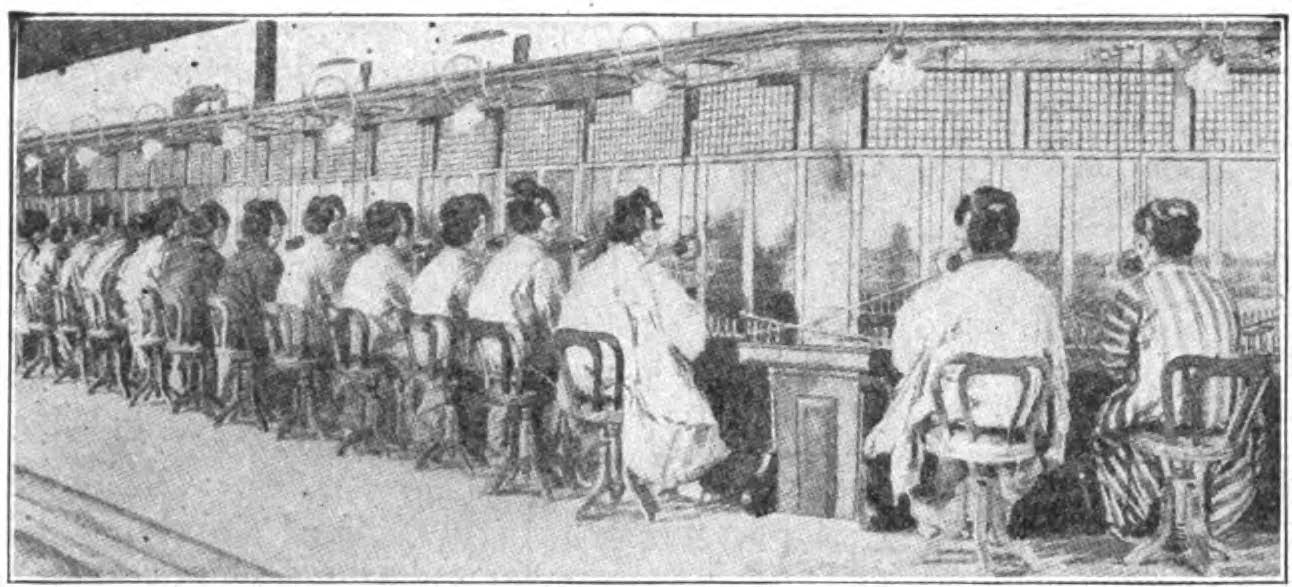
How is our wealth produced? There are about 800,000 factory workers. A considerable number of these are women and girls.
There are 2,500,000 workers, excluding the official classes, farmers and farm laborers. About 1,000,000 men are engaged in governmental work, teachers in various schools, doctors, journalists, authors, lawyers, etc. The farmers and farm laborers number six or seven millions.
With the present session of the Imperial Diet the civil and military officers will get an increase of salary of 25%. This increase has been greatly opposed by the people, because Japan has been kept up with the war taxes which are the heaviest in the world. However, the present government is a military government and has its root in the army and navy together with the civil officers who monopolize every interest of the country.
Now the government with its employes of 300,000 persons in the various government offices, with the military officers, has the power to spend five or six hundred million yen a year. Therefore there has been a great deal of graft and boodle in vogue with the government.
Of course, the government is on very amicable terms with the big merchants and the rich. It is a well known fact that our cabinet ministers are great stock gamblers and make a big profit in Kabutocho (Tokyo Wall street.)
You may ask why this is so, for Japan has a representative body elected by the people. Indeed, we have a constitution and a parliament of two houses. Apparently all is well with the politics of Japan!
But in reality Japan is the best adapted country in the world to modern capitalism!
First, Japan has 53,000,000 souls, patient, industrious and ripe for exploitation by the rich. Second, Japan is a small country, consisting of groups of 4,000 or more islands, mostly rocky and mountainous, unfit for cultivation, so that labor is cheap and kept down by a barbarous police system, worse than the Russian gendarmes!
In the third place, a property qualification for the Parliament, which excludes all the poor classes from taking part in politics, leaves the working people with no hand in the administration of the government. There are one and a half million voters who participate in the Parliamentary elections out of 53,000,000 people. This narrowly limited franchise makes Japan an ideal country for a greedy capitalism.
There is not a single law to hinder the capitalists in exploiting the workers in any manner. The employer may wilfully murder, by defective machinery or an unhealthy factory, or kill his workers with dangerous poisonous chemicals. There is no law to protect workers.
So the capitalists are free to make profits by the worst sacrifice of labor!
To pacify the public, the government introduced a factory bill to the present Diet, but it is said that it will be laid on the table at a committee. This is all. It took fifteen years to prepare the bill, which is now almost killed by the capitalist M.P.’s in a day.
It is true, the government must get a two million and a half budget in some way. So it buys the biggest political party—the Seiyukai, with a rich booty, and the biggest party sells its power for gold and various protections that will yield large profits!
Always these M.P.’s are representatives of the big capitalists and the rich. They look after the interests of one and a half millions and their families, at the expense of the rest of the population.
The people who support the government are left wholly unprotected. The past twenty years of parliamentary history shows, that every tax and every law passed, has been in favor of the big capitalists.
For instance, our budget is raised by indirect taxation on sugar, tobacco, salt and sake (rice wine) and even on rice, while the large property holders pay very little and sometimes no taxes at all. The capitalists and their government are well organized to exploit the rest of the people.
As a result of the late Russo-Jap War, Japan got hold of Korea and a part of Manchuria. Now the capitalists and their government are trying to exploit ten million Koreans, and the people along the Manchurian railroad. This will not in the least benefit the Japanese people. They have to pay the expenses of war and are even now supporting a vast number of soldiers with enormous sums as pensions.
The workers of Japan have a very difficult life. But will they suffer such oppression for long? No, they will awaken to the necessity of the times and will eventually organize themselves into a union. The hope for union lies in the fact that Japanese industry is rapidly becoming organized and under the modern system of industry, the workers are forced to organize themselves. The Japanese workers will learn this soon.
The International Socialist Review (ISR) was published monthly in Chicago from 1900 until 1918 by Charles H. Kerr and critically loyal to the Socialist Party of America. It is one of the essential publications in U.S. left history. During the editorship of A.M. Simons it was largely theoretical and moderate. In 1908, Charles H. Kerr took over as editor with strong influence from Mary E Marcy. The magazine became the foremost proponent of the SP’s left wing growing to tens of thousands of subscribers. It remained revolutionary in outlook and anti-militarist during World War One. It liberally used photographs and images, with news, theory, arts and organizing in its pages. It articles, reports and essays are an invaluable record of the U.S. class struggle and the development of Marxism in the decades before the Soviet experience. It was closed down in government repression in 1918.
PDF of full issue: https://www.marxists.org/history/usa/pubs/isr/v10n11-may-1910-ISR-gog.pdf
 Revolution's Newsstand