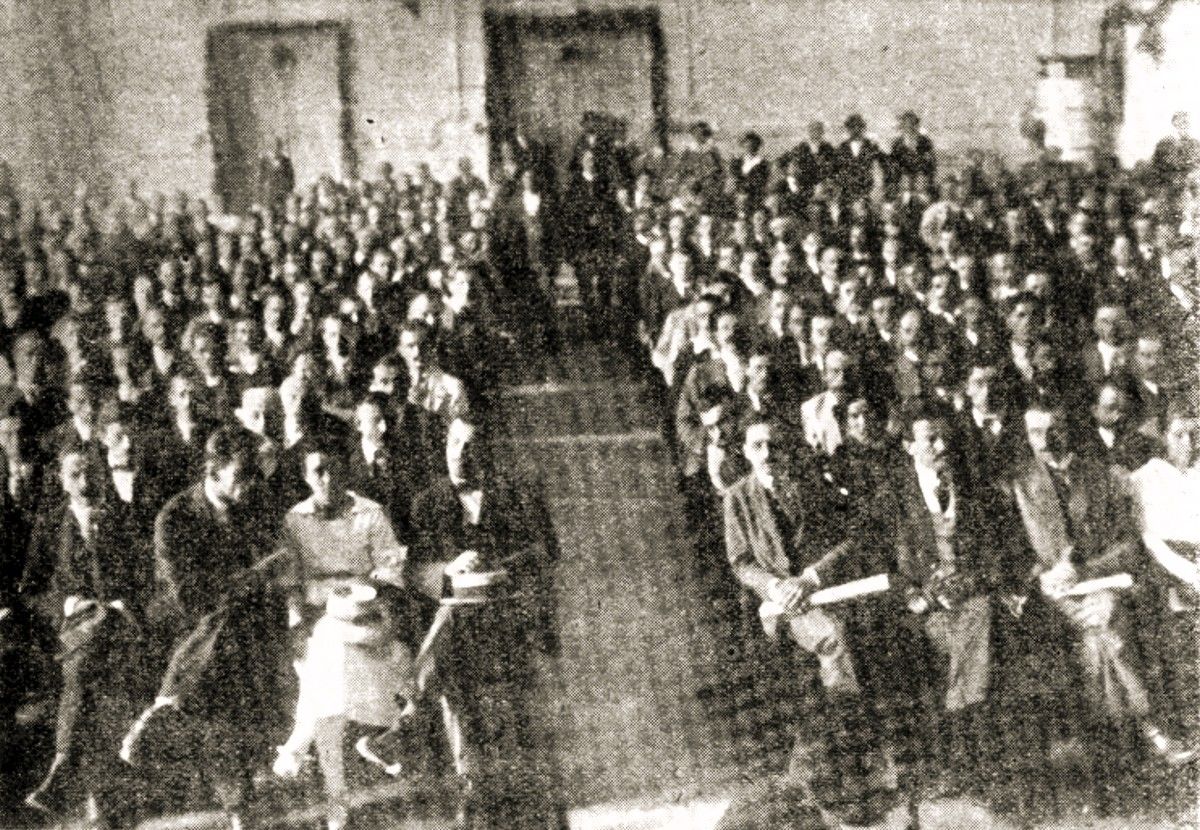
The Yugoslav Communist movement emerged from the rich, if battered, traditions of Balkan Social Democracy as one of the strongest parties in the new International with tens of thousands of members in the immediate aftermath of World War One. Below a snapshot of Yugoslavia economic and political situation, including the work of the Communist Party of Yugoslavia which would soon win 12.4% of the vote and 58 seats in elections to the new Parliament, making it one of the largest parties in the state. And then the hammer came down. By the end of 1920 the Party was banned with subsequent mass arrests, executions, repressions, and exile reducing the Party to just hundreds of activists by the mid-1920s. The Yugoslav Communists were however, and extraordinarily resilient force.
‘The Labour Movement in Yugo-Slavia’ by M Communist International. Vol. 1 No. 13. September-October, 1920.
We shall first of all give a sketch of the economic, financial, and political situation in Yugo-Slavia, and then of our movement.
1. The process of disorganisation of the bourgeois society in Yugo-Slavia reveals itself specially in the economic crisis and the currency chaos. Economic life does not exist, so to speak, it is simply hibernating.
In Belgrade not a single enterprise has been restored during a whole year. In the rest of Serbia, matters are still worse. In Bosnia, and also in Croatia and Slavonia, liquidation of the larger enterprises in the mining, metallurgical, weaving, forest industries is going on daily. This liquidation is called forth by the lack of coal and raw material, and also the complete incapacity of the government to organise work in the institutions, which before the war belonged to “foreign subjects,” and were sequestrated after the defeat of Austria-Hungary. In Dalmatia, economic life has completely stopped. In Slavonia, where industry was developed to a greater degree than in the other parts of Yugo-Slavia, the majority of the industrial enterprises are not working. The revival of economic life has become impossible owing to the unexampled chaos in the rate of exchange. In comparison to the French franc, the dinar has fallen by 200—250 per cent. during the last year, and there is a definite tendency for its further fall. Approximately ten milliard krons are now in circulation. Lately the rate of exchange of the dinar, in relation to the kron, has been established as follows: 1:4 (one dinar=4 krons). But this decision, while establishing the proportion between the kron and the dinar, only led to a parallel fall of both the dinar and the kron, and to nothing else. The unceasing fall of the currency value is involving an automatic increase of prices for food products, which have now attained an abnormal height. During the last year, the prices for foodstuffs and other necessaries have risen:
Bread by 200—250 per cent.
Meat 300
Suet 300
Clothes 300
Rent 300
Salt 50
Petroleum 250
Boots 250
Potatoes 200
Sugar 300
This incredible increase in prices—in consequence of the economic crisis and the chaos in the rate of exchange has created the most unbearable conditions of life for the wider circles of the population in the towns and villages.
Owing to the lack of cattle and agricultural implements, the peasants are not cultivating the land. They are leaving the villages in large crowds and filling the towns and ports. But they cannot find employment there either. Moreover the pay is very low: skilled workers receive from 16 to 56 dinars per day, and the unskilled from 10 to 15 dinars.
The financial situation is a desperate one. Yugo-Slavia, like all bankrupts, is contracting new debts in order to pay the old ones. But all credit is exhausted; the entire assets of the State have practically become the property of the league of robbers in Paris. The national debt of Yugo-Slavia amounts to about ten milhard francs. The budget deficit, which was reckoned at 300 million dinar, actually attained the sum of two milliards. In order to disguise this enormous deficit, and to pay the interest on old debts the Yugo-Slavian bourgeoisie raised the customs tariffs, introduced new taxes, increased the old ones by 300 per cent., and planned some new loans. These burdens will be laid chiefly on the backs of the working masses, and aggravate their already desperate condition.
Economically ruined Yugo-Slavia is, in financial respects, absolutely dependent on the Entente, and particularly on France. She owes 200 million francs for her liberation. All the national riches on the former Austria-Hungarian territory—such as forests and coal mines—all industrial enterprises and public buildings, must be redeemed by the State, and up to then France is entitled to their exploitation.
Moreover, by giving Roumania purely Bulgarian provinces, Yugo-Slavia—purely Hungarian—and Italy-Slavonian provinces, the Entente has shown its cards, and called forth a profound disappointment even in bourgeois circles. This attitude of the Entente has greatly strengthened the spirit of national separatism in Croatia, and especially in Slavonia.
The representatives of the parties in favour of a State centralism (the Serbian-Croation coalition, the Independent Radicals, Nationalists, Progressives, the so-called Democratic Union, with a handful of Social Democrats assembled around Koracz, Bukshek, and Christan) are now ceding the field of battle to the representatives of national separatism (the Serbian Radicals, the Starezeviczantsy of Croatia, and the clericals of Slavonia). The struggle between these two groups has acquired a most acute and implacable form, and the Yugo-Slavian bourgeoisie is expending its best forces. If there is anything in the world capable of uniting these contesting groups of the Yugo-Slavian bourgeoisie, it is the mighty growth of our Communist movement. Only in the face of advancing Communism have the warring bourgeois groups stopped their feud, and entered into negotiations for the formation of a strong united government, directed against us Communists.
But nothing helped the bankruptcy of this national union so much as the constant and eternal adjournment of the solution of the agrarian question, which is extremely acute in Croatia, Slavonia, Voevodino, Bosnia, and Dalmatia. The most favourable moment for the solution of the agrarian question was that of the collapse of the Austria-Hungarian Empire. But this moment was missed by the bourgeoisie, the decision was adjourned, and the agrarian question became ever more entangled. The Democratic Union (block) gave to the peasant the lands of the larger landowners on lease only, it is true, but the present reactionary clerical government is attempting by all means to distort even this already distorted reform. Our Party, with its motto: “All the land, with all the stock in hand, without compensation, to the workers”—raised and grouped around us all the discontented masses of workers and peasants.
2. Development of the Labour movement.
During the occupation of Serbia, the Labour movement came to a complete stop. It awoke to life in November, 1918. In December of the same year the paper, Radnichke Novina (the Labour Gazette) appeared again in Belgrade. In the other parts of Yugo-Slavia, which belonged to Austria-Hungary, the movement was hardly perceptible during the war. In Sarajevo the Glas Svobody (the Voice of Freedom) with Zimmerwald tendencies was published at one time. As soon as the State of Yugo-Slavia was formed, it became our duty to establish immediately a contact with the Socialist parties of all parts of the world, and to become united with them as soon as possible, On April 20-25, 1919, our Central Committee in Belgrade received a mandate to convene and organise a Congress. The only condition for participating in it was to profess anti-militarism, i.e., to repudiate all participation in a bourgeois ministry. This is why neither Slavonia, nor a part of the Croatian Party (with Koracz and Bukshek at the head), nor a part of the Voevodino Party, were represented at the Congress. However, the majority of the proletariat of Croatia, as well as Voevodino sent their representatives. Our Communist group advanced the following propositions:
1. The United Party shall bear the name of the Communist Party of Yugo-Slavia;
2. It shall join the Third International unconditionally;
3. It shall take part in the electoral campaigns according to circumstances and on the basis of a referendum of all the members of the Party.
To avoid a split in the Party, we desisted from the first point; but the other two were passed unanimously under thundering applause. However, notwithstanding the triumph of Communism, the Congress bore a certain impression of compromise. That is why the next Congress must definitely put an end to all that savours of centrism, and must give to the Party a purely Communist character in regard to action and tactics. The presence of vacillating centrists in the Central Committee at the most important moment paralysed the Party in many cases.
A few days after the Congress, at which the new Central Committee of the Party was elected, all the members of the new Committee, and also about 200 other comrades, were arrested in different parts of Yugo-Slavia. On May 1 a military detachment raided the Workers’ House at Sarajevo, destroyed all the furniture, burnt the library, and confiscated over 200,000 krons. All the official members of the Party, and 400 of the best comrades, were arrested. Similar reprisals were carried out simultaneously in Croatia and Voevodino, where in June, 1919, a great military mutiny took place, for which the Communist bore the blame. In connection with the mutiny, 250 workers’ families were arrested. The poor creatures were exiled to Macedonia and there imprisoned.
Arrests took place in Slavonia also, and were frequently accompanied by murder. Among the arrested was Comrade Philippovich, Secretary of the Party. After six months’ imprisonment, the Government set him free, fearing reprisals on the part of the organised workers.
In spite of these acts of violence, the Communist Party is enjoying great success. It includes over 40,000 members, without counting 10,000 young Communists. In the Trade Unions, which always march together with the Communist Party, and at the head of which are Communists almost everywhere, there are from 150,000 to 180,000 organised workmen and workwomen. Communist ideas find favour in the eyes of the women who have suffered so strongly during the war; they take an active share, with great zeal, in all spheres of Party activity.
Many of them play an important role in the Organisation of Communist Children of Yugo-Slavia.
In this organisation—the prettiest blossom of the Communist Party—children from 5 to 12 years are united, and receive a thoroughly Communist education. Their work, play, games, concerts, all bear the stamp of Communism. The organisation is publishing a bi-weekly paper, The Future.
The working masses, in general, are undoubtedly in favour of the Communists, owing to a whole series of strikes in which the Communists played a very active part. Already, in the beginning of 1919, mass meetings were organised throughout the whole of Yugo-Slavia, against high prices and government reprisals. In Croatia, Vandovina, Bosnia, on June 20-21, 1919, a general strike took place as a protest against the intervention of the Entente in the affairs of Russia. There were many strikes for other causes, which it would take too long to enumerate here. The printers’ strike in Bosnia lasted two months; in November, the coal-miners struck work in Slavonia; in December, the printers at Zagreb, in January, 1920, the railway men in Serbia; and so forth.
The municipal elections which were held recently in Croatia were marked by the victory of the Communists, to the great astonishment of the Yugo-Slavian bourgeoisie. It is especially afraid of our victory in the villages. Not only in the towns, but also in many villages, our Party secured either a relative, or an absolute majority. This success is the more remarkable that we advanced the maximum program at the elections: “For the revolution, for Communism.” We understand clearly that our victory at the municipal elections will serve as the beginning of a whole series of collisions with the bourgeoisie and its highest class organisation—the State. We took part in the elections without any illusion in regard to the possibility of “positive work,” in view of the desperate economic and financial situation in the country. We know that, were we to make the slightest attempts, in any municipal institution, to realise our plans of a serious reorganisation of the whole economic administration, we would immediately call forth the harsh intervention of the State authorities; because the bourgeoisie would never allow that the class character of the municipality should be modified, so long as the bourgeois are masters in the State. But in advancing the questions which are at present directly interesting the workers and peasants (the housing question, high prices, etc.), we shall rouse the working population in the towns and villages, by clearly and openly explaining to it that there is only one possible way out of the general chaos of the present time: dictatorship of the proletariat—Communism.
Fully acknowledging the importance of the villages for the success of a Communist revolution in an agricultural country like ours, we are giving our serious attention to them. However, we have to carry on a desperate struggle with two difficulties: a lack of agitators and a lack of financial means. We have, nevertheless, succeeded in rousing the peasant masses, not only where the agrarian question is more acute, but even where it does not exist at all—as, for instance, in Serbia, where almost every peasant is a small proprietor. The Serbian peasant, who during the seven years of war did not acquire anything and has lost everything, is most responsive to Communist ideas. And now our complete success amid the peasant masses depends exclusively on the intensity of our agitation and organisation.
The influence of our Press is very great. The bourgeoisie, especially the intellectual part, is fast losing all hope of the possibility of defending the existing order. The Communist element is ruling among the youth of the schools. The growth of our movement along the whole line is so wonderful that we are looking forward to the future with great optimism. March 26, 1920. Belgrade.
The ECCI published the magazine ‘Communist International’ edited by Zinoviev and Karl Radek from 1919 until 1926 irregularly in German, French, Russian, and English. Restarting in 1927 until 1934. Unlike, Inprecorr, CI contained long-form articles by the leading figures of the International as well as proceedings, statements, and notices of the Comintern. No complete run of Communist International is available in English. Both were largely published outside of Soviet territory, with Communist International printed in London, to facilitate distribution and both were major contributors to the Communist press in the U.S. Communist International and Inprecorr are an invaluable English-language source on the history of the Communist International and its sections.
PDF of full issue: https://www.marxists.org/history/international/comintern/ci/old_series/v01-n13-1920-CI-grn-goog-r1.pdf
 Revolution's Newsstand