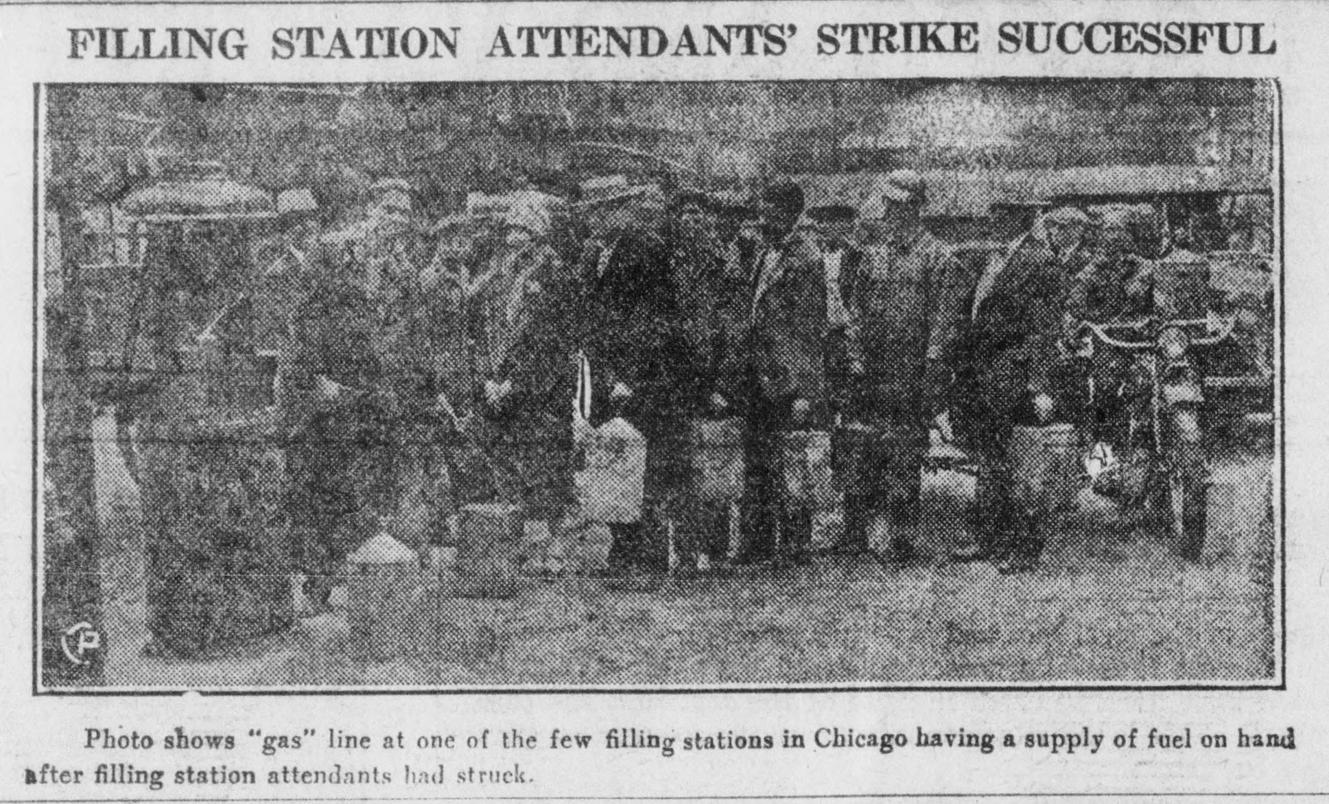
Labor militancy wins for labor in two ‘service industries’ as Chicago’s gas station workers and movie theater attendants struggle over the summer of 1927.
‘Strike! Lockout! Victory!’ by Carl Haessler from Labor Age. Vol. 16 No. 10. October, 1927.
What Happened in Chicago?
Twice this summer Chicago workers, solidly organized in unions, have declared war on a section of their employers, have suffered a lock-out from the rest of their bosses and have carried the fight to triumphant victory. They were not afraid of disturbing industrial peace in pursuit of their legitimate demands and they were not frightened when the enemy showed his teeth. In one case labor historians registered the first strike of its kind in history.
These two scrapping unions are the gasoline filling station attendants, with the allied tank wagon drivers, and the movie operators. The gas strike and lockout began July 8 and was won by the union in less than twenty-four hours after creating the wildest excitement in the Chicago motor world. It brought a sizable wage boost to the 2,500 unionists involved.
The movie strike and lockout sputtered a while, seemed settled and then. broke out in ‘greater virulence August 29, the owners surrendering in time to garner the rich box-office takings of the Labor Day week-end. The union had demanded nothing but observance of the contract, which the exhibitors were seeking to evade.
A Day To Be Remembered
Saturday, July 9, will long be remembered by the police department and the owners of automobiles. The chief had canceled all vacations in the department. Riot squads in flivvers, with machine guns mounted next to the driver, began cruising through the streets. Motorists dashed up to filling stations at the last minute to take on all the gas their tanks would hold and a couple of gallons in their red-painted emergency containers as well. The stations of four counties in the Chicago area were pumped dry of their stock.
And not a drop more was to be had.
When a station was emptied the pumps were padlocked and police saw to it that there was no tampering with them. No deliveries by strike-breaking chauffeurs were attempted. Gasoline is too dangerous a plaything for scabs to handle. That’s why the coppers did not ride on the driver’s seat to replenish the station tanks. That perhaps is why the strike and lockout ended so quickly.
The trouble began when the union, which is affiliated with the International Brotherhood of Teamsters and Chauffeurs, got tired of endless negotiations with the Sinclair Refining Company for a wage raise and called a strike July 8 to show that it meant business. The demands were a $10 monthly raise for the station men, then getting $140 a month, and $15 for the drivers, then getting $175. Vacations with pay were also asked for.
They walked out in the morning, and in the afternoon the Standard Oil Company and the other gas concerns had locked out their employees in order to help Sinclair. The tall talk in the papers about the Standard versus the independents always disappears when there is labor trouble. There are no independents then. All the bosses stick together against the workers. So in this case the corporations, trust and so-called independents, made common cause against men whose wages are relatively low and whose work is dangerous both from the point of view of the material they are handling and from the special liability in Chicago to holdups, with accompanying violence.
The Best Time Chosen
But just as the employers stuck together, so did the men. Their union is full of the fighting tradition of the teamsters’ brotherhood and they were promised support if needed. They did not want the first filling station strike to fizzle. They had chosen the best possible time for the test of strength—a summer week-end when everybody wants to hop into a machine and get out of town.
The result was a clean-cut victory. They did not get all they had asked for in their preliminary demands, as these had been set high enough to permit bargaining if the companies cared to settle. The final terms were incorporated in a two-year agreement and all was normal again in the retail gas industry.
Station attendants now get $145 a month, a $5 raise. Drivers get $182.50, a $7.50 raise. Hopes of vacations with pay were postponed to the next conference two years from now.
More important than the welcome additional pay is the confidence of the local in its fighting power. Its first strike, complicated by a lockout inflicted by the enormously powerful oil corporations, had turned out a gratifying success with almost lightning speed. The comparatively new local has not disgraced itself in the eyes of its scrapping seniors in the brotherhood. It had bucked the anti-union giants of a basic industry and had won.
No Movie Strikebreakers
Neither was any strike-breaking tried in August by the Chicago Exhibitors’ Association, which controls most of the movie theaters in the same four counties that had been gripped by the gas warfare of July. The movie operators, organized in the International Alliance of Theatrical Stage Employees and Moving Picture Machine Operators, are known as an aggressive outfit, ready to fight with any weapons their foe might choose to employ.
The owners did not care to take a chance of queering their show houses for years in case one of their careless gunmen aimed at a union picket and killed a customer instead. Nor did they want a long procession of patrons demanding their money back when inefficient scab operators got films into the projection machine upside down, tore them by clumsy handling and generally made a mess of things in the little cage at the back of the theater.
So they simply hung out signs telling the public that on account of difficulty with the union there would be no performance today. For a week the signs hung there.
The papers were full of operator propaganda with an occasional reply permitted to the union officials. Stories of fabulous wages paid to the men appeared on the front page of the dailies, only to be denied on an inside page a day or two later by the union.
The funny thing about this propaganda was that wages had nothing to do with the case. It was a dispute on a very narrow issue on which the union took a straightforward stand, while the owners tried to conceal their real purpose, which was to break the union.
Both parties had signed an agreement, to expire next January, under which the wages and hours were carefully specified, and in addition it was clearly set forth how many operators were to be employed in each class of theater. The Belmont Theater, an Orpheum Circuit link in an uptown district, was to employ four operators, and did so until the middle of August, when it announced that two men would be enough for its purposes, notwithstanding the contract. It pretended that by adding a few short vaudeville acts it had changed its classification. In reality the exhibitors’ association had been informed by its manager, formerly a union official, that internal difficulties in the union, as shown at a recent election, had made the time opportune for a slaughter of the organized employees.
The Lockout Comes
The union laughed at whispers of discord and called a strike on all Orpheum theaters August 23. This seemed to result in a quick victory until it was discovered at the end of the week that although four operators had again been employed, only two of them received the customary pay checks. Six days after the strike came the lockout, throwing out 553 operators and closing down most of the theaters in the metropolitan area.
A few of the theaters refused to join in the lockout as they enjoyed the friendly peaceful relations with the union and had no desire to mix in a fight based by the owners on smashing a contract. To prevent these theaters from reaping the harvest of overflow houses, the associated owners used pressure on the film exchanges, intimidating them into refusing to release films that had already been contracted and paid for by the open theaters. Thus the owners, to carry through the smashing of their own contract with the union, forced the breaking of further contracts by other business units in the industry.
Just as the union and the open theaters were uniting to compel observance of contracts the exhibitors’ association decided it had enough. The approach of Labor Day, with its higher prices and enormous attendance, made it raise the white flag. It surrendered on the original issue and from now to the expiration of the contract, January 10, four men will work and get their pay at the Belmont Theater.
The union confined itself to keeping clear the matter in dispute, namely the contract. The owners weakened their case by offering to pay a lump sum equal to the wages of the two operators during the life of the contract if the union would release them from the obligation of having four men at the Belmont. The union refused because it will not be a party to speeding up and because it saw no particular reason for accommodating the owners after they had tried the lockout and other means to smash the union.
Fight Was Worth It
The fight was well worth while and it ended long before the union’s resources were seriously tapped. Talk of a national strike against the entire Orpheum circuit was heard in union headquarters and international officials of the union were in constant touch with Local 110. The legal battle against the secondary contract breach hardly got under way. And no direct struggle against strikebreakers had been necessary. Auxiliary strength came from the stage employes’ local which struck in sympathy and managed to get a 7% raise out of the scrimmage.
These two Chicago unions, the filling station men and the operators, demonstrated in sturdy aggressive fashion that there is lots to be won by well planned solidly organized fighting against the employer, whether to win a wage boost or to keep a contract intact. As industrial militants they are all there.
Labor Age was a left-labor monthly magazine with origins in Socialist Review, journal of the Intercollegiate Socialist Society. Published by the Labor Publication Society from 1921-1933 aligned with the League for Industrial Democracy of left-wing trade unionists across industries. During 1929-33 the magazine was affiliated with the Conference for Progressive Labor Action (CPLA) led by A. J. Muste. James Maurer, Harry W. Laidler, and Louis Budenz were also writers. The orientation of the magazine was industrial unionism, planning, nationalization, and was illustrated with photos and cartoons. With its stress on worker education, social unionism and rank and file activism, it is one of the essential journals of the radical US labor socialist movement of its time.
PDF of full issue: https://www.marxists.org/history/usa/pubs/laborage/v16n10-oct-1927-LA.pdf
 Revolution's Newsstand