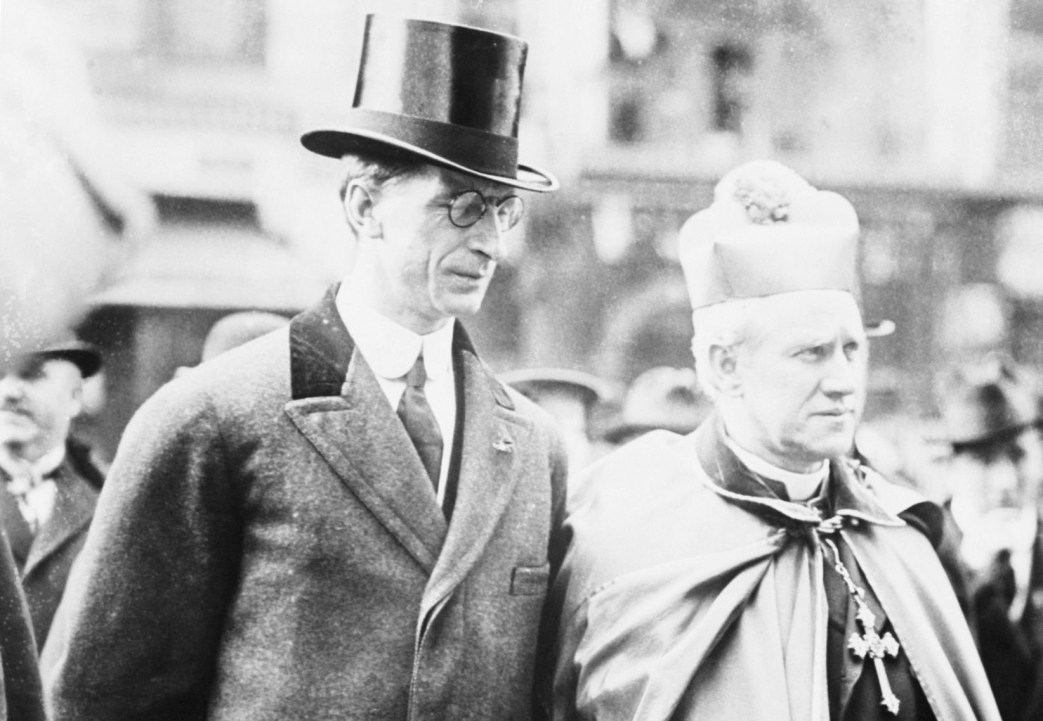
Martin Moriarty of the C.P.-sponsored Irish Workers Clubs on the St. Patrick’s Day spectacle of Irish-Americans, exiled by British Imperialism, marching in proud support of U.S. Imperialism.
‘Whose Friends Are Generals, Politicians in St. Patrick March?’ by Martin Moriarty from The Daily Worker. Vol. 11 No. 67. March 19, 1934.
U.S. Imperialists Use Irish Fight as Club Against England But They Are Oppressors and Exploiters of Irish Workers in America
James Connolly, Ireland’s greatest revolutionist, never disputed the ancient Irish legend which held that St. Patrick banished the snakes from Ireland. “They came to America and turned into boss politicians,” the hero of the Easter Week Insurrection used to say.
Connolly had in mind the type of Fifth Avenue Irish “patriot” who flourishes on March 17. The parade this year is led by detachments of New York’s mounted police; military chiefs of the National Guard, and such sterling “friends” of the Irish poor as the Tammany boss, the Hon. Timothy A. Leary.
Why so many rifles and guardsmen to celebrate a “national and religious festival?” The March 17 parade is an Irish institution here and American imperialists have always sought to use these institutions as cudgels to clout the British empire. Obviously the St. Patricks Day parade does not lend itself so completely to such a purpose. But the prestige of Wall Street’s military machine is raised before thousands of Irish men and women who trail behind the guardsmen, the mounted police, the strutting drum-majors, the Tammany politician. So that when the time does come—and it comes nearer every day—for America to strike at its British rival.
Part of “Irish Question”
It’s all part of the centuries-old “Irish Question” and within the frame-work of world imperialist antagonisms, the “Irish Question” becomes more of an international question for the working class. A potential war base of an enemy power, the British empire’s first colony has always worried the conquerors. “No tampering with the Anglo-Irish treaty of 1921!” nervous British statesmen cry. They shriek of the “sacred obligations,” of a “treaty of peace” enforced by firing squads. Why? Because the treaty gives Britain control of the wireless stations around the Irish coast; the naval bases; the right to build “commercial” airports.
The military side of the question does not exhaust its international complications, and British, Free State and American ministers know this as well as any. Thus, when the British War Debts Mission pressed the case for cancellation of the debts before the United States last fall, the “Irish Press,” organ of the Fianna Fail Government, slyly observed in its editorial:
“At such a moment Ireland’s influence can count for great deal in the United States…Could all section of Irish nationalists group themselves behind the Free State government’s assertion of right in this dispute (i.e., the quarrel over retention of the land annuities’ taxes in the British or Irish government’s treasury), then Britain would find that there is another side to her debt negotiations across the Atlantic.”
The Irish-American press here immediately took the cue. Listen to the voice of American Imperialism in the editorials which thundered: “Make England pay the war debts to the American people.” And from this agitation arises the jingo American Defense League which shouts for a navy second to none.
Mixed up with mud-slinging of John Bull, this propaganda is eagerly swallowed by millions of Irish in the States whose folk were driven from Ireland by blood-sucking landlords protected by British imperialism.
Marx On Ireland
How valuable is their fierce anti-British hatred to Washington’s demagogues! Karl Marx saw its significance way back in the ’sixties. The pages of Capital tell how great masses of the Irish people perished or were hounded abroad “that Ireland might fulfill her true destiny, that of being a sheep-walk and cattle-pasture for England.”
Yet: “Like all good things in this world, this profitable method has its drawbacks. With the accumulation of rents in Ireland, the accumulation of the Irish in America keeps pace. The Irishman, banished by sheep and ox, reappears on the other side of the ocean as a Fenian, and face to face with the old queen of the seas there rises, threatening and ever more threatening, the young giant republic.”
Naturally the young giant republic connived at the raid on Canada by the Fenians (the American wing of the Irish Republican Brotherhood) in 1866. The raid flopped. But it was used against England by America as proof of a strong anti-British mood here which might be appeased only by generous settlement of the Alabama claims. (The claims were based on Great Britain’s “unfriendly acts” against the United States during the civil war: Britain had recognized the southern states as belligerents and had allowed British ships to carry arms to southern ports.)
As the war clouds thicken, DeValera’s American friends hammer away at the war debts. The extreme Irish Republican, the descendant of the old Fenians, shouts a- new Fenian slogans: “England’s difficulty is Ireland’s opportunity; England’s enemy is Ireland’s friend!” The modern Fenian’s instincts are rooted in a revolutionary struggle against British dominion. Yet his uncritical reliance on America as a “friendly power” of Ireland transforms him into mouthpiece of another empire. That empire has shown it can persecute Irishmen as savagely as any English ruling class. That empire too has laughed at “Irish self determination.” President Wilson, who like his British allies of the war had drafted the working class to fight “that small nations might be free,” was glibly indifferent to Ireland’s status as a small nation at the time of the post-war Peace Conference.
Let the Irish exiles in the States ponder over the record: The American empire holds the Irish-American trade-unionist Tom Mooney in the dungeons of St. Quentin. The American empire fought side by side with the same imperialist robbers who had drowned in blood the heroic insurrection in Dublin in 1916. The consul of the American empire said never a protesting word about the torture and imprisonment of the American citizen Sean Mulgrew by Cosgrave’s murder tribunals in 1931. Nor did the American empire’s officials lift a finger to stop the hounding and deportation of another American citizen: Jim Gralton, revolutionary working farmer, driven from his birthplace in Leitrim for leading a struggle for land.
U.S. Deports Irish Fighters
Why not? Because the American empire upholds deportations of working class fighters—it deports hundreds of them every year. And among the hundreds of despised “foreigners” are Irish born workers: Pat Devine, deported for organizing the textile workers; Pat Burke, deported for organizing the unemployed.
Let Irish exiles remember these things. Any capitalist government will gladly use any institution and any cause to embarrass a rival power—provided it suits their interests of the moment. But it is a dubious friendship.
The Irish revolutionist of today, like the 1916 rebels and like the Russian working class led by Lenin in 1917, wall unhesitatingly play off one power against the other should the course of the struggle so demand. But international alliances do not begin and end with capitalist diplomats. You won’t find the real friends of the Irish Revolution of today in the Generals or Tammany politicians or mounted police officers who march along Fifth Avenue on the 17th. The real friends of the Irish people are not in the consular offices of the ruling class. They are in the workshops and mines and mills of the capitalist world—the revolutionary working class before which imperialism will crumble all over the earth.
The Daily Worker began in 1924 and was published in New York City by the Communist Party US and its predecessor organizations. Among the most long-lasting and important left publications in US history, it had a circulation of 35,000 at its peak. The Daily Worker came from The Ohio Socialist, published by the Left Wing-dominated Socialist Party of Ohio in Cleveland from 1917 to November 1919, when it became became The Toiler, paper of the Communist Labor Party. In December 1921 the above-ground Workers Party of America merged the Toiler with the paper Workers Council to found The Worker, which became The Daily Worker beginning January 13, 1924.
PDF of full issue: https://www.marxists.org/history/usa/pubs/dailyworker/1934/v11-n067-mar-19-1934-DW-LOC.pdf
 Revolution's Newsstand