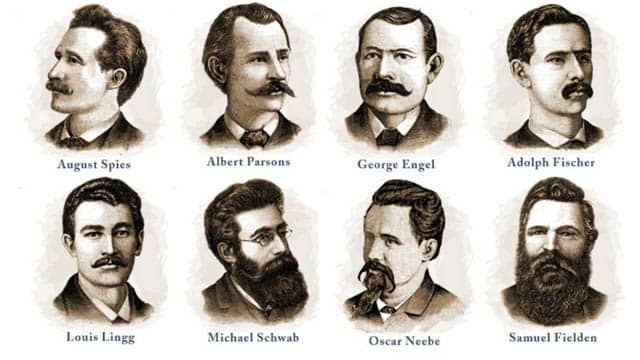
Our comrades meet their death as aware, principled, and utterly dignified prophets of working class emancipation and human freedom. The Alarm reports on the last hours of Albert Parsons, Louis Lingg, George Engel, Albert Spies, and Adolph Fischer before their November 11, 1887 martyrdom. Revolutionaries whose bravery and clarity have given succor and comradeship in the worst of times to so many of us since.
‘Our Heroes in the Strife for Liberty Show the Courage of Their Convictions’ from The Alarm (Chicago). Vol. (new) 1 Nos. 2. November 19, 1887.
ECHOES OF THE PAST.
Our Heroes in the Strife for Liberty Show the Courage of Their Convictions.
The Courage and Heroism of Our Martyred Comrades and the Trepidation and Fear of Their Murderers.
The loaded dice of the state have won the game. Our innocent amnesty-seekers hoped to the last that abstract justice would prevail against concrete power. The fearful specter anarchy was crushed by Gary, and the prostitute press shouted in chorus: “Anarchy is dead!” But lo! the hideous specter would not down. Again appeal was made and again the little joker appeared under the box upon which the state had placed its stakes. And yet again, before that highest tribunal’ where land grants are confirmed and railroad pirates are knighted as industrial barons. “Anarchy is doomed,” sang the hireling frog- voices of the discordant political public solicitors of favors. The “end of anarchy” had been reached, for the law itself had said it.
But the culprits, the criminals, the victims to the capitalistic hatred of as vile and rancorous a mob as ever clustered around the stake of a Bruno or the scaffold of a Rienzi how did these vile wretches, these contemners of Mother Grundy’s social decrees, these despised and hated anarchists, meet their doom? We have but to refer to the columns of the editorial street-walkers who represent Christian Civilization to find the answer. In the hands of the modern inquisition, condemned by a modern Torquemada, with all the appliances of power to weaken their will, to subdue their devotion to principle, their answer is given in the blanched faces of those who expected to witness their weakness. Let the columns of the press be their judges. We will but report as the press recites. Did they cower? Did they beg for mercy? Did they yield to the overwhelming avalanche of sentiment and recant? Did a single anarchist purchase life by groveling in the dust and licking the hand of the monster state which struck them? Listen to the story of the penny-a-liners and judge who were those whose cheeks were blanched and who were those who stood as the representatives of eternal justice, truth, and equity.
Space will not permit a repetition of the scene. We must hurry over the tragedy in which the representatives of labor were sacrificed to preserve the traditional virtue of the ancient wall-flower that poses as the American goddess of liberty…
Let us glance at their last night of life. The supper of the Girondins has been sung and related in story. But these men–nothing but anarchists, confined separately, without convivial intercourse to cheer them, alone “without God and without hope”–displayed a courage unexcelled in history.
ALBERT R. PARSONS.
Reading Whittier’s Poem of “The Reformer” to his Guards.
Albert R. Parsons was of Puritan descent. From his ancestor, Jonathan Parsons, our patron saint “Brother Jonathan” had derived his name. He had returned and voluntarily appeared for trial with his imprisoned comrades, with the deluded hope that Justice still presided over the deliberations of the hireling crew who dispensed her rights in his native land.
The deputy sheriff who was with Parsons for three hours that night undertook, when he was relieved at 1 o’clock, to tell what the condemned man had said, but when he began to realize the enormity of the task, he cut his narrative short by saying: “He was very cheerful and hopeful.” Such was indeed the case. Parsons never was in better humor than he was that night. He seemed to forget entirely that he would have to die within twelve hours, the deputy said, so interested did he become in his conversation with the death watch. He talked about socialism, about anarchy, the Haymarket, and his wife and children. It was not until he reached this subject that he manifested any Sorrow or regret, and the more he talked about it the more sorrowful he became. He said his wife was a brave women, a true wife, and a good mother. And then in the stillness of night Mr. Parsons recited Whittier’s poem, “The Reformer.” With clear Intonation verse after verse flowed from his lips, ringing through the gloomy corridors and awakening prisoners to listen as if to the death-song of a dying hero. “Whether on the gallows high, Or in the battle van, The noblest place for man to die Is where he dies for man.” “That song,” he said, “will go ringing down the corridors of time.” Again, he broke out in melody and sang “Annie Laurie” in sweet but clear accents. At 2 o’clock he was sleeping as soundly as ever he did in his life. He had refused mercy, he had scorned pardon for an offence not committed. He said: “If the American people can afford to hang me can afford to die like a man, leaving to the better judgment of the people my vindication.” In his papers left lying in his cell, and upon the pad upon which he wrote there was found a verse of the “Marsellaise”! in his own handwriting, showing a devotion to a principle that the hired officials were unable to comprehend.
ADOLPH FISCHER.
He Reasserts His Faith in the Doctrine for Which He Gave His Life.
Upon Nov. 5, the last day upon which friends were admitted to grasp the end of a Enger of the condemned through the wire interstices of the “visitors” cage,” Adolph Fischer wrote to the Freiheit a letter in which his faith was again asserted in clear and unmistakable terms. While friends were appealing to the state as if it was the source of benevolence his thoughts were as follows;
“COOK COUNTY JAIL, Nov. 5. My Dear Friend Most: As only six days remain for me on earth I think it time to bid you farewell. When you have read in the newspapers that four of us asked for no grace—that is, commutation of sentence, demanding either liberty or death–you can imagine that answer would be nothing else but death. You can believe me, John, that the thoughts which come in my mind at this supreme moment of my wife and three children make my heart very heavy–but resolution; be firm. The social revolution brings sorrow, and our noble cause of anarchy must have its martyrs. So let it be. I am ready to deposit my life at the altar of the good cause. When stupid young peasants willingly gave their lives for king and kaiser, who rule by the grace of God,” and tyranny in royalty, should we, warriors of liberty and anarchy, not be willing also to give our lives for the highest, noblest principles? Should we let ourselves be considered by our friends and be afraid of harm coming to us? No: nevermore. We must show our enemies that the anarchists are ready and willing to die for their cause. I have indorsed and praised our true principles, and am ready to go to the scaffold for them. I say again, farewell. Be true to our cause as you always were, and carry forward our banner with powerful grasp, even though storms should rise and difficulties beset you. I hope you may take part in the last final contest. How readily I would be at your side holding firm on the beloved red standard; but it’s not to be. It was fated that I should be a pioneer advance guard in this battle, and should lose my life. Be happy. Long life to the social revolution. Long may anarchy reign. I give you a brother’s embrace, and remain yours affectionately, ADOLPH FISCHER.
“P.S.–Give my regards to my relatives and friends. See that my family knows no need and that the children have a good education. A.F.”
With the same firmness he calmly awaited the fatal moment when his eyes were to forever close on earth. One of the death watch who were with him upon being relieved in the morning said: “He is the peer of any hero in point of courage. He talks freely and calmly of his actions and their results. He will die a second John Brown. But never again in my life do I want to spend with a condemned man his last night on earth. The mental torture is terrible.”
GEORGE ENGEL.
He Calmly Discourses on the Principles of Socialism and Religion.
George Engel was one of the tenderest-hearted and truest men that fate ever condemned to pass through such an ordeal. That he had no fear of death was apparent to all; he laughed and chatted pleasantly, smoked a good cigar and enjoyed it. In reply to questions he is reported as saying: “I am satisfied to die. Tomorrow is the 11th of November. I am not afraid. I was known as a socialist, but I never was in a conspiracy and I never was arrested, and not a vestige of a bomb was found in my house. But this revolution in behalf of the workingmen is like the revolution of old. Christianity had to make its forward march through bloody wars and through revolution, but it triumphed at last. Christ taught us that he who is rich shall give unto him who is naked, but that is not carried out to day. The first apostles were stoned to death and cast into dens of wild beasts. And so with us. We are cast into cages and we shall suffer death, but the workingmen will win. The best men are among the laboring classes. The worship of the rich is not Christianity, but the almighty dollar. The employer has no use for the poor devil after he has worked him so that he becomes a wreck. He can go to shoel then and shift. Government is conducted to protect the rich and not to protect the poor. Some of the ministers are rich, but they look to self, and their main object in life is the attainment of the almighty dollar. Oh, yes, there are some men among them, but in many cases they have no use for the poor and lowly. In shadow of the gallows, as I stand, I have done nothing wrong. I have not done everything right during my life, but I have endeavored to live so that I need not fear to die. Monopoly has crushed competition and the poor man has no show, but the revolution will surely come, and the workingman will get his rights. Socialism and Christianity can walk hand in hand to gather as brothers, for both are laboring in the interest of the amelioration of mankind. All I ever did to merit punishment was to make a speech and tell the crowd that the time had come when the workingmen must stop the police from breaking up meetings. with club and revolvers. I advised them to bring something in their pockets to prevent the police from interfering in these meetings. I have no religion but to wrong no man and try and do good to everybody.
At 1:30 o’clock the “death watch” was changed. Deputy Charles W. Peters, who was with Engel, said: “I have had three hours conversation with Engel, and braver, calmer man never lived. He is perfectly resigned to his fate, and expresses no sorrow for anything. On the contrary, he says he would repeat his actions if he had the opportunity. He said: Any man who is a true socialist, thoroughly imbued with its glorious principles, can go bravely to the scaffold and die for them. “Did he refer to his family?” “Yes, and in terms so affectionate and eloquent that I was astonished, never having believed him capable of such fine feeling. He said to me: They did not tell me that it was my last visit with my wife and daughter, but I thought it was. The parting was hard, but I tried to comfort them and cheer them. From the very first I have prepared them gradually for what is now to happen. I told them not to indulge in false hopes. I have always believed that we would die. I was not in favor of appealing the case to higher courts; I knew it was useless. But, our death more for socialism than our lives could. It has grown stronger and faster since our arrest than ever before. The time is coming when we will be vindicated. Socialism is too great, too grand, too good to die.”
AUGUST SPIES.
He Politely Declines “Spiritual Consolation” from a Clergyman.
After parting with his mother and wife Spies sought rest, but did not at first find the slumber he sought, and was up from midnight until nearly 1 o’clock, and fell asleep a few moments later. Before that he chatted pleasantly with Deputy Sheriff Quirk, smoked cigars, and enjoyed himself as well as he could. He did not say much about anarchy, except that he believed the sacrifice the law was about to make would help the cause.
About 4 o’clock the Rev. Dr. H.W. Bolton called on Spies and offered him spiritual consolation. The condemned man turned an icy stare on the divine and said: “You can’t pray for me. Go pray for somebody else who needs it. I don’t need prayer.” The minister entered a mild expostulation to this sentiment, but Spies was firm. Later he told Deputy Sheriff Haertke that his death would be a help to anarchy. “You remember,” he said, “that when the courts entered judgment in the cause they trembled. Now, in all other cases when a court enters judgment the prisoner, not the court, trembles. Perhaps the reversal of positions means something. Who knows? In five or six years from now the people of Chicago will regret what they have done, for they will realize, then, the enormity of their crime.”
When Dr. Bluthardt called on him, Spies was in his gayest humor. Noticing the downcast look on the doctor’s face he exclaimed: “Don’t be down-hearted, doctor. There’s no occasion for sorrow here.”
Deputy Sheriff Baumgartner, who was with Spies from 7 o’clock, said, when relieved this morning: “I never saw such courage as these men are showing. When the sounds from the gallows reached the cells I trembled and shuddered, but not one of them moved a muscle or breathed a word. They paid not the slightest attention to it.”
LOUIS LINGG.
The Death of the Handsome Young Carpenter Remains a Mystery.
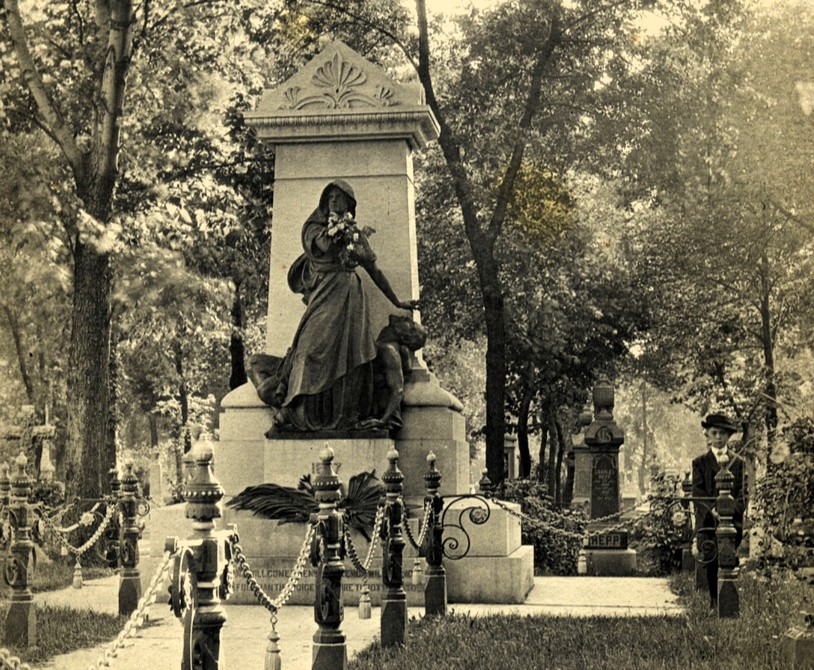
Concerning the tragical death of Louis Lingg we can offer no explanation. It remains a subject of perplexity and doubt. Brave and even rash to a fault, fear never led him to suicide. Whether he sought to remove his life to render the fate of the rest less hazardous, or to prevent the officials from having the satisfaction of hanging him, or, in fact, any of the details of the act itself, must be left entirely to conjecture. Time will yet vindicate his memory.
The Alarm was an extremely important paper at a momentous moment in the history of the US and international workers’ movement. The Alarm was the paper of the International Working People’s Association produced weekly in Chicago and edited by Albert Parsons. The IWPA was formed by anarchists and social revolutionists who left the Socialist Labor Party in 1883 led by Johann Most who had recently arrived in the States. The SLP was then dominated by German-speaking Lassalleans focused on electoral work, and a smaller group of Marxists largely focused on craft unions. In the immigrant slums of proletarian Chicago, neither were as appealing as the city’s Lehr-und-Wehr Vereine (Education and Defense Societies) which armed and trained themselves for the class war. With 5000 members by the mid-1880s, the IWPA quickly far outgrew the SLP, and signified the larger dominance of anarchism on radical thought in that decade. The Alarm first appeared on October 4, 1884, one of eight IWPA papers that formed, but the only one in English. Parsons was formerly the assistant-editor of the SLP’s ‘People’ newspaper and a pioneer member of the American Typographical Union. By early 1886 Alarm claimed a run of 3000, while the other Chicago IWPA papers, the daily German Arbeiter-Zeitung (Workers’ Newspaper) edited by August Spies and weeklies Der Vorbote (The Harbinger) had between 7-8000 each, while the weekly Der Fackel (The Torch) ran 12000 copies an issue. A Czech-language weekly Budoucnost (The Future) was also produced. Parsons, assisted by Lizzie Holmes and his wife Lucy Parsons, issued a militant working-class paper. The Alarm was incendiary in its language, literally. Along with openly advocating the use of force, The Alarm published bomb-making instructions. Suppressed immediately after May 4, 1886, the last issue edited by Parson was April 24. On November 5, 1887, one week before Parson’s execution, The Alarm was relaunched by Dyer Lum but only lasted half a year. Restarted again in 1888, The Alarm finally ended in February 1889. The Alarm is a crucial resource to understanding the rise of anarchism in the US and the world of Haymarket and one of the most radical eras in US working class history.
PDF of full issue: https://dds.crl.edu/item/54019
 Revolution's Newsstand