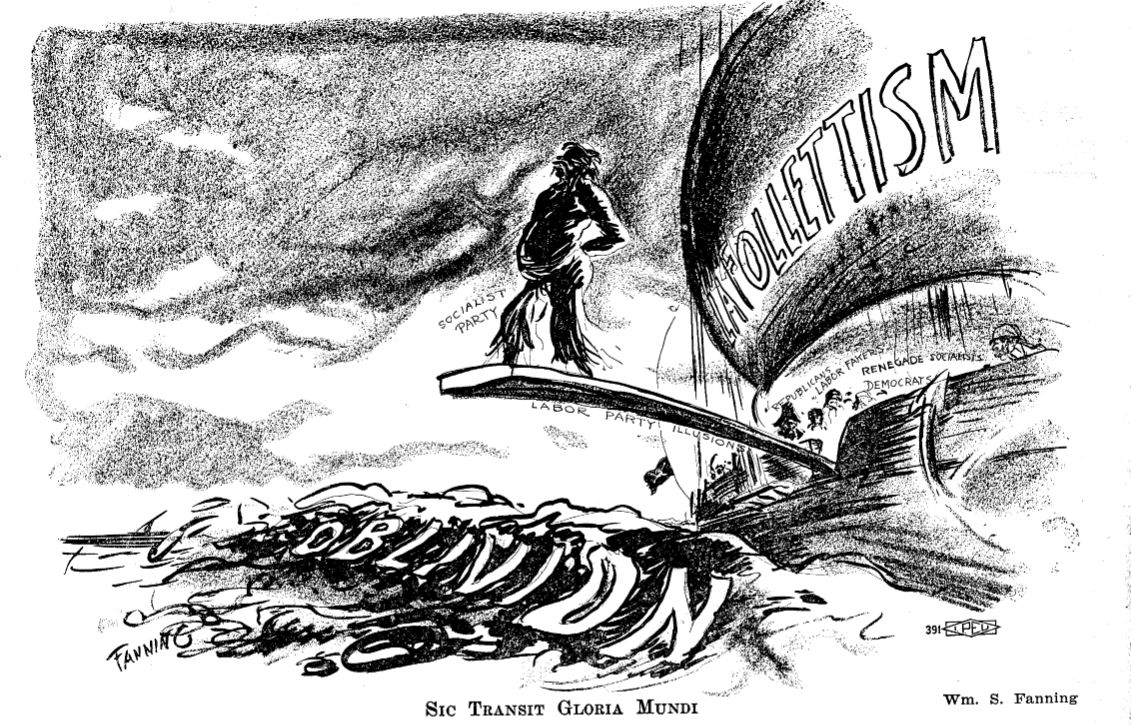
In 1924 Wisconsin’s Robert LaFollette ran a third party campaign as a Progressive winning 4.8 million or 16.6% of the vote. LaFollette was central to an issue that deeply divided the Communist Party in the mid 1920s, the Farmer-Labor Party and the attitude in general to a non-Communist independent or labor party. Foster gives his position.
‘The Significance of the Elections Three Stages of Our Labor Party Policy’ by William Z. Foster from Workers Monthly. Vol. 4 No. 2. December, 1924.
IN the months preceding the election, as the LaFollette movement was taking shape and volume, the leaders in it made the most extravagant prophesies relative to its prospects in the struggle against the two old parties. Many of these declared that LaFollette would certainly be elected. Others expected he would carry the entire West. Even the least optimistic believed he would win enough states to throw the presidential election into Congress. The country was psychologized with the idea that LaFollette would make a great sweep, even the representatives of big capital conceding that he was the man that Coolidge had to beat.
The election results have dispelled these exaggerated hopes and fears. Although 5,000,000 ballots cast amount to a large vote, the outcome in reality constitutes a serious defeat for the LaFollette movement in view of the previous overestimates of its strength. The election shows again the tremendous power of the capitalist dictatorship, which by its skillful playing up of the “red” scare, and by its ruthless use of economic terrorism, literally forced millions to vote for the representative of big capital, Coolidge. The Progressive Movement, and with it the labor unions that took part, have suffered a major political defeat.
The spectacular appearance of the Progressive Movement in its independent role and the consequent absorption by it of the farmer-labor party movement make it necessary for the Workers Party to reconsider its labor party policy. The question raised is whether our Party shall continue to carry on a militant campaign under the slogan of “For a Mass Farmer-Labor Party.” The Central Executive Committee, in a statement published in the Daily Worker on Nov. 7, answers this question in the negative. It declares that it “completely eliminates the immediate possibility of the growth of a mass farmer-labor party of industrial workers and poor farmers, distinct from the Workers Party. A general agitation campaign by the Workers Party under the slogan of ‘For a Mass Farmer-Labor Party,’ would not be profitable or successful. Our chief task in the immediate future is not the building of such a farmer-labor party but the strengthening and developing of the Workers Party itself as the practical leader of the masses and as the only party that represents the working class interests and knows how to fight for them.”
This constitutes a reversal of the previous policy, and in order for us to understand its causes and implications, it will be well to examine our labor party policy to date in its three political stages: (1) the entrance of the Workers Party into the movement for a labor party; (2) the withdrawal of the Workers Party from the labor party as a definite organization; (3) the discarding of the labor party slogan.
Adoption of Labor Party Policy
When in 1922 the Workers Party declared in favor of participating in the effort to build a labor party, we were confronted with a developing movement of the working masses for political expression independent of the two old parties. Under the pressure of the “open shop” drive and the complete and constant betrayal of their interests by the Republican and Democratic parties, which the masses had supported under the old Gompers policy of rewarding friends and punishing enemies, great numbers of organized workers were awakening to the need for some kind of a labor party. For four years the number of state and local federations of labor on record for such a party was rapidly increasing. The growth of the Farmer-Labor Party of the United States and the Conference for Progressive Political Action were but two manifestations of the general movement in favor of independent political action by the workers. The oppressed masses were seeking a political instrument to use in their own behalf.
This movement of the workers for a political organization of their own offered great advantages to the Workers Party. The duty of Communists and the general principle by which a Communist mass Party must be built is the participation in the daily struggles of the workers against the capitalist class. The growing labor party movement offered us an excellent means of reaching the masses with our propaganda and of furnishing them with practical leadership in this, their first important step towards definite political organization.
Some elements in our Party looked askance at the proposition of working for the formation of a labor party, but the advantages were so patent that their opposition was broken down and the Party launched into the campaign. This campaign was waged with vigor. It was not long until the Communists became the acknowledged leaders of the labor party movement everywhere. Every place that sufficient consciousness developed amongst the workers and poor farmers for a political organization of their own, our hand was in evidence. The consequence was that our arty derived the most substantial advantages. The Workers Party became a definite and recognized factor in the labor movement. Its gain in experience, prestige, and influence was invaluable.
Withdrawal from Farmer-Labor Party
The first stage of the W.P. labor party policy, that is active participation in the struggle to build a farmer-labor party, came to an end with the development of the LaFollette movement as distinct from the two old parties. This was caused thru the swallowing up of the Farmer-Labor Party generally by the LaFollette movement. The first active manifestations of this took place at the St. Paul convention of the Farmer-Labor Party on June 17 of this year. The growth of sentiment for LaFollette to take the field and the likelihood of his doing so upon an independent ticket tended sharply to cut to pieces the June 17 convention. LaFollette completed the job by his denunciation of that gathering. He succeeded in driving out of it most of the mass elements and attracting them to the July 4 conference of the C.P.P.A., where they were quickly absorbed into the general LaFollette movement. The National Farmer-Labor Party, born at the June 17 convention, was the merest shell of an organization.
This situation made necessary a rapid change of policy by the Workers Party. The only basis upon which our Party can afford to participate in a farmer-labor party is if this party puts us in contact with great masses of workers to whom we can propagate our Communist program effectively. This the National Farmer-Labor Party emphatically did not do. It was composed only of the Workers Party and more or less vague numbers of sympathizers. The masses had gone to LaFollette. Under these circumstances for the Workers Party to support McDonald and Bouck, the candidates of the National Farmer-Labor Party, would have been a serious error. It would have meant the Workers Party doing almost all the work of the campaign and getting none of the credit for it. It ‘would have amounted to what was practically only the Communist movement making the fight on behalf of non-Communist candidates and slogans.
Confronted by this condition, the Central Executive Committee, after extended debates, unhesitatingly cut loose from the National Farmer-Labor Party and placed its own presidential candidates in the field. In substance, the farmer-labor party movement in its organized form had become useless to the Workers Party as an organizing and propaganda instrument, so it had to be dropped. The experience of our Party in the campaign showed this policy to be a wise one. As it was, the Workers Party was able to place a clearcut Communist program before great masses of workers for the first time. Invaluable political experience was gained in many directions. The casting off of the dead body of the Farmer-Labor Party, killed by the LaFollette movement, was absolutely essential to the life of the Workers Party.
Discarding Farmer-Labor Party Slogan
The Workers Party is now entering upon the third stage of its policy regarding the farmer-labor party movement. This consists in going one step further than dropping the farmer-labor party as an organization and also dropping it as a slogan. This is necessary because the farmer-labor movement, due to its absorption by the LaFollette movement, is no longer a living factor in the workers’ struggle, at least for the time being. The farmer-labor party movement has been destroyed root and branch by the LaFollette movement.
In order to understand this it is profitable to glance a moment at the evolution of the modern labor party movement in the United States. It is not necessary to examine here labor party movements that took place in the early days of trade unionism. The one that is important to us began to take shape about 1918. It consisted almost altogether of trade unions, various city and state bodies voting to go into politics as organizations. Thus it was almost entirely proletarian in character—a real labor party movement. In 1920 this movement, finding its principal center in the Labor Party of the United States, headed by John Fitzpatrick, held a convention and broadened its social base by setting up an alliance with the more conscious elements among the farmers. It became, consequently, the Farmer-Labor Party of the United States. Thenceforth, all over the country, wherever the workers went into politics in masses their organizations took the form of alliances with the farmers. They established farmer-labor parties.
Now this evolution has proceeded a step further. The farmer-labor elements have joined forces with the petty bourgeoisie generally and have merged into the Progressive Movement under the leadership of LaFollette. At the 1920 convention which founded the Farmer-Labor Party of the United States various sections of the petty bourgeoisie, organized in the Committee of 48, were present and tried to establish an alliance with the workers and farmers. But in this they failed, although even in that convention they proposed LaFollette as the candidate for president. Parley Parker Christensen was nominated. It was not until the July 4, 1924 conference of the C.P.P.A., which endorsed LaFollette, that the farmer-labor elements and their organizations were definitely and nationally amalgamated with the petty bourgeois elements into the Progressive Movement. In thus extending their base to include the petty bourgeoisie generally the conservative workers in this country are simply doing what has been done in Europe. The difference is that, whereas in most of the European countries the workers have first built up proletarian, or near-proletarian organizations, and then entered into alliances with petty bourgeois organizations, here in this country they are attempting, in the LaFollette movement, to build this alliance with the petty bourgeoisie from the ground up in the one organization.
So long as the mass political movement of the workers remained in the labor party stage, that is merely the labor unions in politics, it offered an excellent field of propaganda for Communism. But when it reaches the stage of a farmer-labor party, the Communists had to wage a war against petty bourgeois influence by demanding the limitation of the organization simply to industrial workers and poor farmers. And finally, as it has now passed from the farmer-labor stage into that of the Progressive Movement, the center of gravity is shifted to the petty bourgeois elements. The organization loses its proletarian character and adaptability to proletarian ends. The Communists are forced to withdraw. The Workers Party could not follow the farmer-labor movement into the trap of the petty bourgeoisie.
Now we come to the crux of the situation. This alliance of the labor officialdom with the petty bourgeoisie, supported by the workers, is an established fact. It is true that the Progressive Movement has received a setback in the elections. This will hinder its development. Gompers will run back to the old parties and most of the bureaucracy in the unions will do likewise. Pessimism will seize upon the “progressives” who will hesitate to form a third party in this situation. But the movement, representing as it does the discontent of the broad masses of petty bourgeoisie and workers, will live, even though it does not crystallize definitely into a party immediately. In the near future insofar as the masses of workers take any political action at all, it will be in the shape of this alliance with the petty bourgeoisie.
To break this alliance and to bring the workers into political action on their own behalf, is one of the big objectives of the Workers Party. This cannot be done by the formation or attempted formation of a mass farmer-labor party. Only a very small percentage of the workers, and these the most radical, are now prepared to break the alliance with the petty bourgeoisie. To attempt to form these into a party would be merely to set up a rival to the Workers Party. This would be sheer folly. The Workers Party must absorb these advanced elements directly into its own ranks or, where this cannot be done, to form united fronts with their organizations upon vital issues of the everyday struggle.
In the era of the developing farmer-labor party movement, when masses of workers all over the country were demanding a party of their own and before this movement was swallowed up by LaFollette’s organizations, the advocacy of the slogan “For a Mass Farmer-Labor Party” was practical and beneficial for the Workers Party. But now, when such a mass farmer-labor party is out of the realm of possibility for the near future, the advocacy of the slogan in a general campaign becomes distinctly detrimental to the Workers Party. It would sabotage our organization. In the future, as the Progressive Movement runs its course, the Workers Party will criticize its policies from a Communist standpoint. After doing this, then to tell the workers that what they have to do is to form a farmer-labor party would not only be ridiculous but would shove the Workers Party into the background and ruin its interests. In our fight against LaFollettism we must not only propose to the workers a Communist program but also a Communist organization.
When the LaFollette movement swallowed up the farmer-labor party movement in the months preceding the election it left us with two dead things on our hands. One of these was a dead organization, the National Farmer-Labor Party, and the other was a dead slogan, “For a Mass Farmer-Labor Party.” The Central Executive Committee was quick to see the necessity of ridding the Workers Party of the dead organization, and now it has also rid the Party of the dead slogan. As against the LaFollette movement we must raise the slogan not of an impossible farmer labor party but of the Workers Party. Now, more than ever, the Workers Party must throw itself into all the struggles of the working class, political and industrial, establishing the widest mass contacts and leading those struggles into ever-widening fields and for ever-growing demands. Not a retreat to sectarianism, nor the creation of opportunistic substitutes for Communism, but immediate and direct participation of the Workers Party in all phases of the class struggle.
The Workers Monthly began publishing in 1924 as a merger of the ‘Liberator’, the Trade Union Educational League magazine ‘Labor Herald’, and Friends of Soviet Russia’s monthly ‘Soviet Russia Pictorial’ as an explicitly Party publication. In 1927 Workers Monthly ceased and the Communist Party began publishing The Communist as its theoretical magazine. Editors included Earl Browder and Max Bedacht as the magazine continued the Liberator’s use of graphics and art.
PDF of full issue: https://www.marxists.org/history/usa/culture/pubs/wm/1924/v4n02-dec-1924.pdf
 Revolution's Newsstand