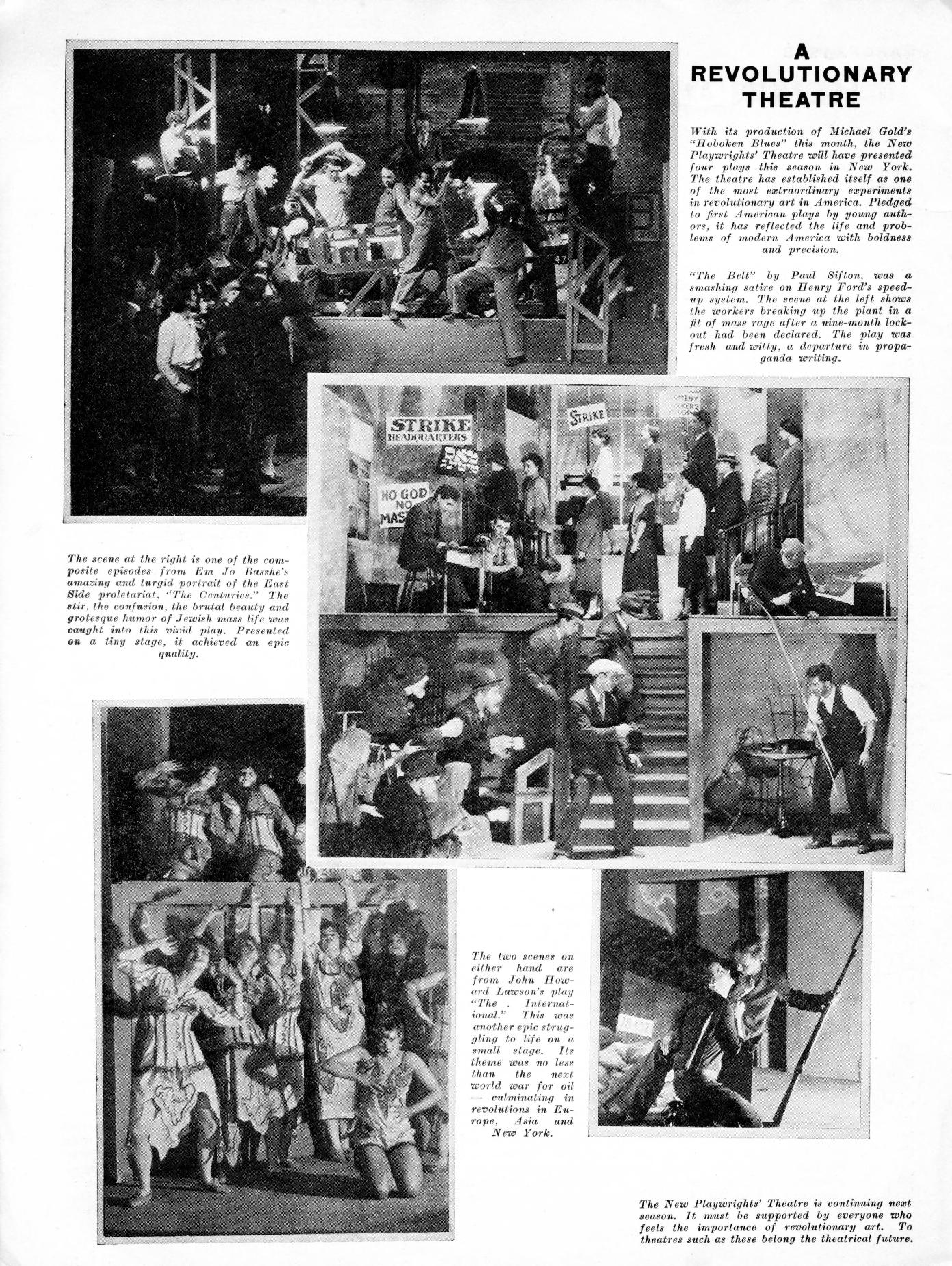
The revolutionary theater that began in the 1920s would grow into a real cultural movement in the 1930s.
‘Toward a Revolutionary Theater’ by John Dos Passos from New Masses. Vol. 3 No. 8. December, 1927.
Definition: By theatre I don’t mean a building or an idea, I mean a group of people, preferably a huge group of people; part of the group puts on plays and the rest forms the audience, an active working audience.
By American I don’t mean that the group’s interests must necessarily be limited to America, but that they should be as deeply rooted here as possible.
By revolutionary I mean that such a theatre must break with the present day theatrical tradition, not with, the general traditions of the theatre, and that it must draw its life and ideas from the conscious sections of the industrial and white collar working classes which are out to get control of the great flabby mass of capitalist society and mould it to their own purpose. In an ideal state it might be possible for a group to be alive and have no subversive political tendency. At present it is not possible.
This is big talk. Still the theatre is a matter which it seems to me demands flamboyant treatment. If it is to compete with the vast milliondollar ineptitudes of the billiondollar movies, and with the crafty skill in flattering the public of the smart real estate men who run Broadway, the revolutionary experimental futurist “revolting” (or whatever you want to call it) theatre, has got to be planned on a large scale. The day of the frail artistic enterprise, keeping alive through its own exquisiteness, has passed. A play or a book or a picture has got to have bulk, toughness and violence to survive in the dense clanging traffic of twentieth century life.
Still big talk. Now let’s talk small. What have we got as a basis of operations? (I am assuming that there are people, hundreds, thousands, maybe ten thousand people in this city who would be willing to take part in such a theatre as I’ve outlined. If that’s a false assumption, we’ll learn soon enough.) There’s the Workers’ Theatre, a small room on South Washington Square with the rent unpaid. Unfortunately there’s little else to say about it. It’s a germ that has vast possibilities of development and that’s about all. Then there’s talk of building an auditorium in one of the new cooperative apartment houses in the Bronx, and then there is the New Playwrights’ Theatre, target of all the critics’ bricks, operating obscurely on Commerce Street (that a bunch of London-minded aesthetes once tried to rename Cherry Lane). It is from the vantage point of the latter that I write.
The tunnel-shaped auditorium, gloomy at best, sloping down to a low proscenium, containing two hundred and forty uncomfortable seats, and some of them busted, is about as far as anything could be from the circus-shaped hall we would like to have; the tiny stage cramped into a picture-frame proscenium, is far indeed from the series of platforms jutting out into the audience that are needed for mass-plays. Beggars can’t be choosers. The thing at present is to operate even if we come down to putting on a flea circus. Big talk won’t get us anywhere. American cities are full of the wrecks of theatres, derelicts from big talk in the past. Look at the Century.
On one side of the auditorium is a yard stacked with the debris of last season’s sets which are to be rebuilt into this season’s sets, upstairs is a workbench where the props are made, some cans of paint, a gluepot and a series of cramped dressing rooms where the longsuffering actors have to sit motionless and silent waiting for their cues, as every step on the floor sounds from the auditorium like an elephant doing a cakewalk. In the basement there are some offices where the white-collar slaves work on promotion and publicity and where desperate efforts are made to stop the steady trickling out of the dollars.
That’s about all the N.P.T. has in the way of a plant.
In intangible assets we are richer. It’s very surprising how easy it has been to find skillful, reliable and enthusiastic people willing to work; in the theatre in spite of the starvation salaries we are forced to pay. There is one thing about which there is no doubt in my mind: at this moment the human material exists in New York out of which the acting and the backstage of a great American theatre can be built. If we don’t do it, somebody else will. If we don’t do it, it will be due to lack of organizing skill and not through any deficiency in the crowd, in many ways raw and untrained, but genuinely rich in potentialities, that has in such a short time been collected in that ramshackle house on Commerce Street.
As I see it the three problems of a theatre of this sort (and I’m still assuming that there is a need for it and a working energetic audience for it) are hokum, internal organization and money.
We live in an air saturated with hokum. Particularly if you try to do anything in any of the so-called arts you are stifled by all the exhalations left in the profession by the rotting egos of the discouraged sons of doctors, lawyers and ministers, who for a century have used the arts as a mushy refuge from themselves. In a world building out of polished steel and glass all this padded brocade round the necks of sniffling geniuses is hokum and death to any sincere work. The first aim of an enterprise so dependent on human cooperation as a theatre must be the elimination of hokum, individually and collectively.
With hokum cleared out I don’t think internal organization offers very serious difficulties. It’s just a question of being willing to try all possible combinations of people until you find one that works. After all if all the individuals in a given body of people are more anxious to get certain work done than to find a niche for their own personal neuroses they are likely to find some satisfactory way of dividing it.
The trouble about money is its intimate association with hokum. We are so accustomed to part with our money only when drugged with the requisite dose, that it is going to be difficult, say the wiseacres, for a dehokumized organization, no matter how efficient it is, to get money. The cure is not more hokum, but less money. In spite of the enormous cost of everything connected with the theatre, it is possible for such a theatre, by continual and heartbreaking economy, to be self-supporting (assuming again the possibility of building up an audience of say ten thousand people, an audience that is not passive like a Broadway audience, but actively part of the theatre). Economy is most difficult because there is something about the very word theatre that connates lavishness.
The group that solves these three problems, in its plays as well as in its organization, will create a real focus in American life. In method of presentation it will be something between high mass in a Catholic church and Barnum and Bailey’s circus, both of which are rituals stripped to their bare lines. Vigor and imagination must take the place of expensiveness and subtlety. When it’s possible to put on a great play in a big theatre for a couple of thousand bucks and sell your seats at fifty or seventy-five cents, you’ll have something worth having. But where are the great plays you say? The woods are full of them. Give them a theatre for an outlet and the life pressure of a hundred million people will do the rest.
The New Masses was the continuation of Workers Monthly which began publishing in 1924 as a merger of the ‘Liberator’, the Trade Union Educational League magazine ‘Labor Herald’, and Friends of Soviet Russia’s monthly ‘Soviet Russia Pictorial’ as an explicitly Communist Party publication, but drawing in a wide range of contributors and sympathizers. In 1927 Workers Monthly ceased and The New Masses began. A major left cultural magazine of the late 1920s to early 1940s, the early editors of The New Masses included Hugo Gellert, John F. Sloan, Max Eastman, Mike Gold, and Joseph Freeman. Writers included William Carlos Williams, Theodore Dreiser, John Dos Passos, Upton Sinclair, Richard Wright, Ralph Ellison, Dorothy Parker, Dorothy Day, John Breecher, Langston Hughes, Eugene O’Neill, Rex Stout and Ernest Hemingway, Artists included Hugo Gellert, Stuart Davis, Boardman Robinson, Wanda Gag, William Gropper and Otto Soglow. Over time, the New Masses became narrower politically and more journalistic in its tone.
PDF of full issue: https://www.marxists.org/history/usa/pubs/new-masses/1927/v03n08-dec-1927-New-Masses.pdf
 Revolution's Newsstand