Justus Ebert was comrade who voice was central to the workers’ movement for decades. Through its 1908 split with the I.W.W., the Socialist Labor Party lost many of its most formidable comrades, including activists like James Connolly, Frank Bohn, B.H. Williams, and the staggeringly prolific writer Justus Ebert. For forty years there was almost no week that went by without a left-wing publication printing an article by Ebert. Based in Brooklyn, a lithographer by trade, Ebert was senior editor of the S.L.P.’s The People, and later for Solidarity and Industrial Pioneer, his articles as ‘J.E.’ gracing nearly every issue of the I.W.W. press, then writing for Labor Age (like other former I.W.W..ers B.H. Williams and Covington Hall, throughout the 1920s. Here, he tells why he left the S.L.P. in 1908.
‘A Letter of Resignation Well-Known S.L.P. Man Tells Why He Leaves it’ by Justus Ebert from Industrial Union Bulletin. Vol. 2 No. 8. April 18, 1908.
The letter of resignation from the Socialist Labor party printed below was written by Justus Ebert, of Brooklyn, N.Y. Ebert is well known in trades union and Socialist circles. He was formerly secretary of the New York association of the International Lithographic Artists, Engravers and Designers Association of the United States and Canada, and was unanimously nominated president of the last-named body at its Detroit convention, but was compelled by ill-health to decline the office. Ebert was also active in the Progressive Lithographers Alliance, an industrial organization connected with the Socialist Trade and Labor Alliance, serving as its secretary for many terms. Naturally, he joined the I.W.W. upon its organization, and has always been one of its staunch defenders and advocates.
While connected with the lithographic unions Ebert became a contributor to the columns of the Weekly People. His articles on the litho industry, written over the nom-de-plumes of “Brooklynian,” “Sennefelder, Jr.,” “Litha Artist,” etc., achieved quite a vogue in litography, one of them, “Artists Proletariats.” causing a running discussion between the National Lithographer, a capitalist trade journal, which printed it almost in full with comments, and “Brooklynian,” who answered through the Weekly People. This discussion was of immense educational value, as the defense of capitalism and its handmaid, Gomper’s trades unionism, was exposed, to the lasting advantage of Socialism.
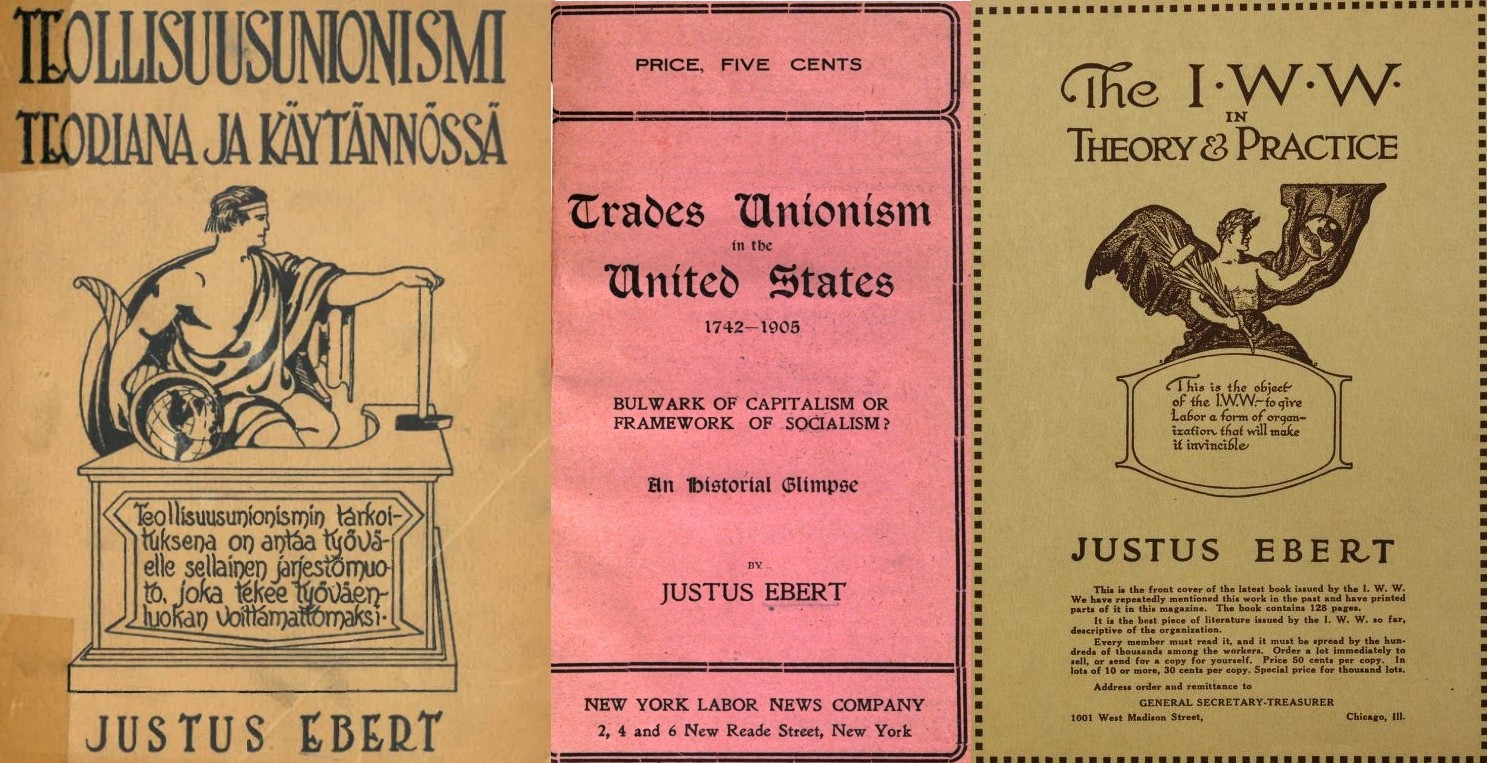
In 1900 Ebert joined the editorial staff of the Daily and Weekly People, becoming, in 1902, the associate editor of both organs. The value of his services in that capacity may best be judged hy the fact that Ebert held the office of associate editor for a period of five years, resigning in July, 1907. During this time Ebert served as acting editor at frequent intervals, filling that position for one year in all. To Ebert’s editorial initiative and care the People owes the long series of trade articles which enriched its columns about four years ago. The “Brief Socialist Essays” by “James Donnelly,” were also leaflets on “Arbitration” and kindred from his pen. Besides a number of subjects, Ebert has also written three pamphlets entitled, respectively, “The Trusts,” “Trades Unionism in the United States” and “American Industrial Evolution.” He joined the S.L.P. in November, 1887. His letter of resignation will prove of general interest and is published on that account.
“876 Greene Ave., Brooklyn, N.Y. April 10, 1908.
“To the Members of Section Kings County, Socialist Labor Party.
“Dear Comrades: I herewith tender my resignation as a member of the Socialist Lahor party. My reasons for so doing are many and would require too much time to set forth as fully as they require. Briefly stated, they revolve around one single point, to-wit: the belief that the Socialist Labor party has historically and logically outlived its usefulness, and is now, in consequence, a party in name only, without a sound, fundamental mission to perform. The truth of this belief should be as evident to you as it is to me, as it is reflected in the complete loss of political power and status, and in the destructive economic policy with which the Socialist Labor party is at present afflicted. The S.L.P. can in no wise hope to retrieve the first or escape the second with profit to either itself or the class for which it stands. History is adverse to the former; the determination to ignore the logic of events prevents the latter.
“Permit me to make the truth of my belief plain to those of you who either do not see it, or prefer to differ with it.
“The majority of the present members of the Socialist Labor party can easily recall the time when it was a flourishing party, marching ‘On to 100,000 Votes, and holding the balance of power in New York State. How virile, how influential for working class good, how confident of capturing the powers of state we then were! Contrast the present with the past!! From our former proud eminence we have been compelled to retreat, until now we are only a band of artful petitioners for official status, who fain would forget the triumphant past in the sophistical arguments against the ballot of the decrepit present. Where formerly there was verve and enthusiasm at the polls, we now strike an attitude of political indifference and educational determination that would be admirable in an organization that is not self-avowedly political, but which, on the whole, is detrimental to our growth as a party, and so inconsistent in its application (as witness our joy in getting on the official ballot, and on receiving an increase of votes, however small), as to render us, the supreme vote-despisers, fit subjects for the satirist’s pen. We have so fallen politically as to fail to realize the depths of the descent.
“This is especially evident when we’ recall the fact that the history of this country does not afford an instance in which a political party like the Socialist Labor party ever underwent a revival that restored the ascendancy it once enjoyed. Such a party generally fuses with other parties, in whom its principles again appear in a modified and (sometimes) higher form; or else it disappears completely from the political horizon, leaving no trace of its existence behind. Either of these fates awaits the Socialist Labor party. The membership unconsciously reflects the fact in the desire for unity with the Socialist party, and the belief, often expressed among them, of an impending realignment of the labor forces of the land. Such being the case, what good purpose can the Socialist Labor party serve by lingering on in its present deceptive state? What justification has it for raising the political hopes of the working class by its empty pretenses of being a vital political factor?
“In view of the foregoing facts, it can safely be said that the Socialist Labor party is at best a noble tradition; at worst, a dangerous delusion, in that it is a bar to progress along correct lines. This brings us to a consideration of the economic policy of the Socialist Labor party; or, to put it more accurately, its policy toward the Industrial Workers of the World.
“The Socialist Labor party believes that the political is a reflex of the economic. With this belief in mind it aided in launching the I.W.W., and protecting it from the onslaughts of reaction. For this, its last grand act, the Socialist Labor party cannot be too highly praised; it acted in accordance with correct principles and tactics. The Socialist Labor party has not, however, had the courage of its convictions, nor does it dare to act according to the logic of the events in which it has been so sterling an actor. The Socialist Labor party, having aided in founding and protecting the economic organization that is to reflect the true political party of labor, refuses to vacate the field to its untrammeled and logical development. Instead, it persists in being the political guide and mentor of the I.W.W.–that is, its self-appointed reflex and guardian. The result is detrimental to both organizations. The I.W.W. hampered in its growth by the illogical posture of the S.L.P., is compelled to serve notice in big, black type that it has no political affiliations of any kind. And justly so, for the organic structure of the I.W.W., being industrial and democratic, repels any external body that is political and dictatorial-that is, in brief, not by, for and of itself alone. The fate of the Socialist Trade and Labor Alliance will be the fate of the I.W.W., if it permits an external political body to dominate its politics. On the other hand, the membership of the Socialist Labor party drifts out of its folds, sick and tired of its unhistorical and illogical position, thus leaving it weaker and more desperate than ever before.
“As pointed out above, the Socialist Labor party can never again be a political factor. Nor can it be the political reflex of an organization that inherently rejects it. No good purpose can be served by the Socialist Labor party lingering on in its present deceptive state. Nor has it any justification for raising the political hopes of the working class by its empty pretenses at being a political power. At best, a noble tradition; at worst, a dangerous delusion, in that it is at present a bar to progress along correct lines, the Socialist Labor party can only prove historical and logical by merging into the I.W.W. and working with might and main, as the new conditions demand, for the true economic and political organization of labor.
“But I fear the Socialist Labor party, as a party, will not do this. The influences that mold its thought and action are adverse to such a course; they prefer domination or destruction to democracy and development. The history of the S.L.P. is proof sufficient for that assertion. The only course left then is to withdraw from the S.L.P. This I herewith do, firmly convinced of the rectitude and soundness of my conduct. It is better that we leave a dying political party without hope of resuscitation, for a live economic organization with promises of growth in this way, than wait for putrefaction to set in in one, while the malodors therefrom asphixiates the other. No good can be achieved by for the working class by such a course; hence my action.
“I do not expect you to agree with me in all this. In fact, I know that many of you will accuse me of ulterior motives and diabolical designs upon the working class; that is the fashion at present. You may even bring charges against me and have me expelled; that was once the fashion, and fashions, you know, are frequently revived. But, no matter which of these paths you follow, should you not follow the right one of accepting my resignation, I will prevail until you prove that the S.L.P. is not unhistorical and illogical and without a sound, fundamental mission to perform. That is the issue the Socialist Labor party will have to meet.
“Wishing you the kindest regards under the circumstances, I remain, yours truly. JUSTUS EBERT.”
The Industrial Union Bulletin, and the Industrial Worker were newspapers published by the Industrial Workers of the World (IWW) from 1907 until 1913. First printed in Joliet, Illinois, IUB incorporated The Voice of Labor, the newspaper of the American Labor Union which had joined the IWW, and another IWW affiliate, International Metal Worker.The Trautmann-DeLeon faction issued its weekly from March 1907. Soon after, De Leon would be expelled and Trautmann would continue IUB until March 1909. It was edited by A. S. Edwards. 1909, production moved to Spokane, Washington and became The Industrial Worker, “the voice of revolutionary industrial unionism.”
PDF of full issue: https://www.marxists.org/history/usa/pubs/industrialworker/iub/v2n08-apr-18-1908-iub.pdf
 Revolution's Newsstand