It would be difficult to over-state the impact of the automobile on our lives; from where we work and what we eat to climate change and species extinction, it has remade our world. Ben Lifschitz charts the meaning of its rise and how it overtook rail in the U.S.
‘Automobile—Symbol of Modern Slavery—A New Octopus Has Risen to Power’ by Ben Lifschitz from The Daily Worker. Vol. 5 No. 198. August 16, 1928.
Horseless Carriage Becomes Vehicle of Business Driving Force to War
From the laughable little “horseless carriage,” but of the jokes of the practical and sane, the automobile has in a short generation grown into an octopus of transportation which helped empires to build their economic greatness. The past fifteen years in the life of this remarkable industry has witnessed a boom development unprecedented in economic history.
Vast fortunes have been made literally overnight in furthering its progress. Bankers and finance capitalists have staged the most dramatic battles for its control. Hundreds of thousands of workers have been drafted into its service—and slavery. Speed-up, exploitation, standardization, mechanization of the human being—the Belt!—these and a thousand other revolutionary developments have occurred in the short span of its life-time.
Whither Automobile?
Has this giant attained in the U.S. its maturity or is it still in the upward stage of development? Upon the correct answer to this question depend other, vastly larger, questions of economic perspective.
This much may be said: The Bonanza period of the industry is drawing to a close! Capital, investment in unbelievably enormous amounts has flowed into the industry. The rapidly concentrating money power is leading to bitter competition between capitalist combinations not only in the United States but between those at home and abroad.
In the United States this struggle is most clearly marked in the rivalry between the gigantic Ford and General Motors Company groups. The development of the new model Ford car, accompanied by the production of the new model Chevrolet, reflects this conflict. This struggle is further accentuated by the fact that the automobile market is nearing the saturating point at an increasing speed, whereas the productive apparatus of the industry is capable of an ever enlarging output.
This contradiction is forcing American manufacturers to give ever increasing attention to the problem of the foreign market. At the same time we note similar preparations being made by European manufacturers, especially the British, to compete with the American automobile industry. Thus the newer developments in the automobile industry, as in the other important industries, point to the inevitability of international conflicts and war.
Economic Importance of Motor Vehicle Industry.
The magnitude of the motor vehicle industry, and the extent of its recent growth are not generally comprehended. Inasmuch as these have an important bearing upon present and future relations with railroads, we may present a summary of the industry as it is today. This will indicate also how rapidly it has grown.
Broadly speaking, the automobile has now been used more than a quarter of a century for transportation. As a factor of major importance in national transportation, however, the spectacular development of the motor vehicle began about a dozen years ago when the war agencies drew sharp attention to its possibilities, notably in the case of motor trucks. While the automobile primarily as a pleasure vehicle, and secondarily as a means of business transportation, had established itself firmly before the war, the motor truck was used only in very limited degree until it was employed on a large scale for military transport and as a supplement to railroad service in 1917 and 1918, when the heavy demands of military traffic placed an overload on the older form of transportation.
The Development of the Automobile Industry and its Relation to the General State of Industry.
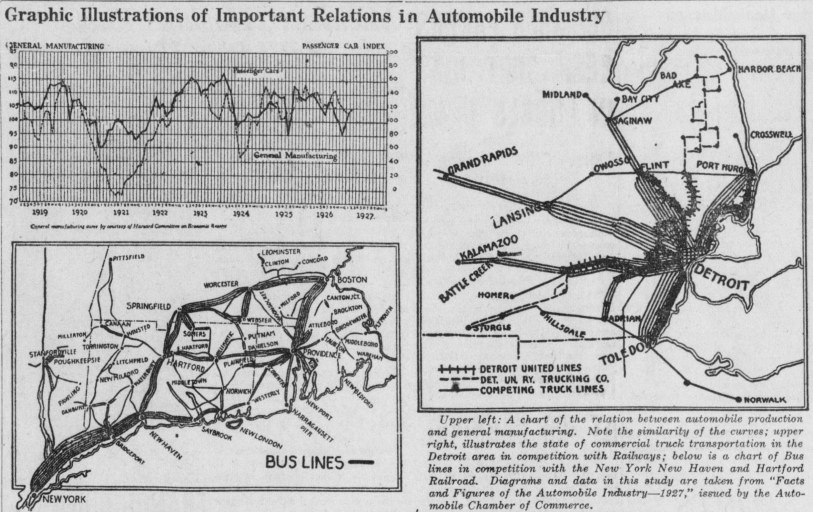
The automobile industry fluctuates with general industrial activity. An upward or downward movement of the general industrial curve is as a rule accompanied by n similar but smaller swing of the automobile curve The time-saving, “one-handling” factor is an added reason for truck haulage, which continues to give the track an economic place in furniture hauling, even on the long distances, where the truck rate is higher.
The motor truck is becoming so effective in transportation that railroads are using motor trucks very extensively. Forty-six railroad lines are using the motor truck for terminal operations; fifteen for store-door delivery; eleven to replace local freight trains. (See Facts and Figures of the Automobile Industry, 1927 edition, page 74.)
In order to make a comparison between the automobile industry and industry in general, it is necessary to allow for seasonal factors, as well as for differences in the rate of growth. The rate of growth in the output of passenger cars during the period 1919 to 1926 was computed to be 2,000 cars a month. Seasonal and growth factors have been eliminated from both curves.
Motor Truck Trend Similar to General Manufacturing.
The major trend and monthly variations in the production of trucks are very similar to those of general industrial activity. The use of motor trucks for transporting both raw materials and finished products accounts for this similarity in the curves.
The rate of growth of the truck industry since 1919 is computed at 170 trucks a month. When we compare the relations of the production of the motor truck to passenger car production, we see that the tendency is towards a higher percentage of production towards the motor trucks. While in 1917 the production of motor trucks was only 76 per cent of the total production, by 1922 it was already 10.3 per cent, and by 1926, 12.5 per cent.
The motor truck is becoming a very effective competitor to the railroad, especially for hauls within a 20-mile zone, and is a factor in general haulage up to 60 and 70 miles.
Above that distance the truck is used chiefly for special services, such as hauling furniture and perishables.
Need for all forms of transport serving the same territory is indicated in the map above filed by the Detroit United Lines with the Interstate Commerce Commission. The map shows the extent of truck roads and routes operating in areas which also have electric and steam road facilities. While the rail service is station to station and occasionally siding to siding, the truck service is rarely exactly competitive with rails, even between the same cities, because it is door to door.
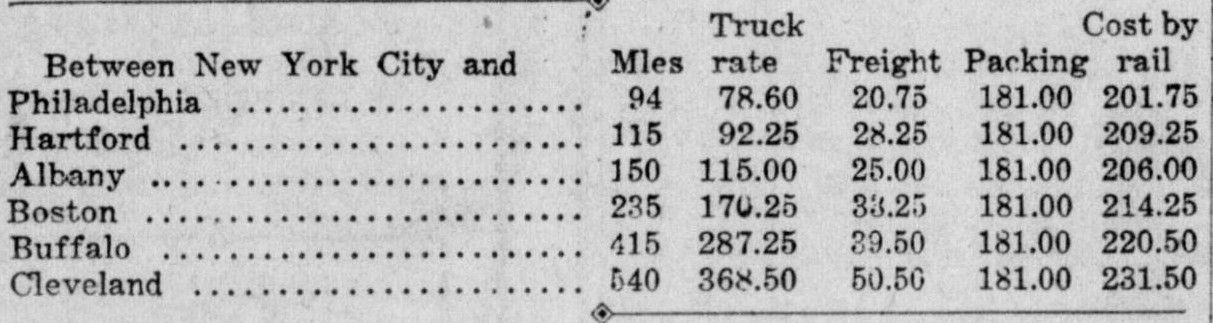
Another factor in the development of motor service is that the total cost of hauling certain articles, such as furniture, is less by truck than by rail in distances under 300 miles. 80,000 Motor Buses in U.S.A. The motor coach is even younger than the motor truck. Its extensive use began only about six years ago.
The extension and growth of motor coaches is assuming ever greater proportions. Sixty steam railroads use buses directly or through subsidiaries. Electric railway companies now use 7,284 buses. There were 62,017 miles of exclusively interstate lines and 270,000 miles of common carrier bus roads in 1927. (See diagram.) Public support of motor buses for rapid short haul transportation has spread rapidly in New England.
Solid thin lines show bus routes in Connecticut, Massachusetts and Rhode Island and New York which compete with New Haven Railroad. (Maps filed as testimony before Interstate Commerce Commission by New York, New Haven and Hartford Railroad.)
* * *
Tomorrow’s article will deal with the automobile industry in its relation to war; the powerful combines: Ford, General Motors and Chrysler-Dodge; it will also deal with the question of whether the saturation point of the market has been reached.
The Daily Worker began in 1924 and was published in New York City by the Communist Party US and its predecessor organizations. Among the most long-lasting and important left publications in US history, it had a circulation of 35,000 at its peak. The Daily Worker came from The Ohio Socialist, published by the Left Wing-dominated Socialist Party of Ohio in Cleveland from 1917 to November 1919, when it became became The Toiler, paper of the Communist Labor Party. In December 1921 the above-ground Workers Party of America merged the Toiler with the paper Workers Council to found The Worker, which became The Daily Worker beginning January 13, 1924.
PDF of full issue: https://www.marxists.org/history/usa/pubs/dailyworker/1928/1928-ny/v05-n194-NY-aug-16-1928-DW-LOC.pdf
 Revolution's Newsstand