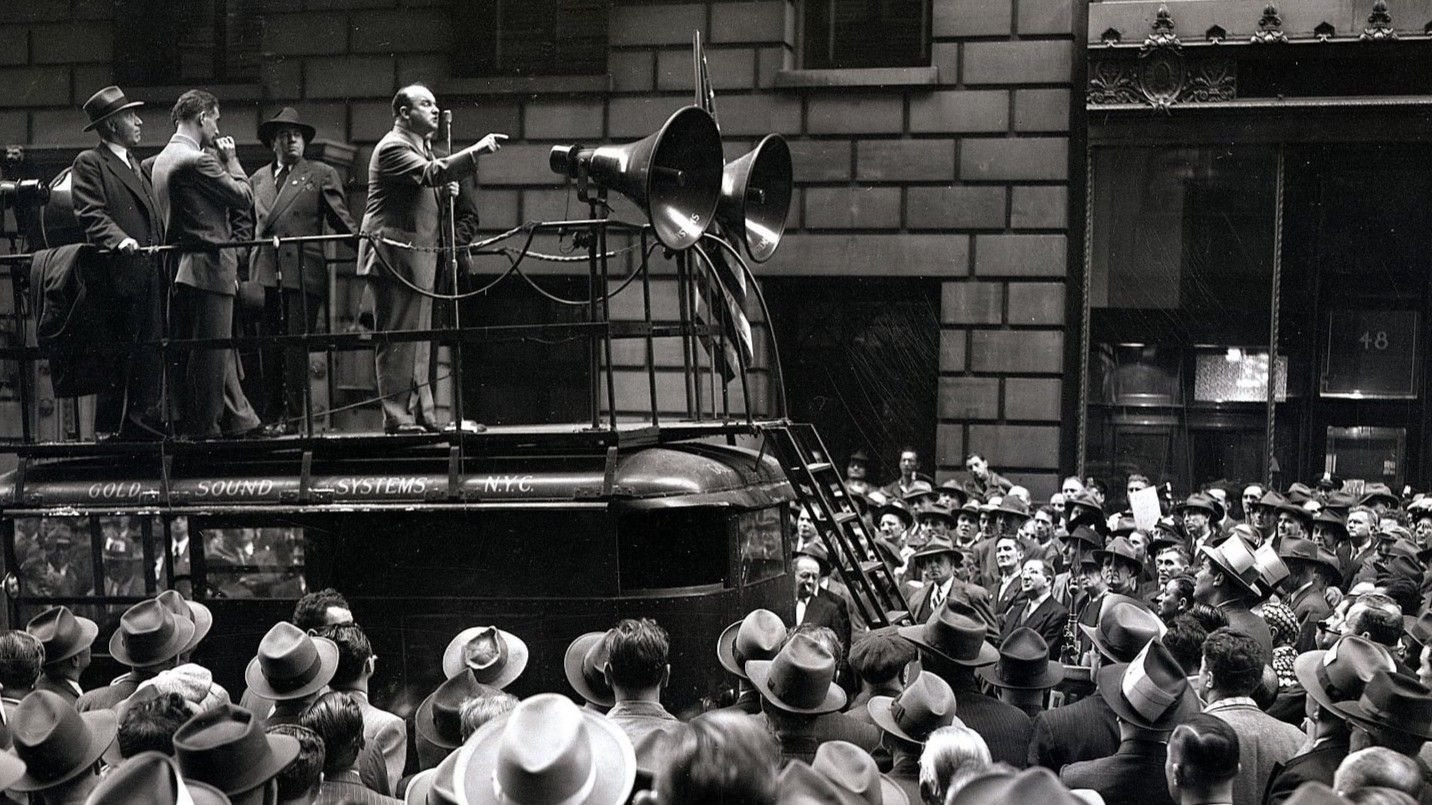
One of the most important union in U.S. history is born. Of all the ‘new unions’ built by C.P.-affiliated activists in the early 1930s, the Transport Workers Union, begun at the end of that period in New York City during April, 1934, was arguably its greatest success. Today New York’s Local 100 has 44,000 members while nationally the T.W.U. has around 140,000. As an industrial union it took in all the employees and was in direct competition with A.F.L. and company unions. Growing quickly, the T.W.U. was a leading force of the C.I.O. Named as a nod to Jim Larkin and James Connolly’s Irish General Workers and Transport Union, the union was formed by Irish repair shop activists associated with Clan na Gael, many former I.R.A. guerillas like the legendary Michael Quill, and T.U.U.L. organizers on the subways like the author below. Within a year it had its first strikes, with in three, it won recognition and unified the workers into a 40,000 member force in city politics. Below, one of the first reports on the new union.
‘B.M.T. and I.R.T. Subway Workers Organize New Union’ by John Santos from The Daily Worker. Vol. 11 No. 104. May 1, 1934.
To Fight Against the 1932 Slash in Wages Action Started in 148th St. Repair Shop Spreads to Other Sections of the Subway System; Union Raises Demand
The transport workers of New York City began recently the building of a new, independent, rank and file organization—the Transport Workers Union. The first and second general strike of the taxi-drivers against company unions and for improvement, of conditions j found a wide echo among the workers of the I.R.T. and B.M.T. They too feel that now is the time to organize and prepare for struggle.
Signs of Revolt
The mood to struggle is evident everywhere among workers of the transit system. Since the crisis wages were reduced through a series of indirect measures. Not being satisfied with this, in 1932 wages were reduced 10 per cent with the help of the company union “delegates” and “representatives.” At the present time new layoffs are taking place, part time and split time is practiced as well as demotion of higher paid men to less skilled jobs that naturally pay less. Hours of labor range from 30 to 85 per week for certain categories of workers. On top of all this the companies use “scientific” espionage, “beakies” and spotters not only during working time but also to pry into the private lives of the men.
Against these conditions there are signs of revolt everywhere. The most, outstanding example is the 148th Street I.R.T. repair shop, where close to 1100 men are employed. The firing of 14 men started the fireworks. The rank and file forced the “Brotherhood” officials to call a special meeting where a unanimous vote was east, to demand from the company the stopping of all lay-offs. This urns “solemnly” promised at the time of the 10 per cent. cut. They also demanded the rehiring of the 14 laid off men and the immediate introduction of the 44-hour week with the same pay as previously for the 50-hour week. Mr. Doyle, Assistant Manager of the I.R.T. first “promised” to consider these demands. After the company union officials had succeeded temporarily in bulldozing and intimidating the rank and file, all demands were rejected. But the revolt continued to spread to other shops.
In the 8th Street I.R.T. repair shop the company union officials “allowed” the workers to elect a “shop council.” This “shop council” has no other power except to take the grievances of the workers from the shop to the company union officials. Of course, this is about as useful as filing complaints to the devil about his grandmother—but it shows at the same time that the company union is completely exposed in the eyes of the transport workers.
Betrayals by A. F. of L. Bureaucrats
The Amalgamated Association of Street and Electric Railway Employees bureaucracy has very well earned the hatred and contempt of the transport, workers of New York. They betrayed and sold out the strikes of 1920 and 1928 and laid the basis thereby for the establishment of company unions. Just recently they added to their black record of betrayal that of the bus-drivers of the Fifth Avenue Coach Company as well as the Bee Lines of Jamaica, Long Island. At both instances the N.R.A. Labor Board was the “solution” offered by Mr. O’Shea, leader of the Amalgamated. No militant tactics, no mass picketing no spreading of the organization and of struggle—but negotiations with Mrs. Herrick and trips to Washington. The results? About two dozen best union men of the Fifth Avenue Coach Co. fired and in Jamaica the strike of the Bee Lines is dying off by inches.
The road toward better wages and shorter hours in the transit industry lies over the dead body of the company unions as well as that of the Amalgamated Association through the building up of a new rank and file Transport Workers Union.
Aims of the New Union
The new union, basing itself on the principal of militant industrial unionism alms to include all transport workers–I.R.T., B.M.T., elevated lines, street cars, power house workers, busmen, etc. It recognizes that the aims and interests of traction trusts who own and control the lines are directly opposed to the interests of the transport workers. Gains for the workers can be gotten only through militant struggle and organization. This union is being built by the rank and file and must, at all times be controlled by the rank and file of the industry.
The building of this new union is of the greatest Importance to all other trade unions are well as to the whole working class. First of all it is a key industry, without which all other industries would be paralyzed. Secondly this industry is the stronghold of company unionism while the I.R.T. is in receivership it paid out $194,822 for the upkeep of the company union. Thirdly this industry is very closely related to city politics and will be more so in the future. The Wall Street bankers who own the subway lines are spending enormous amounts to prepare the introduction of the 7-10 cent fare.
Any development therefore in the transport industry will decisively affect and influence all other trade unions. On account of this it is necessary that all unions and workers organizations shall help and union. Members of other unions support the building up of this can be helpful by popularizing among transport workers whom they meet in the subways, busses, neighborhoods and mass organizations the launching of the Transport Workers Union.
Ready for Organization
The transit workers are ripe and ready for organization. They are organizing groups on the job, in the shops, depots and lines which they affiliate with the Transport Workers Union, located at 89 E. 11th St. The immediate fighting program is as follows:
(a) Return of the 10 per cent cut.
(b) Increased wages to meet the rising cost of living.
c) Introduction of the 40-hourweek with the same pay as previously for longer hours. No lay-offs but hiring of more men to stop speed-up.
d) Safe and sanitary working conditions.
e) Recognition of shop and depot committees and the Transport Workers Union.
It is the task of all subway workers, bus drivers, etc., to agitate for these slogans and to join and build their union—the Transport Workers Union. By building up this organization. and through militant struggles it will be possible to protect and improve the working conditions and living standards of all transport workers.
The Daily Worker began in 1924 and was published in New York City by the Communist Party US and its predecessor organizations. Among the most long-lasting and important left publications in US history, it had a circulation of 35,000 at its peak. The Daily Worker came from The Ohio Socialist, published by the Left Wing-dominated Socialist Party of Ohio in Cleveland from 1917 to November 1919, when it became became The Toiler, paper of the Communist Labor Party. In December 1921 the above-ground Workers Party of America merged the Toiler with the paper Workers Council to found The Worker, which became The Daily Worker beginning January 13, 1924.
PDF of full issue: https://www.marxists.org/history/usa/pubs/dailyworker/1934/v11-n104-may-01-1934-DW-LOC.pdf
 Revolution's Newsstand