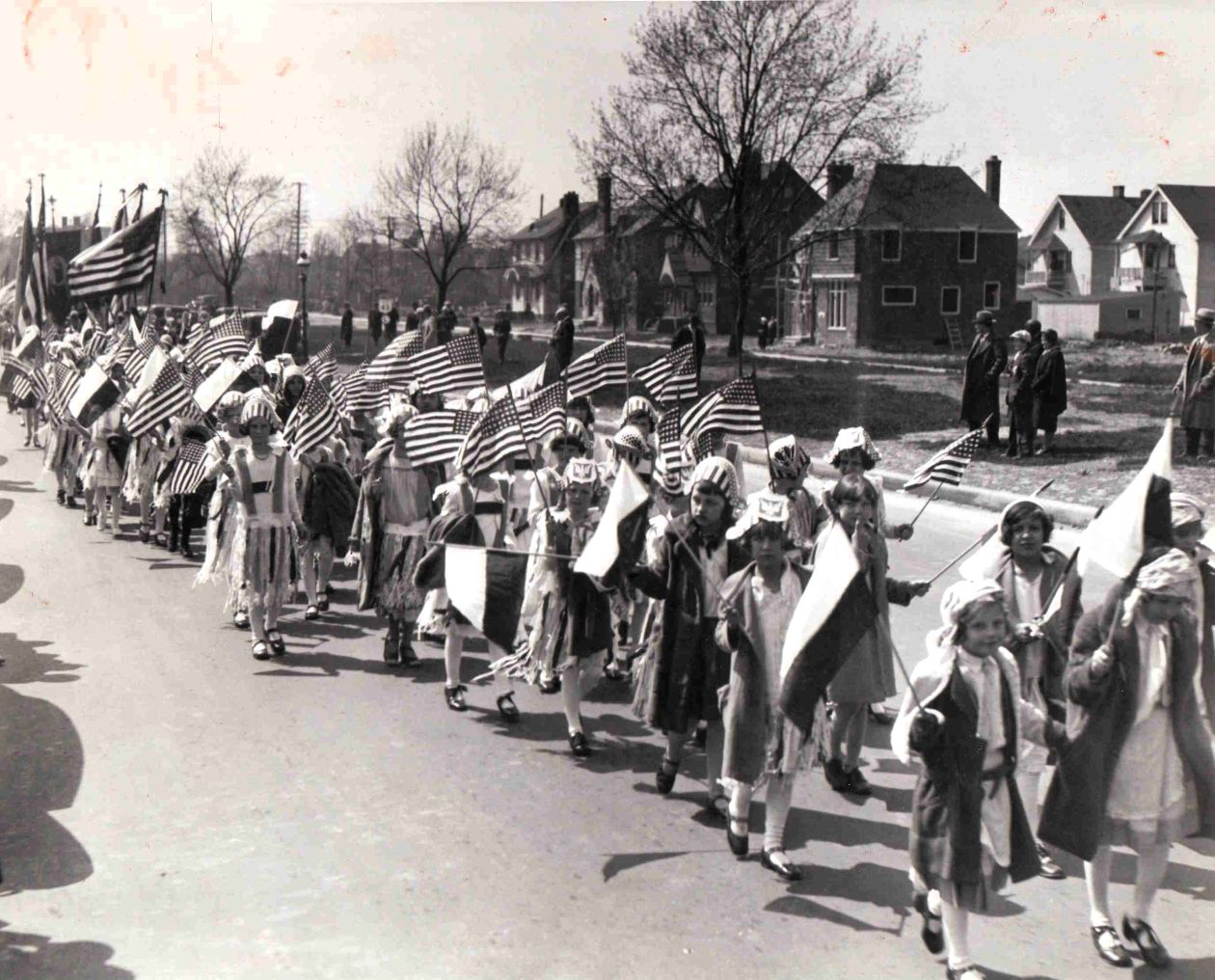
Veteran radical labor journalist, the Federated Press’ Harvey O’Connor with a close look at the specific issues with organizing Cleveland, Ohio’s massive, and largely quiescent, Polish working class.
‘Facing the Unorganized: Cleveland’s Polish Workers’ by Harvey O’Connor from Labor Age. Vol. 16 No. 2. February, 1927.
It is good to face the unorganized—to view their background and to note the difficulties in our way. When we see these difficulties—as presented by Brothers O’Connor and Dabney—they grow much less insurmountable than we generally suppose. Every one of them can be overcome—in Cleveland with the Poles, throughout the country with Negroes. Armed with the facts, let us get on the job! Further articles will show even more clearly how this can be done. LABOR AGE has already indicated the general line of procedure.
The Coming Harvest: Pawlowski and Goscka
Twenty men “made” Chicago, asserts C. W. Baron in a vainglorious editorial in his WALL STREET JOURNAL. Cleveland can boast of a wider and a greater basis for her greatness, because it took the flower of a nation to build and operate her mills and factories. That nation is Poland.
Cleveland was merely another Columbus or Indianapolis, a cross roads town with none too large a hinterland behind her and the blank waters of Lake Erie before her when the invasion of America by Poland commenced. Ten years after that tide of humanity had rolled over this country, the banks of the muddy Cuyahoga reflected the night glow of huge steel mills while her air rivalled Pittsburgh’s as a hundred sprawling mills and factories belched smoke into the Ohio heavens.
From the interminable pages of the 11th Decennial Census report, you can learn that 40,000 Poles claim Cleveland for their own. The finest sons and daughters of the vast Polish plains, they came to the Fifth City bearing gifts worth far more than a king’s ransom. Poland, torn as she was between three imperialist powers, had reared these men and women to maturity, had borne the full costs of their development into sturdy, full-blooded workers, and then had presented them to America. Had that peasant land given Cleveland her great factories, the world would have marveled and America would have paid tribute in laudation and interest on the investment. Instead Poland gave flesh and blood, ready and eager to toil before the hot furnaces and the throbbing machines of the American factories erected for these peasants.
Cleveland’s rise to industrial greatness on the shoulders of the Poles is just another of the crucial problems posed for solution by the labor movement. For theirs has not been the reward given the 20 men who “made” Chicago. Not palatial mansions in Bratenahl or Shaker Heights, nor winter homes in Florida have fallen to the men and women who made Cleveland, but slum dwellings down in the smoke and dirt of that city’s belt. There for square miles are the squat houses of the steel workers and the machine shop workers, relieved only by the spires of Polish Roman Catholic churches.
When the steel mills shut down, terror spreads through those glum haunts of inarticulate workers. Families telescope, a dozen living in quarters where half a dozen had lived before and none should live. The queues of black-shawled women, ambling one, two and three miles to the downtown public markets for baskets of the cheapest vegetables and a small cut of the cheapest soup meat, grow longer as they haggle with the sharp hucksters for a penny and an ounce.
But no, we cannot jump to the conclusion that these Polish people, these quiet uncomplaining folk who furnish the sinews of industry not merely in Cleveland, but in Pittsburgh, Youngstown, Akron, Detroit, Toledo and even Chicago, have been entirely neglected by the trade union movement. Truth to tell, they constitute an organization problem before which the most aggressive and intelligent movement might well pause.
A superficial survey of the reasons for their hard conditions, for their failure to organize and for their apathy in the face of oppression might reveal some of these factors:
1. A deep feeling of fear brought over from the old days of Czarism in Poland when opposition to authority—any authority whether of the police, religion or the boss—met an immediate and stern punishment.
2. The peculiar strength of the Polish Catholic religion over its adherents. In a strange land, the Poles have turned almost instinctively for advice and guidance to the parish priest, a fact of tremendous significance.
3. A distrust of their own leaders, inculcated by a long and disgraceful reign of fraud by Polish editors, lawyers, politicians, doctors and other “intelligentsia” over the unlearned masses. In Cleveland, for example, not one Polish lawyer could be found to defend—without an enormous fee—a countryman accused of murder with all the familiar apparatus of a frame-up. An American Civil Liberties Union lawyer of high standing before the Cleveland bar gladly took up the case.
4. A distrust of American labor organizers because of charges—whether true or not the writer does not know–that they victimized the Poles as badly as their own fellow-countrymen had.
* *
Allow me to introduce my friend, whom we’ll name Pawlowski:
“The more intelligent Polish workers in the steel mills yearn for a union. They know what a union could do for them because many of their friends are in the build ing trades. They compare their conditions with those of the union building workers. But what are they to do?
“It is easy to strike against a little construction boss. But our bosses are the subsidiaries of the Steel Trust.”
“And who would lead us? We have not developed good leadership among ourselves. And we remember too well the steel strike when that rascally organizer came among us.”
“He drove into town in a Ford and started collecting dues and initiation fees. Everyone joined. Then came the strike call and we responded 100 per cent with the other steel workers. But by that time our organizer was riding a Buick and pretty soon he disappeared. We were left alone, without relief, without leadership. Our people become discouraged, the priests were busy all the while and our business men were yelling through our Polish newspapers that we must go back to work.
“And so we did. But we still remember that and so we fear to strike, even to organize a union. If the company spies don’t get us, the little band of us who still talk unionism fall before the fear and apathy of our own people who suffer terribly now but fear that they would suffer more in another strike.”
But perhaps our friend Pawlowski dwells too much in the past. Then let us hear Goscka. Goscka is a member of a railroad brotherhood, a born promoter and an inveterate politician of the better sort. He hovers between the depths of despair and the heights of confidence.
He enters my office triumphantly waving the latest edition of the Polish Catholic weekly paper. “Look,” he gloats, pointing to the English column. And there, phrased in rather awkward English perhaps, is an ardent appeal for Sacco and Vanzetti, equal in spirit to any labor editorial yet written about the two victims of Massachusetts injustice. A truly tremendous achievement, considering the character of the paper.
This indefatigable propagandist, who had swung the Polish daily over to the LaFollette cause, is now working to liberalize the Catholic paper. Next week Goscka reports he has been placed on the political committee of the Polish Chamber of Commerce, there to present labor’s side in local electoral matters.
“But what about a little union activity down there on Broadway (Little Poland’s Main Street)?” I ask.
Goscka shrugs his shoulders. “The thinkers are the rulers,” he answers apocryphally, ending up with a florid peroration from E. Haldeman-Julius, evidently the H.L. Mencken of the Midwest.
The topic is a painful one to him, for he shies off at any or no opportunity. Pinned down, he answers:
“Well, what’s the use of all this work I’m doing, if not to back up the progressives among the Polish people when they are in trouble?”
“But can’t we also be doing some actual organization work among the steel workers and machine shop workers?” comes my inquiry.
The problem is too big, and there is no answer.
***
Cleveland’s problem is not merely a Polish and a steel mill problem. Other nationalities, principally the Hungarians, the Czechoslovaks and the Jugoslavs are main ingredients in the Fifth City’s industrial population. And steel mills are just one of the many industries; in fact they are the outposts of steel, which centers in the Mahoning Valley and down into Pittsburgh along the Allegheny and Monongahela. Indeed, the fabrication of steel into machinery, engines and equipment of every sort is Cleveland’s main basic reason for existence. Trucks and sewing machines, tools and forgings, every implement needed for a civilization founded upon iron and steel, are turned out of Cleveland. Midway in America’s industrial belt, it enjoys admirable distribution facilities. It is in the center, too, of primary production, with the ore boats of Lake Superior dumping at her docks and long trains of coal winding down from Ohio and West Virginia valleys.
It is more akin to Detroit, also a steel fabrication town, than to Pittsburgh. Toledo is just Cleveland on a smaller scale. So are Erie, Ashtabula, Painesville, Lorain along the south shore of Lake Erie. Roughly, the union problems of the cities stretching along Lake Erie up to Detroit, the very heart of the Ruhr of America, are substantially alike. With native Americans, there are the mid-Europeans in all these cities (Cleveland for example is the geographical center of America’s Jugoslav population); the employers generally are intelligent, alert and aggressively non-union; the industries are about the same.
Among notable differences must be mentioned Cleveland’s progressivism. In 1924, Cleveland and Milwaukee were the only major cities to swing to LaFollette. Outstanding progressives of national note, such as Peter Witt and Marie Wing, are influential members of its city council. Three big railroad brotherhoods have their headquarters there. The city has a heritage of progressive tradition from the days of Tom Johnson, of 3-cent fare fame.
***
The problem of the unorganized in Cleveland can be summarized roughly in this manner:
1. Prosperity for the underlying population is no more real in Cleveland than any other industrial center. Hundreds of thousands live below the comfort line; the city’s industrial leaders can boast of Negro slums equal in squalor to the worst in Dixie.
2. The liberalization of the foreign workers continues. Their papers are becoming somewhat less mercenary. The isolation of the foreign language groups from the rest of Cleveland and America is being visibly permeated by English columns in their papers, by discussions of local and national politics, by the spreading influence of labor ideas. The former towering position of the corrupt foreign language newspapers which customarily sold out to the steel trust and other employers during big strikes is being undermined by the growth of a sturdy labor and progressive press. Some of these papers, such as Radnik, the national Jugoslav paper; Americke Delnisty Listy, the strong Cleveland Czech socialist weekly; and the Cleveland progressive Hungarian weekly will give most valuable aid in a union campaign.
3. The leadership problem is not a hopeless one. Fleeced so consistently by their own fellow countrymen, they place touching confidence in American leaders, once they are convinced of the native’s sincerity and honesty. Among their own ranks, too, are young men who will hitch their wagons to the labor star if only labor has some program with fire and spirit. Naturally they are not greatly inspired by some examples of native craft unionism in action.
4, The knotty problem of the attack on the employers has not been approached, much less solved. Certain shops are more vulnerable. Research should indicate them. Strategy, given the heterogeneous working force and the aggressiveness of the bosses, is yet to be evolved.
5. In an intelligently planned fight, unionists could count on the moral support of a great portion of Cleveland’s million people. Two of the dailies are fairly liberal and a financial apparatus could be erected with assurances of local relief. Certain progressive leaders would be towers of strength in a union campaign.
6. The trade union movement would be an asset in such a drive. Although its strength is centered chiefly in the building trades, yet it has real influence and good machinery. The Cleveland building trades are being subjected to stiff attacks from a so-called Citizens Committee which has a war chest of $5,000,000 and instructions to break the back of the unions. The Building Laborers have had to abandon their fight for a $1 an hour scale while the Painters have lost a protracted strike; clearly the building trades have their hands full.
7. An imperative need is a central skeleton organization which could be expanded easily for research, mobilization of speakers and organizers and for relief work. A branch of the American Bureau for Industrial Freedom would be ideal in such a capacity and might well be the way to open wide the door of trade unionism to Cleveland’s 250,000 non-union toilers.
Labor Age was a left-labor monthly magazine with origins in Socialist Review, journal of the Intercollegiate Socialist Society. Published by the Labor Publication Society from 1921-1933 aligned with the League for Industrial Democracy of left-wing trade unionists across industries. During 1929-33 the magazine was affiliated with the Conference for Progressive Labor Action (CPLA) led by A. J. Muste. James Maurer, Harry W. Laidler, and Louis Budenz were also writers. The orientation of the magazine was industrial unionism, planning, nationalization, and was illustrated with photos and cartoons. With its stress on worker education, social unionism and rank and file activism, it is one of the essential journals of the radical US labor socialist movement of its time.
PDF of full issue: https://www.marxists.org/history/usa/pubs/laborage/v16n02-feb-1927-LA.pdf
 Revolution's Newsstand