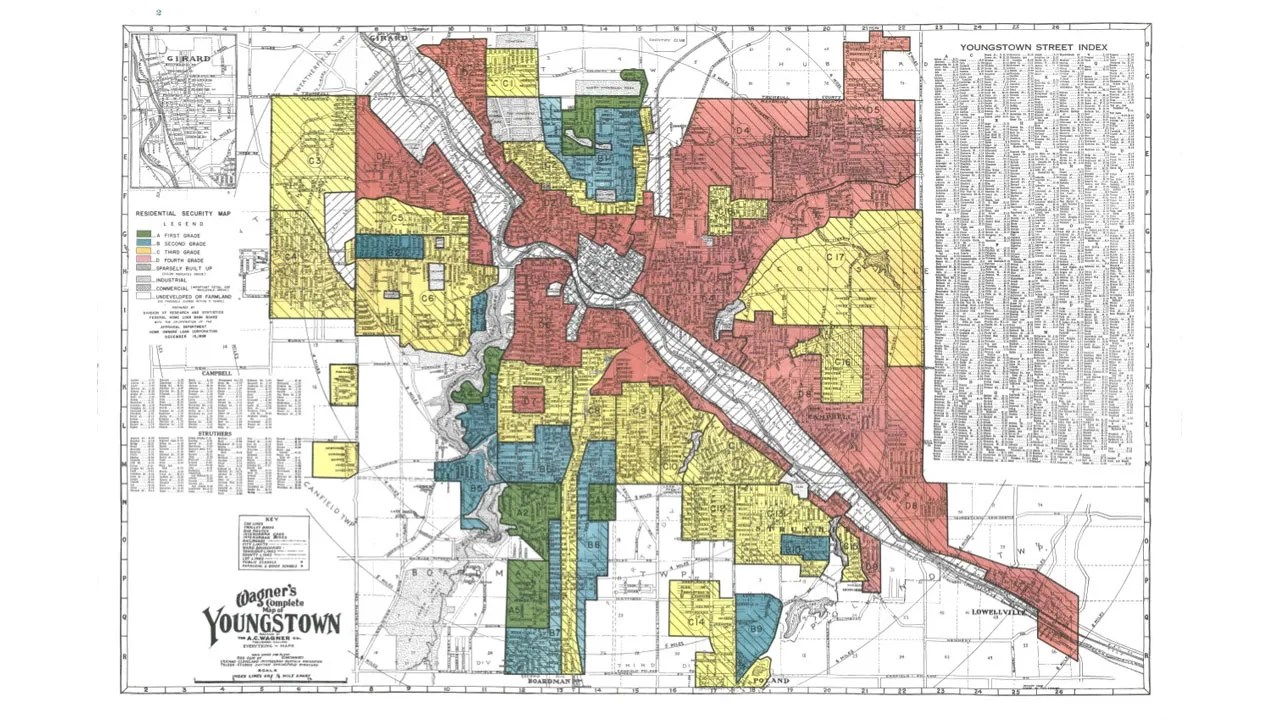
Youngstown’s population in the 1930s was around half foreign-born and their children, the steel mills a definite majority. Largely emigrating from Southern and Eastern Europe, every national group had a social world built around their common language with newspapers and clubhouses in the city’s ethnic neighborhoods. Most of these were either Church or left-connected labor organization. As this internal reports shows, building the T.U.U.L.’s Sheet Metal Workers Industrial Union in the multi-national, multi-lingual Youngstown steel mills was a difficult task for the multi-national, multi-lingual local Communist Party.
‘Language Work in Youngstown Section’ by John Roman from Party Organizer. Vol. 7 No. 4. April, 1934.
Language Forces Should Be Made Instrumental In Rooting the Party in the Factories and Basic Industries
THE importance of giving our language fractions the proper orientation and of raising the political level of our “language comrades”, who are permeated with all tendencies of federational-sectarianism, becomes apparent as we consider the large number of foreign-speaking elements in the basic industries and the great percentage of foreign comrades in the Party and especially in the concentration districts, sections and cities.
Let us take as a vehicle of discussion one of the most important concentration points, the Youngstown section.
What is—first of all—the composition of the working-class and that of the Party membership in this section? Overwhelmingly foreign. Steel is the main and practically the only industry of significance. Estimates concerning the foreign-speaking amongst the steel workers vary from 60 to 75 per cent. Three-fourths of the Party membership in the Youngstown section is estimated to be foreign-speaking.
These figures, even allowing for slight inaccuracy, speak for themselves. The significant role and double responsibility of the language comrades is obvious. But do our language forces have the proper orientation in their activities, do we possess the proper political understanding required for the fulfillment of the tasks?
Language Forces Lack Understanding of Their Tasks
Perhaps some of the “modest,” “simple,” “petty” everyday occurrences will be illustrative of the general attitude and political level:
One instance: The Section is in a chaotic situation because of the political and organizational bankruptcy of the previous Section leadership recently removed. Everything is upside-down, and great efforts are made to put things in order. The units are faced with urgent tasks. In unit No.— a South Slav comrade proposes the postponement of the unit meeting, because the language comrades are involved in rehearsing a play, and there is little time left to make the acting successful.
Another instance: A language comrade, on the evening of his local union meeting, goes to the headquarters of his “language-society”, to warm his feet. Since he is the chairman of the local, he was asked as to the reason for not going to the local meeting. “Hell, it is too cold, there is hardly gonna be anybody, anyhow”, he answered with a feeling of justification.
In the city of F— non-party workers went to a comrade asking for advice because the workers were in a fighting mood in that particular steel mill and wanted to fight for a wage increase. The comrade advises them to form committees, etc. The workers hand in a signed petition demanding 20 per cent increase in wages and they got it. Yet our comrades “forget” to bring these workers into the S.M.W.I.U., they are busy with “language work” and rehearsing a play, “Struggle on the Barricades.”
In the city of Y– we made a checkup of the membership of the Hungarian organizations under Party influence, and also of the readers of Uj Elore. We find that there are about 30 sympathetic steel workers, a good number of them employed in steel mills, Republic, Carnegie, Sheet and Tube, etc. How many of them were asked to join the S.M.W.I.U.? None. We find that a number of our fraction members are working in steel mills How many of them are members of the union? None.
Now these “petty” “everyday occurrences” characterize the situation. But since our language forces (the majority of the Section membership) are “concentrating” practically all their energies in their language societies, one would assume that there at least we would find a mass movement of some sort. But do we?
On the contrary. The circle of their following is very narrow. We have a situation where a dozen communists “lead” 20 to 30 Party-sympathizers (Hungarians, etc.).
Language Work Isolated from Basic Tasks of Party
But why the isolation? Is it because ”we don’t do work”? No. Primarily because we go about it in the wrong way. Because of our failure to link up our activities on the language field with the basic tasks of the Party. Do our language forces in the Youngstown section properly participate er engage in systematic work in the factories, among the steel workers, on CWA jobs? Are they doing work among the unemployed? Are they working systematically in the reactionary organizations, where the great masses of indifferent misled workers are left to the mercy of the reactionaries, the fascists? National experiences on the language-field show that where this was done, the isolation of our language movement began to disappear, and new masses began to flock toward us. These experiences also show (New York, New Jersey districts) how the language forces; can be instrumental in organizing shop nuclei, rooting the Party in the factories, etc., and by such activities in turn also securing new members and injecting new life and vigor to our lifeless language organizations.
There is a complete lack of understanding of this on the language field of the Youngstown section.
The general attitude of the language forces is characterized by incidents quoted above. There is a very low level of political understanding, irregular attendance and participation in the so-called general Party work, a shrinking from any activity that is not within the narrow shell of “society doings,” their activities in the main are that of the old line of federationalism. That is, limited to associating with their own friends, seeing the same faces year in and year out, having a dance and lecture here and there and of course giving financial support to their language press.
Needless to say that in a section where the overwhelming majority of the basic proletariat is foreign-speaking where almost the whole Section membership is that of the “language forces” such a situation as that in Youngstown is more than intolerable.
How to Improve the Situation
There are certain steps that could be taken immediately which would undoubtedly tend to improve the situation:
1. A systematic and thorough ideological campaign amongst the language forces to stamp out the federational-sectarianism. This should he conducted in their own specific language. The various Language Buros of the district could be of great assistance by arranging study courses for at least two weeks, where the fraction members and active sympathizers would get political education in a language they understand, and among other topics, the question of “federationalism” would be clarified.
However, actual results are attainable only if the Section leadership will carry out its decision of establishing very close contact with these fractions, giving personal guidance, checking the work, and systematically insist on carrying out the basic tasks. A Section representative should attend these fraction meetings, and regular meetings of all fraction secretaries should be an institution-like procedure.
2. An immediate putting into effect of the Party decision that all Party members eligible to union membership must join the S.M.W.LU.
3. An immediate registration of the readers of various Party language press and the membership of the language organizations under our influence; to have a clear picture of our contacts amongst the steel workers. Since the S.M.W.I.U. in the section is still in the embryonic stage, a campaign of individual recruiting should be started. Through utilizing these contacts, that are “right in front of our nose” we could undoubtedly “discover” some valuable connections, and form some factory or department groups, as a preparation of the anticipated upsurge of steel workers. Also the setting up of “Build the S.M.W.I.U. committees” in language organizations would be of assistance.
4. A functioning Language Department should be established in the S.M.W.I.U. involving our language comrades in day-to-day concrete work amongst their specific nationality, and issuing leaflets and union bulletins in foreign languages since thousands upon thousands of these workers do not understand English. And since the financial capacity of the union is very limited, the various language buros of the district should take upon themselves the task of translating and financing such material of union propaganda, in their own languages.
The above enumerated steps could be undertaken immediately, and would, it appears, improve the situation.
The Section leadership, because of the very character of its territory, must give immediate attention to the “language situation”. The main responsibility lies with the Section leadership, because only the Section Committee by the virtue of being on the sport and able to give push and guidance, can reorientate the work of the language forces. Experience shows that with proper methods of work “language forces” may become most instrumental in building the union, rooting the Party in the factories and among the basic strata of the proletariat.
And with the anticipation of the upsurge of the masses, this should and could be the case in the Youngstown section also.
The Party Organizer was the internal bulletin of the Communist Party published by its Central Committee beginning in 1927. First published irregularly, than bi-monthly, and then monthly, the Organizer was primarily meant for the Party’s unit, district, and shop organizers. The Organizer offers a much different view of the CP than the Daily Worker, including a much higher proportion of women writers than almost any other CP publication. Its pages are often full of the mundane problems of Party organizing, complaints about resources, debates over policy and personalities, as well as official numbers and information on Party campaigns, locals, organizations, and periodicals making the Party Organizer an important resource for the study and understanding of the Party in its most important years.
PDF of issue: https://www.marxists.org/history/usa/pubs/party-organizer/v07n05-06-may-jun-1934-Party%20Organizer.pdf
 Revolution's Newsstand