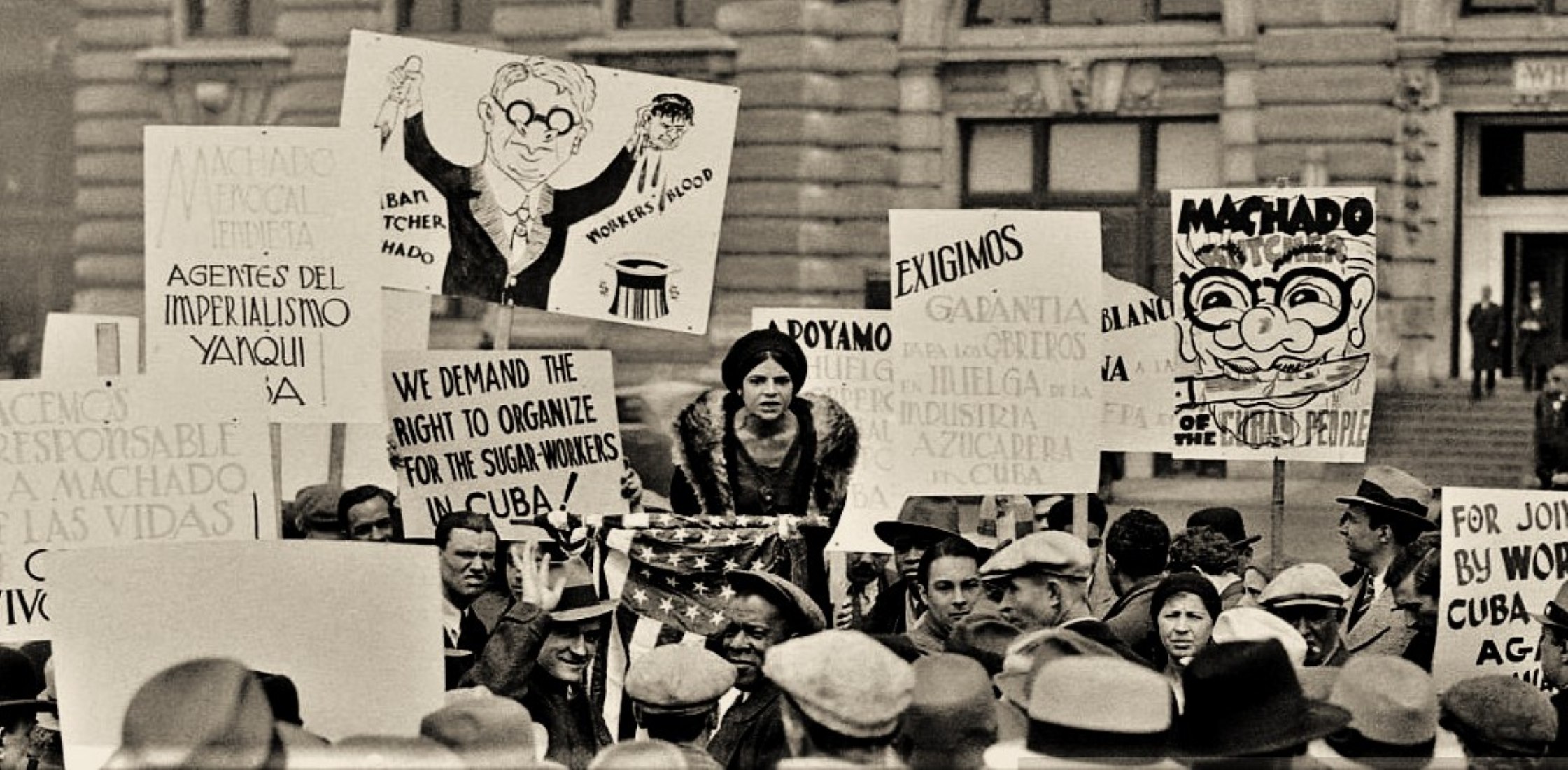
This excellent snapshot of Cuba in the mid-1920s is a rare English-translated article from the future famed Cuban psychologist and educator, Alfonso Bernal del Riesgo, a founder and leader of the Cuban Communist Party and a close collaborator of Julio Mella’s for much of the 1920s. In European exile during the early 1930s, he studied in Vienna under Alfred Adler. While the focus of his work changed, he remained committed and would be a major figure in the refounding process at the University of Havana after 1959’s Revolution where he inaugurated and led the School of Psychology.
‘Cuba Under United States Imperialism’ by Alfonso Bernal del Riesgo from The Daily Worker. Vol. 3 No. 39. February 26, 1926.
Entire Country at Mercy of U.S. Sugar Barons
(Member Central Executive Committee, Communist Party of Cuba)
CUBA is an island, the largest of the Antilles, situated at the very entrance to the Gulf of Mexico. It is only six hours’ steamship ride from the United States; an airplane can make the trip in forty minutes.
The population of some 3,000,000, about a third of whom are Negroes, stretches out over an area of 114,000 kilometers, whose fertile soil is capable of producing every tropical fruit known. Despite the luxuriant variety of Cuba’s natural products, the financial interests of the Yankees have made her almost exclusively a land of sugar. The tobacco crop becomes smaller every year, and coffee, the traditional early basis of Cuban wealth, has ceased to be cultivated since the “Independence” of Cuba and the annexation of Porto Rico.
Politically, Cuba has much in common with other Spanish-American nations. Her territory is divided into six provinces, each with a governor elected by direct suffrage but subordinated to the president. Every province is divided into municipalities but such a thing as municipal home rule is unknown. The president has in fact almost dictatorial powers, is really a veiled monarch—within the narrow limits left to him by imperial overlordship, that is. This has been demonstrated in practice by the history of the tyrants Menocal and Machado, the last named being the present reactionary dictator of the country, having acted in that capacity since last May.
The independence that Cuba is supposed to enjoy was acquired after the Spanish-American war of 1898. In that year the Yankees intervened in the civil war that was raging in the country, following upon the mysterious blowing-up of the battleship Maine. Thus ended Spanish rule on the island, giving place to the domination of the United States.
II.
Spain maintained a more or less veiled monopoly in Cuba and the United States was determined to supplant her. The Cuban war of independence presented to North American imperialism, then in its swaddling clothes, one of its first opportunities. No sooner had Cuba been declared independent than the capitalists of the north committed an assault upon the constitution of the new “republic” in order to assure themselves a legal basis for their outrages. They imposed on Cuba the Platt amendment, demanded and secured the island’s two best ports as naval stations and put thru the celebrated “reciprocity treaty.” Cuba freed herself from the tutelage of Spain only to become a vassal of the United States. The aforementioned “agreements” and amendments to Cuban independence, annulled that independence completely. Cuba has no guarantee whatsoever against the aggressions of the United States; the right to intervene is sanctioned by the constitution itself, the fundamental law of the land.
The right to revolution is denied; U.S. property must not be endangered.
The Swindle Treaty.
By the reciprocity treaty Cuba was obliged to let U.S. merchandise enter free of duty, receiving in turn the right to ship goods freely into the United States. This famous treaty is known in history as the Swindle Treaty, for while the United States exports to Cuba every kind of article of consumption, Cuba is able to export to the United States nothing more than she produces, which means sugar. But that was only the beginning. An American senator, Mr. Fordney, was of the opinion that the swindle was not complete enough and proposed a special tariff for “one of the products of Cuba”: sugar.
At the present time sugar pays an import duty 13 per cent above the earlier arrangement. Nevertheless, the U.S. differential in favor of Cuba as against others keeps Cuban sugar out of the world market.
These customs fences and the conditions of maritime traffic make it impossible for Cuba, to think of trading with any other country than the United States. Lords of our commerce, masters of the national prosperity, the Yankees pull the strings of Cuban economic life at their will; at the caprice of Wall Street, Cuban sugar rises or falls, and as sugar is the sole product, the entire economy of the nation rises or falls in unison.
Under these conditions it is impossible for the most intelligent bourgeoisie to develop its finances. Bourgeois production is anarchic; imperialist production is chaos squared and cubed. At the present time Cuba is in economic decline; perhaps she will not succeed in finding her feet again. This depends on the national resistance, on the small proprietors, the colonos of the sugar-cane fields.
Workers Like Coolies.
At present the sugar workers are being gradually reduced to the position of coolies. The price of one cent does not cover the cost of colono production of cane. As a result the entire country is in bankruptcy. Already workers are toiling in the fields for no other recompense than their meals; soon there will not be even that. Only the government appears to be in a flourishing condition. Having imposed the most onerous burdens upon the population, it now spends its time shooting down in the streets workers who protest against this state of things.
The Communists, as in all parts of the world, are those receiving the most careful “attention” at this time.
If the colonos were wise the present crop would never have been grown.
Nothing has been achieved in the nice of the perennial voyage of poverty to Cuba, always coincident with new purchases of land and with new taxes and loans. On the last crop there was a surplus of more than half a million tons, out of a total crop of 5,000,000 tons. And now Cuba, without having opened up new markets, without having established a minimum price, without any security, without her own refineries —launches out, on the word of the president of the republic, upon another crop. This year, in order that next year’s crisis may be still worse, the yield wilt be upwards of 6,000,000 tons.
Unsupportable has become the condition of oppression, of exploitation. Moreover, has been no such thing as political responsibility. All that count are money and good relations with Uncle Sam. The bourgeoisie is the same the world over, but in the Latin-American countries its attitude is particularly odious.
The regime of exploitation out of which these things arise is not difficult to understand. It is necessary to wring from the colony the greatest possible amount of surplus value, and in the most advantageous form. To accomplish this, the colonos are befooled and the developing radical unions of workers and peasants is brutally repressed. In truth organization of the peasants has not been possible to effect in Cuba; it has sprung up momentarily in periods of extreme oppression but the government, faithful watchdog of its imperialist masters, has drowned it in blood and deportations.
Workers Paid in Script.
Life in the sugar “centrals” or mills or factories is insufferable. The material conditions of labor are of the worst. There is no money wage, workers are being paid in script that can only be exchanged for merchandise at the company stores, where fantastic prices are charged. Socially, the workers in the fields are treated in about the same way as the animals. He must be submissive and exaggeratedly respectful in the face of all the abuses of the bosses who are pleased to humiliate him.
In treatment of the workers the “central” has not changed in 60 years. In place of the old mill turned by horses there is now a magnificent machine; instead of ten bags of sugar a day, a 1,000. Only the worker remains as before. Formerly he was called slave, not Juan or Pedro, but life for him continues on the same level of misery.
“Yankee methods” of exploitation have been extended to all the centrals.
While sugar is the one big industry on which Cuban prosperity depends, it is not the only one on which the American capitalists have gotten their hands. The United Fruit company dominates a great part of the export of pineapples and other fruits. In the city of Banes—”yellow Banes,” as it is now called—the company has a field of its own. Trespassing is not permitted without permission of the special police maintained to “keep order” in the American possessions. All products going into the old city of Havana enter byway of the Yankee-owned Banes railroad. Cuba will soon be an enormous city of Banes.
Dare Not Offend Crowder.
Wherever they go the Yankee capitalists leave their trail. They believe, as in China, that it is sufficient for the native if he produces for them. Their rights are the only ones respected and respectable, their agents are the only ones that may not be removed, and their desires must be fulfilled to the raising of an eyebrow, like Father Jupiter. The father Jupiter of the Cubans is called Crowder. One must be “persona grata” to Crowder. Woe to the government official, party or individual who raises the wrath of his excellency, the ambassador of the United States…

Aside from the ones mentioned, Cuba’s products develop very slowly, if they develop at all. We have no markets. The Americans do not want our coffee, nor our delicious rice, nor most of our various fruits. Tobacco is on the down grade and is already being displaced. What is the cause of this disdain for the fine Havana cigar? Can it be the workmanship, the eminently careful, personal, Cuban touch? Or is it perhaps the Virginia tobacco interests?
The general situation of Cuba has been and is that of a colonial country. The Cuban bourgeoisie, almost entirely a hereditary class, is of the most despicable and stupid—its representatives (the government) cheap peddlers who sell out the wealth of the land to the highest bidder. And the Yankees pay best and back up their money with force, with force…
The Daily Worker began in 1924 and was published in New York City by the Communist Party US and its predecessor organizations. Among the most long-lasting and important left publications in US history, it had a circulation of 35,000 at its peak. The Daily Worker came from The Ohio Socialist, published by the Left Wing-dominated Socialist Party of Ohio in Cleveland from 1917 to November 1919, when it became became The Toiler, paper of the Communist Labor Party. In December 1921 the above-ground Workers Party of America merged the Toiler with the paper Workers Council to found The Worker, which became The Daily Worker beginning January 13, 1924.
Access to PDF of full issue: https://www.marxists.org/history/usa/pubs/dailyworker/1926/1926-ny/v03-n040-NY-feb-27-1926-DW-LOC.pdf
 Revolution's Newsstand