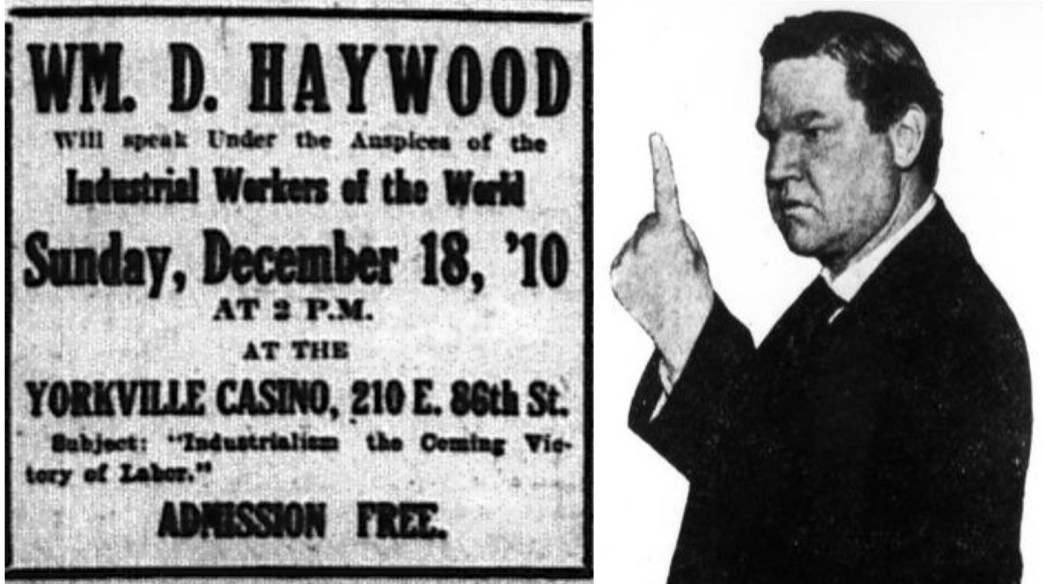
William D. Haywood is what revolutionary Socialism looked and sounded like in the U.S. before the Russian Revolution. Here he is growing into his role as a major working class figure. Just returned from Europe where he attended the International’s Congress in Copenhagen, Haywood challenges every tenet of the Socialist Party’s opportunist leadership in their stronghold at a packed house on the Upper East Side on December 18, 1910.
‘Haywood Home from Europe Speaks in Yorkville’ from The New York Daily Call. Vol. 3 No. 353. December 19, 1910.
HAYWOOD SEVERELY CRITICIZES A.F.L. ORGANIZATION
Declares That Leaders Play Into Hands of Bosses.
FACES BIG AUDIENCE
Believes in Widest Political and Industrial Organization on Class Lines.
Yorkville Casino, on East 86th street, was packed to the doors yesterday afternoon to hear William D. Haywood, who has just returned from Europe, speak on “Industrialism, the Coming Victory of Labor.”
Haywood said he thought there was a mistake made somewhere in characterizing the meeting as a “welcome home” to him. He said:
“America is not my home. While the working class remains in bondage as it does today I will be an ‘undesirable citizen,’ I prefer to be known as a worker in my industry, than to be a citizen of any state or nation.
“It gives me great pleasure.” continued Haywood, “to speak from this platform under the auspices of the Industrial Workers of the World. I would rather speak for the I.W.W., with Gurley Flynn on one side of me, and Joseph Ettor on the other, than from a place between Sam Gompers and some other Civic Federation union official.”
The big miner, filled to the brim with enthusiasm for his class, reviewed the class struggle as it is at present being waged in every country where capitalism exists.
“There is a bitter class struggle in society today, regardless of the efforts of John Tobin and his stripe of labor leaders, with the aid of the Civic Federation, to convince the workers otherwise,” he declared. “When the Bloody Czar of Russia ordered his Cossacks to slaughter the hungry people who gathered before the winter palace with prayers and crucifixes on that memorable bloody Sunday, that was the class struggle. When the volleys rang out which put to death Ferrer, one of the world’s greatest educators, that was an echo of the class struggle. When the millions of India revolted against the sacrifice of their fellow creatures, and the products of their labor to parasites, that was the class struggle. Yes, when the railway workers in France, through their aggressive action, compel the setting up of a new government, that is the class struggle.”
World-Wide War.
Haywood then went on and showed how the same class war is being waged in Japan in the effort to execute the twenty-six Socialists and anarchists there at the present time. He carried the audience to Mexico and pictured what was taking place under the direct order of Diaz and capitalism. “The rumblings of a revolution,” said Haywood, “can be distinctly heard in Mexico. Diaz and capitalism cannot with all his soldiers prevent the progress of the movement of the men and women who dream of liberty.”
The speaker then, in vibrating tones, and with deep feeling, plunged into a statement of the necessity of a strong industrial organization of the workers and an analysis of the weaknesses of craft unionism.
“Every time,” said he, “that I have felt the weight of the soldier’s gun upon my head, I have felt the necessity of one big merger of labor–the need of a labor trust. I have never felt that there was an identity of interests between the exploiter and the exploited.”
He then went on to show that a labor organization must recognize this class struggle in order to be of benefit to the workers. The labor organization, according to Haywood, that does not come out openly and plant itself upon the fact and acknowledgement of the class struggle is not only an obstacle in the path of labor achievement, but it is an ally of the capitalist class in keeping the workers in submission.
Haywood then arraigned the tactics of the American Federation of Labor. Said he:
“First of all, the American Federation of Labor is not a fighting organization. The basis upon which it is formed will not permit it. It was born as a compromise. There are 117 international unions in the organization and these 117 international unions are divided and subdivided into 27,000 local unions. The local unions enter into contracts expiring at different dates. The heads of the American Federation of Labor talk about putting up a fight against the bosses, but they all hold to agreements as sacred. The trade unions were not organized to protect and to fight the battles of the working class. They were organized to protect those skilled workers who are fortunate enough to get inside the wall which they have built up. They are based upon the principles of craft interests and not class interests. They are of the days of the stage coach, when the skilled worker with his hand tools was supreme in industry.”
Criticizes Craft Unions.
“The craft union, said Haywood, “perpetuates itself only by entering into agreements with capitalists for the benefit of a few workers at the expense of working class interests.”
He declared that the apprentice system and high initiation fees operate in preventing the craft union from becoming a working class organization.
Haywood compared the time agreements of trade unions with enlistments in the army or navy. He said in a similar manner the trade unions which sign time contracts are, in doing so, lining up and fighting for capitalists’ interests and against their own class. Craft unions, according to Haywood, breed scabs and perpetuate the false teaching that the interests of the workers and the capitalists are Identical. He referred to the Boot and Shoe Workers’ Union, against which about 800 men are out in Brooklyn, as an example.
“Bill” provoked considerable surprise when he said: “No Socialist can be a trade unionist. The ethics of trade unionism are those of the identity of interests between capital and labor. Trade unionism does not act upon the principle of the class struggle, and a Socialist cannot be a craft unionist.
Recalls the Past.
Haywood, after his caustic criticism of craft unionism, said, however, that he remembered what they did for him, particularly what the rank and file did for him when he was about to be hanged for his defense of his class.
“I was a Socialist when I went to jail,” he said. “I was also an industrial unionist then. And I hope to remain one all my life. I am going to tell the truth, even if what I say may cause hard feelings among many of my friends who are members of trade unions. I realize what I have said against the craft unions is bitterly hostile, but I do know, too, that from my talk with thousands of them they realize the necessity of one big union.”
This one big union, Haywood said, could not come from or through the American Federation of Labor. When the question was asked if a member of a trade union who believed in Industrial unionism should get out of his organization and join the Industrial Workers of the World, or stay in his own organization, and do the best he could there, he said that if a worker had to remain a member of a craft union in order to get and hold a job in his industry, that was about the best thing he could do. But otherwise, he advised breaking away from the craft union and joining industrial union.
Believes In Political Action.
After the address, when an opportunity was given for questions, a score or more sprang to their feet, one asked if the speaker believed in supporting the Socialist candidates in conjunction with the economic activity. Haywood said he believed in action on both fields. He advised voting for the Socialist ticket. He sale: “We should remember, however, that if working class candidates were placed in office, from the President down to the last dog catcher, would not be Socialism.”
Haywood compared the attitude of the Chicago city administration toward the garment strikers with that of Milwaukee. He said that had there been a Socialist city administration in control in Chicago the striking workers there would have a better chance of victory.
Constructive Program.
The constructive program which the workers will carry out in the realisation of Socialism, Haywood said, was not difficult to understand. He declared that when the organization is strong enough it will determine the number of hours necessary to produce coal sufficient to run the industries of the country. So, if four hours will do it, four hours will constitute a day’s work. The same is true of safety appliances. According to him 95 per cent of the accidents are due to the hurry and stupidity of the men and the greed of the bosses. When the workers have charge of the mines, he said, they will see that all the necessary safety is furnished.
Elizabeth Gurley Flynn presided over the meeting and Joseph Ettor spoke on the shoe makers’ strike in Brooklyn and New York.
Miss Vina Flynn read the poem entitled “Revolution.”
Resolutions were passed protesting against the proposed execution of Emil Durand, the French railroad worker who took part in the recent railroad strike. It was also decided to assist in the defense of the Italian shoe worker in Brooklyn, who recently shot a foreman in one of the shops.
Resolutions were also passed in defense of Fred Warren and of Preston and Smith, of the West. The protest on behalf of Emil Durand will be cabled to France today.
Haywood speaks in Paterson, N.J. tonight.
The New York Call was the first English-language Socialist daily paper in New York City and the second in the US after the Chicago Daily Socialist. The paper was the center of the Socialist Party and under the influence of Morris Hillquit, Charles Ervin, Julius Gerber, and William Butscher. The paper was opposed to World War One, and, unsurprising given the era’s fluidity, ambivalent on the Russian Revolution even after the expulsion of the SP’s Left Wing. The paper is an invaluable resource for information on the city’s workers movement and history and one of the most important papers in the history of US socialism. The paper ran from 1908 until 1923.
PDF of full issue: https://www.marxists.org/history/usa/pubs/the-new-york-call/1910/101219-newyorkcall-v03n353.pdf
 Revolution's Newsstand