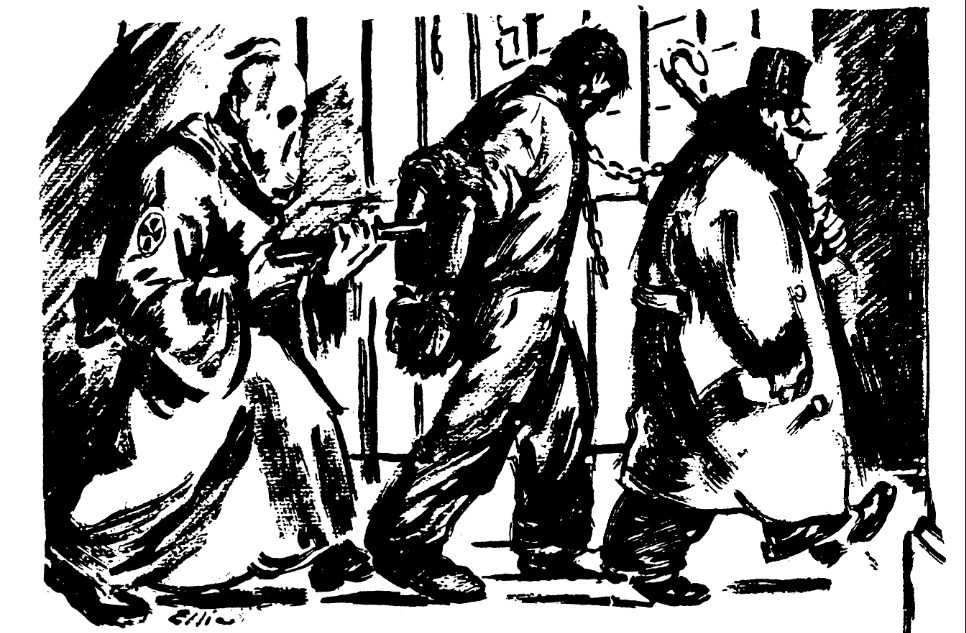
Allen looks for the origin of the ‘Second Klan’ and finds it in the anti-radical crackdown around World War One.
‘The Knights of Fascism’ by Sol Auerbach (James S. Allen) from Labor Defender. Vol. 4 No. 4. April 1929.
WILLIAM JOSEPH SIMMONS led fifteen apostles of white protestantism, American nationalism, Nordicism and financial plutocracy up Stone Mountain, near Atlanta, Georgia, on the Thanksgiving night of 1915, and in the light of a fiery cross he initiated them into the mysteries of the Invisible Empire of the Knights of the Ku Klux Klan.
Simmons had been planning this for years. He hated Negroes violently, he wished to spread his hatred and save “white civilization.” At the same time he would not give his services for nothing, he wanted to cash in heavily.
Events played into Simmons’ hands, for with the entrance of the United States into war, the chambers of commerce could make good use of such as he. Simmons, who had been a minister and was dropped from the church because of incompetence–no doubt in the name of fatherland, flag and religion–joined the civilian secret service. His theoretical outlook broadened with the increased opportunities that reaction offered for building his organization and filling his coffers. He was not only against Negroes now, but against all aliens, especially “Huns” and Bolsheviks,” against all “agitators”—he was one hundred per cent for White American Protestant Nationalism. It paid. The chambers of commerce were with him, the government, also with its judicial, administrative and executive machinery, from the secret service to the judges, from the leading businessmen to their hired thugs and assassins. He used the secret service to build the klan.
Simmons himself boasts to a journalist: “I was in touch in my war time secret service with Federal judges, Federal attorneys and Federal secret service officials and operatives. The klan secret service reported to me.”
During the periods after the war, when soldiers were returning from the front, when workers could not find employment, when workers and farmers starved and the Red Star of Soviet Union struck terror into the hearts of the American bourgeoisie, the Klan was even more useful to the chamber of commerce. As a secret service agent, Simmons had enrolled the whole membership of the klan as his aides. He started a secret service of his own consisting of klan members, and put at the head of his secret service department Fred L. Savage, member of an undercover agency in New York and waterfront strikebreaker. Thus, the Ku Klux Klan joined in the hunt for “reds”, for Negroes who wanted too much, for labor “agitators,” for I.W.W.’s, for members of the Communist Party and the Communist Labor Party. The Klan secret service played its role–who knows?–perhaps as an integral part of the United States Department of Justice. It was a part of the whole red-baiting machinery of the Kiwanis, Daughters of the American Revolution, Veterans of Foreign Wars, Lions, and all the other auxiliary organizations attached to the chambers of commerce.
But Simmons was getting too much of the gravy. He lived in his Atlanta mansion enjoying the millions of dollars accumulated by his class-hate machine.
H.W. Evans, at present the exalted head of the Ku Klux Klan but then a dentist, a member of some shady publicity association in Texas and doing publicity stunts for Simmons; D.C. Stephenson, an Indiana coal-dealer and now serving life in a penitentiary for kidnapping and raping a young girl who later died and Fred L. Savage, the New York waterfront strikebreaker and head of Simmons’ secret service machinery, dethroned Simmons. Evans, the cleverest of the three, succeeded in retaining for himself the honor of being the Imperial Wizard and Emperor of American fascism with the millions of dollars that goes with it.
Evans is a more fitting leader for the Klan than Simmons–he is more consciously a fascist and open reactionary. It is a part of his program to break strikes and break unions wherever possible. He boasts:
“Up along the northern border we stopped Bolshevism among the woodsmen, who wanted ‘One Big Union’. We gave them something else to think about.”
In the hands of Evans the Klan became a little more “refined.” It incorporated itself more as part of city administrations, or had many of its members in strategic places such as judgeships, sheriffs, mayors, city councilmen. It became force in politics–a most reactionary one. It is republican in many places, despite its Southern origin. Today it is the undercover agent for Hooverian imperialism.
As the reactionary essence of the American bourgeoisie, it has its qualities to the 9th degree. Crude and ignorant, but clever and brutal. In its ignorant and extremely brutal fashion, American fascism manipulates its Yankee white guard army. The white gowns of the Ku Kluxers are the white gowns of reaction. They have a blind hate of the American revolutionary working class, and a blind urge to save what they call Americanism–but which is really the rule of the bourgeoisie and their own little positions of prestige, property and authority. Everything which is foreign–by foreign they mean everything which threatens their class they put in one category and condemn. Evans, Imperial Wizard, for instance, conjures up the following picture:
“The Cosmopolitan movement is assailing the foundations of our civilization. Cosmopolitanism includes Universalism, Sovietism, Communism, Socialism, Anarchism, Judaism, and Roman Catholicism.”
The future of the “nation” does not rest with the K.K.K. or any of its brother organizations. The Klan will play the role in increasing force, of fighting against the revolutionary vanguard of the working class. The working class will sweep them aside together with their imperialist masters.
Labor Defender was published monthly from 1926 until 1937 by the International Labor Defense (ILD), a Workers Party of America, and later Communist Party-led, non-partisan defense organization founded by James Cannon and William Haywood while in Moscow, 1925 to support prisoners of the class war, victims of racism and imperialism, and the struggle against fascism. It included, poetry, letters from prisoners, and was heavily illustrated with photos, images, and cartoons. Labor Defender was the central organ of the Scottsboro and Sacco and Vanzetti defense campaigns. Not only were these among the most successful campaigns by Communists, they were among the most important of the period and the urgency and activity is duly reflected in its pages. Editors included T. J. O’ Flaherty, Max Shactman, Karl Reeve, J. Louis Engdahl, William L. Patterson, Sasha Small, and Sender Garlin.
PDF of full issue: https://www.marxists.org/history/usa/pubs/labordefender/1929/v04n04-apr-1929-LD.pdf
 Revolution's Newsstand