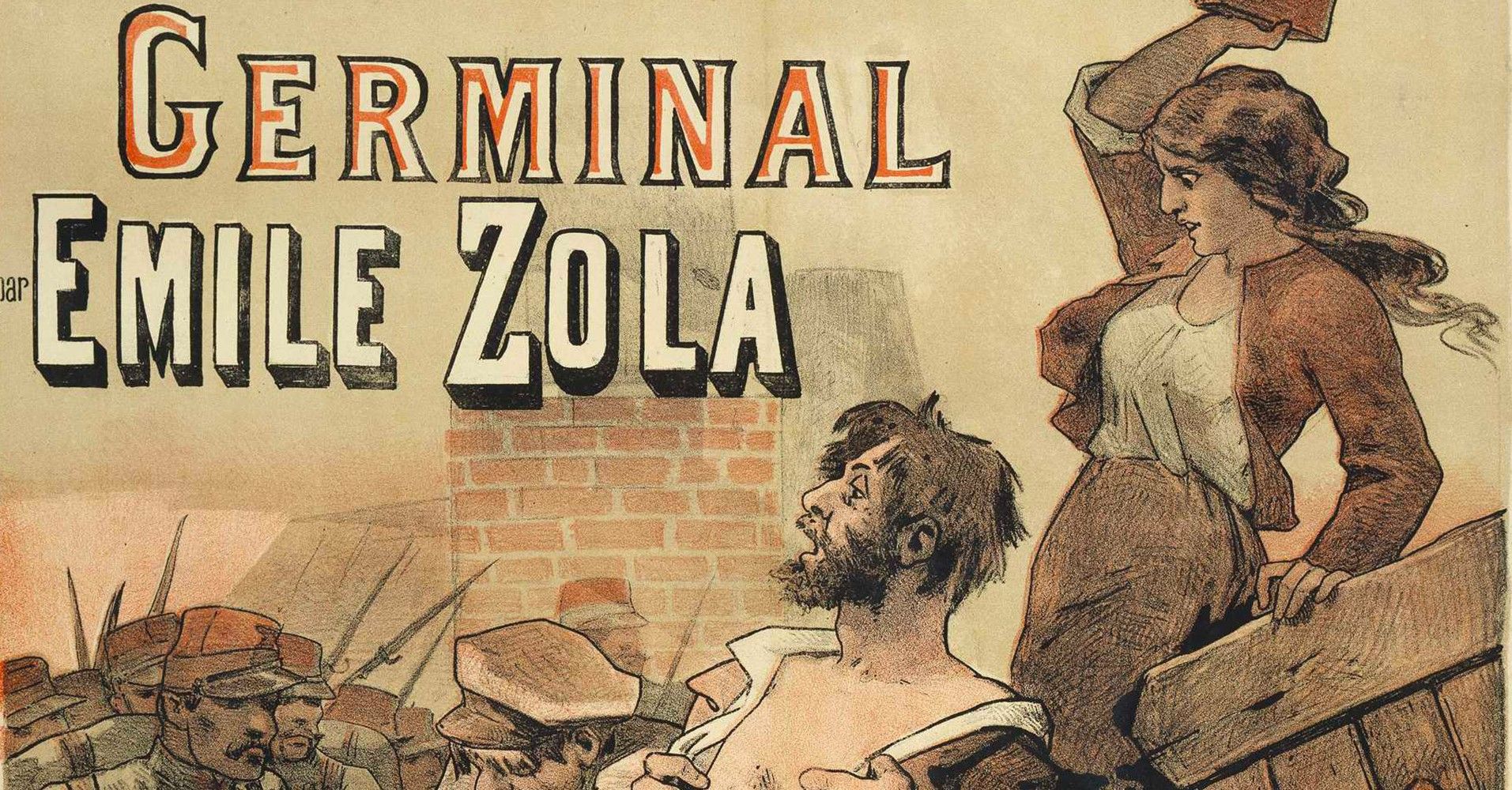
A reissue of Zola’s masterpiece Germinal has William Troy think about the tension between Zola’s naturalism and symbolism in this essay for Partisan Review.
‘The Symbolism of Zola’ by William Troy from Partisan Review. Vol. 4 No. 1. December 1937.
Whatever the motive behind the re-issue of this particular novel of Zola’s at the moment, it does force us to mark off more carefully the different stages in his career, to distinguish between Zola the salesman for Naturalism and Zola the Man of Action, between Zola the indefatigable charter of “forces” and Zola the artist into whom he now and then permitted himself to lapse. To put it rather naively, Germinal, which represents one of the more conspicuous of these lapses, is something better than one had remembered Zola even at his best capable of doing. Whether or not it is his most powerful novel, as Matthew Josephson maintains in the introduction, it is likely to be found the most successful of his novels that one has been able to get through. And one may improve on Mr. Josephson’s compliment—that it can stand as a model of the social novel—simply by making certain claims for it as a novel: it is not, as a whole, in need of any such restrictive label. The point of this review, as a matter of fact, will be that it succeeds when it does succeed in spite of rather than because of Naturalism or the attempt to make of literary art the overworked drab of a mechanical philosophy. It will be seen as an example of quite another sort, a triumph of quality over quantity, of imagination over “forces,” of mind over lumpy nineteenth-century matter. And in all these respects it will be seen as a particularly timely example.
From such a point of view its weaknesses, to consider these first, are easily demonstrable as effects of the inherent unsuitability of Naturalism, a system of causality based on quasi-scientific principles, to the practice of literature, a matter of grasping wholes of intelligible experience. Despite his determination to be “just” to the Hennebeaux, the Grégoires, and Dansaerts, the middle-class types required by the scheme, he never succeeds in making them as credible as his miners, putters, and others dwellers in the pit. Their conversations at dinner, their attitudes and sentiments, such an incident as the delivery of bakery goods at one of their doors immediately after a show of mob violence, all possess that sharpness of contour which means that they are more the products of an intellectual necessity than of a creative process. The will toward Justice dissolves before the greater will to apply the law of the primacy of economic forces. The single exception among these people is Deneulin, who is ruined by the marauding strikers, although he has always been a “good” employer. Up to a point Zola can ignore this man’s role as member of the owning class; he can place him outside the diagram; but since he cannot make him too real without making him seem too sympathetic he is forced to line him up with the other “pawns” on the flat table of his doctrine. Irony is an uncomfortable mode for the doctrinaire; having blundered into it, Zola retraces his steps as quickly as possible. The greatest weakness in the novel, however, is the characterization, or rather lack of characterization, of the central figure of Etienne Lantier, through whom Zola reveals his own most profound embarrassment. For to Etienne is given the impossible role of demonstrating the laws of heredity—a relative of the Macquarts, he is cursed with alcoholism and insanity–and of being an inspiration to the miners to exert their will sufficiently to throw off their chains. A dim phenomenon, arriving from nowhere and returning to the same place, moving like a somnabulist among the distraught miners but persuading them no more than the reader of his reality, he reflects the essential contradiction of his creator’s career. That contradiction of course was how belief in any great creative movement, whether of literature or life, could be reconciled with a philosophy that gives to the individual so little control of the sources of creation.
It will be a transition to more positive aspects to suggest that in his practice Zola admirably transcends the theoretical recommendations of Naturalism in regard to the handling of crowds and the use of detail. Documentation was the name that the Naturalists gave to the concrete vehicle that literature had always had, and must always have, in order not to possess a body without substance. The peculiarity of Naturalism was not in its fondness for details but in its peculiarly inorganic use of them, which at times amounted to detail for detail’s sake. Zola, a notorious offender, has here achieved such relevance because, as will be noted in a moment, most of his details are fused around a dominating symbol. As for his actual rendering of crowds, it is something different from the reference to vague “social masses” in his notes. A crowd is a notion, an abstraction, a language symbol for an aggregate of separate realities. To become a symbol for art or literature it must take on the concretion that derives from its physical mass, as in the plastic arts, or from metaphor and partial individuation, as in literature. Otherwise it retains its abstract character, as in the Greek chorus, the anonymous and depersonalized voice of the collective code. Zola realizes the crowd that teems through the middle sections of the book through a wealth of metaphors that would repay close study. But what really makes it come alive is our previous familiarity with everything that need be known about the Maheus, Mouquettes, Pierrons, and others who make it up on the plane of intensive personal relationships.
Zola is probably so successful in treating these people because their experience approximated his own so closely that he could render them without the paralyzing interference of his system. There is also Mr. Josephson’s point that he had spent some seven months in close contact with them in the mining region of the Loire valley. This desertion of the longueurs of the Medan villa was tantamount not only to an exchange of theory for experience but to a profound alteration of method. For the humbler characters in Germinal are not the “pawns” of anything but life itself; they are symbols of a deep and sympathetic intuition of the nature of human experience. This is true not only for individual creations, like old Maheu and the wanton Mouquette, but for the relationships between them and the whole structure of the work. The most moving of these relationships undoubtedly is the love affair between Etienne and the girl Catherine, in which the last scene, in the depths of the collapsed mine, brings us back to an atmosphere and a meaning at least as old as the story of Orpheus and Eurydice. For what is the mine itself but a re-integration of the Hades-Hell symbol? The immediate and particular social situation is contained within the larger pattern of a universal recrudescence—”the seeds of a new order sown underground.” Etienne emerges from his journey underground to la vita nuova of his own and of social experience. Both the title and the heavily rhetorical final pages give support to the idea that in this work Zola was striving to integrate the theme of social revolution with the great tradition of literature—which is, first and last, symbolical.
Chronologically, Germinal belongs late in his career, after that long cycle of novels in which he sought to compete with Matter, and at the moment when Huysmans and others were turning from Naturalism to the equally blind alley of Decadence. It came too late to stem the reaction which Zola’s own earlier excesses had made inevitable. Symbolism came to mean the isolation of one of the several elements of the ancient pattern that he had attempted to revive in modern terms. But it may not be too late, in the light both of Naturalism and Symbolism, for the writer of today to profit from his effort.
This would seem to be the lesson: if literature is to be effective it had better be literature and not something else, and it is more effective when dealing with symbols than with theorems. To the reminder that “Symbolism” is a discredited movement the only answer can be that since literature cannot dispense with symbols the trouble must have been with the nature of the symbols and the particular use of them by the members of this movement. Zola has indicated the manner in which they might be recharged and reordered for our time.
Partisan Review began in New York City in 1934 as a ‘Bi-Monthly of Revolutionary Literature’ by the CP-sponsored John Reed Club of New York. Published and edited by Philip Rahv and William Phillips, in some ways PR was seen as an auxiliary and refutation of The New Masses. Focused on fiction and Marxist artistic and literary discussion, at the beginning Partisan Review attracted writers outside of the Communist Party, and its seeming independence brought into conflict with Party stalwarts like Mike Gold and Granville Hicks. In 1936 as part of its Popular Front, the Communist Party wound down the John Reed Clubs and launched the League of American Writers. The editors of PR editors Phillips and Rahv were unconvinced by the change, and the Party suspended publication from October 1936 until it was relaunched in December 1937. Soon, a new cast of editors and writers, including Dwight Macdonald and F. W. Dupee, James Burnham and Sidney Hook brought PR out of the Communist Party orbit entirely, while still maintaining a radical orientation, leading the CP to complain bitterly that their paper had been ‘stolen’ by ‘Trotskyites.’ By the end of the 1930s, with the Nazi-Soviet Pact of 1939, the magazine, including old editors Rahv and Phillips, increasingly moved to an anti-Communist position. Anti-Communism becoming its main preoccupation after the war as it continued to move to the right until it became an asset of the CIA’s in the 1950s.
PDF of full issue: https://archive.org/download/sim_partisan-review_1937-12_4_1/sim_partisan-review_1937-12_4_1.pdf
 Revolution's Newsstand