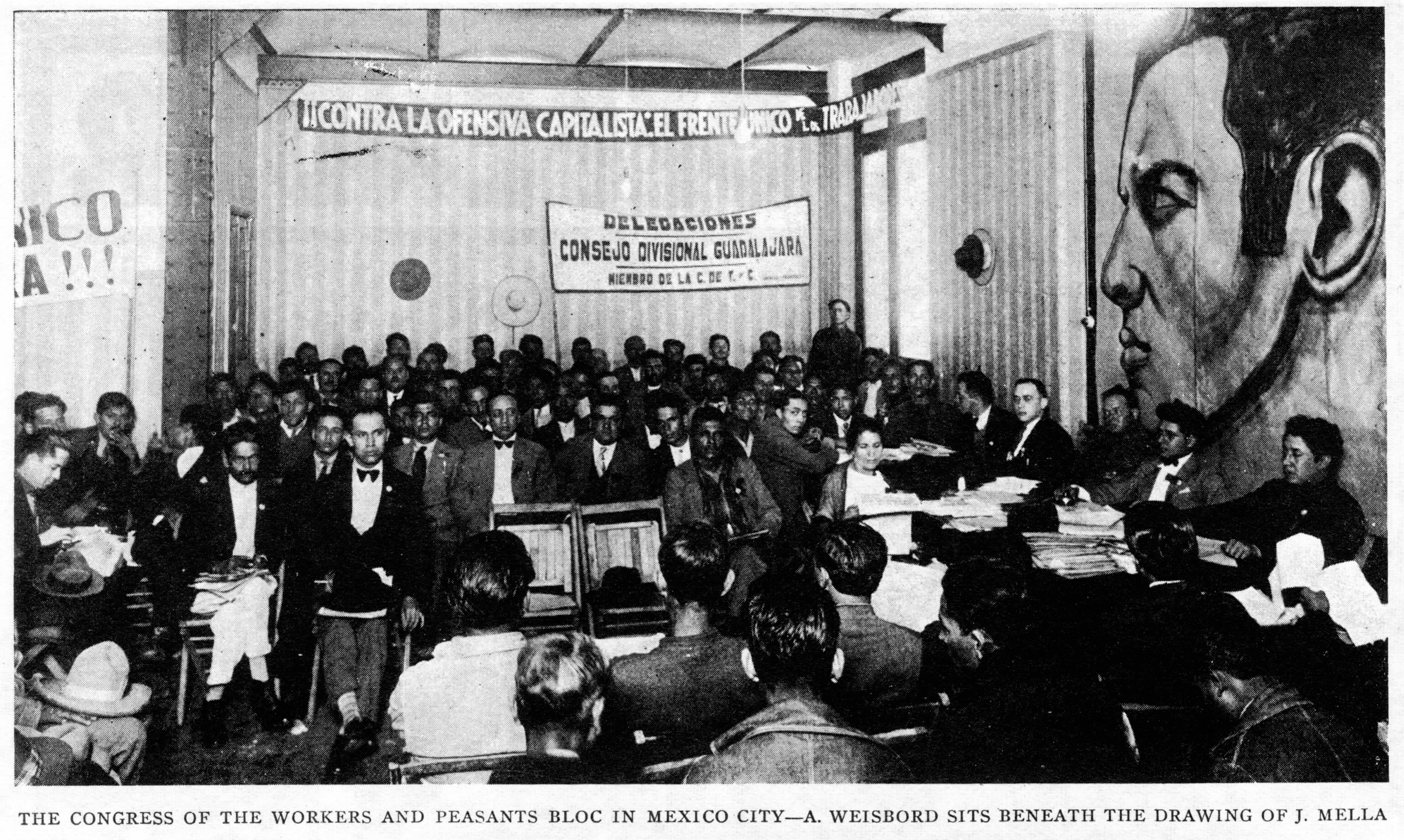
Aside from several countries, such as Mexico, Argentina, and Uruguay, the Comintern did not really begin to develop in South America until the late 1920s and early 30s. Below is a critique of the state of affairs of the Parties in the early 1930s.
‘Party Cadres in the C.P.s of South America and Caribbean America’ by J. Gomez from International Press Correspondence. 12 No. 35. August 11, 1932.
The basic shortcoming in this matter consists of the unsatisfactory social composition of the leading Party cadres (which is to a great extent a reflection of the social composition of the higher organs of the C.P.s). While the lower Party cadres (members and secretaries of the bureaus of nuclei) and the middle Party activists (members and secretaries of district committees) in the main are workers, among the higher leading Party activists i.e. members of the C.C. and the workers in its departments, the proportion of workers is insufficient and the proportion of office-workers and intellectuals, etc. is too high. On the other hand, the worker members of the leading Party organs are chiefly occupied in small and middle factories in secondary branches of industry, which greatly hinders the contacts of the C.P.s of South America with the workers in the basic branches of industry (mines, oil, plantations, etc.).
In addition to this there is another important shortcoming the unsatisfactory national composition of the Party cadres. The rise of the revolutionary movement among oppressed nationalities–Indians and Negroes–which has been noticeable recently raises before all the C.P.s of South America the urgent task of winning the leadership of this movement, converting what has up to the present been a spontaneous struggle into an organised struggle. But this task requires the formation of reliable political Party cadres from among the Indians and Negroes, who know the language and the conditions of life of the oppressed nationalities. In this respect, however, most of the Sections of the C.I. in South America have done nothing.
To some extent the C.P. of Peru is an exception. It has in its ranks several thousand Indians but so far it has promoted from among them a very small number for leading Party work. The C.P. of Brazil has several dozen leading Party workers of Negro origin in the districts. The C.P. of Mexico is now only taking the first steps to attract Indians into the Party and to promote them to the Party leadership.
The next big shortcoming is the extremely low political level of the Party cadres in the C.P.s of South America and Caribbean America. This applies not only to the lower Party activists but to the majority of the leading workers of the C.P. Frequently the leading workers of the C.P. do not even know the basic decisions of the Party and still less the decisions of the Party and still less the decisions of the Comintern. It is therefore not surprising that in a number of cases trends and ideologies which are hostile to us (anarcho-syndicalist, reformist, petty-bourgeois and bourgeois) are reflected in the practical work and even in the political documents of the C.Ps. The political past of the majority of the Party cadres in the C.P.s of South America and Caribbean America (ex-members of various anarchist groups, anarcho-syndicalist and reformist T.U.s, etc.) creates favourable circumstances for the penetration of such influences into the ranks of the C.P.s.
However, the majority of the C.P.s of South America up to the present time have not set themselves the task of politically re-educating the Party masses as a whole and the Party activists in particular, the task of raising the level of the Party cadres on the basis of the theories of Marxism-Leninism. With the exception of the C.P.s of Argentine, Brazil, Uruguay and Cuba, which have organised circles, schools and courses under the district committees and the C.C. for the study of various questions of the revolutionary movement, have formed Party schools even in the prisons, combining these forms of political study with many others such as question and answer evenings, periodical conferences of Party workers on various questions and spheres of the work, conferences of secretaries of Party nuclei, agitprops, org workers, etc. conferences and reports for the Party activists, with these exceptions, all the other Sections of the C.I. in South America and Caribbean America have done nothing or next to nothing with regard to the political re-education of existing cadres and the preparation of new ones. Here also can be felt the influence of anarcho-syndicalist underestimation of political study both by the leading organs and by the lower activists and most of the members of the C.P.
The C.P. of Mexico is a characteristic example. The Party school under the C.C. (one-month course) which has been formed for the first time during the last 3 or 4 years, began with 20 Party members but at the end of the month only 6 graduated, Such fluctuations can be explained firstly by the poor organisational work of the Party school (for which the C.C. itself is to blame) and secondly by an underestimation of the importance of political study by the Party activists.
Party literature is distributed among the Party members very badly, and finally it is practically not read not only by the rank and file members but even by the leading Party activists. On the other hand until very recently the members of the Parties in various C.P.s were still reading all kinds of literature of the anarchists and Trotzkyists which is hostile to us and had not the possibility of receiving Communist literature. Not all the C.P.s have utilised the possibility of publishing Party literature in their own country. In this respect, only the C.P.s of Argentine and Uruguay are doing definite work, while the C.P. of Chile has recently taken the first steps.
In the Party committees, work is usually done by one or two comrades but most of the comrades who are members of Party committees, departments and commissions do not regularly participate and sometimes take no part at all. There is no doubt that such practice of the Party committees is a great hindrance to the preparation of Party cadres.
Among the basic tasks which are of decisive importance for the C.P.s of South America and Caribbean America in the matter of preparing and improving the qualifications and the political level of the Party cadres, we should point out the following:
Increasing the proportion of factory workers and ensuring a majority of them in all Party organs by promoting the best worker activists from the big factories in the chief branches of industry to leading Party work, giving them every possible support on the part of the old Party workers who have experience already in leading Party work, setting up special short courses for them on questions dealing with their direct and concrete Party work and on general political questions. At the same time the policy of the proletarianisation of Party cadres must not become a weapon of struggle against leading workers from the intelligentsia, office workers, etc., who have worked for years in the C.P. and have shown their ability to carry out the line of the Party and the C.I. consistently. A struggle must also be carried on against mechanical promotion of workers to leading Party work, i.e., without taking into account their activity, Party standing, etc. and above all without giving them the necessary support in their work.
The C.P.s must take every effort to raise the political level of Negroes and the Indians among the Party members surrounding them with special attention, giving them all possible help in carrying out the tasks given to them. The C.Ps must take into consideration that in view of the different languages and distrust of the whites and even half breeds by the broad masses of the subject nationalities, the winning over of the Indians and Negroes requires the direct participation of people from these nationalities in Party work.
To prepare new Party cadres on a wider scale, the C.P.s of South America and Caribbean America must organise the collective work of all the Party committees, departments and functions among all the members of the leading Party organs, commissions (including the bureaus of nuclei), must distribute establish systematic control and verification of the fulfilment of tasks which are given to each member of Party committees. An important task is the struggle for the theoretical and political training of Party cadres on the basis of Leninism so that they will be capable of orientating themselves under all conditions, leading the mass revolutionary struggles and carrying out in practice the general line of the Party and the Comintern. This means first of all the development of a struggle against the relics of hostile anarcho-syndicalist and reformist ideology, the struggle against the still strong influence of the petty-bourgeois and bourgeois parties, groups. and trends which penetrate into some parts of the Parties.
The C.P.s must organise Party schools, circles and courses on various questions of the revolutionary movement, for studying the programme and the chief decisions of the C.I. and the C.P.s. Leninist study combined with daily revolutionary practice will be the strongest weapon for preparing and reeducating Party cadres.
The C.P.s must also raise the problem of the self-education of the Party members. While distributing Party literature, not delaying it for a single extra day, all the organs of the C.P. must set the task to all Party organisations of observing that the Party members read the literature and giving them aid by organising the discussion and study of various questions dealt with in the literature. The Party organisations must be mobilised to struggle against the distribution of anarchist, Trotskyist literature, etc. among Party members and workers.
The preparation of Bolshevik Party cadres capable of fighting for the general line of the C.P. and the C.I. presupposes the mobilisation of all the Party masses in the struggle against deviations from the line of the Comintern, against any manifestation of Right and “Left” opportunism. However, up to the present in most of the C.P.s the struggle against deviations and opportunist mistakes was a matter only for a narrow circle of leading Party workers and not for all Party members. This abnormal state of affairs must be radically changed. The C.P.s must develop Bolshevik self-criticism from top to bottom directed towards the improvement of the work. The C.P.s must bring all the Party members into the discussion of the chief questions of Party life, Party decisions and everyday work on the basis of the development of self-critiscism.
International Press Correspondence, widely known as”Inprecor” was published by the Executive Committee of the Communist International (ECCI) regularly in German and English, occasionally in many other languages, beginning in 1921 and lasting in English until 1938. Inprecor’s role was to supply translated articles to the English-speaking press of the International from the Comintern’s different sections, as well as news and statements from the ECCI. Many ‘Daily Worker’ and ‘Communist’ articles originated in Inprecor, and it also published articles by American comrades for use in other countries. It was published at least weekly, and often thrice weekly
PDF of full issue: https://www.marxists.org/history/international/comintern/inprecor/1932/v12n35-aug-11-1932-Inprecor-op.pdf
 Revolution's Newsstand