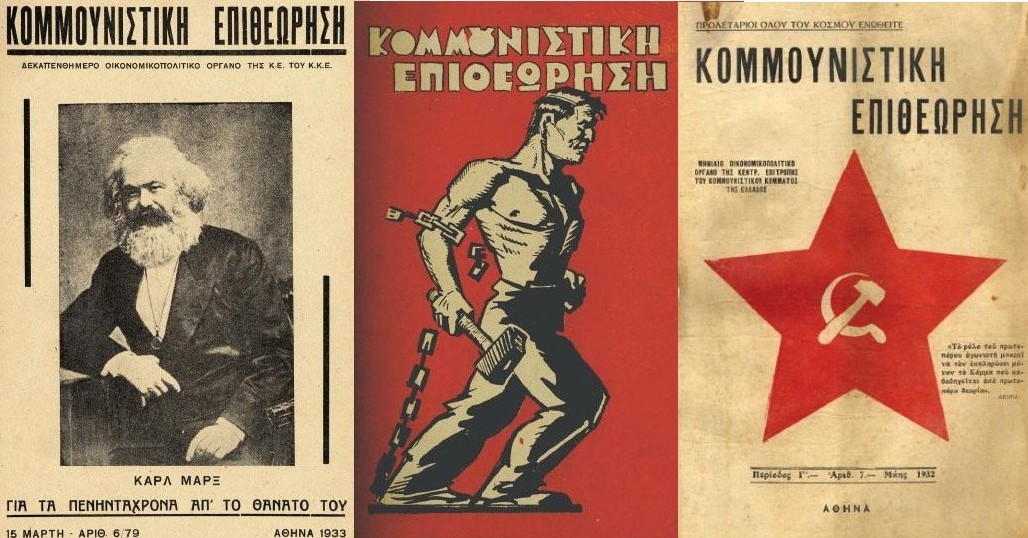
Greek representatives to the Comintern give this rather scathing review of Party work as the Great Depression began. The following year, the Party’s leadership would be overhauled with Nikos Zachariadis rising to chair for the first time.
‘The Revolutionary Rise in Greece and the Tasks of the Communist Movement’ from Communist International. Vol. 7 No. 5. May 1, 1930.
(From the Report of the E.C.C.I. Delegation)
I. THE ECONOMIC AND POLITICAL SITUATION OF THE COUNTRY.
WE are only going to deal here with the most important features of the situation and the deductions to be drawn.
A profound and serious crisis prevails in the entire economic system of Greece, and is inevitably bound up with corresponding phenomena of crisis in all spheres of social life and of the class struggle.
As a consequence of this situation, there is a general bourgeois offensive on wages, working hours, and the various conquests of the working-class. (This is the significance of the employers’ memorandum of January, 1930, the wave of strikes, etc.)
The most important cause of the crisis is the failure of the attempts of the bourgeoisie to heal the wounds made upon the economic system of this small country by the four wars conducted during the last twenty years (two Balkan wars the world war and the Greco-Turkish war) and
The bourgeoisie has tried to bring about stabilisation. This stabilisation has always been thoroughly shaky, more unstable, in fact, than the partial stabilisation achieved in other countries. At the present time it is clear, even to a large section of bourgeois economists, that in Greece these attempts have failed.
All sections of the bourgeoisie are now primarily occupied with the question of this crisis, its causes, its consequences, its prospects, and the ways of overcoming it. Every day sees the organisation of conferences of bank directors, chambers of commerce and industry, and various other institutions—all on the theme of the crisis. Even the government theoretical economists openly admit that the country is experiencing a serious economic crisis which has not yet reached its zenith.
This state of affairs naturally leads to accentuated contradictions and struggle, between the bourgeoisie and the working-class on the one their consequences.
hand, and between the bourgeoisie and various strata of the peasantry (including considerable sections of the middle peasantry) on the other. More than one-third of the entire working-class was affected by the growing strike wave in 1929. In that year there were, throughout the country, sixty big strikes, in which more than 50,000 workers took part, if we also include the August 1st demonstrations, 300,000 days were lost owing to strikes. Mass strikes broke out even in those branches of industry (such as textile production), where we have hitherto had practically no influence, and where 97-98 per cent. of the workers were not organised. During the strikes, in the majority of cases, there was almost 100 per cent. stoppage of work.
NEW STRIKES IMMINENT.
At the present moment there are no big strikes in progress, but all the Greek comrades think it would be wrong to assert that the strike-wave has slowed down. A number of new strikes are to be expected in the immediate future. A strike of agricultural labourers is now in progress at Volossa, while in the Piraeus there is a movement in the tobacco industry, where unemployment is still rampant despite the fact that seasonal unemployment has usually already ended by January. Furthermore, in the next few days, or at any rate the next few weeks, a strike of workers is expected on the island of Mitylene and a railwaymen’s strike in the Peloponnessus (over more than 700 kilometres of the line). In general, the position of the railwaymen is very serious; they have not received wages in the Peloponnessus for several weeks. (All the railway system of Southern Greece is in the hands of one company, which now, as a result of the failure of certain banks, is itself faced with a crash.) On railways in other parts of Greece wages have also been in arrears for a long time. This is a highly important factor, because as is known, our influence among the railwaymen is at present extremely small, and if we work on the right lines in connection with this movement we can considerably increase it.
The employers are preparing a brazen attack on the working-class. They demand (in their notorious memorandum) reductions in wages and social insurance, increased working hours, intensification and “better” organisation of the labour process (rationalisation), etc. This will undoubtedly cause an increase in the strike wave during coming months.
Ferment also continues amongst the peasantry. The chief problem of this peasant movement is the tax question, and the demand for material assistance for ruined agriculture. Cases of exacting taxes and debts by force are becoming more and more frequent, so that on this question even the bourgeois opposition is conducting a “fight” against the government.
This prolonged and growing peasant movement in many cases is of a spontaneous nature, although it often happens that in a particular village this movement is led by communists. The Agrarian Party (reactionary party of rich farmers) who put forward a demagogic programme of reformist partial demands and slogans (cheap credits, agricultural co-operatives, reduction of taxes, rationalisation of certain branches of agriculture) are trying to get the upper hand in this movement. They are often unsuccessful in this. While their basis among the peasantry is extending, the movement as a whole is proceeding sporadically, often being of a purely local nature; and it would therefore be erroneous to conclude that the whole movement is under the influence of the agrarians. But she possible conquest by the agrarians of the leadership of this movement, and their temporary suppression of revolutionary tendencies, constitutes a very great danger.
It is important to note that of late there have been increasing cases of peasants fleeing to the mountains and woods. The bourgeois press speaks of these events in a very calm manner.
EFFECTS ON BOURGEOISIE.
On the other hand, the crisis was bound to have a serious influence on the bourgeois camp and on its directly ruling class. The governmental bloc, which until recently had been very strong, and was led by the old fox Venizelos, has already split up. The influence of the Venizelists, who have an absolute majority in parliament, has declined considerably. The oppositionist Monarchist Party (headed by Zaldaris) has intensified its struggle against Venizelos, apparently not without some success. The supporters of General Kondilis, who played a leading role in the overthrow of the dictator Pangalos (1926), have left the government.
Inside the Venizelos party a strong opposition wing has crystallised, operating with “Left” phrases and headed by the second party leader, Kafandaris. In the Venizelos Party there exists yet another wing, which in words is still more “Left” than the Kafandaris wing (those grouped around the paper Imezthis Tipos).
Venizelos is doing everything possible to keep afloat. Every day he is holding conferences with bankers, industrialists, business men, etc., in which he speaks on all questions, makes appeals to all classes of the population (including the working-class) and endeavours to camouflage internal difficulties by imaginary and negligible successes in the realm of foreign policy (for instance, a certain reduction in Greek indebtedness, obtained at the Hague Conference).
The opposition movement against Venizelos is headed by General Kondilis, mentioned above, who returned from France two months ago, where he had been sojourning for a long time, challenging the government with a fascist programme. He charges the Venizelos policy with being incapable of solving the crisis, asserts that another method must be found, and appeals, on the one hand, to his “friends of the army,” and on the other hand—to the people. His programme is: “Every Greek must be well-fed,” and he is trying to put the programme into action. He thinks that Greece is weak as a military force, that she should be considerably strengthened, and puts forward an openly imperialist programme. At the same time, he uses extremely demagogic “Left” phraseology. He speculates in particular on the peasant movement, and has already entered into a bloc with the Agrarians. He has a strong influence over the army officers. It is very probable that with the support of French military circles (as opposed to Venizelos, the direct agent of British imperialism) he will prepare a military coup d’etat on fascist lines (“Left” demagogy, and alliance with the rich farmers). Unfortunately, until we arrived, our Party did not understand this danger. We will describe below the attitude of the Party on this question.
In any case, this fact, in our opinion, is of great importance. If the Party fails to realise this danger, and does not mobilise the broad masses against these fascist groupings, at the same time not slackening its fight against Venizelos, the very real danger will arise that we shall have in Greece in the near future, an open fascist regime under Kondilis, that Greek expert at military coup d’etat and proclamations.
II. THE CONDITION OF OUR MOVEMENT.
In estimating the condition of the Party in Greece, we must say that after having studied the position on the spot, conferring with many comrades there, and investigating the state of our organisations (it is true, only superficially so far, but sufficiently for our conclusions) we have arrived at the following opinions: There is a correct appreciation of the general position in the country, both economically and politically. But the position of the Party and the trade unions,— their strength, their line, their efficiency and their preparedness to lead the struggle (which is bound to be developed by the objectively favourable situation)—are worse, feebler than we expected.
The Party leadership is very weak, and many big opportunist mistakes have been made. A number of strikes and workers’ and peasants’ movements have developed without the knowledge and without the intervention of the Party. The problem of a general strike or of a political mass strike is very hazily understood, even in Party circles and among the T.U. leadership. After putting forward the slogan for a general strike, the Party has done practically nothing for the last two months in order to prepare itself and the working-class for the putting of such an ambitious slogan into operation. A few leading articles were written, and that is all. The comrades wanted to continue a rather abstract discussion for two months, and only then to commence practical work among the masses. Such a situation and such errors naturally had an unsatisfactory effect organisationally. The Party has 1,500 members. The influence of the Party in the factories has organisationally declined. The circulation of the Party newspaper, which in July last was still 3,000, has now fallen to 1,666. Absolutely no work has been conducted among the peasantry, and in the army and fleet it has only improved in the past few months. In response to the prohibition of the Unitary trade unions, no counter-action was undertaken. The Party knew that various strikes were about to take place, but until the Plenum of the Central Committee, nothing was done in preparation for them, or to assure our leadership of them. Everywhere one comes up against an under-estimation of organisational work, opportunist practices and often an opportunist standpoint. “Left” phrases and sectarianism are also frequent. What surprised us most of all was that there were no signs of the Party and trade unions being in the state of mobilisation which was demanded not only by the situation, but also by the estimation of the Greek comrades themselves.
To all this must be added the fact that self-criticism, particularly among the party leadership, is almost non-existent in the Party.
The trade union newspaper comes out irregularly, while the peasant paper no longer appears at all.
There was no systematic plan of preparation for the general strike. It is highly characteristic that the Party C.C. ever since the appearance of the open letter (November, 1930) and to this very day, has not issued a single instruction to Party organisations, has not sent out a single circular, on the tasks connected with the general strike.
In Athens the Party has only 170 members and in the Piraeus (one of the most important working-class centres) only 70 members.
III. THE MAIN ERRORS OF THE PARTY AND TRADE UNIONS.
We consider that in spite of all these shortcomings the slogan for a mass strike can be put into effect. It is true, the time of the mass strike will have to be postponed for a month or two (in accordance with the development of the movement, etc.). It would be a very big mistake, if, owing to subjective errors and weaknesses, no attempt was undertaken to make the fullest possible use of the objectively favourable situation. Moreover, the prerequisites for a rapid improvement in the condition of the Party —given a correct policy, correctly carried out by a good leadership—already exist. It should also be borne in mind that in Greece the factor of spontaneity plays a fairly large part. Even in the history of the last two weeks, cases have been observed where an active movement of the unorganised masses has led to a considerable improvement in the work of the Party organisations.
The general standpoint of the Party on the question of the strike must be recognised as correct, but we would emphasise that it is not sufficient merely to confirm this general standpoint, but to emphasise its errors and defects, and to elucidate the means of removing them. We now wish to acquaint you, in general terms, with the chief omissions and mistakes.
(1) Confused notion as to the nature, objects aid stages of the general strike. The comrades have acted, one might say, fatalistically: We will announce a general strike, and the trend of events will show what the result will be. It was quite correct to adopt the resolution for the preparation of mass political strikes. At the same time the partial demands were not linked up with the slogan for the overthrow of Venizelos.
(2) The so-called theory of stages. Comrades pictured a general strike and the preparation for it in the form of pre-conceived and arbitrary stages. They produced the slogan. Then they resolved that it should be discussed for several months in the Party and trade unions: that was the first stage. Then Party conferences were to be convened everywhere—the second stage; and only after that was the real mass work, election of councils of action, etc. (the third stage), to commence. With this theory of stages is closely connected—
(3) Schematic manner dealing with the general strike question. The comrades resolved precisely when the respective stages of this programme should end and when the general strike should begin.
(4) Failure to understand the importance of the general strike slogan. Leading comrades have not sufficiently clearly understood what a serious question the conducting of this strike is. They issued the slogan and during two-and-a-half months did absolutely nothing in practice (except as above-mentioned, a few newspaper articles and platonic statements about solidarity at some workers, meetings) in order seriously to prepare for the carrying out of this slogan. Apart from the open letter, the C.C. did not send out a single organisational or political instruction to Party organisations. Preparatory work in the factories was not undertaken at all.
(5) The estimation of the general strike as the only means of overcoming the weaknesses of the Party. In the open letter of the C.C. there is one passage which practically states that the problem of the general strike is at the same time the problem of turning our organisations into mass organisations. The view even exists in the Party that in the Second Period the Party could not be a mass Party, but that the Third Period provides this possibility. It is true, that this view was disputed by the Party leadership.
(6) Under-estimation of partial strikes and partial movements. We will not deal here with the numerous errors committed by the Party in regard to the many strikes that took place prior to the issue of the general strike slogan. It has been established, that certain big strikes (such as the chemical workers’—5,000 out, and the textile-workers’—8,000 out, etc.), broke out quite unexpectedly for the Party, that in certain strikes Party work was more than feeble, etc. But it is also clear that the comrades did not take up the right attitude on the question of partial strikes, even after the general strike slogan had been launched. At any rate they did not do so in practice. Their resolutions never spoke of the necessity to organise partial strikes, extend them, and join them up with the general strike. The formula they contented themselves with, however, was approximately as follows: we should not counterpose partial strikes to the general strike. In practice this attitude to an extent led to the postponement of partial strikes (as in Mitylene, Lorion) and at other times to passivity in the matter of organising partial strikes. Such an attitude is dangerous in so far as a number of such partial strikes are imminent in the near future.
(7) Failure to react to the prohibition of the trade unions and to the recent blows of the government against our movement. The Venizelos government is conducting very clever tactics in regard to our movement: to break it up piecemeal before we are in a position to conduct the general strike. At first the trade unions were only prohibited in certain places (Drama, Arginion). The prohibition emanated from the local authority, and supposedly owing to “local” causes; then the Unitary Confederation was prohibited, i.e., not separate unions (which still continue to exist legally), but the Unitary Confederation uniting them. Then came the prohibition of the I.C.W.P.A. Now they are preparing to prescribe the Tobacco Workers’ Union (our strongest source of support). There came the prohibition, not of the actual publication of our newspaper, but of its circulation by post or rail. Thus gradually, noiselessly, and outwardly “innocently,” one blow falls after the other and our comrades have not understood this plan, and have not reacted to it even now. The Political Bureau has not even discussed this question. The Central Council of Trade Unions issued a statement saying, in rather mild and concealed phrases, that the Unitary Confederation, despite the prohibition, would continue its work and that the working-class would respond to the ban by intensively preparing for the general strike. And that was all. At various workers’ meetings, called for other purposes, resolutions of protest were passed. Only at Salonika and a few other places in Northern Greece did matters go as far as mass-demonstrations on the initiative of the localities.
(8) There was no political consideration of the question of the alliance of working-class peasantry. As is known, the wave of the peasant movement has not yet broken. According to approximate calculations, about 40,000 peasants took part in this movement (peasant meetings, demonstrations, armed encounters). After the Party had advanced the slogan of the general strike, it did not bring up the question of the alliance of the proletariat and peasantry as a necessary pre-requisite to victory. Up to the present day the Party has no programme of demands for the peasant movement. As we have already pointed out, it has sometimes happened that our organisations or our comrades have played a leading part in peasant risings. But the C.C. has no good contacts with its organisations in the countryside. For the most part, it does not know the attitude of our comrades in such events, or only finds out about it from the bourgeois press. There have been cases where our comrades collaborated with representatives of the reactionary agrarian Party. Until recently there has been repetition of such errors as the demanding of cheap credits for the peasants, etc.
(9) Insufficient work in the army and fleet. During the last few months this work has deteriorated. In connection with the general strike there was no political or economic presentation of the question of a united front between the workers and peasants in the barracks and the navy. Up to now work has been conducted mainly from the viewpoint of the solidarity of soldiers and sailors with the workers on strike. Very little has been done to develop simultaneously a soldiers’ and sailors’ movement with its own demands.
(10) Belated appreciation of Kondilis’ fascist movement. Only when we had arrived, and on our insisting, did the Party leadership make a correct estimation of the growing fascist movement, led by Kondilis. The work of exposing this movement before the masses had not yet begun. It is interesting to note that in discussing this and other questions in the Polit Bureau, a mechanical viewpoint was revealed. Very little comprehension of real dialectics and of the concrete class struggle was shown. The comrades were inclined to try to fit it into rigid schemes constructed on the basis of books, or of international resolutions; but as to any specific features which were not to be found in these schemes, they were very unclear. As we have already said, the Party will continue in the future to concentrate all its efforts against the Venizelos government, but will at the same time expose no less energetically the fascist nature and plans of Kondilis and the Agrarians.
(11) Passivity on the national question. Up to now the Party has not conducted practical work among the oppressed nationalities and minorities being content with merely putting forward the slogan: “An independent and united Macedonia and Thrace” in all the official Party documents. We should not only support the fight of the oppressed peoples, but stimulate these masses to this struggle, taking the lead of it, and endeavouring to combine it with the struggle of the working-class. This does not mean that we should organise a national revolutionary party. We are organising the mass struggle of the oppressed nationalities.
(12) Absence of an illegal apparatus and of increased preparations in view of the illegal position which will become inevitable with the further development of the fight.
(13) Absence of self-criticism of the Party leadership. Comrades in the Party leadership favour self-criticism, but only criticism of the Party organisations! Criticism in respect of themselves, recognition of their own errors, is a weak spot in the work of the Party leadership.
(14) Sectarianism and under-estimation of organisational work is to be observed in the Party. This is particularly so in the trade unions—from top to bottom. The Greek comrades are capable of talking for hours and days on political themes, of continuing abstract discussions, of discoursing endlessly about the “problems of the third period,” etc., but the work of the organisation down below, among the masses, in the factories—this is the weakest aspect of our Greek movement.
It stands to reason that all the above errors are closely connected one with the other, in fact, one develops out of another. A number of errors have been committed in various strikes and in the trade union work in general.
The question naturally arises—What remained after all those errors? Was the attitude of the Greek comrades in general, in principle, correct in regard to the general strike? To that we reply most decidedly in the affirmative. The position of the workers’ and peasants’ movement is such that it is absolutely essential to bring their fights up on to a higher plane, and in that the Greek comrades were quite right. For this reason, their main standpoint on the question of the general strike, despite all the omissions, must be confirmed.
IV. INNER PARTY LIFE.
The critical situation in our movement was bound to cause an inner-Party discussion. Inside the Polit Bureau in which only a few months ago there were no differences whatever, two groupings have recently arisen, we all have fought each other, although there has not always been an open fight.
We are firmly convinced that there do not exist between the two groups any cardinal political differences such as would justify an internal-Party struggle. Apart from trivial matters, we were able to distinguish the following four questions on which differences existed: (1) Estimation of the line of the Fourth Party Congress, (2) self-criticism and collective work, (3) nature of the revolution in Greece; (4) differences on trade union questions.
Only on the first two points are the differences of political importance. As to the nature of the revolution, the comrades have not yet a firmly established and thoroughly thought-out view; in our opinion, all the comrades are extremely confused on this question.
Differences on the first point (estimation of line of Fourth Party Congress) arose in estimating the present unsatisfactory position of the Party and its causes. Some comrades asserted that the cause of the present position and of all the errors made, was the fundamentally incorrect general line of the Fourth Party Congress. Other comrades, on the contrary, held the view that the Party line has all the time been correct in its essence, and that the main source of these evils is the practical opportunism with which the Party is saturated through and through.
Great mistakes were indeed made at the Fourth Congress, the majority of which were criticised in the letter from the Executive Committee in May, 1929. At this Congress the Party leadership opposed those comrades who wanted to emphasise still more the instability of stabilisation. There was in general, no reference to the Third Period in the decisions of the Congress. We consider that these errors of the Fourth Congress are the fundamental and prime cause of other mistakes made subsequently.
ABSTRACT DISCUSSION NOT NECESSARY.
The danger existed, however, that the comrades would concentrate their attention on a rather abstract discussion (with long quotations and general theoretical arguments as is customary in Greece) instead of getting down to the question as to why the Party did not advance, though it had a line approved by all comrades, and what should be done so that the Party could accomplish the tremendous tasks facing it. It was for that very reason that the above-mentioned C.I. letter pointed out categorically that despite many Right errors, the main lines of the Fourth Congress (which, for example, quite correctly resolved to exclude the right wing Maximes group, and the conciliators) were correct. It was thus all the more necessary to oppose an abstract discussion at the present juncture. On this controversial question both groupings were wrong. The basic line of the Fourth Congress was correct, but the Congress laid the foundations for a number of errors which were sharply criticised by the C.I. The Party was too late in detecting the commencement of the revolutionary wave, too late in detecting the elements of decline in the attempts at capitalist stabilisation, committed a number of serious political errors, and, most important of all, until quite recently, was opportunistically passive in practice and actually conducted a policy of “dragging at the tail of the movement.” The main cause of that situation consists in the incorrect handling of the Party organisations and incorrect guidance of the Party membership by the leadership, who, even after grasping the situation, drew no conclusions as to practical work. In addition to the recognition of these errors, discussion should be centred on an examination of the immediate political and organisational tasks.
On the question of self-criticism, we think the reproaches levelled against the leadership of the Polit bureau, are on the whole, justified.
The Polit Bureau works badly, its contact with the organisations is weak, and it is dominated by a spirit of politics for politics’ sake, as a result of which the workers, who constitute its majority, cannot sufficiently well get down to their work. There is no division of labour, in the true sense of the term, and no departments or commissions in the Polit Bureau.
As we plainly informed the comrades, we consider that in spite of all their differences, a fractional struggle is impermissible. The Party has made very grave errors, and for these errors the whole leadership is responsible. All the comrades should therefore finally and consistently recognise these mistakes, and, on the basis of the Plenum decisions, should conscientiously carry out their work wherever the Party has sent them. The delegation cannot support either of the two groupings. There are no political grounds for justifying an inner-Party struggle. In discussing the questions in dispute, both sides displayed unhealthy tendencies which must be energetically rebuffed.
The ECCI published the magazine ‘Communist International’ edited by Zinoviev and Karl Radek from 1919 until 1926 irregularly in German, French, Russian, and English. Restarting in 1927 until 1934. Unlike, Inprecorr, CI contained long-form articles by the leading figures of the International as well as proceedings, statements, and notices of the Comintern. No complete run of Communist International is available in English. Both were largely published outside of Soviet territory, with Communist International printed in London, to facilitate distribution and both were major contributors to the Communist press in the U.S. Communist International and Inprecorr are an invaluable English-language source on the history of the Communist International and its sections.
PDF of full issue: https://www.marxists.org/history/international/comintern/ci/vol-7/v07-n05-may-01-1930-CI-riaz-orig.pdf
 Revolution's Newsstand