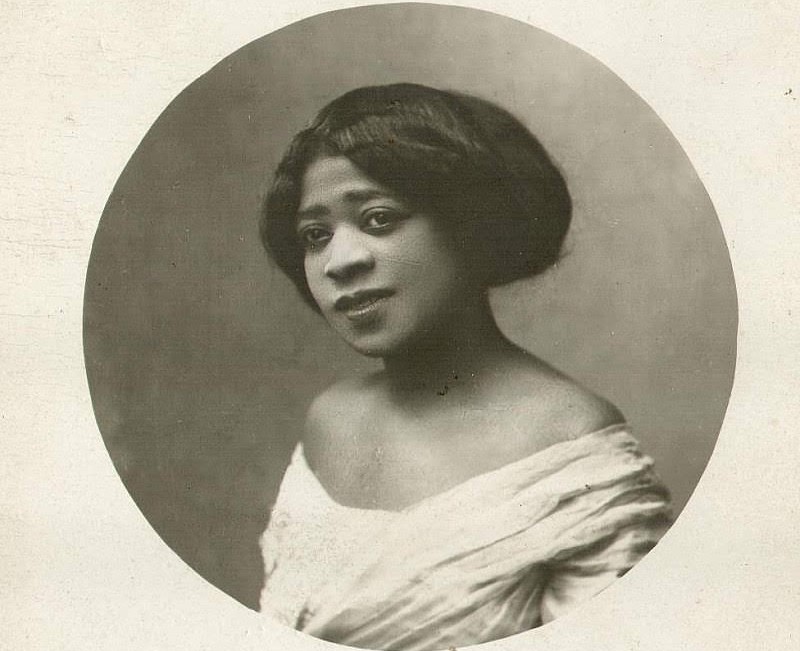
The extraordinary life of Coretti Arle-Titz, who would continue living in the Soviet Union until her 1951 death.
‘A Black Woman in Red Russia’ by Chatwood Hall from The Crisis. Vol. 44 No. 7. July, 1937.
Once a school girl on the upper West side of Manhattan, New York City, this colored woman has become a noted concert artist in Soviet Russia
During the hectic days of the World War a young brown girl strolled through the Summer Garden in St. Petersburg. On one of the sun-kissed promenades she met several big-chinned Tsarist officers promenading with their elegantly and fashionably-dressed ladies.
“What a cute African girl that is,” remarked one of the women to her companions.
One of the officers glanced in the direction which the woman indicated by a nod of her head, immediately withdrew his glance, simultaneously expectorating on the lawn. His conduct was not unusual for military officers and other officials in the Tsarist government service. It was customary for them outwardly to show their “Great Russian” chauvinist contempt for minority and supposedly “lower” races. In the Tsarist imperialist colonies in Turkestan and in other parts of the Russian Empire they spat on the minority peoples; against the Jews they incited bloody pogroms.
By 1924 the “cute African girl” had grown to womanhood, had finished her musical education in both the Petrograd (formerly St. Petersburg, now Leningrad) and Moscow Conservatories of Music, and on April third of that year made her first public appearance on the stage of the Bolshoi theatre in Moscow.
“What was your reaction to this first appearance, especially inasmuch as it occurred in Russia’s greatest and most famous theater?” I inquired.
“Although it seemed at the time a bit of boldness on my part, I eagerly awaited the day,” replied Coretti ArleTitz. “The audience included many of the leading figures in Moscow musical circles, come to see and hear a Negro woman sing the whole evening through not only in Russian music, but also in the Russian language. The great applause which the audience gave me caused my seeming boldness to be replaced with confidence. I can never forget that evening.”
Honored on Radio
In the winter of 1934 the Moscow Radio Center gave a special radio evening in honour of “one of the best known artists on the Soviet concert stage” and to mark the tenth year of Coretti Arle-Titz’s concert work in Soviet Russia. In announcing the program the director of Radio Center said: “Coretti Arle-Titz has appeared in regular concert work in the Soviet Union for ten years with great love and popularity.”
Coretti Arle-Titz had just returned from Archangel, deep in the Arctic Circle, when I went to visit her in her apartment on the Ostozhenko, a district formerly occupied by rich Moscow merchants in pre-Revolutionary days. Plain Soviet citizens like Arle-Titz and her husband, Professor Boris Titz, well-known professor of the piano in the Moscow Conservatory, now occupy the comfortable apartments of the former Muscovite mercantile men.
“I suppose you want to begin from the beginning,” said Arle-Titz, as my note-book and pencil came into view. “I was born in Mexico, but I remember little about that country, because I was taken to New York when I was just a baby. About New York I also do not remember very much, it was so long ago.”
“There can sometimes be much in little” interposed Professor Titz from his Mme. Arle-Titz and one of her young admirers seat near the ice-covered window.
“In everyone’s life there must be some unforgettable moments, though,” I added encouragingly.
“After leaving Mexico my mother went to work in a hotel in the Catskill mountains. From there she got a job in a boarding house in New York City. I was then six years old. Later, my mother entered me in a public school on Ninety-Eighth street and West End avenue. And something happened there that I can never forget; it had much to do with my coming to this part of the world.”
During a spring cantata, related Arle-Titz, the pupils, not finding her present, and knowing that she had one of the best voices, asked the music director why she was not participating. He replied: “It is impossible to use her; she is only a little black girl.” From this day she was determined to avail herself of the first opportunity to flee from America’s race prejudice to some country in Europe, she knew not which one.
Taken to Germany
It so happened that a visiting German woman by the name of Kohn-Wollner visited Mount Olive Baptist church in New York City. Young Coretti was a member of the choir, and her voice so attracted Madam Kohn-Wollner that she forthwith made arrangements to take the girl to Germany. But Germany soon palled on her and she decided to come to the land of Pushkin. That was in 1913, a year before Tsarist Russia, ironically enough innocent of democratic government, hurled her oppressed and exploited millions into the imperialist slaughter to make the world safe for democracy!
“Have you been back to America, Citizen Arle-Titz?” I asked.
“Yes, once I returned to America to see my mother, but my heart remained in Russia, where among the Russian masses I could forget that I am coloured. I found America, with its oppression, frustration, Jim Crow, and hypocrisy, unbearable, and soon returned to my beloved Russia.”
Intense musical training in the Conservatory in St. Petersburg (now Leningrad) followed, supplemented simultaneously by private lessons under the noted professor, Svansiger. Then came her first invitation to sing; it was to be an extremely private appearance, and satisfaction and pride were plainly visible in Arle-Titz’s brown face when she related the source of this first invitation. Many an artist would consider it the highlight of his or her career to be invited (or rather commanded) by some crowned head or “blue blood” to sing. But not so Arle-Titz.
One day there came to her a serious and earnest, though kind Russian by the name of Nicholas Burenin with a request that she come and sing at a workers’ meeting at one of the Petrograd industrial plants. She accepted. Her first concert, she later learned, had been performed for a group of revolutionaries; Burenin was an underground revolutionary worker and a staunch Bolshevik. Young Coretti was now becoming acquainted with the people in Russia who did not despise a “cute African girl” or any other national minority peoples.
Through the Bolshevik, Burenin, she met many of the Petrograd revolutionary intelligentsia—actors, composers, musicians, art workers, writers, etc. It was Burenin who introduced her to the noted Soviet writer, Maxim Gorki, who was her close and admiring friend until his death in 1936. Coretti Arle-Titz reached onto a writing desk and handed me a picture of Gorki. It was autographed: “To dear and beloved Coretti Arle-Titz”—Maxim Gorki.
From her revolutionary acquaintances and from long periods of residence in Russian villages, Arle-Titz became intimately familiar with Tsarism in action. The Tsarist gendarmerie and secret police, she remarked, shadowed and hunted down leaders of the Russian working class with unrelenting fury and brutality. Thousands of the best leaders and teachers of the Russian proletariat rotted in exile in Tsarist Siberian prisons. Nevertheless, the Russian toilers proved themselves masters of illegal and underground activity.
“Many of my early years in Russia were spent in the villages,” stated Arle-Titz. “There I became intimately acquainted with the life of the Russian peasantry and learned at first hand of their miserable condition. They lived in poverty, ignorance, and filth. From the cradle to the grave their life was spent absolutely under the interlocking power of the landlords, the church and the Tsarist government.
“While many of them had use of small strips of land, this was not sufficient to support them and, consequently, they had to work an allotted number of days on the vast estates of rich landlords or for kulaks (rich peasants). Whenever the poor peasants could not pay their taxes the Tsarist village police came and took horses, cows, hogs, and anything of value. The peasants merely wept and declared that it was the will of God, that thus it always had been and so it must always be.”
Sang for Revolutionists
The Revolution of 1917 found Arle-Titz in Petrograd. Later, during the height of the Civil War, famine and foreign imperialist intervention, Arle-Titz found herself in Kharkov, the Ukraine, in the center and at one of the very fronts of the struggle. When the Red Army drove out the “whites” and interventionists, young brown Arle-Titz became one of their favourite singers in their barracks, camps and clubs. She handed me a document of those bitter days. It read: “Tovarisch Coretti Arle-Titz served on the South-West front of the Red Army in 1918, 1919 and 1920, with headquarters at Kharkov, in the Political Department,” Recalling those stormy days, when the combined intervention of European, American and Japanese troops threatened the very existence of the young Soviet Republic, Coretti Arle-Titz remarked:
“The kindness, love and attention which the workers and Red Army men heaped upon me is unforgettable. I especially remember that, following one of my concerts for them, tea was served in the dining room, but there was no sugar. When it became known that I did not relish tea without sugar, the Red Army men took their ration of sugar from their pockets and laid it in front of me.”
It was during those days that Arle-Titz first began her artistic career with her present husband, Professor Titz. Since then, they have been inseparable companions. They have gone on concert tours from the Arctic Ocean to the borders of India and from the Baltic Sea to the Pacific Ocean. Their concerts, with Professor Titz at the piano, have been, and are, musical events in countless Soviet cities and villages, on dozens of collective farms, and at Red Army posts and in workers’ clubs. Invitations for tours throughout Europe have been refused, so anxious are the two artists to devote their artistic talents solely to the cultural demands of the Soviet masses.
Under Three Flags
During her continual concert tours, Coretti Arle-Titz is always asked to sing before the leading government officials in the different Soviet Republics. All of her tours are under the auspices of the State Philharmonic, under the direction of which she has appeared since 1925.
“Please mention some of the differences and changes, in your field, between conditions under Soviet power and conditions under Tsarism,” Arle-Titz was asked.
“To begin with, during my school days I had to pay well for my musical education. Conditions are different now, since the working class runs the state. Students now receive free tuition from the Soviet state, besides receiving a monthly money stipend. Besides, there is no discrimination on grounds of race or nationality in the Socialist society.
“But these wider opportunities and this splendid assistance places great demands and responsibilities on musical students, for Soviet audiences are well-informed, critical and demand that the artist give only the best.”
When she first entered the Russian musical world, Arle-Titz said that the masses of the people had neither the means to enjoy, nor the cultural appreciation of the theatrical and concert world. Audiences were then composed of the rich, the nobles and the aristocrats. Now the cultural level of the masses has been raised to such an extent that the theaters and concert halls are filled with factory workers, collective farmers, Red Army men, chauffeurs, street car conductors and motormen and others who toil.
“You have lived under the American flag, the Tsarist flag, and the Red Flag, Citizen Arle-Titz. Under which flag have you found greatest happiness, freedom, joy?”
“Under the Red flag, of course,” she answered, as she reminded the writer that in an hour she must be at the House of the Press for a concert, her last in Moscow before leaving for engagements in Odessa on the Black Sea.
The Crisis A Record of the Darker Races was founded by W. E. B. Du Bois in 1910 as the magazine of the newly formed National Association for the Advancement of Colored People. By the end of the decade circulation had reached 100,000. The Crisis’s hosted writers such as William Stanley Braithwaite, Charles Chesnutt, Countee Cullen, Alice Dunbar-Nelson, Angelina W. Grimke, Langston Hughes, Georgia Douglas Johnson, James Weldon Johnson, Alain Locke, Arthur Schomburg, Jean Toomer, and Walter White.
PDF of full issue: https://archive.org/download/sim_crisis_the-crisis_1937-07_44_7/sim_crisis_the-crisis_1937-07_44_7.pdf
 Revolution's Newsstand