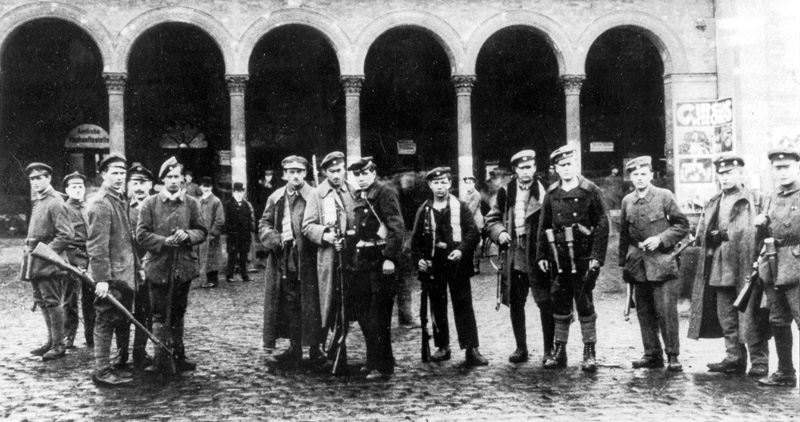
The history of the precariously short-lived Bavarian Soviet Republic and the specific circumstances in which it came into being.
‘A Soviet Republic in Bavaria’ by Victor Roebig (Alfred Kruella) from Communist International Vol. 1 No. 2. June, 1919.
The first question that presents itself if one sets about analyzing the chances for the development of the Soviet Republic proclaimed at Munich in the beginning of April is, how do matters stand as to the organisation of the Soviets in Bavaria. For clearly, the proclamation of Soviet government in the capital of a country is reasonable only if local organs that can and will be instrumental to the proletariat taking over the power in the whole country exist everywhere. That is to say, a Diet, its members, electoral districts and voters can be eliminated only if a capable soviet congress and a whole mechanism of district, parish and factory councils can be put in their place. How about this in Bavaria?
A clear answer to this question is furnished by the first attempt to establish a Soviet government in Bavaria made at Munich after the assassination of Eisner at the end of February, as well as by the form in which this event took place. The revolutionary provisional Central Council, formed in the first days out of the strongly radicalized Munich councils, immediately summoned a general congress of the councils that was to invest the Central Council with a mandate, thereby constituting itself as the supreme governmental power. But the councils’ congress abstained from this act, pronouncing itself not authorized to it (let us say incapable), and re-summoned the Diet.
The chief supporters of this resolution were, of course the Kaiser-socialists represented at the congress. Their opportunist arguments brought forth in defence of their attitude, were, however, based on different motives than those of, for instance, the North-German Scheidemannists on the subject of the National Assembly. The true representatives of democratic ideology among the Bavarian social democrats were at that time excluded or temporarily set aside (Auer, the former minister, Hoffmann, and Timm in consequence of the dissolution of the diet, Franz Schmidt, the leader of the Munich trade-unions, owing to his very disreputable attitude at the last negotiations with the Munich workmen’s council). The remaining majority members of the councils congress were on principle almost unanimously in favour of introducing the soviet system as state organisation (this being the result of the working masses slowly but surely becoming more and more radical). The only thing that prevented them voting for it was the point of view of Realpolitik on the peculiar economic and social structure of Bavaria, a country which, in their opinion, was ill-adapted for the setting up of a soviet government. This opinion, for a considerable period of time shared by the independents, can not be denied some actual foundation. Bavaria is paramountly an agrarian country and, as distinguished from agrarian North-East-Germany, a country of middle sized peasant holdings. Large estates with serf labourers attached to them and cottagers doing statute labour, as is the case in Russia, are as little known there, as poverty-stricken dwarf holdings. As regards industry, Munich, for instance, the largest city, has but 6 or 7 works none of which, quantitatively, comes up to the smaller works of the North-German industrial districts. Moreover, the migration of the industrial labourers to and from the country is greater, probably, than in any other city of Germany, the formation of a permanent sedentary proletariat being thus made impossible. It is only with regard to Nuremberg, Fürth and Augsburg and several smaller country towns, that one can speak of a pronounced majority of the industrial proletariat. From the social point of view, that primarily means an externally weaker, less perceptibly marked accentuation of class-contrasts and, as a result, the absence of direct motives for a struggle. Those actual peculiarities of the economic and social structure of Bavaria are not to be overlooked. They make the attitude of the Bavarian majority more dangerous than that of their North-German colleagues, for the latter’s opportunist grimaces are gainsaid by the plain fact of the existence of a suffering, poverty-stricken proletariat in the large cities and indigent day-labourers in the country.
Notwithstanding, there is a hitch in the train of thought of the Bavarian majority-supporters. If only they could think, if only they were just a little evolutionary-minded and, above all, if only they had acquired the organisation principle put forth by the social revolution of our epoch, of the soviets, they would see it for themselves.
For, as a matter of fact, the less marked character of the class-contrasts is but seeming, nay, more, class struggle in this veiled form is particularly dangerous to the workmen, since makes the triumph of the bourgeoisie anchor fast among the very masses of the oppressed and gives rise to the danger of it coming permanent.
Under these conditions is it the particular duty of the adherents of class-struggle to increase class-consciousness, by all available means of verbal and practical propaganda, to rouse the will to fight for power in the masses and to furnish to the battle-front means of political expression in the soviets, the latter living to be organisations of the purely proletarian strata of the population with any and all other tendencies shut out.
The hesitating majority at the council congress would have been right had they said: We are against the immediate introduction of a soviet-republic because we have no councils that would form the necessary basis for it. For, as a matter of fact, councils conscious of their actual duty never did exist in Bavaria, that duty being to organise the purely proletarian strata of the population with a view to preparing and achieving the taking over of the power by the proletariat into councils of corresponding composition and “purity.” Single revolutionary (i.e. not lawfully elected) workmen and soldiers’ councils during the first November days having concentrated the organisation of the revolutionary mass-movement in Bavaria and thus helped the Eisner-government into power, their example everywhere called forth an as yet half-conscious impulse to form soviets according to the Russian patterns. Unfortunately one had not the slightest idea of what that Russian pattern was like and therefore soon fell back into the old grooves of democratic representation of interests. In the middle of December a decree signed by the Kaiser-socialist Auer ordered a lawful re-election of all councils. The electoral law he issued definitely annihilated the political and combatant character of the councils. Next to representatives of manufacturing concerns there sat delegates from merchant-organisations and even bourgeois professors as representing the intellectual workers. The only revolutionary elements in the city councils were the remnants of the above-mentioned revolutionary labour councils whom it had proved impossible to shut out from cooperation. The only functions left in those “soviets” were the exercise of a sham control over the organs of communal administration as well assume trade-union functions. In spite of five months having passed there has nowhere taken place a re-election of the councils which, it is clear, consisted chiefly of old trade-union employees and, in the country, administrative officials, and the like. While class-consciousness and the will to struggle were steadily growing, thanks to the economic oppression of the masses and the effective propaganda of the communist party in Germany making slow but sure headway–the lack of political functions and the want of clearness as to this executive powers made the councils lose all interest in their work. They finished by becoming exactly the same shattering assemblies as parliaments were before then.
It thus becomes obvious that the representatives of such councils could by no means expect themselves to be the bearers of a soviet government, that is to say, to realise the dictatorship of the proletariat. By this we also may form an idea of what the first proclamation issued by the Bavarian Soviet Government on the 7th April is worth. For we have to bear in mind that the same persons who now voted for the introduction of the soviet system had violently opposed it but a few weeks before. That this could come about is to be explained as follows: The February soviet congress had, out of opportunistic motives, decided to resummon the diet. Yet the congress was revolutionary enough to adopt a motion for summoning the diet for a short session only, with the sole function of sanctioning a ministry proposed by the congress. But, as events developed the diet remonstrated against its elimination and, trusting to the impotence of and disharmony within the congress, decided to meet by its own prerogative in order to appoint a different cabinet. This step of the diet made it clear even to the adherents of the socialist congress majority that nothing but the introduction of a soviet republic could still save the gains of the revolution. The diet was prevented from assembling and Bavaria was proclaimed a “Soviet Republic.” From a purely formal point of view this step was of great import, the more so that the support of the councils all over the country could be counted upon,–those very councils whose official representatives had carried the resolution. In reality, however, it was null and void. The communist leaders of Munich saw it and therefore refused their assistance. But they also saw further than that. They knew that, while the development of the soviets was at a standstill, the masses were becoming more and more radical owing to the increasing pressure of the disintegrated, disorganised capitalistic system. Thus they could venture to issue their watch-word for the introduction of a real soviet system, and the concentration of the whole power in the hands of the proletariat only. It appears that, having passed over the councils that had long ceased to be representative of the proletarian masses, the communist leaders of Munich have actually succeeded in getting into direct contact with the proletariat and thus acquiring real power. After what we have said before it was to be foreseen that the communists could not meet with a like success all over the country, the more so that the organisation of the communist party was not sufficiently advanced in order to–and that they might have done with impunity–set up capable soviets wherever possible. We shall witness this much-promising attempt of the “socialist” Hoffmann government being overthrown to0; perhaps, even with the support of the very comrades that on April 7th, voted for the soviet government. We hope that the communists will, notwithstanding, be able to rescue their organization and keep it effective, so that the experience of these days of struggle may be profited by and possibility may remain above all to continue the further building up of the soviets, the cardinal points of future development.
To carry on untiring propaganda; to work out and put before all the proletarian and semi-proletarian strata of population the most important items of their programme; to arouse the consciousness of the masses to and enhance the class contrasts: to promote the will to struggle and, last but not least, by means of all this so to prepare the moment for the proletariat’s taking over the state- rule that nothing on earth should be able to wrench the power out of the hands of the hard-tried working classes–such is the task that even in Bavaria, with its peculiar economic and social structures is bound to lead to victory.
PDF of full issue: https://www.marxists.org/history/international/comintern/ci/old_series/v01-n02-jun-1919-CI-grn-goog-r2.pdf#page=26
 Revolution's Newsstand