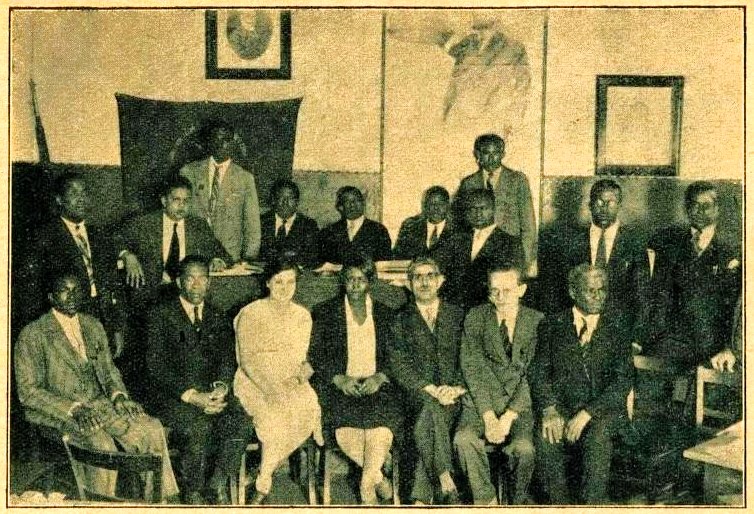
Sponsored by the Red International of Labor Unions, the First International Conference of Negro Workers was held in Hamburg, Germany in June, 1930. Along with discussions and resolutions, delegates gave valuable reports of conditions and their work in the countries and colonies of Africa and the diaspora in Europe, the United States, and Caribbean, with the largest group of participants coming from the U.S. Below are the speeches by delegates T. S. Morton (Gold Coast Carpenters’ Association, Accra), J.A. Akrong (Gold Coast Drivers’ Association, Accra), J.A. Roberts (Food and Packing Workers’ Union, Chicago), Albert Green (South Africa), Comrade Williams (R.R. Workers’ Union, USA), E. Richard (West Africa R.R. Workers’ Union, Sierra Leone), Helen McClain (Philadelphia), Comrade E. Small (Gambia), W. Bile (Cameroon, German Section of the Negro Defence League), Comrade Hawkins (National Miners’ Union, USA), Walter Lewis (Agricultural Workers, Alabama), H. Murphy (Metal Workers Union, Pennsylvania), M. De Leon (Railroad Workers Union, Jamaica), Comrade Budisch (Fraternal Delegate, International Red Aid, Berlin).
‘Delegate Reports from the First International Congress of Negro Workers’ from New Worker. Vol. 3 Special. November 1, 1930.
T. S. Morton — Gold Coast Carpenters’ Association Accra, West Africa
Mr. Chairman and comrades, the Gold Coast Carpenters’ Association sends its greetings to this International Conference of Negro Workers.
In the year 1928, matters affecting the status of Gold Coast Carpenters became so distressing that the men came together for the purpose of organizing a carpenters’ union in the Gold Coast Colony. On the 8th of January 1928, a meeting was held which unanimously resolved that the carpenters should form themselves into an organization to be known as the Gold Coast Carpenters’ Association. Communications were made with Carpenters of various Towns of the Gold Coast Colony and all approved of, and gave their entire support to the scheme.
The status of the Gold Coast Carpenter has been one of a subordinate, under a superior. The Governmental designation of the Gold Coast worker is: “African Technical Subordinate”. The “technical subordinate” in the eye of the Government includes and consist of carpenters, masons, blacksmiths and painters engaged by both the Government, commercial organizations and private individuals.
The working hours as arranged by the Government, range from 6 a.m. to 4 p.m. with a break of about one hour for breakfast — thus consisting of long and continuous work for about 9 hours a day. In order to be punctual at work the worker has to leave his house about 5 a.m. and if it happens that the working place is located far away from Accra, he has to rise up earlier — sometimes being away from his house for a duration of nearly 10 or 12 a day hours. The discharge of our work by working under the bare faced sun and rain, is to great that we decay prematurely and lose absolutely all physical energy and in many cases, we have had to live on the hospitality of our friends. This is the basic factor which led to the formation of the Gold Coast Carpenters’ Association.
The long working hours fixed for us by the Government have been the source whereby the health of many workers has been broken with, the result of premature death. Most of our experienced workers have, in consequence, died. For 9- or 12-hours’ work per day, coupled with all the hardships and self-denials involved, we are paid meagre wages ranging from 2 shillings and 6 pence to 6 shillings per day. Headmen receive the 6 shillings rate. Apprentices are paid from 1 shilling and 6 pence a day for the first year, 2 shillings a day for the second year and 3 shillings a day for the third year.
We view with great dissatisfaction all the worries and weariness involved in our work, and the fact that the Government has regulated our wages to a standard such as this. Our dissatisfaction is intensified when we further consider that we are only entitled to pay exclusive of Sundays and Holidays and the fact that in the event of our being disabled or incapacitated or dead accidentally, no consideration whatsoever is given to us. As Government is always the moving spirit in matters of this nature, such wages have been universally adopted by all.
In order to overcome so grave a danger as I have above described to you, the Gold Coast Carpenters’ Association asks on behalf of all the workers for the assistance of this Conference. Most of us have had continuous employment in the Government service for periods extending over 20 years. This attitude of the Government towards us is raising the militancy of the rising generation. In order to defeat the probability for an utter destruction of our work and to instill in the hearts of the rising generation a spirit of fight, the Gold Coast Carpenters’ Association ask of this Conference such support as will arouse the workers and convince our youths of the advisability to espouse the cause of labour.
The high cost of living for ourselves and families cannot be met from our scanty wages. There is absolutely no margin left for us to meet an immergent need. When sickness attacks us or any member of our families, or death occurs amongst us, .the medical and funeral expenses have always become a burden; and we are preforce driven to seek loans from money lenders who collect from our scanty wages for many months and years. These are matters’ which we entreat this Conference to consider. The town rates on houses have been immeasurably increased. We have always suffered great hardship in meeting the payment of these rates. Our houses are frequently at the mercy of the auctioneer’s hammer.
The workers of the Gold Coast of West Africa ask that this Conference interests itself in the conditions of the workers of our country and do all it can to help us fight to improve our conditions, especially with respect to the increase of wages and decrease the working hours, for old age pensions, and wages during holidays and Sundays.
Comrade Akrong, Gold Coast Drivers’ Association, Accra, Gold Coast, West Africa
Comrades,
The Gold Coast Drivers Association was organized in December 1915 as a result of the repressive measures of the Government against the drivers of the Gold Coast, At that time there were about 8000 drivers most of Whom were employed by the Government at a wage which made it impossible for them to provide themselves with the necessities of life, the founders of the organization immediately began an agitation among these workers for the purpose of organizing them. At the present time the organization has about a thousand members in the City of Accra, capital of the Gold Coast and 21 branches in Ashanti, Northern territory and Togoland with a total membership of about 7000. The Government have resorted to a policy of merciless persecution against the drivers in an attempt to break their spirit and to prevent any organizational measures being taken by them. They were subjected to extremely heavy fines upon the least provocation. In numerous occasions these fines amounting to more than two or three months salary, with the penalty of imprisonment if the driver was unable to pay the fine. In 1915 J.A. Akrong together with a group of other drivers decided to organize an association, in order to carry on a struggle against these tactics of the Government.
The answer of the Government was to reduce the wages of the drivers, who immediately were called out on strike by the organization. After two months of bitter struggle with the Government and the employers the drivers were forced back to work at a reduced wage. At the same time the Government imposes a yearly tax of 12 guinas upon each lorry owned by a native, and also established official parking stations where a tax of 9 pence per day was placed on each lorry. In this way the Government reduced the wages of the drivers to a mere nothing. Further 9 pence daily is charged for parking lorries. These various oppressive measures were adopted by the Government in order to crush the militant spirit of the workers.
At the present time the general economic conditions of the country are so bad due to the tremendous decline in the price of cocoa that hundreds of drivers are unemployed because the planters are unable to transport their produce. Even those drivers who are still able to hold on to their job are so badly paid that they are unable to provide themselves and their families with the most elementary needs. On the other hand the Government continues to increase direct taxation in order to provide funds for the revenue of the colonies which is largely used in paying tremendous salaries to Government officials. This policy of victimisation of the transport drivers is carried on chiefly through the police department. The black policemen are instructed by the white officers to arrest as many drivers as possible, in order that the magistrates may find them so that their wages — the policemen’s — could be guaranteed. It frequently happens that drivers are arrested two or three times in one month. These men are chained heavy fines, and if they are not able to pay the fines they are sent to prison, and on their release their permit is taken away from them. In this way hundreds of Gold Coast drivers are without any means of livelihood.
In view of these conditions, the Gold Coast Drivers’ Union is glad to have this opportunity of bringing their problems before the International Conference of Negro Workers, because in so doing they will have an opportunity of letting the working class of other countries know something of the oppressive nature of the Gold Coast Government and the foreign capitalists.
We feel certain that the delegates here will not only sympathise with the workers of the Gold Coast, but will actively assist them in their struggle against their oppressors so that the conditions of the toiling masses of Negro workers in that country will be improved.
Com. Roberts, Food and Packing Workers’ Union, Chicago, USA
Comrades, Chairman, Delegates,
I bring greetings from the Food and Packing Workers’ Union to this Conference, that is to carry on and to further the struggle for the emancipation of Negro workers, who are the most oppressed and exploited workers.
In the Meat and Packing industry at Chicago (the largest in the world) the Negro forms at least 50% of the total number of the 25,000 workers. Eleven years ago they were brought there by the bosses of the industry, sanctioned if not aided by the American Federation of Labor to break a strike, and they (the bosses) succeeded; so the Negro has been there in that very important industry ever since. The American Federation of Labor has not brought or offered him any real organization. But they had on many occasions deceived them, in one industry or another, for instance on the freight and docks of many rail roads. The A.F. of L. would call a strike; the Negro trying to be true and loyal to the cause of labor would walked out with the white workers, and within a few days the A.F. of L. would bring the white workers back to work and leave the Negro out in the cold; Negro waiters and waitresses have been served the same way by this notorious American Union.
The above conditions together with the propaganda of the bosses among the workers for share-holding, representatives on the Safety Committee, Company and Unions, etc. is causing starvation and misery.
This shows what a job and big task we have to organize the 15,000 or more Negroes in the stock yards of Chicago.
Albert Green, South Africa
Comrades,
On behalf of the African Non-European Federation of Trade Unions, the Lekhota La Bafo (Poor Men’s Organization) Basutoland and thousands of Negro workers who attended the meetings called for the purpose of electing delegates to this Conference and from the left wing of the African National Congress, I bring greetings.
Six other delegates were elected by various Negro organizations in South Africa, but the Hertzog Government fearing exposure of its brutalities towards the native people refused to grant them passports. The Negro masses in South Africa have taken a keen interest in the preparatory work of this Conference. They are anxiously awaiting its outcome and deliberations and will certainly join whole heartedly in the international struggle of the Negro masses allied with the exploited and enslaved workers and peasants in all parts of the world against imperialism and slavery.
The population of South Africa consists of 6 1/2 million Negroes and 1 1/2 million of Europeans. From an economic point of view we may consider the population of South Africa 40 million Negroes. The main question is that of organizing the Negro workers, especially in the basic industries, mining and agriculture etc., where nearly a million Negro workers are employed. There are many difficulties in the organizational work, and all the organizations amongst Negro workers are still very weak. The I.C.U. which started in 1919 and grew into a tremendous organization with a membership of about 100,000 in 1927 has declined since then owing to its policy of reformism, and the exclusion of militants from the ranks of the union. Some time ago the Amsterdamers’ sent Ballinger to reorganize the I.C.U. on ‘ sane trade union lines”. But there seems to be little scope for the reformists in South Africa, whose policy has lead to the total decline of the one time powerful I.C.U. The position today is that the Independent I.C.U. led by Kadalie and the Industrial and Commercial Workers’ Union of South Africa bossed over by Kadalie, are practically non existent and without any influence. Only the I.C.U. at Natal led by Champion has any following at all. After the expulsion of the militants of the I.C.U. 1927 the Federation of Non-European Trade Unions was started with a policy of militancy, and in the course of a short period it had about a dozen unions organized in different industries embracing on aggregate membership of about 10,000. The Federation is really the first trade union organization amongst Negro workers, as all the I.C.U.’s were more in the nature of political parties than trade unions. In South Africa the Negroes are probably more oppressed than in any other part of the world. They are treated as slaves every minute of the day, and are not allowed even one minute of freedom during day or night.
The African National Congress which came into existence just before the war saw the height of its influence in 1919 when it organized a campaign against the pass laws. The leaders, however, got frightened at the militancy of the workers in the course of the struggle and went over to the bosses. This resulted in demoralisation amongst the masses and a decline in the influence of the Congress. At its last annual conference in Bloemfontein April 1930 the reactionaries managed to capture the machine. But the followers of the congress which are found mostly in the Cape Province are definitely against the policy of the Reformists and a resolution by Professor Thaele to exclude militants from Congress activities was defeated by 2,000 to 3,000 votes. The economic decline of the European workers is evident in every sphere of industrial life of the country, whilst from the other hand more Africans are being engaged not only on semi-skilled work but also on skilled work.
Comrade Williams, R. R. Workers’ Union (USA)
Comrades!
While no definite figures are available as to the number of Negro workers employed on the railroads in the United States, a conservative estimate is that there are around 150,000 to 200,000. For a number of years Negro workers have been employed on the railroads in the Southern states, but during the past ten years, particularly following the World War, with their migration from the Southern farming communities into the industries, their number has been greatly increased in the railroad industry and extended to roads further North and in the middle West.
The Negro workers are the lowest paid, have the poorest conditions, and are the most exploited of any class of railroad workers. They are everywhere discriminated against because of color, and given the worst jobs of common unskilled manual labor, and as a rule are prevented from rising above semi-skilled work. When they are made to perform more skilled work, which is frequently the case, they are paid the wages of unskilled workers. Throughout the South and on practically all roads in the North they are Jim-Crowed, compelled to use separate toilets, eating places, and otherwise socially segregated.
The Maintenance of way Department employes a larger number of Negro workers than any other branch of railroad service. Many roads in the South employ Negro workers almost exclusively as section laborers and other maintenance of way workers. The more skilled and higher paid jobs in this department are given to white workers, as well as all jobs as foremen, minor section gang bosses, etc. In the last ten years thousands of Negro workers have entered the railroad shops, roundhouses, and shop yards, employed principally as semi-skilled tradesmen, mechanics’ helpers, and performing heavy common labor. They are seldom permitted to enter the shops as apprentices for the purpose of learning a trade, and when they do acquire a certain amount of skill and perform this class of work they are not promoted to mechanics, nor do they receive mechanic’s pay.
Negro workers are employed as locomotive firemen and brakemen on both freight and passenger trains, and as switchmen and switch-tenders in the yards. The Negro workers performing this class of work are confined entirely to the railroads in the South. Large numbers of Negro workers, both men and women, are employed in the cleaning of passenger cars. There is also a considerable number of Negro workers employed as freight and express handlers, truckers, loading and unloading freight and express. In the railroad stations practically all over the country Negro workers are employed as porters, handling baggage and doing porter work around the stations. On the Pullman sleeping cars and on the dining cars Negro workers are exclusively employed as porters, maids, and cooks and waiters. It is estimated that there are about 12,000 Pullman porters and maids. As cooks and waiters there are a much smaller number.
The rates of wages paid Negro workers in the various departments are from 32 cents to 35 cents per hour. Station Porters receive around $ 50 per month in wages and depend upon tips from passengers. Pullman porters receive from $ 65 to $ 78 per month. With tips received from passengers their average monthly wage is from $ 100 to $ 125 per month. The wages of dining car cooks and waiters is approximately the same. The 8-hour day prevails in all departments, except in sleeping and dining car service who work from 250 to 300 hours per month, and sometimes are on runs for 4 and 6 days. The sleeping car porters are compelled to work excessively long hours, depending upon the length of their runs.
The policy of the railroad companies and the leaders of the American Federation of Labor is to keep the Negro and white workers divided, ill feeling among them, and working against each other. All A.F. of L. unions on the railroads bar Negro workers, with the exception of the Brotherhood of Maintenance of Waymen. While this union takes in Negro workers, a comparatively few have been actually brought in, and these, in most instances, are segregated into Jim-Crow locals. The Negro locomotive firemen have in recent years organized a union of their own which has a membership in the neighborhood of 5,000. The station porters have an organization known as the Red Caps. This is largely a social club.
The most important union of Negro railroad workers is the Brotherhood of Sleeping Car Porters. A campaign to organize the Pullman porters was begun in 1925 by A. Philip Randolph and other reformist leaders among the Negro workers. In 1928 it was claimed that a majority of the 12,000 porters and maids were organized into the Brotherhood. A strike vote was taken with the membership voting overwhelmingly in favor of a strike to compel recognition of the organization, wage increase, shorter hours, improvement of working conditions, and the abolition of the tipping system. The strike was betrayed by Randolph and President Green of the A.F. of L. calling it off at the last moment. Since then disintegration of the Brotherhood has taken place and at the present time a bare skeleton of the organization exists in a few of the larger railroad terminals.
The organization when launched in 1925 had a more or less militant policy, but during the past few years Randolph and the other reformist Negro leaders have adopted a policy of class-collaboration in line with that of the A.F. of L. while headquarters are maintained in Chicago and New York, at the present time the organization shows very little life and practically no organization work is being carried on.
While some slight inroads have been made since the Cleveland Trade Union Unity League Convention last September into the ranks of the Negro railroad workers to draw them into the National Railroad Industrial League, the actual organization established among them is still very weak. The organization of this league is a concrete example of the possibilities of drawing the Negro workers into the railroad league when a determined effort is made to do so. Being the most exploited, the first to feel the pressure of the speedup, layoffs, and wage cuts, the Negro railroad workers are rapidly becoming radicalized, show a willingness to fight, and are looking for leadership in their struggle for better conditions.
Comrade Richard (Sierra Leone) West Africa (R.R. Workers’ Union).
Chairman, Comrades,
I represent as you might be aware, the strong and powerful West African R.R. Workers’ Union of Freetown Sierra Leone. The aggregate membership before our strike in 1926 was 5,000, this number of course has fallen to 750. A petition was got up after the strike in 1926 in Freetown and its purpose was to appeal against the high handed means taken by the Government against us.
I am instructed by my Union to speak strongly on this matter which is one of the burning questions in the minds of the workers. The Railway Workmen’s Union was organized in 1915. The object of the Union is to get the workers to fight for one common cause, for better conditions. When the Government found out that the eyes of the workers were being opened, they succeeded in getting the men to fight against themselves and eventually brought about a split in the Union. The men reorganized in the year 1922. In 1923 the men decided that if they could not get what they wanted they would go on strike. A general strike was called in 1926 and lasted for two months. Workers were drawn from other British colonies to break the strike. After many difficulties the Government succeeded in breaking the strike. Thousands of workers were thrown out of work and to-day we have over 500 men unemployed.
I am asked to bring to the promoters of this Conference the Union’s best thanks and appreciation for the good work which it has started.
Speech of Helen McClain (Philadelphia, Pa. USA)
I bring greetings from the National Needles Workers’ Union; nearly one-half of the workers in Philadelphia are Negro workers. The Italian and the Negro are the most exploited workers, a great number are women workers. We have had a lot of trouble organising the Negro and Italian workers into the Left wing union. The white militant organisers are still struggling and they are jailed and fought by the police. When the strikes occur the bosses uses the Negro workers against the white by promising them better wage and steady positions, which the Negro workers believe and accept. Later on when the whites win the strike, the Negroes are thrown out; so now they realise the situation which they are undergoing.
After a strike the bosses moved their shops to some parts where the workers know nothing of organization, down in the South where the Negro workers are more exploited than in the North. The Textile workers in South Carolina were jailed and sentenced for 117 years for organizing the white and black together. I think the Negro Congress should draw up a plan to help organize these workers. I think we would have real militant and Revolutionary unions to fight the capitalist and against discrimination. I also call special attention to the position of women workers everywhere.
Comrade Small, Gambia (West Africa)
Comrades.
It is my pleasure to bring greetings from the Gambia Labour Union. I shall endeavour to outline our labour conditions so as to give you a general idea of the struggles of our comrades in West Africa. I should preface my remarks by emphasizing the basis on which the unions have accepted the kind invitation of the Provisional Committee of this Conference.
The Gambia workers regard the struggle of their Negro comrades everywhere as their own; they are one in fact with the struggle of the oppressed millions of toiling workers throughout the world. The general labour position in Gambia, which I will now endeavour to state as briefly as possible, is a chapter of the old story of imperialism. Throughout, it will be seen that the stage of imperialism has reached completion; that the State machine is being continually turned from “benevolent and philanthropic” uses to serve exclusive capitalist interests; that the Negro worker and peasant are the hopeless underdogs of the situation – the victims of capitalist and imperialist exploitation.
It is this fact that called the Gambia Labour Union into being a year ago. With the exception of administrative clerical workers, all workers and peasants are now represented by the Union. Of these an aggregate membership of 1,000 workers und 2,500 peasants has been registered. Of course, they are all Negroes. As yet there is no European settlement, Europeans are employed in the administrative and mercantile departments as supervisors. They have no permanent interest in the land. Their periodical tours to the Coast are prompted by motives of self-betterment, and, what is still worse, of racial aggrandizement. Therefore all the same the race-issue in its broadest possible sense, is no less real in the relations of the white bosses to their black subordinates; this imperialist regime is naturally opposed to equal rights and opportunity, and is conducive to race discriminations and disabilities of a colour-bar.
Within few months of its inception the Gambia Labour Unions was called upon to face its first industrial struggle; for the first time in the Colony’s history, hundreds of operatives went on a general strike both for the right to organize in trade unions as well as for an increase of wages and better conditions of employment. I will emphasize only its salient features. Leading commercial firms in Gambia attempted to stifle the newly formed organization at its very inception. They assailed the elementary right of the workers to organize in trade unions, giving their employees three days notice to quit the Union or be dismissed. Strike notices issued by the Union were treated with sheer contempt.
Indeed, every day brings fresh indications that before, during and after the strike the merchants have enjoyed official support in their attempt to suppress the trade union rights of the workers. An official warning issued during the strike against alleged intimidation of workers had the practical effect of preventing picketing, and culminated in an armed Police raid on the 14th of November last, in which civilian passengers were wounded in the streets of Bathurst. So far, standard minimum rates of wages have now been fixed jointly by the Union and the Bathurst Chamber of Commerce, but in spite of the agreement reached in settlement of the strike, workers are being victimized by lock-outs, dismissals without notice etc. It is even proposed to import cheap labour from abroad, Jamaica and other places. And it is hoped this Conference will have some effect in preventing the victimization of Negro workers by their own comrades.
A striking instance of the victimization of trade union workers may be seen at the public Works Department in Bathurst. This you will find combined with a system of piece-work and contract, which constantly throws the men out of work, and is a typical example of State exploitation of cheap labour in the guise of public economy. To carry out this anti-trade union system of exploiting cheap labour non-trade union foremen are employed, while there has been a lock-out of hundreds of trade union workers at the P.W.D., since last November. This lock-out had been threatened by the Government during the strike, when serious objections to the system were raised by the Union. Though the general works of the Department have been stopped for so long the estimated expenditure for the year is allowed to run as if there had been no close down, so that in the end the talk of public economy is a mere lip-service.
Employment for the worker and peasant in Gambia is seasonal. That is to say it is limited to the period of the trade season, which is now regulated to last from December of one year to April of the next. This recent regulation, as will be seen in the case of the peasants, is a striking episode of imperialism. There are no manufacturing industries. The classes of workers are those whose services are required to carry on the trade in groundnuts, of which an average of 70,000 tons are exported annually from the Gambia. Comparatively few of these are regularly employed. The large majority are employed more or less for two to three months of the year. How can this majority subsist for the remaining nine months of the year? It becomes perfectly clear that these workers are faced by the most serious question of a living wage.
The workers and peasants in Gambia are in the most pitiable plight. There are no big farmers in the Colony, nor is there individual ownership of cultivable land; all such land is cultivated by a primitive custom of joint ownership. The peasant is employed during the lean months of wet season. During this part, there is a dearth of foodstuffs, and the conditions of life are the most miserable. The area on which food crops — rice, maize, etc., could be grown is severely restricted, and improved methods of cultivation are beyond the peasants’ means. To obtain money for his other requirements, therefore, they have to supplement the raising of a limited supply of foodstuffs by growing groundnuts so greedily hunted by the European capitalist.
The Government realises the extreme poverty of the peasant. But instead of relief advances are made to the peasants in the shape of a yearly supply of imported rice and seed-nuts. After harvest when the peasants try to hold out for better prices round goes the Government collector to demand the payment of the taxes and debts for rice and seed-nuts. The poor peasants are thus forced to part with their produce at any price. They begin work each year with a debt of £4 to £5. The peasant can reckon on an income of £7. Deducting from this the debt he has incurred of £4 to £5, he is left barely with about £3, on which to subsist with his family all the year round. Can you imagine the degradation to which he is reduced by such circumstances? Can you imagine how population could increase, or how the problems of disease and infantile mortality could be solved so long as the peasants’ hard toil is exploited to its utmost limit for the benefit of foreign capital?
It is important to note that in this state of affairs local merchants in Gambia have gradually diverted their attention from their primary interest — the profits realisable on the sale of capital goods, and are now concentrating upon making big profits from trade in raw material which they contrive to purchase at the lowest possible prices. In spite of the inevitable set-back this entails in goods trade, huge mergers, combines, trusts pools and participations’, local and foreign are being formed to grind down the peasants and corner their produce. These pools are formed to exploit cheap labor and effect economies at the expense of the worker and peasant. Their natural consequences are large overstocks of goods and unemployment. The part the state machine is made to play in the crisis is the most remarkable. By the present regulation of the trade season you have seen how the interests of the peasants are played into the hands of the merchants. While thousands of workers are being constantly thrown out of work there is no effort made to protect the worker or to relieve the unemployed; nor are the benefits of the Workmen’s Compensation Acts extended to workers in Gambia.
From the brief report you can see that Gambia is smarting from the effect of the economic and industrial condition that is sweeping the face of the world. The workers and peasants have experienced the needs for active resistance against capitalist and imperialist exploitation.
The workers of Gambia responded with great enthusiasm to the call of the International Conference of Negro Workers and Peasants. It is our hope that this Conference will go a long way to consolidate the forces of economic and industrial resistance against all forms of capitalist oppression not only among Negroes but among workers and peasants of the world.
Comrade Bile, Cameroon, representing the German Section of the Negro Defence League
Friends and comrades.
In name of the German Section of the Negro Defence League and in name of our fellow-workers in Cameroon, I extend fervent greetings to you. We note with great satisfaction the great number of our Negro comrades who have come from all corners of the world to attend the Congress. Let our discussions be conducted in a spirit of fraternity and solidarity for the benefit of our oppressed friends in Africa and all over the world.
I want, for the natives of Cameroon to inform you that imperialist exploitation is the same now, when the French and British imperialists are sucking out the life blood of the natives of Cameroon by unprecedented exploitation methods sanctioned by the League of Nations, as they were before when Cameroon was groaning under the iron heel of German imperialism; we condemn imperialist exploitation of any kind. In reporting on the conditions in Cameroon we only cite an additional example of the cruel way in which the imperialist powers oppress not only the Negro workers, but also the native workers in India, China, in the West Indies.
In Cameroon our lands were “lawfully” occupied. “Scientists” have set up the theory that we were ignorant of any private property, and we are consequently refused even the right to our own land. The British Government has declared all areas coming under British administration to belong to the Crown; all the lands situated in French Cameroon were declared to belong to the State by the French Imperialists. The Negroes are, in the best of times, given only the use of their own lands which privilege may be immediately taken away from them, as was done in more than one case, whenever the European owners of the concessions wanted to use the land belonging to the natives for their own ends. A similar case that occurred under the regime of the present French administration proves that there is not any difference in the ways in which the imperialists treat the natives. The natives of Duala sent a delegate to Paris to file a protest with the French Government against the expropriation. We were sure that the delegate would fail in his mission if he stayed in Paris for even ten years.
As capitalist profiteering is the sole aim of the European imperialists the natives of Cameroon have been compelled to stop the production of victuals and to work only in the interests of the European capitalists. The result of the policy enforced by the French and British imperialists is that the natives of Cameroon are underfed; whenever the prices fall on cocoa and other commercial produce which they are compelled to plant they are brought to the brink of starvation.
For the purpose of recruiting workers for the plantations, for work in the African forests or for the construction of railways and roads, the usual methods of colonial exploitation come into force: the head and hut tax are fixed at so high a level that the natives are compelled to look for work in the capitalist enterprises so as to be able to pay the taxes imposed on them. Wherever this method of recruitment proves to be ineffective, compulsory labour is introduced thus converting the natives into slaves; as a last resource the capitalist resort to the importation of foreign labour on a contract basis which renders them much more helpless in the face of ruthless exploitation. The crews, that are imported from Tabo (Liberia), and are hired on a five-year contract are compelled to slave for their bosses in Duala: they have to work from 6 a.m. till 8 p.m., sometimes even longer, for wages amounting not to more than a handful of rice and a piece of salted fish. After five years of work they receive 30 Marks and a yard or two of cheap print. Whenever a worker falls ill he is told that “if the monkey dies another monkey will take his place”. The white capitalist looks upon his black workers as upon cattle that have to work until they drop.
Besides these workers the coolies must be particularly mentioned. This kind of work is not classed as compulsory work by the Labour Office in Geneva though it is one of the most terrible kinds of labour enforced by capitalism. The natives are compelled to carry extremely heavy loads from the stores to the ships, and even to transport them on their bare backs from the interior to the coast; even women and children are made to do this kind of work. Whole villages are deserted when a capitalist merchant closes a good bargain in the interior of Cameroon and wants to have the goods brought to the coast.
The workers are terrorized to an unheard of extent. Whenever they endeavour to organize they are simply hanged as rebels. Whenever they complain against their bosses or against the foremen they are mercilessly whipped. The officials of the concession companies are, according to law, considered to be civil servants and, as such are entitled to mete out punishment: even if they kill a native they are not called to account as they acted in the interests of humanity and in defence of European culture. Among the 1,800,000 inhabitants of Cameroon only about 7,000 children attend school. Neither the contracted workers nor the Negroes are given any housing accommodations in the plantations in the European sense of the word where they might take a rest after their inhuman labour! The workers from Liberia are forbidden to bring their families with them; whenever exceptions were granted, the married are compelled to live in the same room with the single. It is no wonder that diseases like typhus, swellings, etc. take a heavy toll among the workers. The missionaries, the preachers of Christian love and peace, not only fully approve of this system but are, frequently partners in the business.
The time has come for us, in Cameroon, to make away with slavery and exploitation. Negro comrades of the world! You all attending here, who have in spite of the terror of the ruling classes, in spite of the oppression of the exploiters, called into life powerful unions and organizations; help the Negro workers in Cameroon in their struggle for emancipation, help us to win the rights and the independence that belongs to Man and to all races!

Comrade Hawkins, — National Miners’ Union (USA).
Comrades,
The National Miners’ Union asked me to bring greetings to the International Negro Workers’ Conference. They ask me to bring reports back to them in the USA, that we may rally the workers around the banner of the revolutionary proletariat.
Comrades, the National Miners’ Union is making a struggle in the coal fields to day for bettering the conditions of the coal miners. We not only struggle against the mine operators, but against the labor fakirs such as Wm. Green, president of the A.F. of L. and John, L. Lewis A.F. of L. miners, and other tools of the bosses. These fakirs playing into the hands of the bosses are busy dividing the workers, setting up Jim-crow organizations in all parts of the industry. We are able to organize workers all over the USA by exposing their role and the part they play in betraying the workers.
Comrades, we must point out at the same time the conditions in the minefields, where the bosses are grinding the blood from the workers by speed up, long hours with small pay and miserable conditions. Miners are working for $2.00 and $3.00 a day, the lowest wages since 1927 when the labor fakirs sold out to the bosses.
Not only do we face low wages and speed up, but we are discriminated against at every point. Unemployment has become very critical and is approaching the workers in all industry. Thousands of workers are daily returning back to their homes to face starvation, but we are able to organize unemployed councils in many towns bringing the miners into the struggle. One of our main slogan is: work or wages.
The Negroes miners are very active in strikes, taking leading parts in all strikes; and are fighting for the right to live; many of them being jailed as they fight hand in hand with the white workers. Bigger struggles of the miners are near at hand, when the miners will come out openly in a fight for better conditions. I believe this International Negro Workers’ Conference will in many ways bring about new ways and means for broadening the attack on capitalism and imperialism.
Comrade Walter Lewis, Agricultural workers (USA, South).
Chairman and Comrades,
I am a delegate from Birmingham, Alabama USA. We have made great success joining the Negro and white workers in the South. The Negro workers put up a broad campaign against unemployment on March 6. We held open air meetings. We were arrested and convicted. The bosses’ plan is to put the Negro workers on chain gangs. In Chattanooga, Tennessee we paraded through the main streets. Negro and white workers have begun to realise that they can not live under their present conditions. They work from 12 to 14 hours a day, and they don’t make half enough to support families. The bosses frame our organizers. The comrades fought the capitalist police. In Atlanta, Georgia, 2 Negro and 4 white workers are facing the electric chair, for organizing white and black workers. The bosses are ruling the country by Lynch law. Negroes are not allowed to mingle with the whites. The parks are closed to “Negro and dogs”. From the cradle, whites are taught to hate Negroes and if an organizer is caught he is shot or put in jail. If workers lay off 1 or 2 days they are fired. Workers only receive from $1.25 to $2.00 a day for 10 and 12 hours a day. We are fighting discrimination and lynching in the south. We have to put up a fight also for the farmers and peasants.
Comrade Murphy, Metal Workers Union, Pennsylvania (USA).
Comrades,
I bring greetings to the International Conference of Negro Workers from the Metal Workers’ Industrial League of the USA.
Because of the terror of the bosses against the militant Unions, we are State of Pennsylvania. We are however putting forward a broad struggle having a difficult time trying to organize the Negro metal workers in the American Federation of Labor, the Church and other agencies that are preventing the organization of the workers, especially the church which constantly tells the Negro workers that they should not agitate and organize, that they do not need any share in the steel corporations. At the same time the bosses carry on terror against the workers joining the Metal Workers’ League, threatening them with the loss of their jobs. However we are trying to spread our organization into the State of Ohio, Michigan and throughout the country.
The Negro workers are ready for struggle. At our Youngstown Ohio Convention last June we worked out concrete programs of action for organizing Negro workers on the basis of struggle against low wages, the speed up system and the long hours of work into this industrial Union of both black and white workers.
In the whole of the steel and metal industry the Negro workers undergo the hardest attacks of the bosses and are the first to be fired from jobs.
M. De Leon, Railroad Workers Union, Jamaica, West Indies.
Comrades,
You might have heard recently a lot being said about the prosperity of the West Indian Islands and of Jamaica in particular. The prosperity that is being held up does not in any way relate to the Negro worker of the West Indies; it is mainly confined to the capitalists who hold in their hands the commercial wealth of the islands accumulated from the meagre and insufficient wage paid to the labouring masses.
The population of Jamaica as shown by the last census is 930,000, of which 700,000 are Negroes — 98% of them the working class.
The country is purely agricultural and the principial form of labour is performed on the Sugar Estates and Banana Plantations. Subsidiary to this are such tasks as the breaking of stones by women for the repair of streets and roads and the excavation of men. The skilled labourers are; Carpenters, bricklayers, masons, blacksmiths, fitters, plumbers, boiler makers, and painters; then there is also the domestic servants whose services are largely in demand all over the island.
None of these labourers has legislative, or any other protection. They are compelled to work for any renumeration offered by the employer, and for any number of hours exacted. You will find the same class of labour in the same district receiving different scales of wages and varied hours of work. There is no health insurance, no unemployment provision; neither is there any liability on the part of the employer for any accident that may occur to a labourer during the performance of his duty.
To bring forcibly to this conference the hardships that each and every class of labour suffers in Jamaica and throughout the West Indies, it is necessary to give you an idea of the renumeration received and total expenditures for the bare necessaries of life. The praedial labourer receives a maximum of 1 shilling and 6 pence per day for men, and women 9 pence on Sugar Estates, Banana and other plantations. The Banana plantations are mostly owned and control by the United Fruit Co., an American Corporation. The ordinary artisan receives an average of 4 shillings per day. Domestic servants are paid from 5 to 6 shillings per week without meals. The fitters, plumbers, boilermakers and machinists generally are employed principally by the Jamaica Government Railway, as there is only one other place of the kind that employs such labour. Their wages are 30 shillings per week.
The cost of living in Jamaica, providing only for the necessaries of life is:
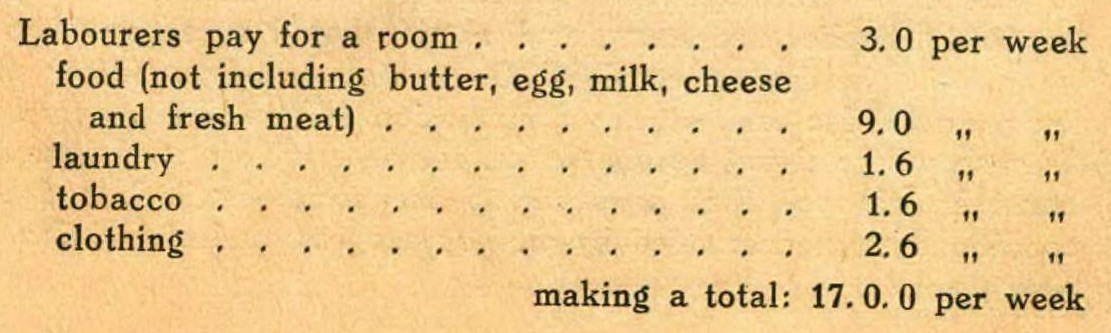
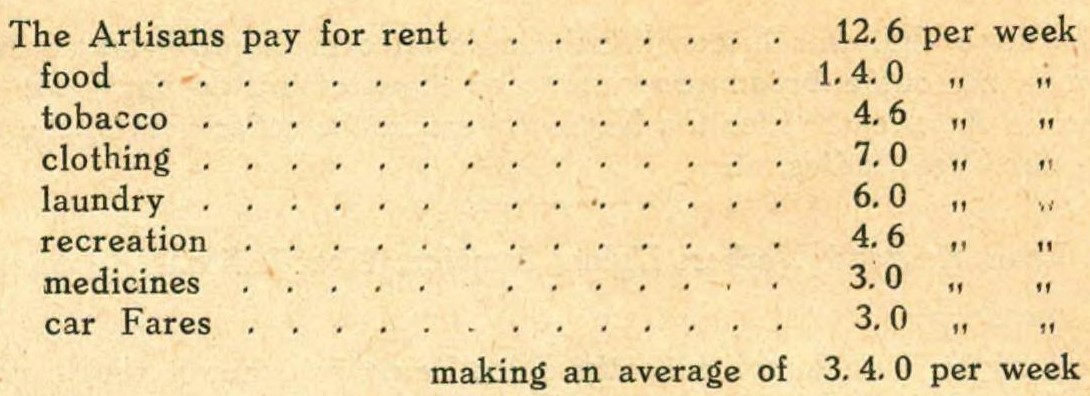
You will observe in the case of the labourer that his minimum expenditure does not include several items as are shown in that of the artisan! To be met out of a wage of 9 shillings per week. The artisan is still no better off, no provision can he make for the education of his children, as his earnings are far below the cost of living. In the labourer’s case, he must work until he is unfit or incapacitated, then give way to another. His only resort is to depend on charity or die in some public institution. It might be asked how these underpaid workers are able to meet their obligations? The answer to that is that the court of civil suits is at present unable to cope with the work, and in a good many instances the debtor is compelled to serve a term in the county jail.
The railway department, a government institution, does not provide for accident or permanent incapacity of its workers caused during the discharge of their duties, nor does it provide for his dependents. He is sometimes granted by the legislature what is known as a compassionate allowance, an amount that is never adequate to permanently relive the situation. There is a new Pension Bill providing for the relief of workers, but in spite of the hardy task and the responsibility attached to these workers, particularly those connected with the rolling stock it is based on a far lower scale than that of other civil servants. The ordinary day labourer who may not be employed as a whole time hand runs the risk of losing his limbs or life by the handling of dynamite or such explosive, to leave his wife destitute and his children to become waifs and strays not from choice, but as a result of the loss of their bread winner.
My submissions to this conference in respect to the Negro Worker of Jamaica is as follows: —
(1) A minimum wage.
(2) A working day of not less than eight hours.
(3) Insurance of all and every kind of labour against sickness accidents and death caused during the performance of labour.
(4) That each employee, domestic and otherwise be given annually rest leave with his or her full pay.
(5) In the case of over and above a certain number of persons be employed on estate farm, plantation, workshop, factory, printing office or any other such place a reasonable and sufficient amount of medical supplies necessary for first aid should be always available for use in the case of accident. On estates a medical officer should be provided for each estate or plantation to attend those employed.
(6) In case where living accommodation is prepared for the labourers it must be of such that conduces to the social hygienic and moral conditions as so demanded by modern progress and civilization.
Comrade Budisch, fraternal delegate, International Red Aid, Berlin.
Comrades,
In name of the Executive Committee of the International Red Aid, I extend hearty greetings to you and wish your Conference the best success.
It is the first International Negro Workers’ Conference and entrusted with the task of coordinating the struggle of the Negro workers with that of the revolutionary workers of all other nationalities, and to enlighten the masses of Negro workers and women workers on the necessity of following the example set by the Russian workers and peasants; only by doing so will the exploited masses, irrespective of colour or race, be enabled to wage a successful struggle against capitalism and imperialism in the various countries, resulting in the final victory of the proletariat of the world.
The struggle for the emancipation of the international proletariat calls not only for the establishment of strong revolutionary and militant organizations, but also for an institution that would give the necessary support to the fighters and the victims of the proletarian battles, and would continually hold up the idea of proletarian solidarity and mutual aid. The capitalist and imperialist robbers inflict heavy wounds to many of the fighting workers and peasants lined up in battle all along the international front of class struggles; the number of the dead, wounded and imprisoned rises continually, particularly in the colonies and semi-colonies. The neglect of giving aid to these victims would be a serious danger sapping the militancy and fighting spirit of the proletariat.
Every fighter on the battle front must be fully aware of the solidarity and love of his class; he must realise that his family is not left to shift for itself, but that the whole working class supports it, when he falls into the hands of the class enemy, is wounded or killed. The IRA is such an organization.
The civil war in China illustrates the tremendous number of victims that may be lost in revolutionary struggles. The Chinese workers and peasants have lost over 350,000 comrades under the bloody reign of Chiangshek. Comrades these figures remind one of the World War. The IRA gives support not only to the victims of the proletarian struggle for emancipation. Other extremely important task are entrusted to it; the struggle against class peace and against the bourgeoisie legislation, against white terror, against colonial “justice”, against lynching, against the persecution of the revolutionary workers’ and peasants’ organizations, and, finally, the struggle against war and fascism.
PDF of full pamphlet: https://www.marxists.org/history/international/comintern/negro-worker/files/1930-v3-special-number-nov-1st.pdf
 Revolution's Newsstand