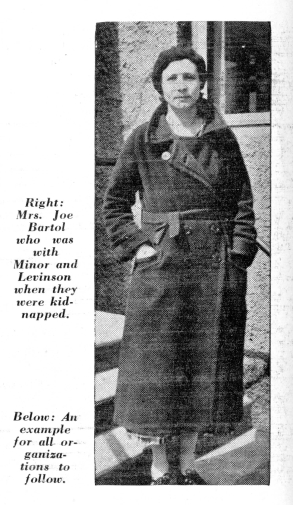
The story of U.M.W.A. local president Joe Bartol, leader struggles of Gallup, New Mexico’s miners of the mid 1930s.
‘A Hero of Gallup’ from Labor Defender. Vol. 11 No. 7. July, 1935.
The story of Joe Bartol, President of the U.M.W.A. Southwestern Mine local, is a story of working-class struggle and heroism, an American tragedy of a hero who, against overwhelming odds, finally triumphed over the forces of decay and destruction.
Like millions of other sturdy foreigners who later became U.S. citizens, Joe came to this country in 1912, when capitalism in its heyday promised to workers the prosperous life which the brain and brawn of bygone toilers had made possible for the first time in the history of the world. Joe believed in that life. He pitched into his first job in a Pennsylvania lumber camp as if his efforts alone were going to bring it about.
Disillusionment then followed with society as it was, but not as it might be. He soon discovered how terrifically the workers even in rich America were exploited. There were many kinds of jobs in many mines and lumber camps. But it was always the old story in the end: the company got the wealth that the workers produced, and they passed it on to stockholding parasites, while the workers got little or nothing. But what puzzled Joe about America most was the fact that certain “Labor leaders” seemed to be working, not for the workers but for the companies. He noticed, for example, that during a Kansas strike in 1917, whenever a real labor leader cropped out, like the U.M.W.A. district president Howard, and really led the men in their struggle against the bosses, not only the state turned against him (Howard was jailed) but even the higher-up “labor” officials fought against their own members. On that occasion it was John L. Lewis (the same old John) who tried to stifle the strike by declaring it “illegal.” But Joe Bartol and the rank and file workers stuck to their strike, got their leader out of jail, and won their demands.
Today Joe is seeing the same tactics used against the workers by certain “labor” officials. He smiles when he sees Nick Fontecchio (U.M.W.A. head, Gallup District) roaring in print, and denying that any of the defendants in the Gallup case is a U.M.W.A. member. Joe knows that on the first Saturday in March, 1935, he and all his comrades. of the Southwestern mine voted to join the U.M.W.A. in a body, and that Fontecchio himself offered the new local a charter in the U.M.W.A. Joe has got wise since his Kansas days. He knows the ways of such leaders as Fontecchio and John L. Lewis.
Much of Joe’s wisdom came to him during the heroic strike of 1933. He remembers how the Gallup miners talked of organizing to get the benefits of section 7a of the NIRA that was supposed to guarantee the right to bargain collectively; how the companies tried to stifle the move by organizing a company union; how the workers rejected this dummy union and swarmed into the union of their own choosing the National Miners Union, and came out solidly on strike to improve their miserable conditions. Joe remembers proudly the solidarity of that strike when not one mine sent a man down to work. He also remembers that without a single act of violence on the side of the workers the state came to the rescue of its bosses, the mine barons, and sent out the National Guard to try to smash the strike. They prohibited picketing, outlawed the union, denied every constitutional right, tossed the strike leaders into a military stockade, and protected scabs and company gunmen. But Joe keeps on smiling as he remembers that in spite of the armed opposition of state, county, and city officials; the sabotage of U.M.W.A. “leaders”; and the smooth palaver of “mediator” Moore, the Gallup workers won their strike and kept their organization intact.
For a year after the strike Joe was a victim of discrimination and could not get a mine job in spite of all “agreements.” But he did get some CWA work and was active in organizations of unemployed both local and state, and became secretary of the I.L.D. He was a member of the strike committee during the FERA strike of 1934 which won every demand and maintained the 50 cent an hour wage in Gallup even while the wage was being cut elsewhere. It is for these activities that Bartol was singled out for victimization after the April 4th shootings at which he was not even present.
Late in December, 1934, Joe finally got a coal-diggers job again, with the Southwestern mine. In January, 1935, came the election of functionaries of the local, and his comrades honored Joe by electing him President. When the local voted to join the U.M.W.A. in a body in March, the workers insisted that Joe remain their president.
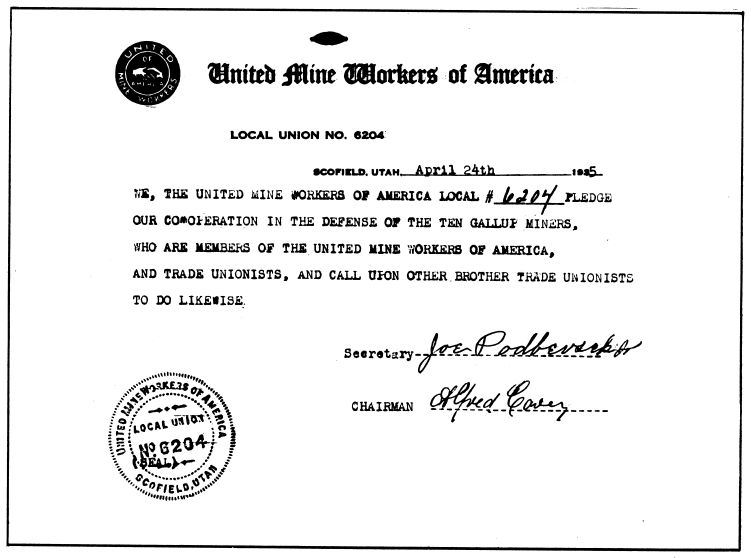
To the man who measures Success by the wealth of Morgan, Bartol does not look the victorious individual he actually is. He is victorious because, in the course of a back-breaking life, he had learned that an abundant life for all can only be created by him and his class, not as separate individuals but as a mass working in its own interest–the interest of all humanity. He knows what kind of a life is possible for humanity, how it can be attained, and by whom; and through this knowledge he is master over all the puny racketeers, company bosses and their political hirelings who are now trying to railroad him to the electric chair. He knows they will not succeed any more than they succeeded in breaking the Gallup strike, and that he will soon be free to work to rebuild the world.
Labor Defender was published monthly from 1926 until 1937 by the International Labor Defense (ILD), a Workers Party of America, and later Communist Party-led, non-partisan defense organization founded by James Cannon and William Haywood while in Moscow, 1925 to support prisoners of the class war, victims of racism and imperialism, and the struggle against fascism. It included, poetry, letters from prisoners, and was heavily illustrated with photos, images, and cartoons. Labor Defender was the central organ of the Scottsboro and Sacco and Vanzetti defense campaigns. Editors included T. J. O’ Flaherty, Max Shactman, Karl Reeve, J. Louis Engdahl, William L. Patterson, Sasha Small, and Sender Garlin.
PDF of full issue: https://www.marxists.org/history/usa/pubs/labordefender/1935/v11n07-jul-1935-orig-LD.pdf
 Revolution's Newsstand