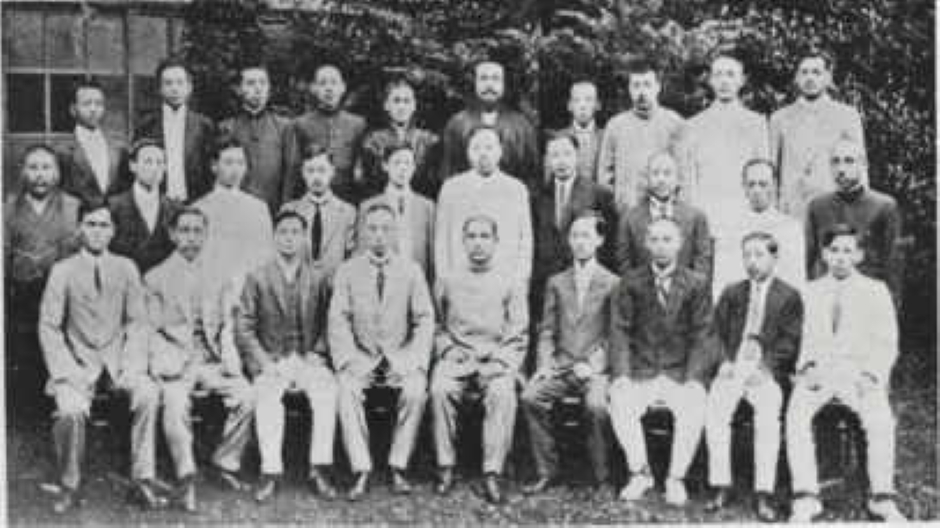
Katayama on the return of Sun Yat Sen and his comrades to Japan after reversals in the Chinese Revolution.
‘Chinese Refugees in Japan’ by Sen Katayama from International Socialist Review. Vol. 14 No. 5. November, 1913.
The Chinese revolution, apparently so successful, has crumbled to earth after many sacrifices and injustices. Only last year the revolutionists forced the abdication of the Manchu Dynasty. After some compromises between Yuan Sie-Kai and Sun Yat Sen and other southern revolutionists, the provisional Government was established at Pekin and Yuan elected head of it. Now that Yuan has become the nominal head of the new Government, he has asserted his power and is determined to rid the country of these revolutionary leaders in order to secure a Constitution that he desires.
Dr. Sun and his friends have long been educating the Chinese people in the principles of Socialism. It was their desire to gradually establish Socialism in China by the election of public-spirited officials who would work for the good of the working class instead of for personal aggrandisement.
At the last Chinese Parliament that gathered to draft the new Constitution the revolutionary element was dominant. The President of the Upper House was elected by Sen’s Party and had an absolute majority. A large number of Sen’s group were elected also, to the Lower House, but Yuan, with a large money bag at his disposal, gradually induced many of the revolutionary party members to give up their principles of Democracy and vote for him. Moreover, it is reported that Yuan succeeded in the bloody work of killing Sang Chiao-Jen, one of the ablest leaders of the southern revolutionists. This crime was investigated and discovered to be the work of Yuan.
As is to be expected, the southern revolutionaries arose to expose this brutal act on the part of the President. They furnished proofs in the way of documents that fixed the crime of assassination on him. Immediately President Yuan suppressed the Press engaged in exposing him. He bribed certain officials and so-called revolutionists and assumed the most tyrannical attitude toward all those who refused to support his measures.
By the support of a subtle financial influence, Yuan concluded the great Five Power Loan [Special loan to authoritarian governments—Editor] that had been consistently fought and opposed by the real revolutionists. The Socialists claim that it was Five Power money that Yuan employed to defeat them. Between the southern revolutionists and the Yuan constituency there spread a wide gulf which grew ever wider.
With the suppression of the Press and free discussion many took up arms against (self) Constituted Authority. The provinces of Canton and Nankin took up arms against the Yuan group. This gave Yuan a further opportunity for suppressing the Liberal Press and the whole Liberal movement. Socialist organisations were immediately dispersed or crushed, and one of the leaders of the Socialist movement was put to death at Pekin. This was not a very difficult matter, for Yuan had at his disposal complete power over the army and navy and money enough to corrupt the Liberal movement as well. Further, the Chinese merchant class is for Yuan all the way through, because they want the PEACE THAT MEANS GOOD BUSINESS.
At so early a date it is often hard to discover the invisible powers that move the puppet Presidents. But the foreign Powers gave Yuan every kind of support in exchange for a chance to grab some of the wonderfully rich natural Chinese resources. Almost openly the Germans lent their aid in crushing the Southern uprising.
And so Democracy (to say nothing of Socialism) has been wiped out temporarily in China. The revolutionary forces are almost routed. Only those in Nankin still wage war; but they are doomed. Yuan will reign supreme.
Dr. Sun Yat Sen is now a refugee in Japan. Ha Han-Min, the ex-Governor-General of Canton, is, too, in Japan with many others. Yuan offered $100,000 for the head of Dr. Sun and $50,000 for the head of General Huang H Sing. There is a price on the heads of many other prominent revolutionists.
Here, in Japan, we now have two sets of Chinese in our midst—the revolutionary refugees and those head-hunters, all of whom are exercising eternal diligence in the hope of pulling down the $100,000 offered for Sun Yat Sen. Perhaps you may remember that Dr. Sun was slated soon to occupy the highest position China had to offer.
Our people are, of course, in deep sympathy with the revolutionary refugees. But the Government, being imperialistic, naturally hates the Republic and favours Yuan’s administration. At first the refugees were denied admission to Japan, but they were finally permitted to land with the understanding that they make no move for the revolution while here. They are watched by the Government and prohibited from meeting any sympathisers, so that they are practically prisoners in Japan.
General Huang H Sing and Dr. Sun may soon come to America, but so far their movements are not known to us. Of the many Chinese refugees in Japan, few are known. Their comings and going are made with the utmost secrecy, as they live in constant fear of assassination. The wives and daughters of General Huang and Dr. Sun are reported to be in Japan, but nobody knows where they are hidden. Both these men were once students in Japan and they have many friends here. They are strong Socialists. Perhaps you will have an opportunity to meet them in America before many months.
In spite of all these disasters, the Chinese comrades will never give up. They have tasted the first fruits of liberty and so will they again.
The International Socialist Review (ISR) was published monthly in Chicago from 1900 until 1918 by Charles H. Kerr and critically loyal to the Socialist Party of America. It is one of the essential publications in U.S. left history. During the editorship of A.M. Simons it was largely theoretical and moderate. In 1908, Charles H. Kerr took over as editor with strong influence from Mary E Marcy. The magazine became the foremost proponent of the SP’s left wing growing to tens of thousands of subscribers. It remained revolutionary in outlook and anti-militarist during World War One. It liberally used photographs and images, with news, theory, arts and organizing in its pages. It articles, reports and essays are an invaluable record of the U.S. class struggle and the development of Marxism in the decades before the Soviet experience. It was closed down in government repression in 1918.
PDF of full issue: https://www.marxists.org/history/usa/pubs/isr/v14n05-nov-1913-ISR-riaz-ocr.pdf
 Revolution's Newsstand