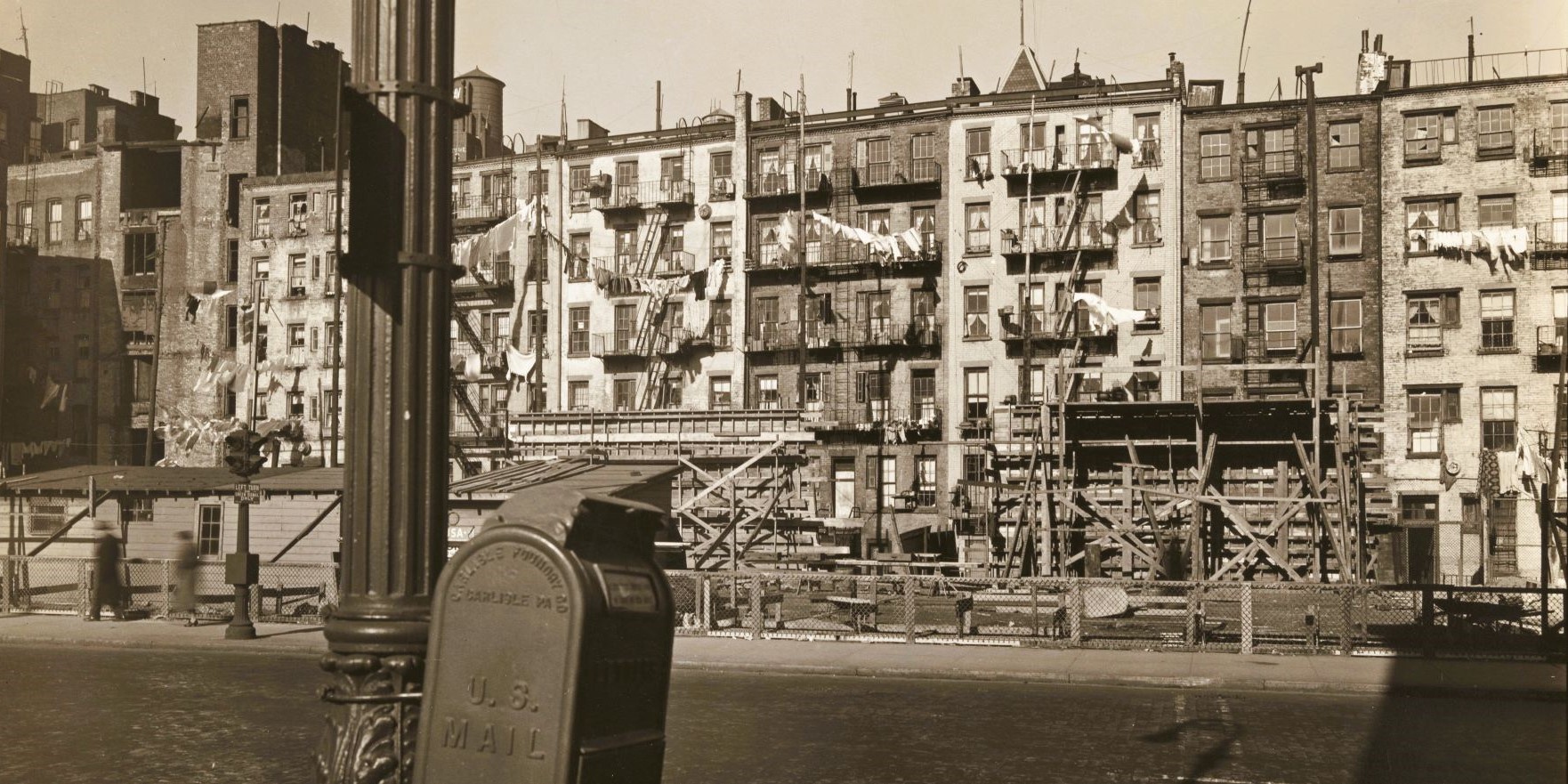
The C.P.’s housing authority, Sidney Hill, on ‘slum clearances’, health, and capitalist non-solutions.
‘Housing and Health’ by Sidney Hill from Health and Hygiene. Vol. 3 No. 6. June, 1936.
While we agree with almost every statement that Mr. Hill makes, we nevertheless feel that he has underemphasized the importance of housing as one of the social factors causing disease. It is true that workers must often pay for slum clearance and improved bousing with their food. But this is not invariably true. The experience of workers in the suburbs of Paris proves that militant action can win better bousing without reducing the worker’s food budget. In a future article other aspects of the relation between housing and health will be discussed. The Editors.
EVERYBODY is opposed to the slums. Penologists and social workers charge that slums breed crime. Slums, we are warned by housing reformers, breed filth and immorality. And from numerous other social experts we learn that slums breed death, disease and insanity.
The case against the slums is supported, of course, by the obvious fact that social evils like juvenile delinquency, malnutrition, tuberculosis and other diseases occur most frequently in slum areas. The attack on the slums, however, draws most of its official ammunition from the many private and governmental surveys which have been made of these areas. The statistics and charts resulting from these surveys follow a familiar routine. First a map is made showing the location, size and other characteristics of the blighted area in question. This map then serves as a base for others which indicate in appropriately horrendous red, green and yellow splotches, the incidence of crime, immorality, infant mortality, and so forth, depending on the extent of the survey.
When these maps are compared, it becomes evident that almost without exception the areas of greatest incidence of these social evils coincides with the slums. What better proof of guilt could there be? The cold figures show that our criminals, our prostitutes, our juvenile delinquents all come from the slums. From the slums also come the tubercular and the insane, the diseased in body and mind. The cure is obvious. Tear down the slums and ipso facto, you strike at the root of all these evils.
This cure for the social evils enumerated above has unfortunately not yet had a real demonstration in this country for the simple reason that the clearance of slums and the rehousing of workers has never been more than a slogan in the United States. In England, however, the theory was actually applied in a number of cases. The experience of the City of Stockton-on-Tees, for example, has aroused great interest in the housing field and because it sheds a revealing light on the question we shall examine it here in some detail.
Following the World War, the town council of Stockton vigorously pressed a housing policy which included the demolition of slums and the building of new houses. In the fall of 1927, a slum area known as Housewife Lane was evacuated, and 152 families living there were moved to an improved area, the Mount Pleasant estate. A similar area, known as Riverside, and containing 289 families remained in the original condition, thereby providing a check on the experiment. The Housewife Lane area consisted of old houses with one or two rooms, and the sanitary conditions and structures were bad. The Mount Pleasant estate seemed to offer everything that modern sanitary science could demand.
Nevertheless, much to everybody’s surprise, the removal to the new quarters was followed by a rise in the death rate. During the five years following removal, the death rate per 1,000 among the population living at Mt. Pleasant increased as follows: measles 1.15, heart conditions 2.59, bronchitis and pneumonia 3.75. The general increase in the death rate per 1,000 was 8.74. No such increase occurred among the population remaining in the Riverside slum area.
The health officer (Dr. McGonigle, Proceedings of Royal Society of Medicine, February, 1933) made an exhaustive study of the various causes of death in the new area and concluded that the increased rate could not be ascribed to such environmental factors as housing, drainage, overcrowding, or unsanitary conditions. There was only one striking difference between the living conditions in the two areas in the Mount Pleasant Estate, rents were higher, and consequently there was less money to spend on food. This is not an isolated experience. The Minority Report on Housing Policy in the City of Leeds, 1933, adds the following: “The Medical Officer of Hammersmith in report for the year 1932 says that in an inspection of the school children belonging to the families of the unemployed, we find that children living in the slums have better health than the children living under better housing conditions on the municipal estates. The explanation is quite simple–the amount of money left to provide food is considerably greater in the slums than that which remains after paying the increased rents of the better housing accommodation. This shows that the provision of food is even more important than the provision of good environmental surroundings.”
SPEAKING before the National Association for the Prevention of Tuberculosis on July 13, 1933, Dr. McGonigle, Medical Officer of Health for Stockton-on-Tees, elaborated on the facts relating to the increase in the death rate which followed upon the removal to the Mt. Pleasant Estate and spoke more emphatically as to the cause. He said: “It must be obvious to every thinking person that if good environmental conditions are obtained only at the expense of a reduction of food-purchasing power…such advantages as accrue from good housing will be more than outweighed by nutritional depreciation and as a consequence, cannot but have an adverse effect upon tuberculosis.”
Similar experiences could be cited from Wales, Scotland and the Continent. In each instance slum dwelling families were moved into clean, modern homes only to find themselves worse off in respect to health than they were before.
The lessons to be learned from these experiences are that slum clearance and rehousing are not of themselves an effective solution of the health problems of the poor and that the basic cause for the high morbidity among slum dwellers is their poverty and not the homes in which they live. This is substantiated by an intensive survey which was made by the Health Department of the City of Chicago in 1917 of 22 blocks where the occurrence of tuberculosis was marked (Regional Survey of New York and Its Environs, Vol. IV, pp. 208-210). This Survey brought out that no constant and definite relation between housing and health was indicated, and further that it was difficult to establish any such relation by statistics. The fact that a map shows a slum area to be coincident with a high incidence of tuberculosis proves nothing except that the low income groups who are prone to this disease are forced to live in the slums because that is where the rents are low. Give the slum dweller a decent income, adequate recreation, clothing and other necessities and the general health statistics will rise even in the slums, But take him out of the slum and put him in model housing with no concern about his income except, as in the cases cited, to diminish its value because of higher rents, and you do him a great disservice.
There are some who may object that my examples are unfair because they involve the payment of higher rents in the new houses than in the old ones. These persons may claim that my point will not be completely proven until I can show what happens to slum dwellers who are moved into new homes at no increase in rent. Unfortunately I cannot produce such a case because there is none. The sordid history of slum clearance and “low-cost” housing for the past hundred years reveals that, whether subsidized by the government or not, the rents in the new dwellings have always been out of reach of the very people for whom they were allegedly built. We are living in a real world and not in one of pious wishes. The economic system which has produced the slums is unwilling, or, if you wish, unable to provide decent homes for the great majority of the population at rents they can safely pay. It has actually gotten to the point in England, for example, where slum dwellers who are given an opportunity to live in new, model homes refuse to do so for economic reasons.
The real issue involved in the objection which I have anticipated in the foregoing paragraph is the extent to which sub-standard housing or slums is a causal factor in poor health. A concomitant issue, of course, is the extent to which slum clearance and better housing under the conditions encountered in actual demonstrations, will cure or even ameliorate these evils.
In the first place, what are the basic causes of infant mortality, tuberculosis and the alarmingly poor general health conditions in the slums?
The numerous surveys made in England of the consumption of milk and other foods at different income levels shed some light on this question. For example, the Market Supply Committee in 1935 analyzed the budgets of 1152 families in each of six income groups as follows: (The income figures are in terms of shillings. There are approximately four shillings to the dollar.)
Compare these figures with the standards of milk consumption set by the British Medical Association (British Medical Journal, 1933-Nov. 25-Supplement). These standards are: One pint per day as the basic primary requirement of children 1-5 years old.
Half pint per day as the basic primary requirement of children 5-10 years old. Quarter pint as the minimum milk requirement of adults.
THESE surveys indicated not only that the consumption of liquid milk falls with income but also that the consumption of milk tends to lower per head of population with the greatest degree of overcrowding, with the heaviest loss of infant life and the highest rate of general mortality. (Milk Consumption and the Growths of School Children, by J. B. Orr. The Lancet, Vol. I, No. 5448.) Is it bad housing which causes these evils? Are our housing experts and reformers really striking at the underlying causes when they glibly attribute tuberculosis, for example, to the slums and their overcrowded conditions. The answer is contained in an article written by Dr. Herbert D. Chalk, M.S., M.R.C.C., D.P.H., and entitled “The Part Played by Housing in the Causation of Tuberculosis in Wales.” (The Welsh Housing and Development Year Book, 1934.) He writes: “This town boasts a number of excellent working class houses, recently erected by the Local Authority. There have already been deaths from tuberculosis in three of these houses. Thus, although infection of others is liable to take place in small, unventilated houses, it may occur in any house…This is more liable to happen if we are undernourished or fatigued, or if, for any reason, our health is lowered.”
This is not to say that unsanitary, substandard housing does not have a harmful effect on health. Of course it has. Clean, airy, safe homes are certainly desirable and necessary attributes of hygienic living. So is sunshine. But let the reader stop at this point and consider the children of the slum dwellers and tenant farmers of the South whose undernourished bodies are exposed to sunshine all day. A moment’s reflection will show that better housing and sunshine, while important, are not, under the existing circumstances, the vital factors in health for the masses which many believe them to be.
Dr. McGonigle, in his report on Stockton-on-Tees, has demonstrated how relatively slight is the relation between housing and health, and how inadequate slum clearance has been as a remedy. Were it not for limited space it would be possible to adduce equally competent proof showing that the same conditions hold true for the other social evils in question.
It may be true, as the maps and surveys show, that most prostitutes come from poor families who live in the slums. Nevertheless, it is generally admitted today that the root of prostitution is economic. For every girl who goes wrong because of influences peculiar to the slums, there are nine who do so because of economic pressure. Under the circumstances these nine would be just as inevitably drawn into their profession if they lived in palaces.
There remains then the question of whether slum clearance will have a beneficial effect on insanity. It seems to the author that if insanity is more prevalent in the slums, then it probably is due to the greater economic insecurity with its related problems. Slums alone should not draw our fire, but also unemployment, low wages and inadequate relief.
We should not, of course, give up all effort to eliminate slums. But we must fight for the clearance of slums and the construction of low-rental houses, with a clear understanding of the factors involved. We must understand that slum clearance will not of itself cure social evils, that ill-considered slum clearance schemes tend to obscure the real issues, and that we must advance a realistic program which would also relate itself to the movement for adequate wages and unemployment and social insurance.
Health was the precursor to Health and Hygiene and the creation of Dr. Paul Luttinger. Only three issues were published before Health and Hygiene was published monthly under the direction of the Communist Party USA’s ‘Daily Worker Medical Advisory Board Panel’ in New York City between 1934 and 1939. An invaluable resource for those interested in the history history of medicine, occupational health and safety, advertising, socialized health, etc.
PDF of full issue: https://www.marxists.org/history/usa/pubs/health/v3n6-jun-1936-health-hygiene-n.pdf
 Revolution's Newsstand