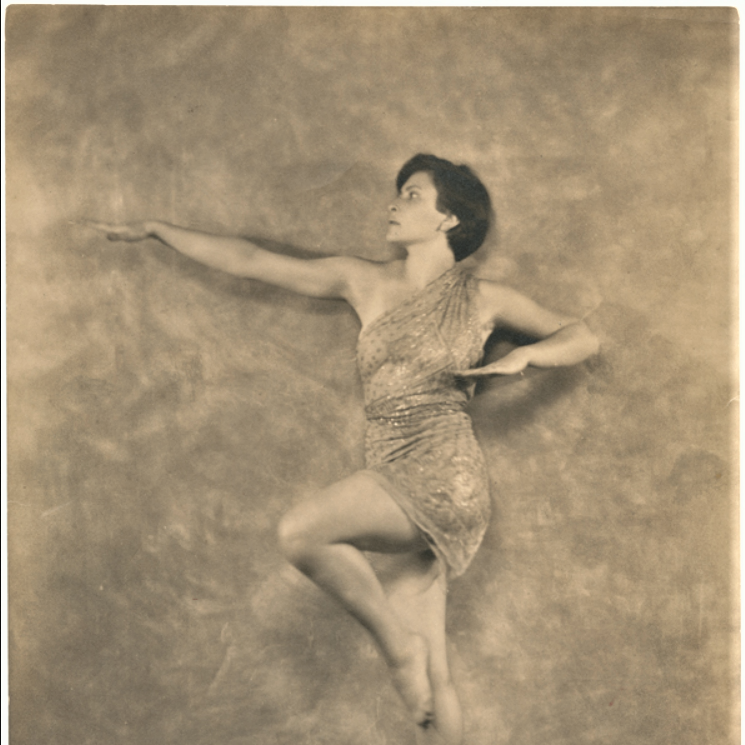
Reviews of a night of evolving revolutionary dance from artists Nadia Chilovsky, Anna Sokolow, Lilly Mehlman, Sophie Maslow, Jane Dudley, Mirim Blecher, and Edith Segal.
‘Workers Dance Movement Makes Great Strides Forward’ by Simon Hall from The Daily Worker. Vol. 11 No. 285. November 29, 1934.
THE program of revolutionary solo dances on November 25th at the Civic Repertory Theatre, sponsored by the Workers Dance League and New Theatre, was performed to an enthusiastic overflow house. Hundreds were turned away at the door. Those who could not get in Sunday, as well as those who will want to see these dances again, will be cheered to know that there will be a repeat performance next Sunday night at the Ambassador Theatre.
The solo dances afforded the greatest variety in technique and in subject-matter. There was the ludicrous clowning of Death of a Tradition (Anna Sokolow, Lilly Mehlman, Sophie Maslow), the saturnine, condensed hate of Parasite (Nadia Chilkovsky), the richly complex moodiness of The Dream Ends (Jane Dudley), and an ironic critique of sensuality contained in The Woman (Miriam Blecher).
Since the revolution has come to mean all of life to these young artists, and to their audiences, they have found room for light and joyous aspects in their interpretations, side by side with the tragic and heroic. The scope of last night’s program was broader, more popular in the good sense of the word, more flexible than heretofore. Their revolutionary art is beginning to feel at ease with its receptive audience. Not all the dances given were revolutionary in the previously accepted use of the term, that is, the specific worker, or his attitudes to his work, or his specific participation in the class struggle. New elements, which have always cried out for place on the revolutionary dance program, were admitted last night: lyricism in The Dream Ends, Homeless Girl, The Woman; cruel mockery–as in Anna Sokolow’s Histrionics; humor, as in her “romantic dances.”
***
THE admission of these new leavening elements in our once over-heavy and unmitigatingly sombre dance marks our release from certain sectarianisms in subject matter. Nor does this mean that deep-seated proletarian convictions in these dancers were lacking. In the dances of protest and militancy there was a greater dignity, power and directness. In fact, more seasoned in their art, more highly educated in the foundations of the class-struggle (thanks to the educational work of the Dance League) dancers like Miriam Blecher, Nadia Chilkovsky, Jane Dudley were outstanding for their clear grasp of revolutionary content.
Nadia Chilkovsky’s evocation of The Homeless Girl from Eviction Sketches was frail and sensitive, admirably suited to her physique, but Parasite showed her capable of great vitality, too. The latter piece was a theory of the leisure class objectified in dance, forceful in denunciation. As flashing was Lilly Mehlman’s Defiance. Building up to a climax swiftly, dynamically and energetically, it ran a hurricane course to great applause. Sophie Maslow’s Themes from a Slavic People, suave and brooding, was commendable for its reserved unity of mood and dexterity of execution.
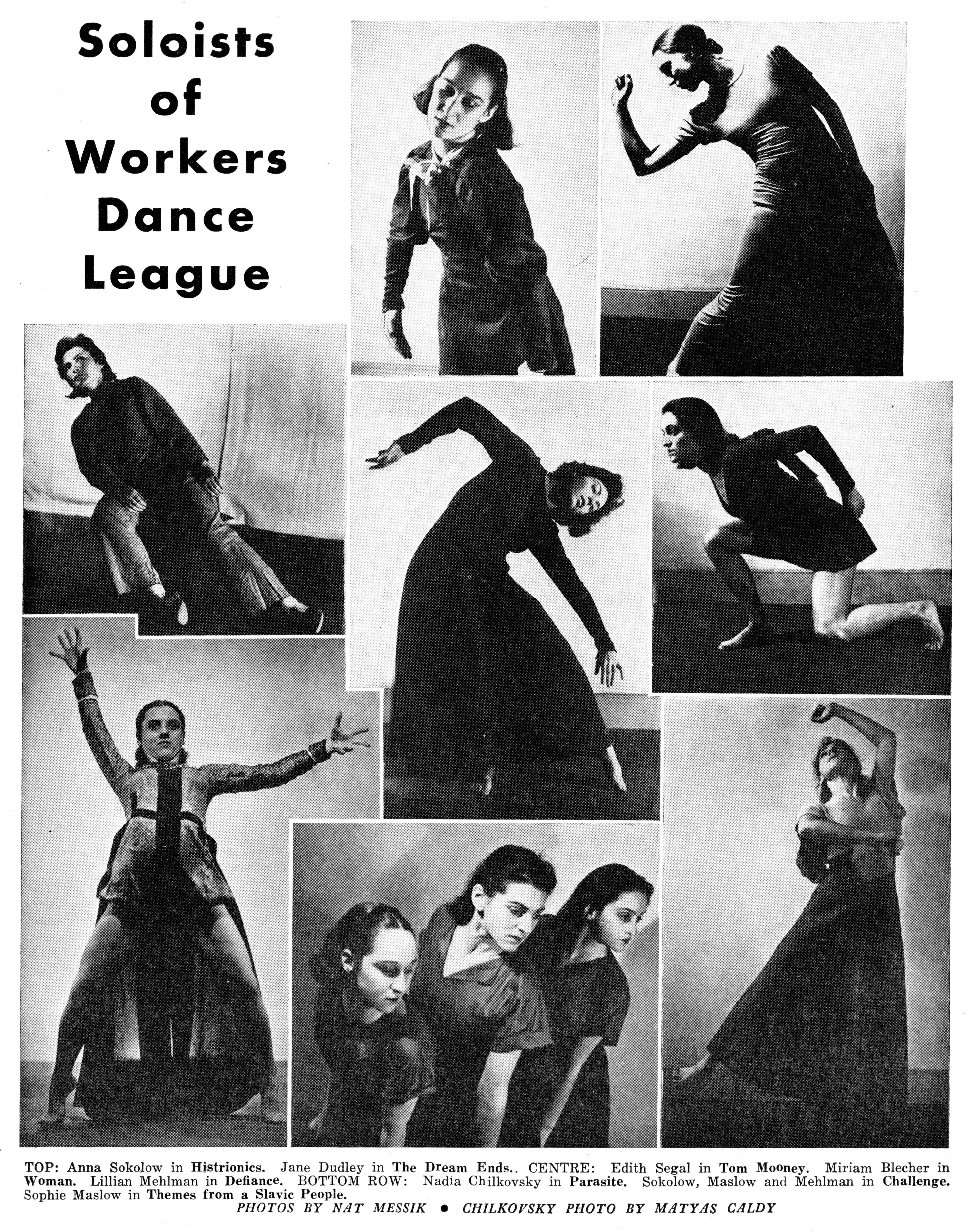
For daring in conception, Jane Dudley certainly ranked highest on the program. In the Life of a Worker revealed her powerful grasp of proletarian subject matter, while her imagination, steeped in understanding of the worker, evolved his life composed of work, war and struggle with a sympathy sheared of overemphasis or simplification. The latter failing was the great defect of Edith Segal’s Tom Mooney, and, like the poem to which it was read, over sentimentalized; now was it quite coordinated to its word-rhythm accompaniment.
Jane Dudley’s dance to S. Funaroff’s poem Time is Money, was better constructed, more fluent in movement. She disregarded the limitations of the poem’s rhythm spans, lets the dance flow organically, and used the words only for programmatic text. Miriam Blecher’s three dances showed her a finished technician, with a marvellous power of projection and animation. This power was especially marked in The Woman and in the opening number of the program. Awake, a thrilling and dramatic call to action. Three Negro Poems while finely executed, seemed to this reviewer, a little too self-conscious, though there again her dramatic projection was outstanding.
***
THERE has never been anything so farcically funny in the theatre as Death of a Tradition, a droll travesty on the favorite themes of sentimentally bourgeois dancers. Anna Sokolow’s Histrionics, almost a burlesque, was nevertheless magnificently danced. This program opened the eyes of the audience to the propaganda values of caricature and burlesque, and to Anna Sokolow’s talent for that type of dance.
Although it may be premature to predict a brilliant future for these talented dancers as revolutionary artists, it is not unsafe to prophecy a rapid and praiseworthy growth in the workers’ dance movement.
The revolutionary dance has gone a long way since last year; it has much to accomplish in the way of specific propaganda for the revolutionary movement, but it has achieved professional standards and a diversity of subject matter that will take it far ahead toward the accomplishment of its tasks.
The Daily Worker began in 1924 and was published in New York City by the Communist Party US and its predecessor organizations. Among the most long-lasting and important left publications in US history, it had a circulation of 35,000 at its peak. The Daily Worker came from The Ohio Socialist, published by the Left Wing-dominated Socialist Party of Ohio in Cleveland from 1917 to November 1919, when it became became The Toiler, paper of the Communist Labor Party. In December 1921 the above-ground Workers Party of America merged the Toiler with the paper Workers Council to found The Worker, which became The Daily Worker beginning January 13, 1924.
PDF of full issue: https://www.marxists.org/history/usa/pubs/dailyworker/1934/v11-n285-NAT-nov-29-1934-DW-LOC.pdf
 Revolution's Newsstand