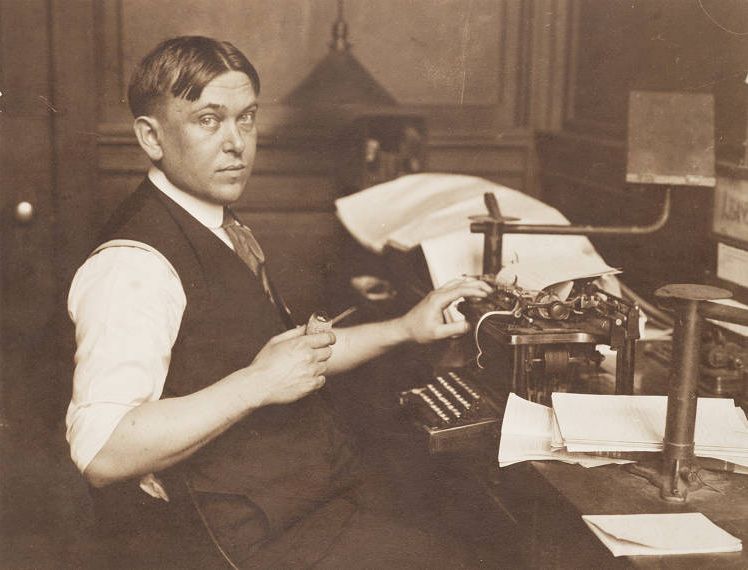
A pleasure to read this century-old humbling of H. L. Mencken, who still deserves a drubbing, from Joseph Freeman.
‘H.L. Mencken as a ‘Sociologist’’ by Joseph Freeman from The Daily Worker. Vol. 5 No. 35. February 11, 1928.
YOU ask what I think of Mencken as a sociologist?
Mencken as a sociologist can’t be discussed seriously. Even a sound citizen like Ernest Boyd, who thinks god smart set is willing gels have suspended the laws of capitalist development for Wall Street’s benefit, twits the Baltimore Sage for putting the cart of politics before the horse of economics. The philosopher of the Hencken and the catholic and to ditch Marx and Veblen because they’re “dull writers,” and thus confuses a proletarian scientist and a liberal pedagogue as exponents of the same point of view. Mencken has never understood socialism because he is a typical bavarian spuzbuerger, a bohemian in outlook, a good American citizen, a romantic worshipper of the alleged glories of feudal society. It was his hard luck, intellectually, that he first heard of socialism from a profound revolutionary thinker like Robert Rives LaMont.
***
Mencken makes no bones about his “sociology,” which makes him a much safer “thinker” from the working class point of view than a lot of “liberals,” “radicals,” etc. He says capitalism is good and democracy a lot of hocus-pocus, schweinerei and flap-doodlery. It is true that under capitalism (which for all its beneficiaries, including the author of “Prejudices” is a pleasant system) democracy is a fake pure and simple which shouldn’t fool anybody but half-wits and the Fellowship of Reconciliation. Mencken should be given a congressional medal or the seat of Comparative Archeology at Dukes University for his services to American capitalism as a sociologist, for his defence of private property and his attacks on Soviet Russia. The fact that he raises hell about a lot of things is only proof that the court-jester can stick a pin into the king’s hip so long as he supports the monarchy. Discussing Mencken as a sociologist is like discussing Coolidge as a poet. He knows less about the laws of economics than a Puritan about real virtue.
***
But to tell the truth I don’t think it’s as a sociologist that Mencken is or has been the hero of the day, but as a social phenomenon. First grant him his virtues: he is clever, his style makes reading a pleasure (it’s not easy to imitate it, either! I’m trying, as you see). He observes many truths about individuals and books; he is vigorous and above all, rarest of all virtues in modem ink-slingers, he is honest. I agree with a lot he says about people, and with nothing he says about society, but I always feel that he means what he says, and though that is no virtue in a politician, it is no doubt a quality which is very useful for a writer. As a social phenomenon Mencken fulfills a real function. He is a “character” that does for the “average” American what Sam Johnson did for the “average” Englishman; he is the embodiment of the American petit-bourgeois. Take all of his pet ideas and compare them with the superstitions of the “average” intelligent hundred-percenter: you will get a book that is funnier even than the “American Credo.” He has laughed at Greenwich Villagers, politicians, the booboisie, the national specimen, and the rest of it, but at bottom, and often right up on the very surface, his notions about life and society are very much like theirs.
In common with congressmen, college professors, cub reporters, Eighth St. poets and Chautauqua orators, he believes that history is made by great individuals. In common with bookkeepers he believes that the majority of mankind are incurably and hopelessly stupid and that wisdom and superior brains are god’s gifts to a select few. In common with elderly spinsters who invite bad artists to tea he believes that a real artist must be sick, preferably syphilitic. In common with every devotee of the Book of Etiquette he believes that civilization is a matter of a small aristocracy. In common with every police-court judge he believes that the Bolsheviks are evil and stupid. In common with every cloak and suit manufacturer he believes that capitalism is good enough for the world and that if you have money you’re all right. You could go on like this for a long time.
***
Where Mencken differs from the rest of his fellow-compatriots is in his genuine love of literature that is not too new, his quixotic devotion to learning and culture. This is what makes him the god of the learned professions, the intelligentsia. It is not for nothing that he is read, imitated and worshipped by all the younger editorial writers of the land, or that he wraps himself in the Stars and Stripes in any real controversy.
He is a Jeffersonian liberal in politics, an anarchist in philosophy, a bohemian in his pose, a free lance kidding the authorities and abiding by the status quo; a trusted citizen who raps the Declaration of Independence and fights for free speech. Could there be a more perfect popular “philosopher” for the middle-class intelligentsia with its fear of machine civilization and the working class?
The Daily Worker began in 1924 and was published in New York City by the Communist Party US and its predecessor organizations. Among the most long-lasting and important left publications in US history, it had a circulation of 35,000 at its peak. The Daily Worker came from The Ohio Socialist, published by the Left Wing-dominated Socialist Party of Ohio in Cleveland from 1917 to November 1919, when it became became The Toiler, paper of the Communist Labor Party. In December 1921 the above-ground Workers Party of America merged the Toiler with the paper Workers Council to found The Worker, which became The Daily Worker beginning January 13, 1924.
PDF of full issue: https://www.marxists.org/history/usa/pubs/dailyworker/1928/1928-ny/v05-n035-NY-feb-11-1928-DW-LOC.pdf
 Revolution's Newsstand