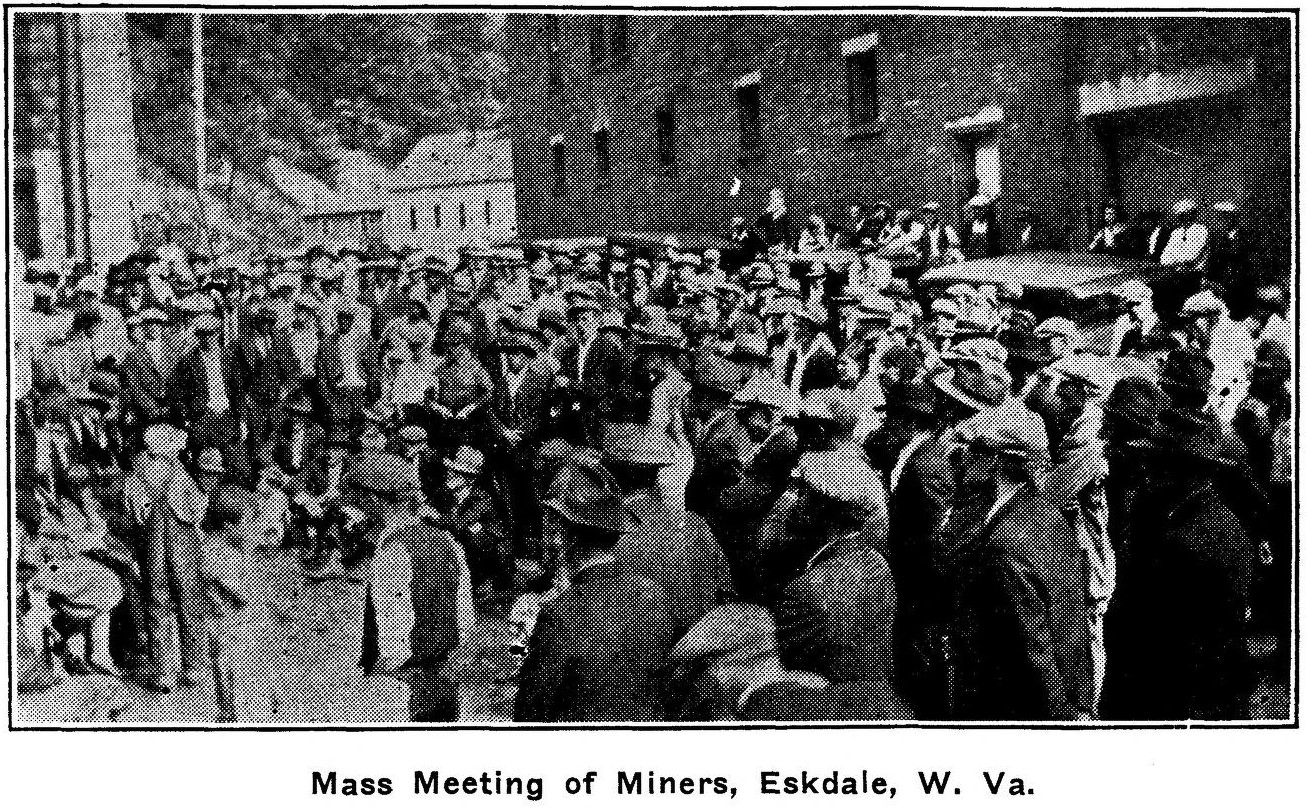
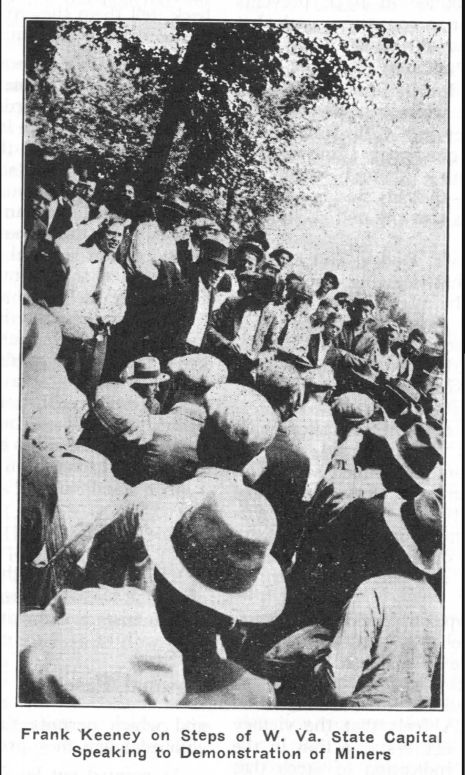
Outstanding working class leader Frank Keeney was central to the West Virginia Mine Workers Union and associated Labor Party founded in January, 1931. Below, a report on its conference, its decisions, and Declaration of Principles.
‘The Independent Labor Party of West Virginia’ from Labor Age. Vol. 21 No. 2. February, 1932.
AS we walk into the vestibule of the Kanawha County Court Building in Charleston, West Virginia, Sunday afternoon, January 30, to attend the meeting at which the miners of that section formed themselves into an Independent Labor Party, we found the walls of that vestibule plastered with yards upon yards of what from a little distance looked like wide paper streamers. On closer inspection they proved to be constable’s or sheriff’s notices pasted together in long strings and announcing sale of properties for non-payment of taxes. The Charleston Daily Mail of that evening contained twenty-two and a half solid columns of such notices. Verily an appropriate time for the miners to make a clean break with the old parties and to set about forging their own political weapon, though there were not many miners directly affected by these legal documents, since they, for the most part, live in company houses and so far from ever having had property, seldom see any United States money at all. A number of the mining companies have actually given notice in recent weeks that they are not going to go through the formality of having pay-days and issuing pay-envelopes to the miners any more. This is a serious matter even though the pay-envelopes in 90 per cent of the cases indicated that the miners were in debt to the company instead of having any cash wages coming to them. The bookkeeping expense of issuing pay-envelopes will henceforth be saved. If there is work, miners will work; if there is any food left in the company store, they will eat a little; if not, “God only knows” as former President Taft said on an historic occasion.
About 150 delegates and sympathizers representing miners‘ union locals in the Kanawha Valley and a few Socialist locals from other parts of the state were in attendance at the convention. Harold W. Houston, attorney for the miners in many important cases, was temporary chairman, and C. Frank Keeney, president of the West Virginia Mine Workers’ Union, permanent chairman. ‘Boots’ Scherer, who is the secretary of the W.V.M.W.U. served as both temporary and permanent secretary of the Labor Party Convention. Harold Houston was also chair of West Virginia man of the Committee on Statement of Principles, and Brant Scott, vice-president of the W.V.M.W.U. was chairman of the Resolutions Committee.
The convention was addressed by A.J. Muste, chairman of the Conference for Progressive Labor Action, and director of Brookwood Labor College; Tom Tippett, Extension Director of Brookwood Labor College; Norman Thomas and Murray Barron of the Socialist Party, and by Mr. Houston. The most vigorous and spontaneous outbursts of applause came when Houston referred to the workers’ republic in Russia, and when A.J. Muste, after referring to the terror practiced against the miners in Kentucky, expressed the hope that the Convention will send its greetings to the Kentucky miners and pledge support to the Defense Fund and to all efforts to break the terrorism in Kentucky and elsewhere against the miners and their fellow-workers.
The ringing Declaration of Principles adopted by the Convention and setting forth the definitely working-class basis of the Party together with some of the specific measures for which it is going to work is printed in full at the conclusion of this dispatch.
For a National Labor Party Conference

On the important questions of organization and national affiliation, the Convention adopted the program for which the miners’ leaders have stood since the organization of their union a year ago and which is in line with C.P.L.A. policy. The name of the Party is The Independent Labor Party of West Virginia. It has declared squarely against bargaining and intriguing with the old parties. For the time being it will concentrate its energies upon building a solid organization from the bottom up in Kanawha, Boone, Fayette, Putnam and Raleigh Counties. The Convention did not affiliate with the Socialist Party, leaving the question of national affiliation for future determination. It was agreed that while individuals would not be barred from joining the Socialist Party if they wished, the I.L.P. would be opposed to the building of rival socialist locals in the five counties.
The I.L.P. will invite the socialist locals in West Virginia, trade unions and other working-class groups interested in the promotion of independent political action along the lines of its Declaration of Principles to confer on the possibility of “harmonious” action together with the state ticket. The Convention also instructed its Continuation Committee to make every effort to bring about a national conference of all political, trade union, fraternal and other organizations interested in national action along similar lines.
The miners of West Virginia want to see a mass labor party built up in the United States. They believe that the action they have taken is most likely to further that end. Their decision not to affiliate with the S.P., at least for the present, does not indicate any lack of militancy on their part, but rather the reverse, as a reading of the Declaration of Principles suggests. Many of their leaders want to be more sure than they now are of the sound, working-class character of the S.P. and its militancy both on the political and industrial field, before they would think of joining, though they make it clear always that they deeply appreciate the assistance in the form of strike relief and in other ways which has been given them on the industrial field by S.P. organizations and individuals.
Resolutions were adopted favoring compulsory unemployment insurance covering all workers and with no contributions from the workers themselves; endorsing the LaFollette-Costigan bill for direct federal relief for the unemployed and demanding that the initial appropriation should be not less than five hundred million dollars, the sum recently appropriated by Congress for the relief of bankers and industrialists in connection with the Reconstruction Finance Corporation; for the nationalization and democratic control of the mines; demanding that the Red Cross furnish relief to miners and other workers; protesting against the terrorism in Kentucky, pledging support to the Kentucky Miners’ Defense and to efforts to break the anti-labor terrorism in Kentucky and elsewhere.
The Convention agreed to meet again on March 26 to nominate candidates, adopt a full platform and take such other steps as may then be indicated. The Committee which issued the call for the Convention will continue to serve as Committee until the March 26 convention and will carry on an active campaign to arouse labor party sentiment throughout the five counties. This recent convention of the Independent Labor Party of West Virginia may well prove epoch-making. The miners, their families and adherents in the five counties number not less than fifty thousand voters. In the present state of affairs in the U. S. that is not a small addition to the independent working-class vote.
Declaration of Principles
Adopted by the Independent Labor Party of West Virginia at Charleston, W.Va. January 30, 1932.
WHEREAS WE, members of the working class of Southern West Virginia, have learned by bitter experience that both the Republican and Democratic parties represent solely the interests of the propertied and employing classes; that having control of the powers of government, they have, with rare exceptions, used those powers, legislative, executive and judicial, in behalf of the employers and against the workers; that they have organized and used the police powers, especially the powers of the so-called Department of Public Safety, to defeat the workers in their just right to organize unions and carry on their lawful activities; that members of the old parties, elevated to judicial office, and notably to the Supreme Court of Appeals, have given judicial sanction to the notorious and infamous “yellow dog” contract, a contract savoring of the tyranny of England’s darkest industrial period; that the courts, obedient to the voice of the industrial overlords, have granted injunctions depriving the workers of the elementary civil rights to peaceably assemble and to use argument and persuasion to induce their fellow workers to join unions of laborers; that the courts, by judicial interpretation, have construed the laws of this State so as to deprive the workers of the right of trial by jury and to permit the eviction of them and their families without process of law where it can be done without violence or breach of the peace; that the courts have solemnly, in defiance of every principle of American law, elevated the military powers over the civil government where the rights of the workers are concerned, thus permitting them to be convicted by kangaroo military courts; in short, that the government of West Virginia, in the hands of the old parties, has become merely an instrument for the protection and preservation of property rights as against human rights, and,
WHEREAS, the present chaotic condition of the coal industry, not alone in Southern West Virginia but in all of the coal fields of the country conclusively shows that their private owners are wholly incapable of organizing planned and scientific production; that under private ownership and control the priceless natural resources of this State are being ruthlessly destroyed and dissipated and the workers in the mines and their families reduced to idleness, want and starvation, carrying into the homes of the miners all the horrors of under-nutrition and disease, and,
WHEREAS, The government of West Virginia, under the rule of both Republican and Democratic politicians and political gangsters, has wantonly wasted the public revenue and placed a crushing burden of taxation upon the people of the State, resulting in the virtual confiscation of small land holdings and the progressive impoverishment of those who are dependent upon their labor for support,
THEREFORE, BE IT RESOLVED, That we, workers and representatives of the working class in convention assembled, form an independent political party, committed to the great fundamental principle that to the worker belongs the full social product of his toil; that labor, applied to the products and forces of nature, is the sole basis of wealth; that the vast creation of labor saving machinery and the consequent socialization of the instruments of production must inevitably lead to social ownership and control; and,
BE IT FURTHER RESOLVED, That in our struggles for recognition of the fundamental rights of the working class we proclaim the following measures as a part of our program of political, industrial and economic reform:
1. The complete nationalization of all of the coal mines in the United States and its possessions.
2. The adoption, by all of the states and the nation, in all lines of industry, of a six hour day and a five day week, to the end that the workers may benefit by labor-saving machinery and affect a more equitable distribution of employment and leisure.
3. The adoption, both by the state and the nation, of unemployment insurance, old age pensions and free medical services for the workers, thus insuring the workers and their families against want during periods of depression, and preserving the aged workers from destitution and humiliation after their years of usefulness are past.
4. The re-organization of the Workmen’s Compensation Department of West Virginia to the end that it may be administered in the interest of the workers, and not as a department of cheap insurance for the employers.
5. That anti-injunction laws be enacted to halt the tyrannical use and abuse of judicial power during the efforts of the workers to organize and carry on their lawful activities.
6. That the so-called Department of Public Safety of West Virginia be abolished, to the end that it may cease to be an instrument of the employers for the breaking of strikes and suppressing the lawful activities of labor.
7. That the so-called “yellow dog” contract be outlawed by legislative enactment. 8. That a law be enacted forbidding to employers the right to evict employees during periods of industrial controversy.
AND BE IT FURTHER RESOLVED, That a delegate convention of the workers of Kanawha, Putnam, Boone, Fayette and Raleigh Counties be called to meet in the city of Charleston on the 26th day of March, 1932, for the purpose of nominating candidates for public office; for drafting a platform setting forth the principles, aims and purposes of the party, and for doing such other things as may be found advisable in advancing the political interests of the workers.
Announcement: The West Virginia Mine Workers’ Union is forming an Independent Labor Party. Convention here unanimously adopted declaration of principles indicating our position. Another delegate convention scheduled for March 26th to translate declaration into party platform, and to nominate candidates for office. Our declaration now being enthusiastically discussed in field campaign to clarify character and purpose of March convention. We hope time has come at last when American workers everywhere will build strong industrial and political organizations striving consciously to assume the direction of a world of plenty which their labor has created, and in which they are now starving and suffering as they have never suffered before. C. Frank Keeney, President.’
Labor Age was a left-labor monthly magazine with origins in Socialist Review, journal of the Intercollegiate Socialist Society. Published by the Labor Publication Society from 1921-1933 aligned with the League for Industrial Democracy of left-wing trade unionists across industries. During 1929-33 the magazine was affiliated with the Conference for Progressive Labor Action (CPLA) led by A. J. Muste. James Maurer, Harry W. Laidler, and Louis Budenz were also writers. The orientation of the magazine was industrial unionism, planning, nationalization, and was illustrated with photos and cartoons. With its stress on worker education, social unionism and rank and file activism, it is one of the essential journals of the radical US labor socialist movement of its time.
PDF of full issue: https://archive.org/download/v21n02-feb-1932-labor-age/v21n02-feb-1932-labor-age.pdf
 Revolution's Newsstand