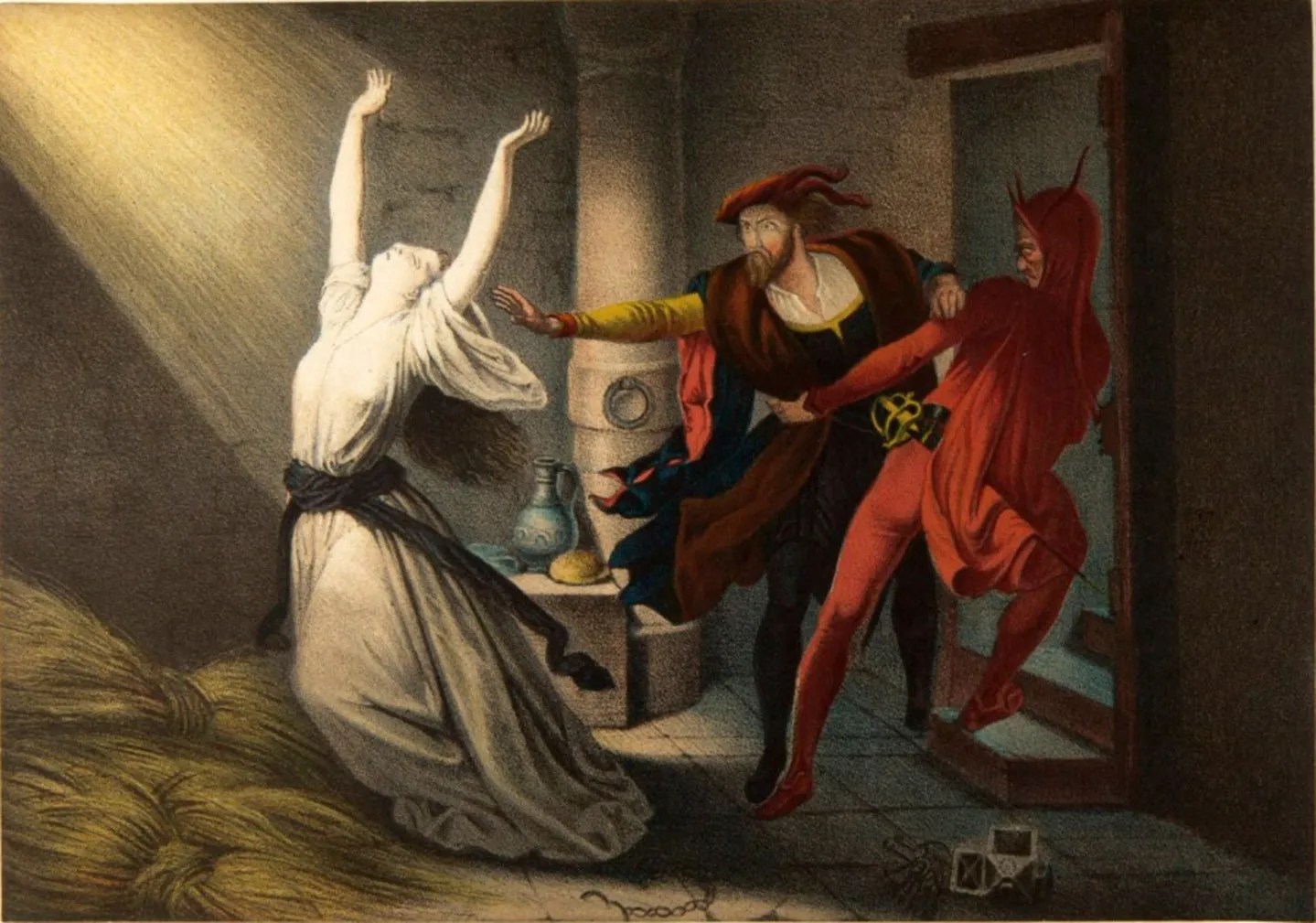
Early Marxist literary critic and Socialist lawyer, the always interesting Marcus Hitch speaks from the Marxian generation of Ibsen, Bebel, and the Suffragettes, in re-reading the story of Gretchen in Goethe’s Faust from his larger study of a work central to the imaginations of a whole century of radicals.
‘The Gretchen Tragedy’ by Marcus Hitch from Goethe’s Faust: A Fragment of Socialist Criticism. Charles H. Kerr Publishers, Chicago. 1908.
THE GRETCHEN TRAGEDY.
Let us now go back to the pseudo-tragedy of Gretchen, which occupies about one half of Part I in space and more than that in popular interest.
If Goethe’s idea of women does not coincide with that of Euripides, viz., that one man is worth ten thousand women, it is certain that in Goethe’s time their social position and learning sank into insignificance when compared with an intellectual giant like Faust. We cannot discuss here the large question of the wretched position of the female sex during the entire Property Age. But we shall take exception to the practice of treating seduction as the subject of a tragedy, no matter how beautifully it may be handled. If it be excused as a necessary part of a great man’s experience in class society then again we say, so much the worse for class society.
Gretchen was a pure, young girl, a devout Catholic, almost a child in experience. Her mother is a widow and poor, of course. Necessarily poor, or you couldn’t make the tragedy. Gretchen’s education has been neglected and she is overworked from dawn till dark.—No need of going any farther. There is the tragedy right there! Stop and think a moment. A girl “past fourteen”; no father, no property, no education, no experience.
“Must cook, knit, sew, must wash and dry; Run far and near—rise ere the light. And not lie down till late at night.”
Isn’t that tragedy enough? One would think so for a person of normal taste. But the morbid taste of class society demands “hot stuff”. It finds its highest entertainment in the unhappy condition of its own victims.
The first step, of course, towards winning Gretchen’s attention is to give her what she lacks most,—property. A casket of jewels is sent her. Why that? If Gretchen is a human being in the pursuit of happiness, why shouldn’t she give Faust a box of jewelry,—gold watch, cuff buttons, diamond stud and all. Think what pleasure it would have given her to witness Faust’s gratitude for such a gift. But that is not the way to make a tragedy; Gretchen is not a human being and has no right to pursue happiness. Faust monopolizes this business for himself. What would an economically independent girl, with an economically independent mother and the education and training which this implies, care for a casket of jewels from a stranger? It would be resented as an insult. That the underlying cause of seduction in a majority of cases is an economic one is so generally recognized as to need no proof. The overworked and underpaid department store and sweat shop girls are regularly, almost proverbially, cited in illustration of this. But not only in the inception of the evil is the economic cause predominant. In its ultimate results it is the economic condition of the unfortunate one which becomes so unbearable as to lead to despair. She is deprived of the opportunity to earn an honorable livelihood, even if she is able and willing to do so.
That Gretchen’s moral defect is not fatal, Goethe himself has shown by landing her in heaven, and if she is good enough for heaven, why should she not be given a chance on earth instead of being served up as material for a tragedy? Her love is so pure that it saves Faust in spite of himself.
When Mephistopheles, seeing her at Martha’s house with the box of jewelry, pretends to take her for a “lady” she and Martha are perfectly dumfounded, and inform him that she is nothing but a “poor girl.” The seduction of a “lady” might furnish material for the yellow newspapers, but it could not afford the basis for a high grade literary “tragedy.” It lacks the element of Economic “Fate.” The seduction tragedy is based on the fictitious necessity of poverty and ignorance.
It requires no great insight to see that most of the little romances and love tragedies which Goethe experienced in his own life and which caused him and others that infinite suffering which only sensitive natures can understand, were owing to economic (and hence social) differences in the situation of the respective parties interested.
If the victim in these cases were given a chance to become again a useful member of society, doing her share of the work and receiving her share of the good things of life, she would, it is true, carry a sad heart in her bosom, but all the other noble qualities of a human being would still be hers,—intelligence, skill, gentleness, helpfulness, kindness, truthfulness, courage, justice, yes, even “benevolence”. Just think of that! Do all these count for nothing? Is the mere animal side of woman of such paramount importance that when this is once marred, nothing is left of her? This is the characteristic bourgeois view of woman as an instrument of production and sensuality. Her impairment for such purposes is looked upon as depreciating her commercial value, is called her “ruin”.
So deep seated is this commercial estimation of woman and so ruthless and irresistible is the property instinct that it has falsified the teaching of Christ and created a sole and only “scriptural” ground for divorce, viz: throwing suspicion on the genuineness of a paternal heir to the family estate. Tolstoy has clearly shown that according to Christ’s teaching there is no scriptural ground for divorce whatever. It is strange that his acuteness did not reveal to him the reason why this particular ground, out of so many, was interpolated as the one necessary concession to the Property State; and this would have led to the further discovery that not religion moulds the ruling class, but on the contrary the ruling class moulds religion. Instead of the Christian marriage being adopted by society, the property marriage has been foisted upon Christianity.
The working up of this so-called “ruin” of a lower member of society into a factitious and frenzied tragedy is the highest delight of those who think that the economic conditions created by their own class rank the same for tragic purpose as those arising from the uncontrollable workings of nature. This, of course, is much nicer than to allow the victim to become recuperated through the beneficent in-fluences of nature and start with an Alpine sunrise to begin life over again, as did Faust. The essence of the Tragic is that it appear inevitable. The moment it appears to be avoidable, it loses its tragic force and is detected as a spurious article.
There is another point that must not escape us. Gretchen got to heaven and welcomed Faust on his arrival there. But what became of the baby that was thrown into the pond? Did Faust welcome it in heaven? It is the constant boast of modern society that it protects the sanctity of motherhood. But here is a large class of mothers whose sufferings are ignored, and who are looked upon as a burden to the taxpayers and who, in many cases, have no other course but to abandon or murder their off-spring, for which a merciful God may forgive them, but Society never does. This circumstance gives simply additional zest to the tragedy in the eyes of a bourgeois audience. It flatters the ruling class to reflect that its laws are as immutable as fate.
Why not have Gretchen appear as a Madonna with her child in her bosom, as she welcomes Faust, and he taking it and tossing it in his arms for joy. But no, the bourgeois heaven, modeled after the bourgeois earth, will not stand for any foolishness on the bastardy question; it touches a property right,—the right of inheritance.
Faust’s love affair with Helena in the castle near Sparta, though a greater breach of morality than that with Gretchen, occasioned no tragedy, not even a ripple. The child, Euphorion, instead of being drowned in a pond was the pride and joy of the entire household. That is the difference between the law of the castle and the law of the “plain room”. Wealth stands above the moral law. It is wealth (the wealthy class) that moulds the moral law as it pleases and pays those who teach it as so moulded. “She was not the first one”, Goethe lets Mephistopheles say. No, Goethe, and (leider!) she will not be the last one. So long as the Property Age endures there will be thousands like her every year in spite of your Gretchen tragedy. Even if this were played in all the theaters of the land every night in the year as a moral lesson, it could have but little effect so long as economic conditions remain unchanged; and while these are ignored, we do not care to have you try your skill in working up our pity. It is not a fit subject for that purpose and the effort falls flat upon one who has seen the light.
This method of teaching virtue is as roundabout and maladroit as the capitalists’ famous plan of making workingmen happy by extending commerce, etc., It consists of these steps.
1. Provide a large class of girls oppressed by poverty and ignorance and overwork.
2. Provide a class of wealthy and idle men seeking sensual pleasure.
3. The natural result will then happen.
4. Provide a great poetical genius to write a tragedy involving a seduction.
5. Have it played in the theaters as a moral lesson and warning to all “good” men and girls.
6. Influence on the aforesaid working girls=0.
We object therefore to seduction as a subject of tragedy for the same reason that we object to the tramp and the hobo as a subject of comedy either on the stage or in the illustrated papers. The reason is, that in both cases the victim of social injustice is utilized for the entertainment of the class which is responsible for the wrong. Viewed in this light, there is nothing comic about the one nor tragic about the other.
It is a hopeful sign that the working class has now reached a stage where it no longer enjoys being either laughed at or pitied by its masters. It is imbued with a seriousness which does not admit that its inferior condition is to remain an accepted fact—much to the discomfort and unrest of the class whose highest literature is rooted in the assumption of the helplessness of women and the degradation of the wealth producers.
But it will be said that we have criticized a poem, a work of art, as if it were a philosophical treatise. No, we have simply shown that in Class Society the highest poetry reflects merely class ideas,—is merely class poetry, toy poetry, and gets its recognition, its standing from that fact alone.
Goethe’s Faust: A Fragment of Socialist Criticism by Marcus Hitch. Charles H. Kerr Publishers, Chicago. 1908.
Contents: Goethe’s Faust, An Outline of Part One, An Outline of Part Two, Comments, The Model Colony Freedom, The Gretchen Tragedy, Goethe and Milton. 127 pages.
The Charles H Kerr publishing house was responsible for some of the earliest translations and editions of Marx, Engels, and other leaders of the socialist movement in the United States. Publisher of the Socialist Party aligned International Socialist Review, the Charles H Kerr Co. was an exponent of the Party’s left wing and the most important left publisher of the pre-Communist US workers movement.
PDF of original book: https://archive.org/download/goethesfaustfrag00hitc/goethesfaustfrag00hitc.pdf
 Revolution's Newsstand