The conference to ‘Bolshevise’ party presses with reports on the publications of France, Scandinavia, Germany, England, Italy, Czecho-Slovakia, and the U.S.
‘The International Conference of the Communist Press’ by G. Smoljansky from International Press Correspondence. Vol. 5 No. 29. April 9, 1925.
The slogan issued by the V. Congress, the Bolshevisation of the Party, raises the simultaneous problem of the Bolshevisation of communist propaganda and agitation. For this last the question of the Party press plays a part of preeminent importance, especially in those countries in which the Sections of the CI are mass parties, and have at their disposal a considerable number of daily and weekly papers.
What does Bolshevisation really mean? It means the transformation of our press into a real mass press of the workers. The communist newspaper must be a workers’ newspaper, not merely a newspaper for workers. It must elucidate every aspect of class warfare and working class life, from the factory to Parliament. The communist newspaper must form a connecting link between the Party organisations and the broad masses of the workers. The communist newspaper must be such that the non-party workman does not regard it merely as a remote organ representing a political party, but as his own labour newspaper, comprehensible to him, mirroring his hopes, his interests, his daily life, and his struggles.
Thus the whole character of the communist newspaper must be changed. Many comrades, accustomed to the traditional type of bourgeois newspaper, and unable to break abruptly with this conservative tradition, are alarmed at what appears to them to be a “weakness” of our press (which is not “equal” to the firmly established bourgeois press, aided by a large number of intellectual literary forces) but this so-called weakness is in reality a symptom that our press is on the right road to proletarisation, that its contact with the masses is becoming closer, and that it is ceasing to follow in the ruts of the social democratic press, which differs from the bourgeois press solely by a political nuance. Emancipation from this tradition is the first step towards the Bolshevisation of the press.
The real purport of the extensive Worker Correspondent movement now being called into life is to bring wide masses of the workers into the ranks of the Party, and to make these into conscious and active Party members. It is obvious that the communist press will accomplish this task efficiently in proportion to its closer contact with the masses, with the works and factories.
Since the V. Congress, our press has been able to report considerable success in this direction in a number of countries, and it is a suitable moment to make a survey of these first attempts, to praise the best efforts, to encourage the backward. The convening of an International Press Conference appears to us to be the most suitable form of carrying out this survey. But from the ideological and organisatory standpoint the most suitable date for an extensive campaign of this nature appears to us to be 5. May the anniversary of the founding of the Bolshevist newspaper “Pravda” in 1912. This campaign could be made to form the immediate continuation of the campaign beginning on 1. May, the opportunity being thus given for carrying out mass agitation on an extensive scale in the five days till the 5. May.
This press conference may be made the opportunity (as our Russian comrades made it) of more firmly establishing the connection between the Communist Party and the labouring masses by means of the communist newspaper, and of awakening active interest for the communist newspaper among the broad masses of the non-party workers. On this day a communist newspaper must be found in every factory, in every workshop, in every workman’s family. Mass meetings a special number of the newspaper being distributed gratis on this day must be made to serve as connecting link between the working class and the workers’ newspaper. On the occasion of the first press conference in Russia on 5. May 1912, 18,000 roubles were collected for the reserve funds of the “Pravda”. The workers’ newspaper must make it its endeavour to widen the “shears”, that is, the ratio between the number of readers and the number of registered Party members. And finally, the campaign must culminate in the propaganda for mass participation by the workers in the immediate work of the newspaper itself, that is, in the organisation of a mass movement of Worker Correspondents.
But the essential factor of Bolshevisation is differentiation. The campaign has not to be carried out in all countries alike, nor conducted with threadbare slogans and on threadbare lines. In my opinion the following lines of action might be laid down for the most important countries:
England. Here the Party has not had one single daily paper up to now. The revolutionary Minority Movement has however attained such an extent to say nothing of the broad masses backing up the “left wing” that there is sufficient foundation upon which to build up a daily labour newspaper for the masses. For England the question to be discussed at the Communist Press Conference is the founding of a daily communist newspaper. The fact that the present weekly paper the “Workers’ Weekly”, the central organ of the English Communist Party, disposes of an edition of 50,000 copies, although the number of members belonging to the Party is only 4000 to 5000, shows that our English comrades could fulfil this task. The revolutionary minorities could at the same time be used as a starting point for the establishment of contact between the labour newspaper and the works and factories, and for the formation of extensive cadres of worker correspondents. The organisation of the worker correspondent movement should precede propaganda for a daily mass newspaper.
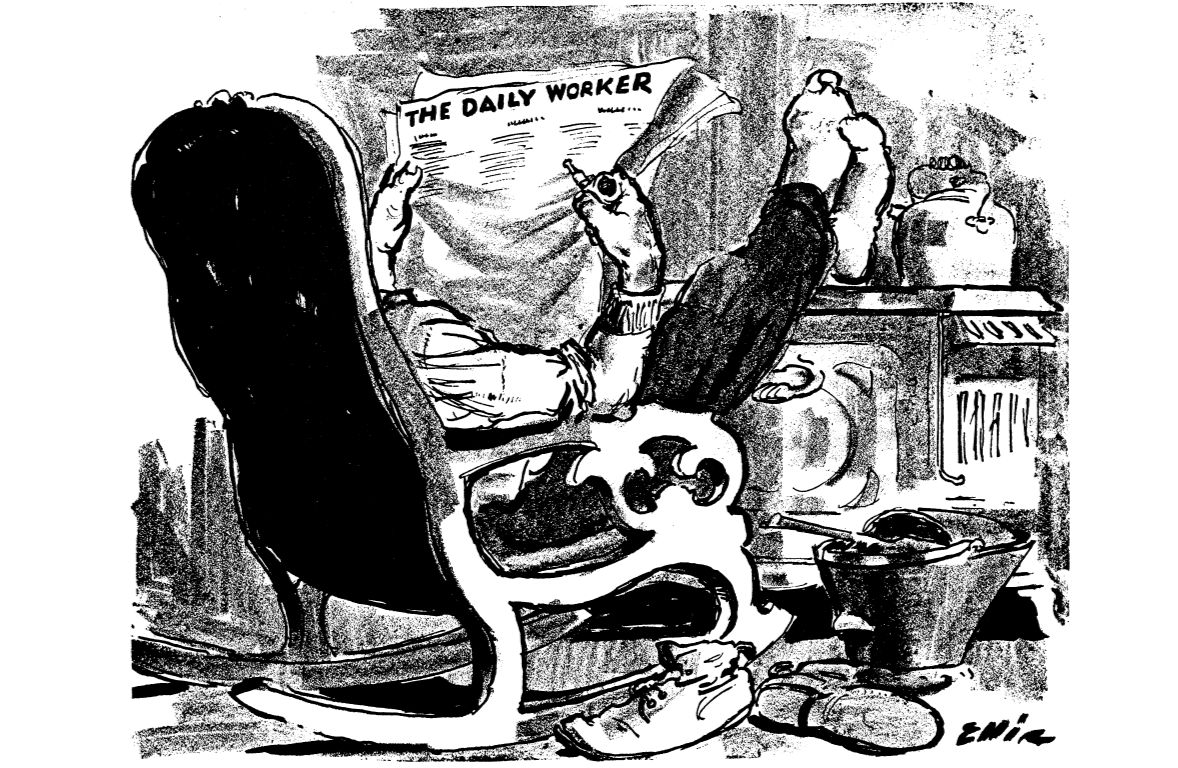
The United States. In the United States, on the other hand, our little Party has more than a dozen daily newspapers, but we are confronted with a number of other problems: 1. These newspapers are not published under any uniform Party control, they do not pursue a uniform communist line, and are at times subject to such aberrations that it is difficult to distinguish them from the ordinary Menshevist newspapers (this applies for instance to the “New Yorker Volkszeitung”). Here the Bolshevisation of the press would thus signify in the first place a strictly centralised control of the communist press by the Communist Party. 2. The chief newspaper in the English language, the “Daily Worker” must be converted into a mass newspaper. The organisation of a Worker Correspondent movement is one of the first tasks imperative for this newspaper. 3. The main weakness of the non-English newspapers is that they devote too little attention to the life of America, and cling too much to that of the country in whose language they are published. This weakness must be overcome, for it only leads to an enhancement of national separatism, and to a weakening of the feeling of class solidarity of the American Proletariat.
Italy. The organ of the Italian Communist Party should be converted into a mass organ, and be brought into closer contact with the working masses. This is the slogan of the Press Conference for Italy. The communist daily newspaper, the “Unita” accords a certain amount of space to worker correspondents, but the letters sent in are a perfect example of how such reports should not be drawn up. The workers’ reports printed in the “Unita” give the impression of having been written in the editor’s study. Besides this, these reports throw no light upon the life and interests of workshop and factory, but refer exclusively to the opinion held by this or that “worker correspondent” on questions under discussion by the Party or other abstract subjects. Some Italian comrades are of the opinion that the discussion of the life of individual factories is not the affair of a serious central organ, since factory newspapers and wall placards exist for this purpose. We are of precisely the opposite opinion. Our newspaper must form the platform from which the workers from the various factories and shops report on the life and struggles of the individual.
France. The central organ of the French Communist Party: “Humanité”, is the only organ published by a Section of the Comintern, outside the Soviet Union, which has attained an edition of 200,000 copies. This newspaper has a magnificent foundation in the half million mass of workers organised in the C.G.T.U. trade unions. A certain amount of exertion, combined with skilful propaganda and firmer establishment of the connection with the masses organised in the trade unions, would enable the paper to increase its circulation to one and a half times or doubles its present. The newspaper is however unfortunately deficient in the necessary prerequisite for this; up to now the “Humanité” has accorded but a very small part of its columns to workers’ reports, and gives but scanty reports on the Soviet Union (a matter of intense interest to the working masses).
Germany. In this respect the press of our German Party is much in advance of others. The Conference of Worker Cor respondents lately held, the number of similar local conferences (Hamburg), the founding of an editors’ school for the instruction of worker journalists, all these are positive symptoms of the proletarising of our press in Germany. At the present time the German CP counts about 30 daily newspapers, but the fact that the central organ, the “Rote Fahne” has a circulation of 30,000 only, shows, that our press in Germany is not yet a mass press. It must be recollected that at the last election the Communist Party received three million votes. For the “Rate Fahne” the slogan for the Communist Press Conference must be: “Double circulation!” The factory councils and the Party factory nuclei must form the foundation of this campaign in the shops and factories. Every worker reading the “Rote Fahne” must gain a new reader.
With respect to the provincial centres where no newspapers exist as yet, but where one could be founded, the campaign must be carried on under the slogan of gaining “readers for the publication of a local newspaper”. As soon as 5000 readers are secured, a new communist local organ can be published.
Scandinavia. In Norway the Party possesses 15,000 members, and publishes five daily newspapers and four to five weekly newspapers, or papers appearing twice to three times a week. The total circulation of the communist press is 45,000 to 50,000 copies, the central organ publishing an edition of 8000. This shows that the number of daily newspapers published is much too large for this small country. The number should be reduced, no readers of course being lost.
In Sweden 8000 Party members have two daily newspapers and five weeklies or semi-weeklies, total circulation about 30,000 copies.
Both in Norway and Sweden the ratio between the mass of readers and Party members is very unfavourable. This must be improved in such manner that there are at least ten non-party readers to every Party member. The attainment of this object means that the Scandinavian communist press must establish closer contact with the factories and workshops. Workers’ reports have up to now been almost entirely absent from the Scandinavian press. For the Scandinavian Party press the main slogan for the Press Conference is thus the organisation of a comprehensive Worker Correspondent movement, and the proletarising of the press.
Czechoslovakia. For Czechoslovakia the chief slogan must be: Deprovincialisation and politisation of the provincial press. The Czechish press must be converted into a really proletarian fighting press. The Party press possesses but few worker correspondents. Not even the whole of the members of the Party and of the revolutionary trade unions are to be counted among its readers.”
This is the road to Bolshevisation to be followed by our press. The Russian “Pravda” was successful in gathering hundreds of thousands of proletarians around it, and in becoming a mighty source of revolutionary energy for the working class of Russia and its Bolshevist party. This was made possible solely by the fact that the “Pravda” did not follow in the ruts left by the bourgeois Menshevist press, but found the right way of establishing contact with the broad masses of the workers. In this way only, and by renouncing the influence of the “great” capitalist sensational press, is it possible for the communist press to penetrate into the masses, and for the Communist Parties to become really Bolshevist mass workers’ organisations.
International Press Correspondence, widely known as”Inprecor” was published by the Executive Committee of the Communist International (ECCI) regularly in German and English, occasionally in many other languages, beginning in 1921 and lasting in English until 1938. Inprecor’s role was to supply translated articles to the English-speaking press of the International from the Comintern’s different sections, as well as news and statements from the ECCI. Many ‘Daily Worker’ and ‘Communist’ articles originated in Inprecor, and it also published articles by American comrades for use in other countries. It was published at least weekly, and often thrice weekly.
PDF of full issue: https://www.marxists.org/history/international/comintern/inprecor/1925/v05n29-apr-09-1925-inprecor.pdf
 Revolution's Newsstand