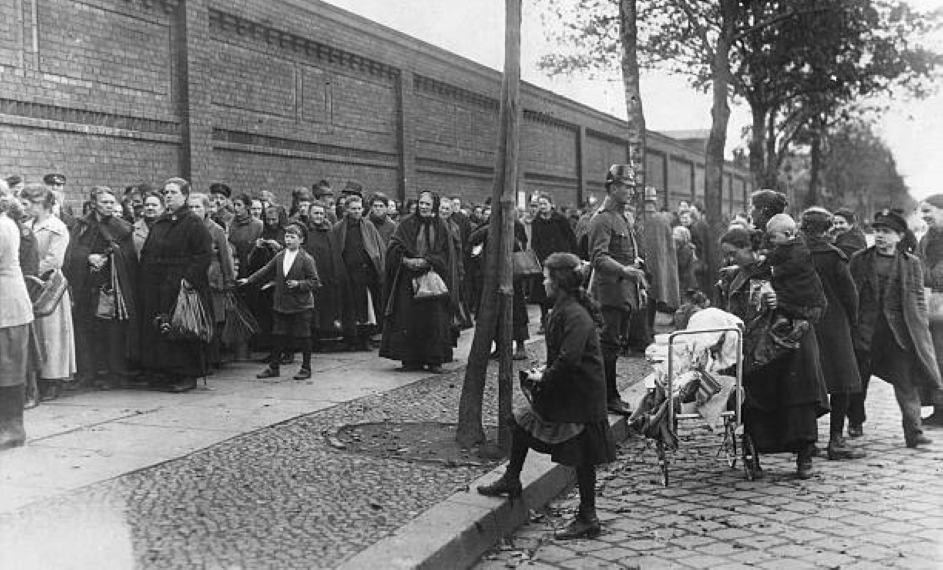
A report on the birth and growth of a working class women’s movement under conditions of deprivation in the Weimar Republic. Bertha Braunthal was a founder of the German Communist Party and central figure of its Women’s Secretariat.
‘Women in the German Shop Stewards Movement’ by Bertha Braunthal from International Press Correspondence Vol. 3 No. 2. January 19, 1923.
Now that the workers have fully recognized the necessity of establishing a united front, they have of recent months sought more and more to give tangible expression to this recognition. The movement following the murder of the minister Rathenau, at the beginning of July, and having for its object the combatting of reaction, caused the spontaneous appearance of control committees in the factories and workshops, by which attempt is being made to attack the counter-revolutionary nationalist murder organizations.
This movement greatly increased in energy towards the end of the summer and the beginning of autumn, with the disastrous depreciation of the mark. The workmen, and above all the working women, saw their households deprived more and more rapidly of even the barest necessities of life, saw amount of their little pittance exhausted a few days after its receipt. The women were seized with utter despair at the sight of their starving children, weak and ill-nourished, subject to the attacks of disease, and at the realization that it was utterly impossible for them to feed and clothe their little ones. Hitherto women had been accustomed to confine their cares and sorrows within the silence of their four walls, but now despair drove them into the streets, into the market places, to protest with other equally desperate women against the wrong being done them, against the usurers and profiteers. It was quite natural that communist women came forward from among these desperate women and explained to them the cause of their misery, and that they and the whole of the working class must fight in self-defense.
In July, shortly after the murder of Rathenau, a spontaneous demonstration of women took place in the market place at Mannheim; they marched before the town hall, and laid before the mayor their demands for the establishment of a living wage, and for the appointment of a control committee.
As prices rose higher and higher during the next few months, when the price for the cheaper bread allowed by the weekly bread card rose from 45 marks at the beginning of September to 308 marks at the beginning of December, and the price for milk from 76 marks to 190-200 marks per litre, the movement against high prices increased proportionately amongst the housewives, and drove them in masses to our meetings and demonstrations. During recent months there were great public meetings for housewives held in all the important cities of the Country; these were preceded by the distribution of leaflets, and brought us many sympathizers and members. These meetings proved that a real fighting spirit existed among the women. In Ahlen (Rhineland) 120 women joined our party in one week. In Düsseldorf, Bremen, Königsberg, Leipzig, Danzig, and other cities, our women comrades have appealed to the women’s committees of the German Independent Socialist and Socialist Parties to join forces with them. These appeals have however been in vain, for the leaders of these two parties were invariably so alarmed at the idea of fighting alongside of communists, that they either entirely ignored the inquiry, or made use of the ridiculous pretext that they did not think the right moment for action had arrived. And this at a time when even the bourgeois classes exemplified for instance by the Association of Physicians in Saxony was appealing to the German public for aid in the most heart-rending manner, trying to awaken its conscience and rouse it to help, in view of the desperate physical condition of the proletarian population, particularly of the children.
The movement has developed with particular strength and energy in central Germany. Here is the centre of the home industries, and here the manufacture of toys, lace, and woollen goods is carried on in the homes of the workers, forcing rot only all the women, but a the children, even those of the tenderest age, to toil in the treadmill of the capitalist working front. Here the indignation of the women, and their determination to resort to self-defense, reached the highest point. The women of Gotha, before all, set the example for the whole country. For this reason we take the development of the Gotha movement to illustrate the movement of the housewives as a whole. At the beginning of October a gigantic meeting for women was held. A women’s committee was elected, and commissioned to enter into negotiations with the town council for the purpose of obtaining a number of demands, as for instance the obtaining of a supply of cheap potatoes and coals for the working population, feeding of school children, etc. The meeting closed with a request to the shop stewards and confidential representatives of the workers of Gotha to form a common control committee with the women. Thus in Gotha, in Mannheim, and in many other places, it was on the initiative of the women that the joint control committees working with the shop stewards were formed. The demands formulated by the women’s meeting were then most effectively brought forward by our representatives at the town council meetings, and numerous working women mounted the platform. Despite the heart-rending descriptions given by our comrades as to the misery in the families of the workers, of the unemployed, and of the recipients of small pensions, who were being forced to sell one article after another of their household effects in order to stave off the utmost hunger of their children, all the demands of the women’s meeting were rejected.
A few days later a second spontaneous demonstration of the housewives of Gotha took place before the town hall, demanding the distribution of bread cards for cheaper bread for the families of workers. Although the town hall was surrounded by the police, the women forced an entrance, and succeeded in obtaining bread cards for the whole of the demonstrators, in accordance with the size of the family. But this is all that the women have been able to attain up to now. But they have not allowed themselves to be discouraged. They have attempted to spread the housewives’ movement beyond their own town, and have sent representatives to all the most important towns of Thuringia for the purpose of holding women’s meeting and for ming women’s control committees. In order to carry out this task it has been necessary to organize speakers’ evenings, in order to in the members of the women’s high prices committee for the work of agitation.
After every fresh action in Parliament, public meetings were held pledging again to continue the fight for the demands already formulated, and to mobilize still more forces for this fight. Thus it was decided, on the occasion of the last impressive women’s demonstration on November 25, to make all preparations for a housewives’ conference for Thuringia, to the end that the struggle being carried on by the housewives may be unified and extended.
The movement has made practically the same progress in the important industrial centres of the Rhineland and Saxony, where housewives’ control committees have been formed and are working in the same manner. The committees themselves are formed of communist and nonparty women in proportion to the character of the housewives’ meetings; in the Rhineland the women participating energetically in the movement are Christian women under the influence of the Centre Party.
The housewives’ control committees have regarded themselves from the very beginning solely as forming part of the common control committees of the workers, and have carried out all work in consultation with the latter. The housewives’ representatives also take part in the meetings and consultations of the control committees of the shop stewards; they were present at the Provincial Shop Steward Congresses in Saxony, Thuringia, and the Rhineland, which preceded the General Shop Steward Congress. At all these preliminary conferences proletarian housewives were also elected to the provincial committees of the shop stewards.
The General Shop Steward Congress was also participated in by the representatives of the housewives from all important districts, and their demands were brought forward, especially those regarding combatting the misery among children, in which they were further supported by a demonstration of the proletarian women of Berlin. If the resolutions and the program of the General Shop Stewards Congress are to be carried out, if the measures which it proposes against usury, profiteering, housing difficulties, and the capitalist offensive are to be really effective, it is absolutely necessary that the proletarian housewives participate actively in the work, and they were appealed to by the congress to gather together in the control committees, and to undertake the special tasks of controlling the markets and retail prices. A representative of the housewives was also elected to the General Committee of the Shop Stewards, her duties consisting a forming housewives’ control committees, combining them into provincial and national housewives’ conferences, and organizing and training the masses of housewives for the struggle towards the common goal.
The movement of the proletarian housewives, and their organization into housewives’ control committees, is the beginning of the mobilization of the masses of women still outside of our ranks, for the class war, and their enrolment in the united front of the revolutionary proletariat for self-defense against further oppression and misery. The fact that these women are being revolutionized will be more effective in the near future in helping forward the proletariat in the coming decisive battles between the bourgeoisie and the working class.
International Press Correspondence, widely known as”Inprecorr” was published by the Executive Committee of the Communist International (ECCI) regularly in German and English, occasionally in many other languages, beginning in 1921 and lasting in English until 1938. Inprecorr’s role was to supply translated articles to the English-speaking press of the International from the Comintern’s different sections, as well as news and statements from the ECCI. Many ‘Daily Worker’ and ‘Communist’ articles originated in Inprecorr, and it also published articles by American comrades for use in other countries. It was published at least weekly, and often thrice weekly.
PDF of full issue: https://www.marxists.org/history/international/comintern/inprecor/1923/weekly/v03n02-jan-18-1923-Weekly-Inprecor-stan.pdf
 Revolution's Newsstand