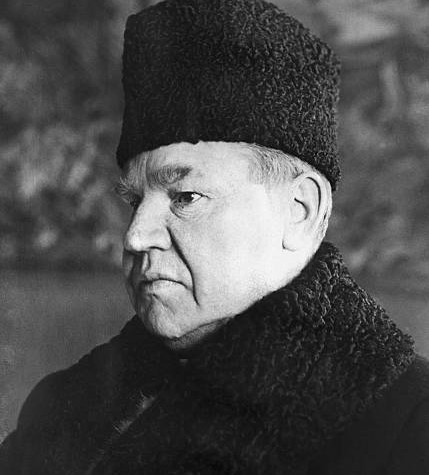
U.S. Communists are with Haywood as his long illness comes to an an end and he dies in Russian exile on May 18, 1928 with a part of his ashes interred in the Kremlin Walls and part near the Haymarket Martyrs at Chicago’s Waldheim Cemetery.
‘Bill Haywood’s Last Days’ by Sam Darcy from The Daily Worker. Vol. 5. No. 168. July 17, 1928.
THIS is being written about a week after Bill Haywood died. Looking back on the last moments that J. Louis Engdahl, Haywood’s wife, and the writer spent with him we must express our admiration for him, a real revolutionist, who even on his death bed thought only in terms of leading the proletariat along correct revolutionary struggle.
For those who know him, it is unnecessary to characterize Haywood. It was fitting that the most militant section of the working class should have produced him. At nine years of age he joined his father in the mines. At thirty he led his first strike (a miners’ strike in Idaho.). There followed thirty years of struggle so intensive in character, and filled with heroism as only the best revolutionaries in any country and very few in the United States can show.
He had no clear and correct theory to guide him. But he had unlimited courage, unyielding loyalty to his class, a keen intelligence and tremendous dynamic energy. This won him his place among the workers. It is not exaggerating to say that during the period 1891 to the time he left the states, workers followed him more trustingly and fought more militantly under his leadership than they did under that of any other leader.
His Last Hours.
This powerful man was lying on a white-sheeted bed as we came in knowing full well that his hours were counted. Three or four times during the previous two weeks we were told that he would be gone in a few hours. But he held on. Now, however, he lay calmly, awaiting the end. Part of him was paralyzed he could speak only with great effort, and he could digest no food.
He answered our first few questions very briefly. He felt no pain. He was however, very tired. He had received everything he wanted Was he coming home soon? He wiped a tear that forced its way out but did not answer. He heard that the Central Committee of the American Communist Party had telegraphed asking after his health. This pleased him immensely. Finally he wanted news.
We told him of the latest developments in the strike of the coal miners, and of the textile strike in New England. Occasionally he interrupted and asked questions. We told him that Lewis had issued an expulsion order. He looked with scorn and hate.
“Now the miners can get somewhere. They’ve got to kick Lewis out. The Save-the-Union movement has big mass support. It must use it and not be afraid to go forward. It will have difficulty getting enough good organizers. We always have that difficulty. But they can do it if they stick together. The Party is doing good work. In this respect the miners are better off than they have ever been. In the old days we never had any Communist Party to help us.” He was by this time panting for breath. His nurse looked angrily at us. A clumsy silence ensued. He turned his head towards the window. “It’s summer-time, eh?” We nodded. Another silence.
A Big Job.
“Too bad the New England strikers didn’t go out while Passaic was tied up. They weakened their chances by separating. They got to get the unorganized out. This is the biggest job they face, and it won’t be easy. But it’s the only way they can win.” Again silence. We showed him a Pittsburgh paper with his picture next to a story on the coal struggles.
“That picture is from Kuzbas.” We said we knew it. We showed the picture to his nurse and his wife who had just come in. Also a batch of other newspapers containing stories of his illness. Soon our visiting time was at an end and we had to leave.
Much of the discussion we have not set down here. But the above gives a glimpse of the man and somewhat explains why the workers always trusted him. His mind and heart were always completely occupied with the class struggle. There are few miners, lumber-jacks, or textile workers who do not know of his work. The South, which even up to the present, has hardly been penetrated by labor organiations, has felt his hand. He was one of the few who succeeded in bringing white and black workers together. Who that knows the South does not appreciate the struggle that this alone must have involved?
Many Stories to Tell.
We knew stories of his work that we picked up among the workers in various parts of the country. But once in a discussion with him we asked him to tell us about them. He embarrassedly laughed, “there is nothing to tell—you simply fight and let your proletarian conscience be your guide.”
But there are many stories to tell. He went through the stormy days of the Western Federation of Miners, of which he was secretary-treasurer, and of the early militant I.W.W. of which he was one of the founders. He went through the Cripple Creek struggle, the famous Moyer, Haywood and Pettibone trials, the Lawrence, Lowell, Paterson and many other textile strikes.
He went through the anti-war agitation and was one of the few who did not compromise with the bourgeoisie. He was the leader and organizer of dozens of small strikes. The story of the most militant struggles 1890-1919 is the story of the location of his activity.
He represents the best traditions of the American class struggle of his time. It is a sign of strength of our Party that a working class leader of his mettle, experience, and ability should himself come and bring many of his best followers to the banner of the Communist International.
The Daily Worker began in 1924 and was published in New York City by the Communist Party US and its predecessor organizations. Among the most long-lasting and important left publications in US history, it had a circulation of 35,000 at its peak. The Daily Worker came from The Ohio Socialist, published by the Left Wing-dominated Socialist Party of Ohio in Cleveland from 1917 to November 1919, when it became became The Toiler, paper of the Communist Labor Party. In December 1921 the above-ground Workers Party of America merged the Toiler with the paper Workers Council to found The Worker, which became The Daily Worker beginning January 13, 1924.
PDF of full issue: https://www.marxists.org/history/usa/pubs/dailyworker/1928/1928-ny/v05-n168-NY-jul-17-1928-DW-Q.pdf
 Revolution's Newsstand