
The story of the dramatic, bloody founding convention of the National Miners Union is told by its first President, .John J. Watt. Even as the mass strikes of 1927 were still ongoing, U.M.W.A. leader John L. Lewis began wholesale expulsions of militants, dissidents, and rivals after the 1927 expiration of the national Jacksonville Agreement with the coal operators brought a wave of discontent. The Communist Party counted many hundreds of miner members, including important local and regional leaders. Those militants and supporters formed the ‘Save-The-Union’ caucus in April, 1928 and by September of that year, the U.M.W.A. expelled enough locals that it was decided to establish the National Miners Union. Though often associated with the ‘dual unions’ of the ‘Third Period’, the N.M.U. had its own specific reason for being.
‘Launching the National Miners Union’ by John J. Watt from Labor Unity. Vol. 2 No. 9. October, 1928.
THE National Miners Union is founded, though not without considerable struggle. The mine owners, their supporters among the officials of the United Mine Workers of America, and their supporters in city, county, state and national office all understood the importance to them of preventing a real, militant, rank and file union of coal miners. What they did not understand was that when thousands and tens of thousands of coal miners really want something, they are likely to get it, no matter what is done to stop them. Attack on the convention called to consider the organisation of a new coal miners union was made by Lewis gangsters, and Pittsburgh police. It was preceded by a series of assassinations of delegates. It was followed by proclamations against the convention by the sheriff of Allegheny county, and the presence in the convention hall of sheriff’s deputies, sent there to stop it. Following the convention, after the new union was organised, federal marshalls and post office inspectors, with the aid of state troopers, tried to put out of business the National Miners Relief, an organization which has been feeding the striking miners in the field, and which fed the starving delegates, just out of jail during the period when the convention had just adjourned, and the men could not make connections.
The fact that all of this opposition to the new union, and all of these attempts to cripple its friends have failed makes the National Miners Convention, Sept. 9-10, 1928, one of the most interesting, colorful, and hopeful chapters in labor history.
The convention was called by a conference of recently elected executives of Districts 5, 6 and 12, together with other well known miners, some of whom had been expelled from the U.M.W.A. for opposing the treachery of the Lewis machine in past years. This conference met in Pittsburgh, June 12, and issued a stirring call, pointing out that John L. Lewis had wrecked the union and lost the strike through a consistent treacherous policy of settling one district after another at cut rate wage scales with an absence of provisions for safety for the miners underground, total loss of most other conditions, no solution for the machine problem, etc. The conference pointed out that Lewis’ tactics of dividing the miners into helpless separate district unions with separate contracts, forced in the future to scab on each other, forced now to take a defeat, was the end of the union. It showed that Lewis using gang rule and miscounting the votes in elections could not be dislodged by the rank and file in the union. And it argued from this that the union men should set up their own union, and leave Lewis stranded.
Difficulties of Arrangement
A National Miners Convention Arrangements Committee was established by the June 12 conference, with Pat Toohey, editor of the Coal Digger, and secretary of the National Save-the-Union Committee as secretary, and myself as chairman. The apparently impossible task was begun of organizing a convention which must have at least six hundred delegates to get a fair representation from the vast mining fields of America, some parts of them a thousand miles away from the center at Pittsburgh; a convention for which there was no money, a convention literally of starving men who had been through a seventeen month strike, who could with the greatest difficulty traverse these distances, a convention which had to be held in Andy Mellon’s state, where the biggest scab coal company owner dominates all forms of government.
Some day some poet will write in verses of flame of the sacrifices that had to be made by those delegates, elected by locals constantly threatened with gangsterism by the Lewis machine, delegates four of whom fell under the bullets of assassins during the two weeks before the convention, delegates going without meals, and started on their way in auto trucks with gasoline bought by hundreds of rank and file miners in their localities who went without food to do it.
Some one will some day be able to adequately thank the countless thousands of workers in other lines of industry who saw the frantic appeal of the convention arrangements committee and donated their and earned pittances to the great work. All I can say here is the bare fact—the necessary sums were raised, and the convention delegates, 675 of them, came into Pittsburgh. A thousand more were elected and could have come if there had been a few more dollars.
Death Did Not Stop It
The delegates arrived sobered with the news that Delegate Frank Bonita, brother of the Sam Bonita framed up for murder by the Lewis-Cappellini machine of District 1, had been murdered in his home in Wilkes Barre. A bloody challenge greeted them in Pittsburgh. Friday night, two days before the convention date, three delegates, George Moran, Charles Glovak, and Theodore Glovak were shot in a union meeting at Bentleyville by a Lewis spy, Louis Carboni, who was trying to prevent the local from adhering to the new union.
A day before the meeting of the convention, scheduled for Labor Lyceum hall, the police superintendent refused to give a permit for it, tried to argue the arrangements committee into postponing it—postponing it with nearly 700 miners in town to take care of!
And news went around that the Lewis machine was mobilizing throughout the mining field, from West Virginia to Washington state, all of its gunmen and gangsters, on the payroll as organizers (organizers who never left the organized territories!) all of its officials who had nerve enough to come and face real miners.
In preparation for the onslaught, 400 delegates went up to the convention hall during the night, Saturday, and waited there to hold it for the convention which was to meet at ten o’clock.
About nine o’clock some 200 Lewis organisers assembled around the hall. They were led by such officials of the Lewis union as:
Frank Hughes, International Organiser, Joe Angelo, International Organiser (not Joe Angelo of the National Meiner Union), Heartneady, President District 7, Studdard District 31 (West Virginia), Buzzarelli, Sub District Board Member, William Hynes, Sub District Board Member, John Cramarich, Field Worker District 5, Thomas Robertson, District 5 Organizer, and Vice President of the Pennsylvania-Ohio, State Federation of Labor, Boso Damich, International Organizer and his son, William Stevenson, International Board Member of Michigan, Fred Gulick, Sub District Board Member, James Feeley, International Organizer, Rube Fern, International Organizer and former welter weight champion of the world, Henry Jones, his assistant, William Prentiss, International Organizer, Frank Hefferly, International Organizer, Jack Hassan, District Board Member, Frank Dobbins, District Organizer, William Dineen, International Organizer, Carl Wolcutt, District Organizer.
The fact that only 200 of these thugs could be secured by the Lewis machine in this crisis shows a definite collapse of morale on the part of his thousands of paid agents.
The gangsters tried to force their way into the hall, and got decidedly the worst of it. The Lewis slugs carried clubs and blackjacks, the delegates were unarmed, but had a high spirit. When the total of broken heads and loose teeth is counted, it will not be i entirely on one side.
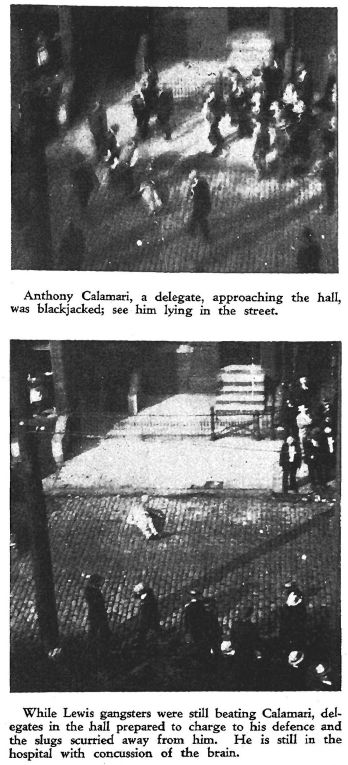
After losing their attack on the hall, the gangsters turned with the greatest ferocity to the dirty work of sniping individual delegates arriving alone and unprotected for the convention. Many were injured. One, Anthony Calamari, is, as this is written, still in a serious condition in Passavant hospital, with concussion of the brain. The Lewis sub-district organizer Buzzarelli jumped on his head after he had been knocked down with many blows, and the police were dragging him to the patrol wagon.
Police-Gangster Co-operation
Yes, the police followed the gangsters to the assault. No, Buzzarelli and the other Lewis slugs were not arrested, except here and there, one of them by accident. The Lewis gangsters wore large red-white-and-blue badges, and when police saw sluggers so identified beating up a delegate, they waited patiently until the delegate was down, and then arrested the victim, never his attackers.

The police charged into the hall, where by this time the delegates were quietly seated, with the doors closed, waiting for the call to order from the chairman. The police shouted, “We want the leaders,” and drove the delegates from the hall. Stationed in the entrance way, they began a period of arrests which continued down the streets wherever delegates walked, and was followed by a series of raids on the hotels where they were quartered by districts. All they found in hotels were arrested. Some were beaten up by Lewis gangsters with the police.
In all 120 delegates were arrested, including the West Virginia delegation which arrived in the middle of the day, when all was quiet at Labor Lyceum and walked into the hall, and into the hands of the police still occupying it. They could have had absolutely nothing to do with the fight Here we see the police tactics exposed. They were trying to stop the convention. Though they charged all arrested with felony, to keep them in jail over Sunday (in Pennsylvania such charges can not be bailed on Sunday) they released them all the next day, some with trifling fines, as soon as they found that the convention had been held.
Determined on Convention
For the convention was held. Oh yes. Miners do not come so far for nothing. Within a few hours after the Labor Lyceum was lost to the police all the unarrested delegates were on their way to East Pittsburgh, two hours’ trolley ride from Pittsburgh, another town, but in the same county. There Sunday afternoon, with about 500 delegates present, in the Workers Home, with the secretary of the arrangements committee on the platform, I had the honor of calling the first session of the National Miners Convention to order. Both of the officers of the arrangements committee had evaded arrest at the Labor Lyceum by a process of quick changing of hats, caps and coats, and some lively dodging.
The convention was not exactly secret, for the Workers Home is like the Biblical “house that is set on an hill,” and it could not have been hidden if we had wished. We merely relied on the known stupidity of police and gangsters, when faced with an unusual situation, and calculated on shortening the agenda, and rushing through the main business before we could be attacked again. The arrangements committee worked ceaselessly bringing in the delegates, and arranging for most of them to stay in East Pittsburgh.
Oratory was largely dispensed with. Everybody knew the situation. Resolutions submitted from all parts of the mining country were turned over to committees elected that afternoon and night. The first session adjourned at midnight, and if we had found the militia in charge of the hall the next morning, and all of us arrested, we could still have said that the main purpose of the convention had been accomplished. For the National Miners Union was launched at that first session, and a complete set of officers elected as well as the main lines of organization and policy agreed upon.
The Workers Own Union
Although the committee on constitution was still working for hours later on the draft of the document, the convention had specified that there should be a democratic union, with the basis resting on the pit or mine committees, elected by the men in each mine. Locals are based on these committees. The committees themselves are the grievance boards, taking up with the management of the mines directly all cases of injustice to miners working there, thus doing away with all the hierarchy of “courts” which the Lewis administration established to cheat the miners and aid the management.
Whether or not sub-district grievance committees shall be formed is a matter left entirely to the various districts themselves to decide. However, it is suggested that sub-district and district boards be formed so as to handle the problems where one or more mines in or out of the sub-district are involved in a dispute over contract matters.
There is to be sub-district and district administration, to be established by conventions called in the districts. In the higher boards, the locals are represented proportionally to their size. No more “blue sky” or “paper” locals. Officers are subject to easy recall. No more machine rule. Officers may also be charged and prosecuted before their own local union or by their membership directly, not as in the old U.M.W.A. where charges are preferred at the executive officers’ boards.
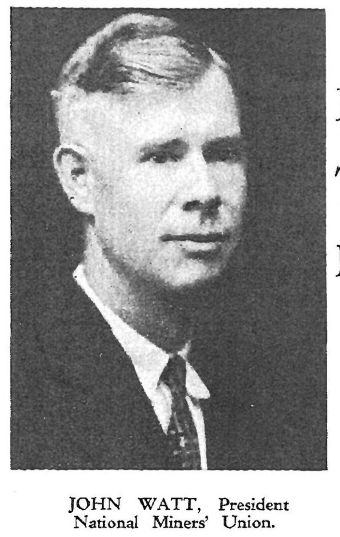
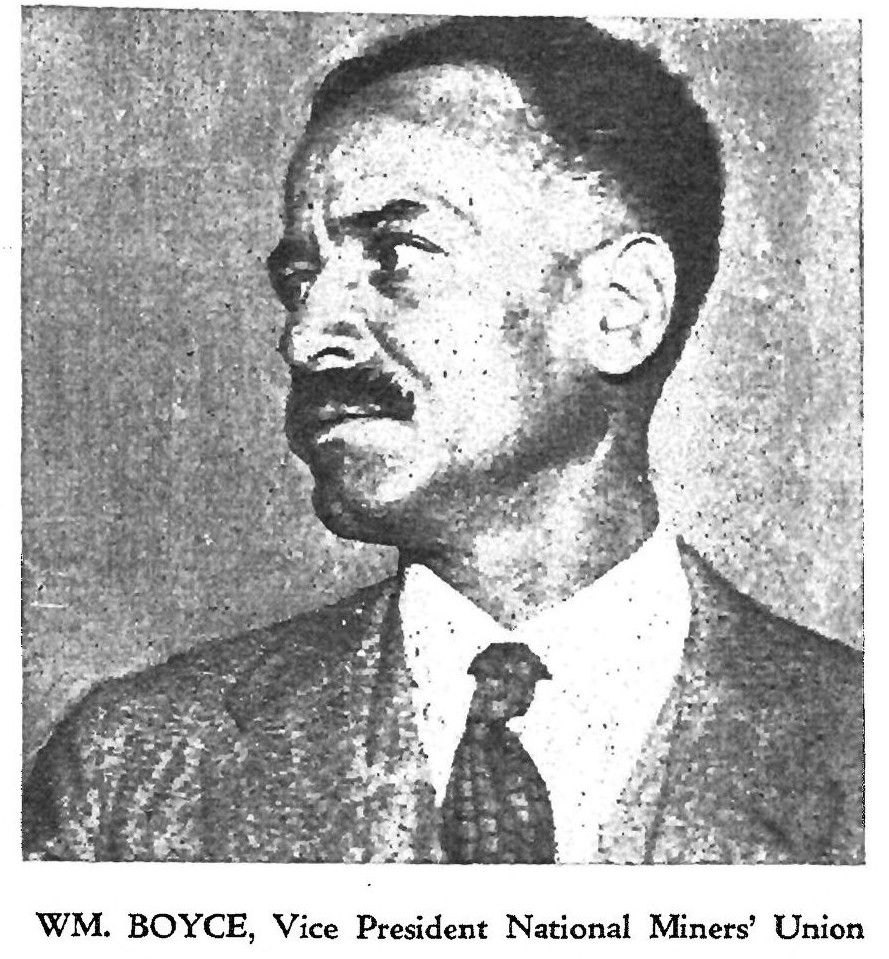
The officers elected were a National President, myself; a vice president, Wm. Boyce (a Negro miner from Indiana) and a secretary-treasurer, Pat Toohey. There is also a National Executive Board, with limited powers subject to referendum of the membership, composed of one man from each district, elected in the first case by delegates from his own district.
The first Board is composed of:
District 1, Frank Vrataric; 2, Charles Killinger; Anthony Calamari (or in case he cannot serve because of the injuries inflicted on him by Lewis thugs, Isaiah Hawkins); 6, Robert Matusick; 7, John Daly; 9, Carl Herman; 11 James Stimson; 12, Freeman Thompson; 13, Frank Hendley; 14, John Hunter; 15, J. Budnikoff; 23, Daniel Wilcox and from the unorganized fields, Tony Minerich and Vincent Kamenovich.
All these men are real miners, who have made their living by digging coal all their lives. All of them are staunch militants, with long histories of struggle against the Lewis machine, and activity in strikes.

The officers are guided by the decisions of the convention. The statement of policy adopted by the convention begins by analysing the starvation of the miners and the profits of the companies, rationalisation, speed-up, more machinery, and open shop, and shows how the Lewis bureaucracy in the United Mine Workers has cooperated completely with this employers’ policy, smashing unions, betraying strikers, signing one district at a time, separating anthracite from soft coal, losing the strike and abandoning the Jacksonville scale. The statement of policy says:
“John L. Lewis and his corrupt clique can no longer speak in the name of the coal miners. We call upon the rank and file in all the fields to refuse to recognize any wage cut agreements signed by them. Fight against the check off and thereby destroy their hope to keep you enslaved to the company union. Break completely with the Lewis machine and join the National Miners Union.
“We solemnly declare to use every ounce of our energy to fight to the last to remove every obstacle to build an organization to comprise the whole of the rank and file coal miners. An industrial organisation taking into its membership all men employed in and around the mines, except the bosses. Within our ranks we welcome the colored miner as well as the white, the foreign-born miner as well as the American. We pledge ourselves to fight for complete equality for all, in every respect, regardless of race or nationality.”
The policy of the new union is to struggle without pause for better hours and wages, for a labor party, and in solidarity with all other struggling workers. The eventual aim is complete emancipation from capitalist exploitation.
The business of the convention, at least in all essential details was sufficiently finished by two 6 o’clock Monday afternoon, so that when the deputies of the sheriff of Allegheny County arrived, closely preceded by a gang of Lewis sluggers riding high powered cars and armed with wrenches and black jacks, we could afford to adjourn. There was complete calm among the delegates at the belated declaration of the sheriffs deputies that no such convention could be held in this county. It was a calm tempered with a certain amount of exultation. After all of the hell of the preceding few days, the sheriffs action came as a kind of an anticlimax; Andy Mellon and the big bosses had locked the stable door after their old time work horses, the miners, were gone, kicking up their heels in freedom. The Lewis sluggers did not dare attack the delegates when they marched out, an hour later, having stopped to eat the good dinner provided in the kitchens of the workers’ home.
No More Objection
Without much trouble the authorities of Pittsburgh consented to the continuation of the convention, when belabored by a committee of prominent Pittsburgh citizens who had a feeling that even Mellon’s state belongs to the U.S.A., and that some sort of freedom of assemblage and speech was at least theoretically prescribed by the U.S. constitution. Why shouldn’t the police permit the convention now? The convention was over; every repressive power had been used except the navy, and they had all failed. The authorities yielded late, but gracefully.
The convention and the first meeting of the National Executive Board the next day took time off to answer some slanders poured upon them by an old enemy of the workers, Vice President Murray of the so-called United Mine Workers of America. Murray said in the Pittsburgh press that the delegates, these starving miners, were all Reds and that they were stealing relief money. The convention pointed out that every variety of political opinion was present at the convention, which was not a political but a union meeting, and that the money did not come from relief funds but from the workers directly. It also called attention to the fact that Lewis drew his thousand dollars a month and about a thousand a month in “expenses” through the whole strike while the miners starved, and that Murray and all Lewis officials profiteered on the strikers in proportional measure. “People who live in glass houses shouldn’t throw stones.”
John Brophy, resigned some time ago as chairman of the Save-the-Union Committee, the organised form of the opposition to Lewis within the U.M.W.A. which committee had come heart and soul behind the movement to organize the new union, issued a statement condemning Lewis, but opposing the new union, on the grounds that it would divide labor. As if Lewis did not do that most effectively! The National Executive Board in its answer explained the situation, and challenged Brophy to find a place for the thousands of miners Lewis drove from the union, as well as the 350,000 he had always refused to organize, also to find a way to stop Lewis misleadership as long as he could count the votes.
Now The Real Fight Starts
Our policy as it works out, the results of the district conventions which will come soon, and our treatment of such important questions as unemployment, mining machines, the youth, Negro miners and women of miners’ families, international solidarity, labor party, wages and conditions, organisation of the unorganized, grievances, check off, etc., on all of which the convention adopted resolutions, or prepared resolutions and turned them over to the board, must be left for a later article. It is enough to say here that we are not following the Lewis policy of crushing 300,000 miners out of the industry as superfluous, we are giving membership and all of its rights to all races, creeds and colors of workers, we are against the check-off which goes now to the Lewis machine.
What is the present situation? Well, we have made a beginning. The miners as a whole (there are 800,000 or them) are not in the Lewis union. They are joining our union by whole locals, and as individuals. Seven thousand who had not yet repudiated Lewis in Illinois, the old stronghold of the U.M.W.A. have gone on a strike against the Lewis-Fishwick administration’s reduction of their wages from $7.50 a day to $6.10 (only a few days a week work). In the anthracite the McGarry independentist movement against Lewis, which did not line up with the National Miners Union has been expelled by Lewis, and all is confusion. We are making an especial appeal to these anthracite workers not to be fooled by Lewis propaganda, or local leaders, and to join with the main stream of the miners’ movement, the National Miners Union, Our headquarters are in Pittsburgh, a coal center, the center of the U.S. fields geographically, not in such a non-mining town as Indianapolis, where Lewis hangs out. The National Miners Union is hard at work, it is growing fast, its road is a rough one, but it is the only road for miners who want their own union, and who are determined to force concessions from the operators.
In 1924 Labor Herald was folded into Workers Monthly, an explicitly Party organ and in 1927 ‘Labor Unity’ became the organ of a now CP dominated TUEL. In 1929 and the turn towards Red Unions in the Third Period, TUEL was wound up and replaced by the Trade Union Unity League, a section of the Red International of Labor Unions (Profitern) and continued to publish Labor Unity until 1935. Labor Herald remains an important labor-orientated journal by revolutionaries in US left history and would be referenced by activists, along with TUEL, along after its heyday.
Link to PDF of full issue: https://www.marxists.org/history/usa/pubs/labor-unity/v2n09-w28-oct-1928-TUUL-labor-unity.pdf
 Revolution's Newsstand