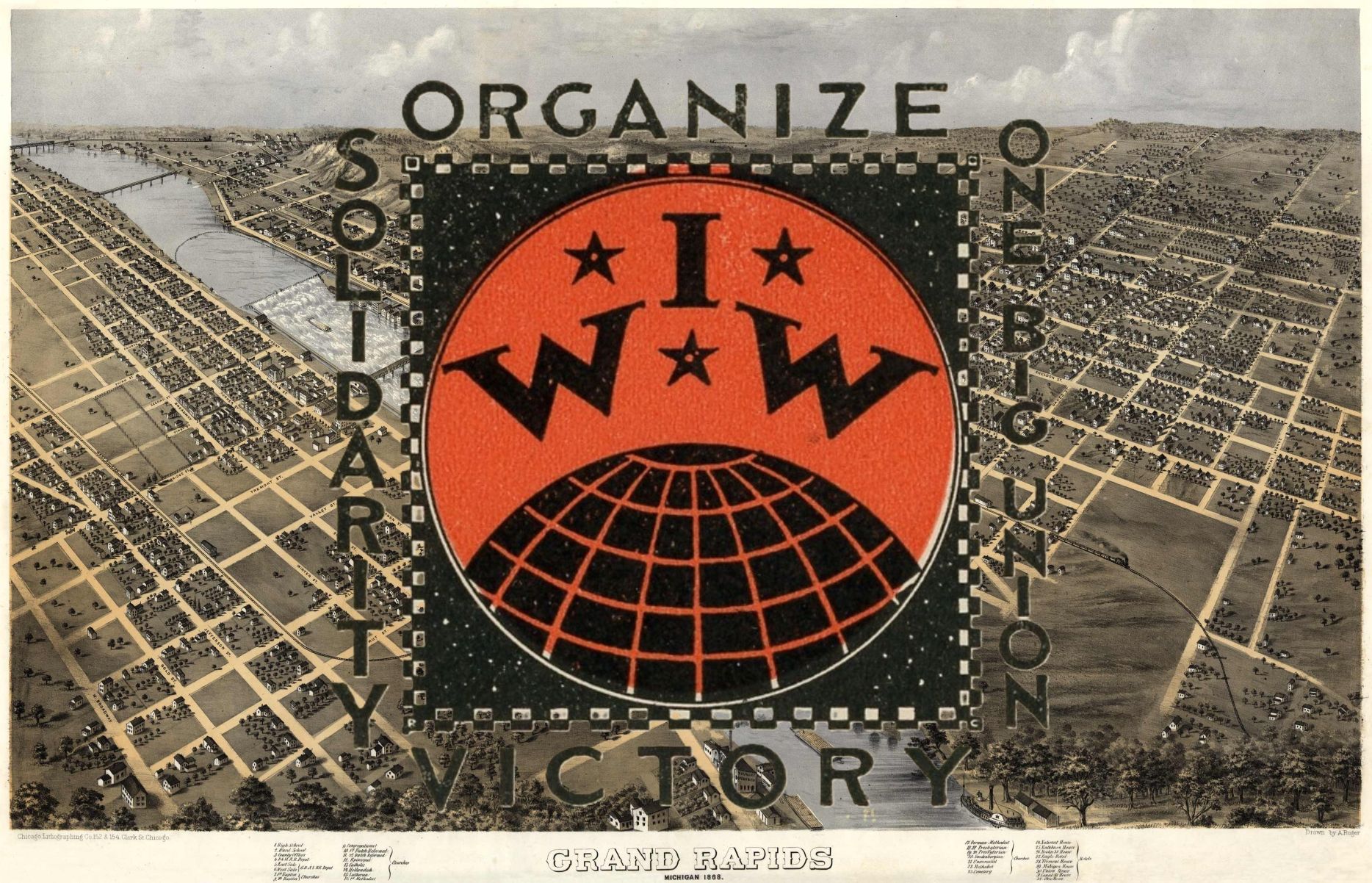
News of then I.W.W. General Organizer William Trautmann’s visit to Grand Rapids and the story of how the local there developed from the Reds of the the city’s Socialist Party.
‘The Story of Grand Rapids I.W.W. Local 202’ by T.F.G. Dougherty from Solidarity. Vol. 2 No. 37. August 26, 1911.
Holds Four Successful Meetings With Much Interest. History of I.W.W. Local.
Grand Rapids, Mich., Aug. 16. Last week the workers of Grand Rapids had an opportunity to hear the revolutionary message of the Industrial Workers of the World, and large numbers took advantage of it. The “messenger” was General Organizer W.E. Trautmann. He is the “goods” all right. Local Union 202 secured Fellow Worker Trautmann for a three days engagement, and the only regret of the little bunch of fellow workers is that we could not keep him here for a month,
Trautmann addressed four street meetings all well attended; not only that, with a few exceptions, the crowd remained from the open to the close of the meetings and then many remained discussing the speech. At every meeting the speaker received the closest attention and at many points there were outbursts of enthusiastic applause and such remarks as “That’s the talk,” “Give us more,” “You’re right,” “Give ’em hell,” were frequently heard.
I looked over the crowd and studied the faces of the slaves, many of whom were strikers; and the predominating expression was earnestness, indicative of thoughtful consideration. There were many sad, careworn, toil wrecked men and women in the crowds whose somewhat despondent, hopeless air seemed to end there, to be transformed into one of hope as they listened to the fervid, eloquent, fearless spokesman of the Industrial Workers of the World. Fellow Worker Trautmann spoke Friday, Saturday and Sunday nights, also Sunday afternoon.
It is necessary to have a permit to hold street meetings, but under the present city administration this has always been issued without questions. No. 202 secured its permit May 12 and it is good till May 12, 1912. In order to sell literature other than newspapers and periodicals, it is necessary to have a license. This costs $1.00 per month or $10 per year. We did not have the literature license in time for the Friday night meeting, so could not make any sales; leaflets and cards, however, were distributed. At the succeeding meeting $5.00 worth of literature was disposed of, the best seller being. “Why Strikes Are Lost.”
Everyone of Fellow Worker Trautmann’s talks was good; fine. But in my estimation the best was the one delivered Sunday afternoon, “The I.W.W.–It’s Form of Organization, Its Object and the Methods by which It Will Attain that Object.” Trautmann has a pleasing personality, a fine voice, a fund of information concerning the history of the various workers’ organizations that have come, gone and are going, a facility for arranging his knowledge in an orderly, concise and comprehensive manner, and above all, he is a tireless worker for the organization. May be come again and stay longer. And it’s us that would like to have a good I.W.W. speaker at least twice a month, and we hope to have one for Saturday, Sunday and the Labor Day that the workers did not take, but crawled on their bellies before their masters and begged the boss to please let ’em have a holiday.
Struggles of Local 202.
A word or two about No. 202 might not be out of place here. This local was organized a year ago last July. Most of those who formed the local were formerly members of the S.P., and a few retained their membership in that organization, and with one or two exceptions, those who retained their political affiliations, are in arrears to No. 202. Those who were foremost in advocating the organization of the I.W.W. local were former S.P. members who had become convinced that the power to transform and overthrow capitalism could not be accomplished by political action represented by a potpourri political organization composed of petty employers, petty traders, sky pilots, lawyers, doctors, professors, capitalist-minded trade unionists, with a small sprinkling of proletarian revolutionists who endeavored to use, the S.P. to carry on a propaganda for industrial unionism. The latter could not see where a political party, that wanted to get possession of the political state for the purpose of securing economic control, (and a party that had not been thrown off by the industrial organizations of the workers) could emancipate the workers; and moreover, while a lot of the S.P. members proclaimed their “belief” in industrial unionism, and loudly shouted, “We need both organizations,” it struck the Reds that a “belief” in industrial unionism was different altogether to building up industrial UNIONS, and that those who shouted about “both” organizations only paid dues into the one that seemed most important–the S.P.
Also, the Reds who left the party have been bawled out ever since by some S.P.-ites as “traitors,” “fools,” as “anarchists,” etc., and these “class conscious revolutionists” have not missed any opportunities to sneer and jeer at the little bunch of I.W.W. men who had the courage of their convictions and left the organization that did not and cannot reflect the material interests of the proletariat, to aid in building up the only organization that is based on the material interests of the proletariat.
This idea of going up into the air and building the roof of the cooperative commonwealth prior to the process of laying the foundations and sticking up the framework appealed to us as something of a joke. It also seemed to us that to divide our energy between two organizations was wasteful, and we know that “divide and conquer” has been the motto of all ruling classes. Knowing also that when our eyes. are blinded by the “sacred” ballot box we are unable to clearly discern where our power is on the job, where we are robbed–the Reds came to the conclusion that one big union, with one big object, wherein the workers can concentrate their energy and give it their undivided attention, never deviating from the revolutionary purpose, was the thing. So we went to it. We were not “pulled out” of the S.P., as one college professor comrade asserted after being in the city for ten minutes (his first visit). A number of the members, the writer among them, had not paid dues in the S.P. for from four months to a year prior to the organization of No. 202.
When we were first organized the S.P., through the efforts of some “good” ones, gave us the privilege of meeting in their hall Saturday nights. We met there a few weeks, when we were unceremoniously canned. By the way, the workers who left the S.P. for the I.W.W. had been the live wires and workers in the S.P., and it was mainly through their efforts that the S.P. had been built up, and their work that furnished the hall. Also it was. the uncompromising revolutionary attitude of these workers that gained for the S.P. local here the reputation of being the “reddest in the state.”
We rented a hall and held business meetings once a week and propaganda meetings every Sunday. But things went against us. We were misrepresented and lied about by the officials of the craft unions, chief among the liars being MacFarlane. Many of the workers were intimidated against our meetings and many of our own members left the city, while others became discouraged. We gave up the hall and rented a room, where we have since been holding business meetings and carrying on propaganda work as well as we could.
The little bunch that has stood firm, going into their jeans for the wherewith to meet the expenses, hopeful and undismayed, resolved to stick, firm. in the belief that the little seed we have been sowing will in time germinate and blossom forth into a big organization. And it will. When the little bunch of revolutionists listened to Fellow Worker Trautmann and observed the attention given him and the interest aroused by his, remarks, we felt that in a few months more the leaven would begin to move the mass. We felt good. D’ye blame us?
T.F.G. DOUGHERTY.
The most widely read of I.W.W. newspapers, Solidarity was published by the Industrial Workers of the World from 1909 until 1917. First produced in New Castle, Pennsylvania, and born during the McKees Rocks strike, Solidarity later moved to Cleveland, Ohio until 1917 then spent its last months in Chicago. With a circulation of around 12,000 and a readership many times that, Solidarity was instrumental in defining the Wobbly world-view at the height of their influence in the working class. It was edited over its life by A.M. Stirton, H.A. Goff, Ben H. Williams, Ralph Chaplin who also provided much of the paper’s color, and others. Like nearly all the left press it fell victim to federal repression in 1917.
PDF of full issue: https://www.marxists.org/history/usa/pubs/solidarity-iww/1911/v02n40-w092-sep-16-1911-Solidarity.pdf
 Revolution's Newsstand