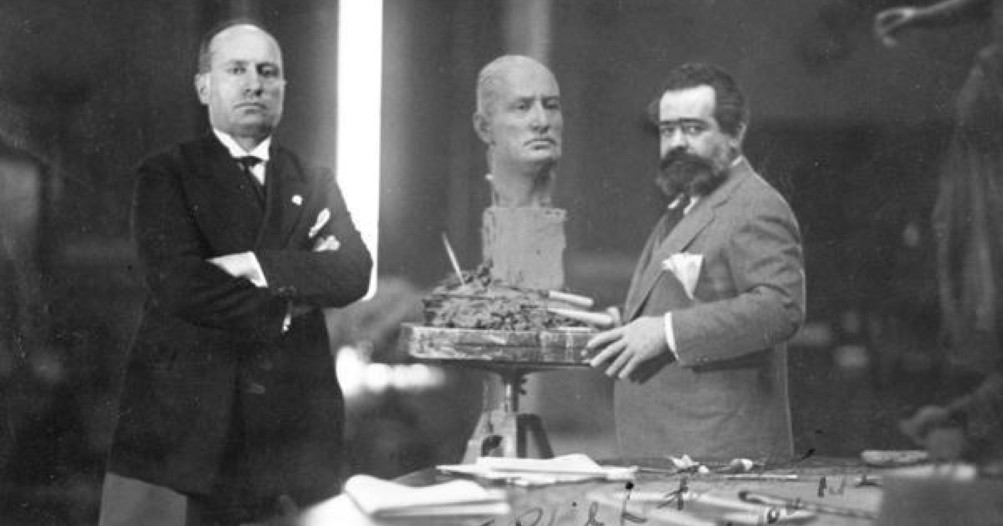
A major work by one of the Comintern’s early theorizers of European fascism looking at Mussolini in power. Hungarian Communist and advisor to its short-lived Soviet government, Julius Spitz fled to Italy in 1919 where he was a Comintern representative in the Italian party. After Mussolini’s 1921 victory, Aquila moved to Berlin where he joined the KPD and worked with Willi Münzenberg. A Comintern specialist in Italian affairs and editor on Rote Fahne, much of his work was on fascism. After 1933 he had his wife Valentina Adler (daughter of Alfred) went to Moscow where he worked in the office of Karl Radek. Arrested in 1937 during the Purges he and Valentina were sent to a labor camp in the Soviet Far East where she died in 1942 and he in 1943.
‘Fascism in Power’ by Giulio Aquila (Julius Spitz) from Communist International. Vol. 1 No. 24. March, 1923.
Two months have passed since the coup d’état carried out by the Fascisti in Italy placed the Government in the hands of Mussolini. Of course, this is too short a period to enable us to pass judgment on the “Fascist Revolution,” but it has already given evidence of symptomatic tendencies that deserve our close examination. This will not only enable us to anticipate the further progress of events in Italy, but, with a proper assessment of the economic, social and political peculiarities, will enable us to analyse the position in all other countries.
However, to judge these symptoms properly, to analyse the position in other countries and to be in a position to forecast the future development of events in Italy, as well as to understand them in general, it is necessary to determine what this Fascism is. The word “Fascism” has become too much the fashion nowadays, and is being abused. Without understanding the real significance of the word, it is freely applied to all counter-revolutionary tendencies and actions. Reference is made to German, Polish, Japanese and other Fascism, and frequently, the historical role and the relation to the labour movement of the “Fascists” in those countries have not the remotest resemblance to Italian Fascism. In his speech at the Fourth Congress of the Communist International on the capitalist offensive, comrade Radek remarked that the application of the term “Fascism” in this broad general sense had no meaning, for it explained nothing. From this it logically follows that the employment of the term in this manner not only does not bring clearness into the matter, but prevents from the outset a proper examination of the question that is so necessary at the present moment.
After commenting on the fact of the improper employment of the term, comrade Radek analysed the relations existing between Fascism and the labour movement and put the only right question on this subject: How was it possible for Fascism to secure a victory in Italy, and what are the features that distinguish it from the other forms of European counter-revolution? Emphasising the specific character of the Fascist movement, he, by the method of analysis, came to the correct conclusion that the victory of Fascism indicated the bankruptcy of the whole of the Italian labour movement of recent times. There is little left for us to add to his interpretation of the facts, but we will use it, by combining it with the analysis made by the present writer of another part of the problem, to give a brief outline of Fascism.1
The urgent necessity for an exhaustive explanation of the essence of Fascism can be seen from the fact that even in Italy itself the most contradictory views are held with regard to it. Side by side with the general view that it is counter-revolutionary, to this day we have the view that it is an Agrarian White Guard. At the same time, it is held that it is the revolutionary movement of the petty bourgeoisie. In addition there are less widespread views to the effect that the movement is the enterprise of a modern adventurer, relying on more or less considerable groups of declassed elements. The curious thing about all the conflicting views is that they ail contain an element of truth; the error lies in ascribing to Fascism as a whole that which can only apply to a particular phase of its development, and this prevents those who hold these views from understanding the movement as a whole. In order to remove these errors once and for all, and to obtain a clear representation of Fascism, it would be better logically to trace the various phases of its development. In doing so we shall deal briefly with the economic position of the country.
During the last two decades, industrial capitalism in Northern Italy increased to such an extent that it began to play the determining role in the country. It did not, however, succeed in spreading over the whole of Italy. With a few exceptions, industrial capitalism is not at all developed in Central Italy, and particularly is this the case in the south and on the islands. At the same time the importance of agriculture is by no means in opposite ratio to that of industry. Agriculture holds an important position in the north as well as in the south and Central Italy, although its forms are not the same all over the country. In Northern Italy it is partly capitalised and partly bears the character of peasant tenant farming. In the south and on the islands it bears a definitely feudal character, while Central Italy represents a transitional stage in the territorial sense. Right up to the beginning of the Imperialist War, the political system of Italy corresponded to this economic basis. Parliament, the Government and the dynasty served to protect the interests of the landed proprietors and acted as a hindrance to the development and expansion of the industrial north. On the outbreak of the war, that antagonism of interests between the industrialists and the agrarians assumed an acute form. To the industrialists the war appeared to be the most suitable means for achieving their desired goal, i.e., on the one hand, to secure the economic privileges and the possibilities of further development, and on the other, to capture the apparatus of the State. The agrarians, not being economically interested in the Imperialist War and fearing the development of industrial capital, strove their utmost to counteract the campaign which was carried on with the moral and material aid of foreign capital in favour of Italy entering the war.
It would be premature to speak of Fascism in that period, but it should be observed that even at that time the future leader of Fascism, Mussolini—to put it mildly—began to develop activities in the interests of the industrial bourgeoisie, which for the latter were of tremendous importance. The agrarians were, of course, not the only ones opposed to the entry of Italy into the war. This was opposed also by the urban and rural proletariat, and also by the overwhelming majority of the petty-bourgeoisie who feared for their skins. The industrial bourgeoisie desired very much that this mass of opinion be swept over to the side of intervention, and this task, consciously or unconsciously, was undertaken by Mussolini. Soon after the outbreak of the war Mussolini resigned the editorship of Avanti and from the Italian Socialist Party; and in November, 1914, with money provided by the French, founded the Popolo d’Italia. The sole aim of this paper was to conduct a campaign among the workers and the petty-bourgeoisie in favour of Italy’s participation in the war. It is a matter of indifference to us whether Mussolini did this consciously or unconsciously. The method of his propaganda gives ground for believing that he acted consciously. When, simultaneously with the intensification of the campaign in favour of intervention, the resistance of the opposite camp increased, which was reflected in the conduct of the Legislature, Mussolini, in the spring of 1915, issued the watchword: “War or a Republic”: either a declaration of war or the declaration of a republic would have been equally advantageous to the bourgeoisie.
The further progress of events in the spring of 1915 are known. The bourgeoisie managed to break the resistance of the Government. Giolitti was compelled to take flight; the King, in order to save the throne, was compelled to submit, and the new Government declared war. By no means a minor part in this was played by the middle classes and the intelligentzia who were won over to the policy of the intervention.
There is no need to deal in detail with what took place during the war. Forced out of the Government by the bourgeoisie, the agrarians were deprived of all means of resistance, and, indeed, did not make any attempt to win back their former dominant position. The labour revolts that broke out from time to time, like that in Turin in 1917, were suppressed with comparative ease by the bourgeois Government.

The “victorious” bourgeoisie of Italy came out of the war rather badly knocked about. Its economic basis was weakened and disorganised by the prolonged duration of the war. The consequence of the sudden re-organisation of the relatively young and weak industry of Italy to meet the requirements of the war began to tell to an ever-increasing degree. The basic industries were bankrupt, and other branches, which sprang up chiefly to supply the needs of the war, were compelled to cut down production considerably. The economic collapse had fatal results for the bourgeois State. It was not strong enough to act energetically against the proletariat, which raised its head threateningly at the close of the war. Discipline in the army declined, and the bourgeoisie could, no longer rely on the middle class intelligentzia which in 1915 helped it to break the resistance of the agrarians. This is explained by the fact that the interventionists returned from the war to an economically ruined country, and not only saw the collapse of all the hopes they had entertained from a victorious war, but also the impossibility of returning even to the former rut of middle-class existence. Furthermore, they were faced by a powerful labour movement with which many began to sympathise as offering compensation for their blighted hopes. Only the more “class conscious” section of them remained hostile to the labour movement and held it responsible for the blighting of their hopes.
Briefly summarising the above we can say: The agrarians who held political power in their hands at the beginning of 1915 were forced out of the Government by the industrial bourgeoisie, and the latter emerged from the war so exhausted and ruined that it was incapable of taking serious measures to reorganize industry and the State apparatus.
A new power appeared in the political arena—the proletariat. It is no secret that the proletariat in Italy during the first year and a half after the war played a political role unequalled by the proletariat of any of the other victorious countries. It is now clear, however, that this political role was determined by causes of a negative rather than of a positive character. It arose out of the impotence of the class enemies of the proletariat which we have briefly described above. Furthermore, the Italian proletariat, or rather its party of that time—the Socialist Party of Italy—failed to take advantage of the position then prevailing to secure an easy victory. As is known, a number of local strikes and revolts broke out, independently and isolated from each other, and the party made no effort to link them up and conduct them according to a uniform plan.
The first to speak, and in fact rather early in the period, was Mussolini. We know that he organised the first Milan Fascio as early as March, 1919. These Fascisti were a sort of Ex-Service Men’s League uniting elements that had remained hostile to the labour movement. The motto of Mussolini’s propaganda was “Restoration of the authority of the State.” Of course, at first the propaganda was conducted quietly and took the form of pious resolutions. It is characteristic also that under the pressure of the labour movement Mussolini put forward “democratic” demands rather than nationalist demands.
After a year and a half it became quite clear that the Socialist Party would not do more than talk about revolution and that in spite of the self-sacrificing and revolutionary temper of the masses, the organised cadres of the Labour Party were incapable of bringing about a revolution. On the other hand, it became clear also that the bourgeoisie was incapable of restoring “normal conditions”—the time had arrived for the agrarians to act. In the summer of 1920, Giolitti returned to power.
It is extremely important to establish what influence this exercised upon the Fascisti. In spite of the fact that immediately on coming into power Giolitti adopted the motto of “Restoration of the authority of the State,” Mussolini, nevertheless, took up a hostile attitude towards him. This is explained by the fact that the Government and the dynasty merely served the interests of the agrarians.2
During the spring of 1921 the Italian industrialists were forced to experience a severe crisis caused by the financial policy of Giolitti. There was a fall in the currency, decline in foreign trade, falling prices, and closing down of factories. The labour movement also suffered as a result of eighteen months of revolutionary babbling and treachery on the part of the reformist leaders at the time the workers had seized the factories. Deceived and disappointed, the workers abandoned their sympathies for the Socialist Party and dropped back into their former indifference. The party and the trade unions became the first objects of the systematic and organised Fascist “punitive expeditions.” Then came the split at the Leghorn Congress, and the Communist Party began to be organised.
The proletariat was the common enemy of both Giolitti and the Fascisti. That is why for a long time the conflict between the agrarians and the industrialists was kept in the background. Only after Giolitti had succeeded in disarming the working class, after the evacuation of the factories in September, 1920, and after the Government found it possible to carry out their policy directed against the industrialists, did the class antagonism between the agrarians and the industrialists assume definite shape. Simultaneously with the “punitive expeditions” against the trade unions and the co-operatives, which commenced a few months after the evacuation of the factories by the workers, Mussolini commenced his attacks against the Government and the dynasty. In the spring of 1921 he demanded the execution of Giolitti and the abdication of the King, because they were unable to realise the fruits of the “glorious victory.”
This revolutionary form adopted by Mussolini’s propaganda in the spring of 1921—”execution of the Premier and overthrow of the dynasty”—guaranteed its success. It must not be forgotten that in 1919-1921, owing to the general economic and political conditions then prevailing, everybody wished to be revolutionary. This aspect of Mussolini’s activity presented a danger to Giolitti of which the latter was fully aware. Of course, he possessed sufficient power to compel the Fascisti to keep silent, but he did not wish to do this because it would free the hands of the class-conscious workers. He extricated himself from the position by dissolving Parliament and fixing a general election to take place on May 16, 1921, declaring demagogically—”let the nation decide.” Of course, he knew beforehand that the decision would be in his favour. He knew that the workers would not take a very active part in the elections, and that the Fascisti would take no part at all, as they had no “electoral base.” Thus he hoped to secure a comparatively easy victory with the aid of the votes of Central and South Italy.
In dissolving Parliament and causing a new election, Giolitti certainly secured for himself a respite, but that was all. In order to paralyse the power of the working class he would have to give a free hand to the Fascisti, and if he did that the latter would inevitably begin to act, not only against the proletariat, but also against him, Giolitti. If, on the other hand, he had attempted systematically to suppress the Fascist movement, he would have given an opportunity for the revolutionary proletariat to rise, Therefore, for a time he had to fight simultaneously on two fronts. He, however, did not attack the Fascisti, but allowed them a free hand to continue to perpetrate their violence against the workers, and to a certain extent legalized the Fascisti movement by entering into a broad political bloc with them. We pointed out above that the Fascisti did not have an electoral base from which to conduct their electoral campaign. Giolitti formed a national bloc of all the parties of “order,” and invited the Fascisti to join. Of course, they gladly availed themselves of the invitation. Giolitti thus forestalled the propaganda against the Government and the dynasty, and this, together with the “legalization” of the Fascisti by including them in the bloc, led the agrarians to look quite favourably upon the “punitive expeditions”; they even prepared to organise something of the kind against the agricultural workers particularly in the Northern and Central provinces where the agricultural labourers were most strongly organised—Emilia, Toscana, Lombardy, etc. The agrarians began to join the ranks of the Fascisti in large numbers. We have no documentary evidence of the part played in this by Giolitti, but in any case the fact remains that in certain provinces the Fascisti detachments comprised a majority of agrarians. At the same time the Fascisti lost what little centralised leadership they had.
From that time Fascism became the camp of the “united” counter-revolution. Punitive expeditions became more numerous and were conducted with unparalleled severity. This was particularly the case in the agricultural provinces where the Fascisti, by breaking up the trade unions, delivered a heavy blow to the rural proletariat and the small tenant farmers.
The flow of agrarians into the ranks of the Fascisti marks the beginning of a crisis in Fascism which continues to this day. This crisis explains a number of facts which have occurred both prior to and after the capture of power by the Fascisti, which otherwise would seem inexplicable. In the latter days of the election campaign, Mussolini observed that his ranks had been filled by agrarians, but he was quite impotent to combat this; for, if he abandoned the bloc in order to declare open war against the agrarians who had permeated his organisation, he would deprive himself of the advantages presented by the bloc, he would rouse against himself the police who were at the command of Giolitti, and in this way enable the labour movement to recover—which would have meant the death of Fascism. When the elections were over, however, relying on the “genuine” Fascisti, and in the name of the original spirit of Fascism, he began to act resolutely against the alien agrarian elements. A few days after the conclusion of the elections, in an interview accorded to a popular journal representing the interests of heavy industry, he laid emphasis on the republican tendencies of Fascism, and pointed out that it was intolerable that Fascisti deputies should attend the opening of Parliament to listen to the speech from the throne, because under no circumstances could Fascisti cry “Long live the King!”
After this famous interview, which came like a bolt from the blue, several Fascisti crossed over to other parties—to the agrarians and nationalists. Others declared that although they were royalists they would nevertheless stay in the Fascisti organisation. On this matter a joint conference of Fascisti deputies and representatives from the Fascisti district organisations was called at which Mussolini found himself in the minority; he declared, however, that he had no intention of splitting the organisation. This declaration was dictated to him by the same considerations that formerly had compelled him to remain in the bloc. At that time a split in the ranks of the Fascisti would undoubtedly have resulted in an increase of strength for the proletariat. He, however, quietly and unobserved, began a systematic purging of the Fascisti ranks. We will just briefly touch one or two of its phases. First of all, he put forward the watchword of a “Centralised Fascist Party” capable of conducting the impending political struggle both in Parliament and out of it. The former “free” Fascist movement was now to be moulded into a definite party. The object of this demand is clear. Mussolini hoped thereby to bind by discipline and to get into his control the new elements that had permeated the Fascisti ranks. He succeeded in getting his demand carried at the first Fascist Congress in November, 1921, but the opponents of the “centralization” proved to be sufficiently strong to secure halt the seats on the Central Committee that was elected. The fight was continued. Soon differences with regard to tactics broke out between the two wings of the party. Mussolini always stressed the point that construction should always follow destruction and always insisted that one must not go “too far” in destruction. He was eternally speaking about organised terror and condemned individual terror. The agrarians, however, were straining to get their proletariat back to their former conditions of slavery and were prepared to employ all means to secure their end; rather it would be true to say that they used only one method—”blind bloody terror.” In their eyes Fascism meant “Punitive Expeditions.” It was they who perfected the technique of these expeditions, the most effective instrument of which were the “squadrons.” As not all Fascisti were willing to take part in the punitive expeditious it was necessary to form permanent detachments; hence the formation of the squadrons. The members of the squadrons who were unable to support themselves received a “daily ration.” The Fascisti were financed by the industrialists, the banks and agrarians. Each Fascio had its own funds, as settlements with the centre took place very irregularly. Mussolini could not oppose the formation of these squadrons, but he strove to secure himself against surprise action from them and subsequently succeeded in getting them subordinated to a Central National Command appointed by the Central Committee of the party. Nevertheless, the existence of the squadrons menaced the aims which Mussolini and the “genuine Fascisti” had set themselves.
From what has been said above it is clear that the majority of the squadrons comprised agrarian elements—advocates of resolute measures, and of people who regarded service in the squadrons as an easy means of obtaining a livelihood—people for whom the squadron was an end in itself. Both these groups—the agrarians and the declassed elements, “lumpen bourgeoisie” and “lumpen proletariat,” composed in the main of ex-officers and non-commissioned officers, systematically strove to enlarge their “enterprise,” and this created the danger that the Fascisti, in their victory, might “go too far,” as Mussolini expressed it. This created a new crisis, which continues to this day, in spite of the efforts of Mussolini to solve it by forming a “Voluntary Militia for Home Defence.”
We insist that Mussolini never desired a military victory for Fascism either over the former Government or over the proletariat; for he clearly understood that this would lead to a military dictatorship which would be as fatal for the aims of Fascism as the dictatorship of the proletariat. The aims of Fascism were determined by the interests of production, of course, purely capitalist production. All the demands he put forward, all his acts and all] the concessions which he, in the course of the struggle, was compelled to make to other parties, were directed towards this end. It must not be supposed that this applies only to the latter stages. In his speech at the first Fascist Congress, Mussolini made it quite clear as to whom Fascism was to serve. We will quote a few extracts from this speech:
“We are proud of the fact that we and no other in 1915 were the first to raise the serious problem: War or a republic. The fact that Italy, in conjunction with a few other States, is today taking part in the Washington Conference, where the fate of the world is being discussed, is due to the services of the interventionists of 1916.”
“Every individual is imperialistic…A people that does not possess this stimulus is lifeless; it is proceeding along the path to decline, to death.”
“On the economic question we are liberal in the class sense of the word. If it were possible I would return the railways, the Post and Telegraphs, etc., to private hands.”
It is clear now why, immediately after the Congress, when the other “Fascisti” insisted on the formation of squadrons, he put forward his trade union programme.
While the other wing strove to destroy the spirit of the proletariat by fire and sword, Mussolini said:
“No, we do not in the least intend to torture the workers, we will only punish those who follow the Socialists and the Communists, who still believe in the class struggle which threatens to destroy the nation. To those workers who abandon the class struggle and will join the National Trade Unions and, in the interests of the well-being of the nation, will strive by peaceful means to remove the antagonism of interests between employer and employed and substitute this by a realisation of mutual interests, we promise peace, freedom and employment.”
Thus, in spite of some points of internal differences, Fascism is the fighting army of Italian industrial capitalism. Its task is not only to combat the “Bolshevik Menace,” but to solve the problem of the restoration of the bourgeois economic system. For that purpose the bourgeoisie had to remove from its path of development the survivals of the “old regime” and, in addition, to deprive the proletariat of its economic, political and moral gains; for restoration is only possible at the expense of the proletariat.
Of course, it is the latter point that is the core of the problem. This must be brought out in greater relief because hitherto we have dealt in detail with the first. The facts referred to above are not so well known; and yet, without knowing them, it would be impossible to understand the events that preceded, accompanied and followed the capture of power by the Fascisti.
THE VICTORY OF FASCISM.
Before proceeding to the analysis of these facts, we must return to the question put by Comrade Radek, viz.: How did the victory of the Fascisti become possible?
This question is a most important one, particularly in view of the fact that Comrade Radek is quite right in considering that the Fascist victory was not merely a victory of arms.
To give a detailed reply to this it would be necessary to go into the details of the recent history of the Italian Labour Movement. This cannot be done, so we will confine ourselves to the essentials.
In the introductory part of this article we pointed out that for a year and a half after the conclusion of the war, the Italian, proletariat played, although a prominent, yet an extremely passive role in the political life to Italy; and we pointed out the causes of this total passivity. This was the incapability of creating an organisation that could consciously pursue a definite aim and lead the proletariat to real victory. We also pointed out that in spite of the absence of such an organisation, not only did the organised workers press forward along the path of revolution, but that the great stream carried with it even the indifferent, the rural poor, a large section of the petty bourgeoisie, and the overwhelming majority of the declassed military elements. The group among which Mussolini’s propaganda may have had some effect at that time was still very small, and barely worth mentioning. After the lapse of a year and a half of revolutionary phrase mongering, however, it became more and more clear to the masses that the Socialists were only promising a revolution, but did not intend to do anything. When the reformists, by a piece of stupendous treachery in inducing the workers to evacuate the factories and give up their arms, struck their blow in the back of the proletariat, not only did the masses of the workers, bitterly disappointed with the movement, drop back into indifference, but also those sections of the people began to hate the revolution who had formerly joined it when the collapse of the dominant class gave ground for believing that the victory of the proletariat was inevitable. More than that: even the genuine if a little muddle-headed revolutionary workers—the syndicalists and the anarcho-syndicalists—began to hate the Socialist Party and its leaders. They charged it with causing the defeat of the workers and considered it their revolutionary duty to fight against these traitors with all the means in their power. This mass of disappointed and disillusioned people of various classes and declassed elements formed favourable ground for the propaganda of Mussolini. Owing to his former connection with the Labour Movement he knew how to win this mass over to his side and even to turn them against the “heavyweight Social-Bolsheviks.” Thus we see the Fascist movement, which hitherto had a hundred or so of followers throughout the whole country—armed only in the North of Italy, where Mussolini developed his activity—recruiting numerous fresh adherents which, from December, 1920, enabled it to organise the first “Punitive expeditions” against the workers’ organisations. The movement became still stronger after the fatal action of the Maximalists at Leghorn. This, together with the pseudo-revolutionary campaign of Mussolini—”Off with Giolitti’s head,” “Down with the dynasty,” created the false impression that Fascism was a petty bourgeois revolutionary movement.
We have already referred above to the events that took place in the spring of 1921 during the elections, when the ranks of the Fascisti were filled by the agrarians. The crisis in the Fascist movement caused by this, the results of the elections, in which the Socialists and the Communists together secured only a few seats less than the number held by the former Socialist fraction, and the organisation of the Communist Party, resulted in the cessation of the flow, into the Fascist organisations, not only of the proletarian elements (which even before, of course, was not very great), but also of semi-proletarian and petty bourgeois elements. Judging from the results of the elections, the latter presumed that the Socialists would soon recover from the blow they had suffered, while the workers began to place their hopes on the Communists. When, however, Mussolini succeeded in camouflaging the crisis in the Fascist organisation and in carrying out his trade union programme, and as it became clear that the Socialist Party was slowly dying from the organic canker from which it was suffering, and owing to its notorious “passive tactics” would be incapable of defending itself against the bloody blows of the Fascist squadrons; when finally even the Communist Party, for a thousand and one reasons, some due to its own fault—as, for instance, its stubborn desire to maintain a purist policy—failed to come up to expectations, the Fascisti, however contradictory it may appear, even while the squadrons were committing their bloody deeds of terror, managed to become a “mass movement.” Of course, this was not a “revolutionary” mass movement of the “Petty Bourgeoisie.” Where the “overthrow of the old political system” demanded it, the Fascisti put forward revolutionary demands, but in the main this mass movement was imbued with a chauvinist and sometimes even an unconcealed reactionary and Black Hundred hatred of the workers.
At the moment of its victory, Fascism consisted of three distinct elements:
(a) A Political Party, which to this day has two antagonistic wings: the wing of the “genuine” Fascisti, the “Fascisti of 1919”; headed by Mussolini, Bianki, Vinci, etc., and the other wing composed of what we, for the sake of brevity, will call the “agrarians,” although such a term will have only a historical meaning, for in the agrarian group we can include all those who do not belong to the “industrial wing” and characterised generally by their pliability and narrowness of outlook.
It is impossible to determine the numerical strength of the party. The official report issued by the Fascisti some little time prior to the coup d’état speaks of over half a million membership; but this figure is incredible. It is interesting, however, to follow the development of the Fascist organisation. According to the official returns it is as follows:
October, 1919…56 Fascio.
May, 1920…100
February, 1921…about 1000
May, 1921…2000
November, 1921…2200
At the present moment the number of Fascio is probably four to five thousand. Mussolini, without any difficulty, retains the lead of the party.
(b) The Squadrons, composed, particularly in the rural districts where they are most developed, mainly of agrarians and declassed elements—lumpen bourgeoisie and lumpen proletarians, non-commissioned officers who had distinguished themselves in the war, etc., for whom service in the squadrons was an easy means of obtaining a livelihood and who regarded the squadrons as an end in themselves. These elements are insistently urging the squadrons to “action” and for the last year have become a direct menace to “genuine” Fascism, which desires to be wise and “not go too far,” as Mussolini repeatedly has declared.
To establish the numbers of the “black shirts” at the end of October is as difficult as establishing the number of the members of the Party and the trade unions. After the coup d’état, Mussolini spoke of a membership of 300,000. It is hardly likely that he has more than half this number. This is seen from the fact that the squadrons of “Fascist Militia” which he has recruited only number about 100,000.
(c) The Fascist Trade Unions, known as “National. Corporations,” the aim of which is, on the basis of “class peace,” to unite, not only the workers and the rural poor, but ALL sections of society, divided into organisations according to occupation. The membership of these organisations is unknown. We think that neither the Central Committee of the Fascist Party nor the Central Committee of the National Corporations would say how many members there are. In November the Fascisti spoke of having half a million members in their trade unions, but it should be taken into consideration that while all the “black shirts” belong to the party only a small percentage of the party members belong to the “corporations.” The overwhelming majority of the members of the “corporations” are not really Fascisti. The majority of the workers and peasants join them as a result of the intimidation of the Fascist terror. This is particularly true of the rural workers. In recent months workers have been forced to join the “corporations” by economic need; this applies particularly to the workers in those industries most affected by the crisis; they know that the first to be dismissed are those that belong to the “red” trade unions and that preference for employment would be given to those who belong to the “corporations.”
However little “Fascist” the workers may be at heart, nevertheless they represent the mass of Fascism. It is true this mass is very passive; nevertheless, this worker and peasant mass is compelled to join the “corporations” to defend their immediate interests; they join them out of the instinct of self-preservation and out of a desire to make existence for themselves secure.
The Fascist victory, however, was not made possible by the passivity, or perhaps it would be more true to say, only by the passivity, of this mass. It was not large enough for that. The Fascist victory was due to the passivity of the broader mass. We can say without error that it was due to the passivity of the whole mass of workers and peasants. This passivity is undoubted. It increased in proportion as the “red” labour movement declined, when, after the miserable collapse of the general strike of August 1, it became evident that the revolutionary proletariat was incapable of putting up a serious resistance. When the activity and ferocity of the squadrons began to develop—convinced that they would meet with no resistance—a qualitative change had been brought about in the colossal passivity of the masses, a change which fully deserves our attention. In order to bring about a cessation of the bloody violence, which, during the preceding two years, had claimed thousands of victims, the masses were prepared to agree to anything. More than that: they thirsted for a way out. As Mussolini had frequently and definitely promised them this in the event of his being returned to power, they viewed the events of the end of October with mixed feelings of terror inspired | by the memories of the dark past and the last flickerings of an impotent hope.
This must be taken into account if one desires to understand what this Fascism is as a whole, or even if one desires to understand certain of its features that became revealed after the Fascisti had captured political power. Of course, this picture is not complete; statistical evidence is lacking. We feel this the more in view of the fact that certain comrades do not agree with our point of view. But then these comrades do not agree with each other. We are in possession of some statistical evidence, and it will be revealed in the book already referred to. For the time being we will rest content with the above and proceed to the analysis of Fascism at the moment of its assumption of power.
THE HONEYMOON OF VICTORIOUS FASCISM.
The characteristic feature of this Fascist revolution which has caused surprise to many was its harmlessness. As is known, Mussolini not only spared the constitutional “institutions” of the old régime, against which he directed his revolution, but even prohibited any violence against the “Red” workers. Indeed, we know that, even though the “bloodless revolution,” as Mussolini called his coup d’état, was not literally bloodless, certainly much less blood was shed than was anticipated. During the attacks of the Fascisti there were fatal casualties only in Rome and that only on the first day. This may sound somewhat frivolous, but it must not be forgotten that while the daily casualties prior to the coup d’état could be counted in dozens, between the 1st and the 15th of November only four killed were recorded as resulting from conflicts between Fascisti and workmen. Mussolini did not prevaricate when he pointed this out in his speech at the opening of Parliament. We do not mean to infer that apart from this there were no more acts of violence, but by bringing pressure upon the Fascist detachments, the Government managed to prevent bloody acts of vengeance or at any rate to reduce them to a minimum. Mussolini could not bring about a total cessation of violence. It is no secret that the Fascisti compelled our comrades to drink castor oil: we must recognise, however, that there is a difference between compelling a victim to drink castor oil and killing him, and we must recognise also the difficulty with which Mussolini managed to secure this.
Why did Mussolini strive to bring about a cessation of violence? In order to reply to this question we must return to the period preceding the revolution, when Mussolini dd all he could to prevent it taking place.
Under the pressure of circumstances—after the failure of the general strike on the 1st August, the activity of the squadrons increased—Mussolini was compelled to put forward the motto, “We must capture political power by constitutional means or by force.” Nevertheless, he always laid emphasis on the necessity of resorting to the latter only in the case of extreme necessity. During the period between the 20th and the 24th October he was willing to form a coalition government, if not with Giolitti then at least with Sandro. He demanded five places in the Cabinet for the Fascisti. In this he was guided by two considerations, viz., the desire to secure influence within the Government and the endeavour to make the coalition acceptable to the Fascisti. Only four days prior to the coup d’état, speaking at the conference of the Southern Fascisti in Naples, he said, “Loyalty or disloyalty? Since I demand new elections”—and he did demand this at that time—“should it not be clear to all that I have already chosen the path.”
The same evening also in Naples, addressing the Fascisti squadrons who were wildly shouting, “To Rome! To Rome!” he said: “I tell, I assure you, I vow to you that if this will be necessary the order will be given,” and then asked them to disperse quietly to their homes.
Even on 29th October, when the “revolution” was in full swing—and at that moment things looked devilishly like a revolution—Mussolini, in a leading article in the Popolo d’Italia, wrote:
“A considerable portion of Upper Italy is undoubtedly in the hands of the Fascisti. The whole of Central Italy, including Toscana (the province of Rome) is occupied by the “Black Shirts.” It was not worth while making a mobilisation of such an extent for the sake of a transitional Government headed by Salandro (read: “A Coalition Government can no longer restrain events”). The Government must be a purely Fascist Government…There can be no other solution. The people at Rome must understand that it is still possible to solve the crisis by constitutional means; tomorrow it may be too late.”
In the same article he once again declares that “Fascism will not abuse its victory.”
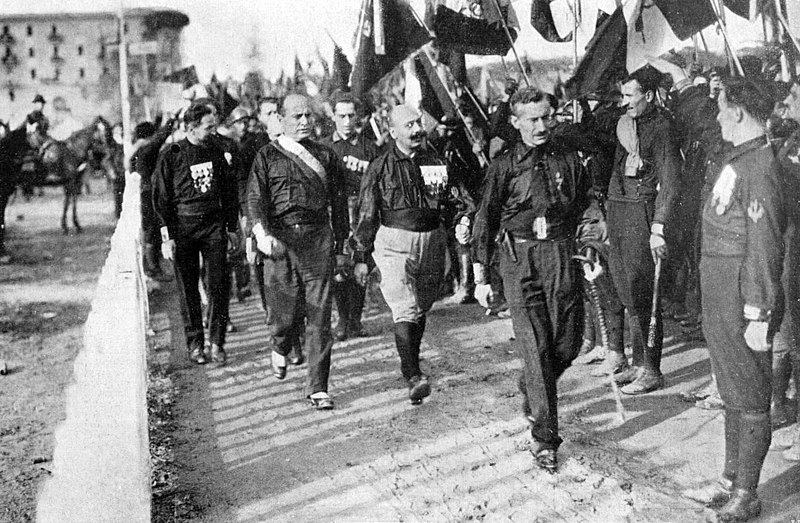
Why this desperate appeal for constitutionalism which on the next day would be impossible? The explanation is very simple. We know that for many months the squadrons had been developing and regarding themselves as an end in themselves. When the failure of the general strike of 1st August revealed to the Fascisti that they need not expect the slightest resistance from the workers, the activities of the squadrons begun to develop very rapidly and at the end of October become a direct menace. Mussolini saw that unless the Fascisti, by means of a “bloodless revolution,” took power, he would lose control over the squadrons, and Fascism would go “too far.”
This explains the convulsive clutching at constitutionalism on the part of “republican, revolutionary” Fascism. This also explains the resolute demand of the industrialists for the immediate appointment of Mussolini as Prime Minister. Finally, it explains the further conduct of Mussolini, whose first political act was to issue the order demobilising the Fascisti squadrons (he had little success in this respect) and to issue a short manifesto in which was stated literally the following:
“The Government will exert all efforts to preserve internal peace and to raise the prestige of the nation abroad. Only by means of labour discipline and the unity of the Fatherland will it be possible finally to overcome the crisis.”
…Labour discipline and unity…But every day Popolo d’Italia brings fresh news, Mussolini gives strict instructions to the prefects to maintain peace and order, and orders them to arrest all those who disturb the peace, irrespective of the party to which they belong. He declared that the laws were obligatory for all and that he personally would see to it that his orders were carried out, and that the sole duty of the Fascisti was to obey. Mussolini clearly saw the danger that threatened him and the bourgeoisie. This is seen from the fact that having forced everybody into silence after that victory of the “revolution,” he did not form a purely Fascist Government, but, in form at any rate, a Coalition Government relying on a Parliamentary majority, composed of all bourgeois parties, from national liberals and democrats to the Populists (the Catholic Party). Immediately he was called upon to form a Government, Mussolini asked the former secretary of the Confederation of Labour, who commanded the greatest influence in the Confederation and in the Social Democratic Party (Turatti, Treves, D’Arragona, Baldesi) whether he would agree to join the Government. Only as a result of the pressure of his fellow party members did he temporarily refuse—so Popolo d’Italia wrote—to join the Government as the representative of the Confederation of Labour. Nevertheless, Mussolini gave orders to the effect that not only were no raids to be made on the trade unions and Socialist Party premises and that the local management bodies were not to be broken up, but also that the premises taken from the trade unions and the parties (both Socialist and Communist), and the municipalities “captured” by the Fascisti after the 1st November, must be immediately restored, “in view of the fact that all the laws that had been violated hitherto now come into force again.” All this constitutionalism, legality, “democracy,” was assumed on the one hand to restrain the impetuosity of the squadrons, and on the other to throw dust in the eyes of the proletariat, to pacify it at least for a time until the problem of the squadrons should be solved, as any desperate attempt at resistance on the part of the proletariat would lead to the intensification of the activity of the squadrons and then it would be difficult to prevent them going “too far.”
Of course, these orders were never carried out to the full, but there is no doubt also that, as compared with the preceding months the general situation after the coup d’état not only did not become worse but considerably improved. This is not our statement, but that of the Italian Labour Party and the Labour organisations. In the social democratic Justicia of the 28th November, a resolution was published from the Reggio Emilio Trade Unions, saying, among other things, that “communications received from various representatives indicate that the situation, with a few sad exceptions, has improved.” And Avanti of the 5th December, quoting Voltra, says, “The Fascisti have ceased their violence and their terror in order to adopt more fruitful and less repellent propaganda.”
An article published in Avanti on the 25th November, entitled “From Tascano,” excellently describes the situation. This article says that the activity of the Fascisti in the towns has quietened down, but continues in the rural districts. “A fig for Mussolini; we are masters here,” say the Fascisti in the villages. Recollecting that Tascano is an agrarian province we will understand the reasons for such a “violation of discipline.”
From the 1st December the position again tends to become worse and acts of Fascisti violence increase in number. The Fascisti again seize municipal and trade union premises, break up and disperse the management bodies (as in Lezzias), raid, burn and destroy (Tore, Annunziato, Coliari, Pola, etc.), attack the workers, heat them almost to death and even kill them (the worst case that of Turin). Communists are seized from their places of employment, taken outside of the town on automobiles, and killed. Others are killed in their homes. Nine are already reported killed. Recently, however, not only have the Communists, Anarchists and Socialists become objects of attack; in many places the Fascisti attacked republicans and workers belonging to the Populist Party. A few days ago they compelled a republican and Populist deputy to drink castor oil. In Naples they raided and broke up the editorial offices of two Populist papers, etc., etc.
The increasing violence served as a warning to Mussolini and induced him to hasten the solution of the question of the “squadrons.” In the latter half of December it was resolved to form a “national militia,” which was to absorb the 100,000 “Black Shirts.” The date fixed for the organisation of this militia was the 20th January, 1923 and it was explained that those who joined the militia would be subject to strict discipline. This had some effect.
At the same time, we must point to an undoubtedly important fact, viz., that simultaneously with the prohibition of violence committed indiscriminately against all workers, we observe the organised and systematic persecution of the revolutionary proletariat. This fact is of too recent origin to have its history, but it stands out too clearly for there to be any doubt upon the matter. On the pretext that “conspiracy after conspiracy is being discovered,” scores of Communists and Maximalists are arrested. The whole of the editorial staff of the Communist Il Lavatore were arrested on such a flimsy pretext that they had to be released the next day; the authorities declare every Communist Party organisation to be a “criminal assembly”; the police are given secret instructions ruthlessly to arrest all revolutionary proletarian leaders (Communists, supporters of the Third International, Maximalists, and Anarchists); Popolo d’Italia demands the death sentence for all persons bribed with “Russian gold.” At the same time, not only the reformists and social-democrats, but also Maximalists in the Socialist Party, who are sabotaging unity with the Communists, enjoy the protection of the authorities. All these facts speak for themselves.
The immediate danger threatening Fascism on the part of the squadrons passed by. Fascism now proceeds to the solution of the second half of its problem, viz., the restoration of bourgeois economy.
RESTORATION OF BOURGEOIS ECONOMY.
The problem of restoration divides itself into two parts: valuta and labour. We shall refer to the latter later on. For the present we shall deal with the “problem of valuta,” which is exceptionally important for Italy as it has to import all its coal and iron and annually imports from 2,500,000 to 3 million tons of wheat. In order to regulate the valuta it was necessary to bring the State finances in order, and this Mussolini set to work to do. He issued a “widely proclaimed” programme, the corner-stone of which was economy in State finance and imposing the burden of taxation upon all sections of the population. The following is a list of what has been done to carry out this programme:
(a) Economy of State Finance:–This was to include the transfer by the State to private persons of unprofitable enterprises (railways, posts, etc.), but all that it resulted in was the dismissal of large numbers of State employees and reductions in the wages of those who remained. During the first two months seventeen thousand railwaymen and workers in the railway workshops were dismissed, and another 25,000 are to be dismissed. The eight-hour day has already been partly abolished; Mussolini will soon make the railways “profitable,” and then transfer them to private hands. Nothing more than this has been done in the direction of economy. It would be more true to say that what has been done has had precisely the opposite result as we shall soon see.
(b) What “imposing the burden upon all sections of the population” actually means will be seen from the two orders quoted below.
Taxes are to be imposed upon the wages of the workers in State, provincial and municipal enterprises (tobacco factories, gasworks, etc.), railwaymen and tramway workmen irrespective of whether they belong to the State or a private company. According to an official statement this is only the beginning of the gradual extension of taxation upon all workers, and following the example of Germany, the taxes will be deducted from the wages on pay day.
The new valuation and classification of the land according to profitableness with a view to increased taxation of agricultural capital | and agricultural revenue.
Repeal of the law prohibiting the issue of bearer stock in order to enable the industrialists and financial bourgeoisie in whose hands securities were mainly concentrated to avoid taxation.
In accordance with one of the decrees passed the Parliamentary Commission of Enquiry into War Expenditure and War Contracts was to report not to Parliament but to the Prime Minister, and the report was to be strictly secret. The obvious aim of this was to remove war profits from the sphere of taxation.
Summarised, the programme means, increased taxation of the proletariat (the tax on wages was a little over 10 per cent.). Increased taxation of landed property which at best will be carried out only in the course of several years, and the immediate relief from taxation on a wide scale of the industrial and financial capitalists to the damage of the State budget.
Undoubtedly, this is very advantageous for the bourgeoisie; but what is not advantageous for it—if we include heavy industry—is that the Merah vend meant: cannot bring about any equilibrium in the State finances as, in consequence of the increase in the military budget, State expenditure considerably exceeds the increase in the revenue.
Partly in order to solve the problem of the squadrons, partly to be able consistently to carry out his taxation policy against the proletariat as a means of restoring industry, and partly also as a result of the international situation that had arisen—of which we shall speak later on—Mussolini was compelled to come forward with a fantastical military project. In this connection the following has been done:
THE ARMAMENT POLICY.
A so-called “National Militia” has been formed, composed of the “Black Shirts” called to serve God and the Fatherland, which is under the direct command of the Prime Minister (that is to say, not the King). This militia consists of about 100,000 men.
The period of military service has been increased from twelve to eighteen months, which entails an additional expenditure upon the State Treasury for the maintenance of from 300,000 to 450,000 troops.
The mounted gendarmerie has been increased to 90,000 men.
The police force has been increased, partly as a result of the increase in the number of secret service agents from 6,000 to 12,000, and also as a result of taking several hundreds of thousands of members of the Fascist squadrons into the police service.
Mussolini declared that the disbandment of the Royal Guard would lead to a considerable saving in State expenditure. As a matter of fact, however, the increase in the mounted gendarmerie and police considerably exceeds the reduction made in the Royal Guards. The latter consisted of 35,000 men.
Not less imposing are the other military measures, as, for example, the call to the colours of discharged officers and non-commissioned officers of the Reserve. Judging from recent communications, it is proposed to increase the Air Fleet by 1,000 metal aeroplanes.
Not the whole of the bourgeoisie are in sympathy with these plans and measures. Only a comparatively small section approve of them, while the rest are obviously disturbed.
MUSSOLINI AND THE BOURGEOIS PARTIES.
It must not he forgotten that not all the bourgeoisie supported the Fascisti. Nitti feared the Fascisti more than he had hopes of them. This was due to the fact that he relied on the backing of groups of British and, particularly, American capitalists, who did not desire a Fascisti victory owing to the latter’s close connection with France. Until the collapse of the Banka Disconto, Giolitti defended the interests of the large landowners. From the beginning of 1922, however, i.e., from the time the Banka Commerziale found itself without a rival, he felt more free and began to make overtures to the industrialists; in the middle of 1922, he crossed over to the side of France and began to sympathise with Fascism. The latter, however, he merely regarded as a gendarmerie. After the Fascist coup d’état a change took place in the policy of the Banka Commerziale. The leading men in the Banka Disconto naturally desired to take advantage of the “victory,” and Fratelli and Peroni, a few weeks ago, opened p campaign against the Commerziale. The Commerziale considers it necessary to resume the struggle, and Giolitti is retiring to his former position of hostility to Fascism. In a leader in its issue of the 21st December, entitled “Clearing Up the Position,” Stampa, the principal Giolitti organ, condemns the dictatorial policy of Mussolini, but declares that, not desiring to embarrass the Government, it confines itself to a friendly passivity. The Corriera della Serra, the organ of the Lombardy Industrial and Financial Capitalists, headed by Bonnomi, is as hostile to the hegemony of the Banka Disconto as it formerly was to that of the Banka Commerziale. Only heavy industry and the Nationalists were and are on the side of the Fascists. The former is in close co-operation with French heavy industry, and is dependent upon it. It is the interests of the latter that dictate the “firm,” i.e., Imperialist policy directed mainly against British and American capitalism. (“The Mediterranean Sea must unconditionally belong to the people inhabiting its shores.”)
These internal antagonisms in the camp of the bourgeoisie appeared to have been smoothed over in the period of the “victory of Fascism.” It was obvious, however, that sooner or later, they must come again to the surface. One can only be surprised at the relative rapidity with which this happened. It is not difficult to prophesy that, these antagonisms will become more acute in the future. It is sufficient to recall the Bill drafted by Bianci on the instructions of the Fascist “Supreme Council” on franchise reform and the reform of the Constitution. According to official reports this plan briefly is as follows:
1. A three-quarter majority system is established. Every province, “with a few exceptions,” forms a single constituency in which the party securing a simple majority of votes obtains three-quarters of the seats and the other quarter is divided proportionately among the other parties.
2. The majority in Parliament thus obtained nominates the Prime Minister, which is confirmed by the King, and the Prime Minister selects the members of his Cabinet and submits their names for endorsement by Parliament. Having done that the functions of Parliament cease, and it is then dissolved. The new general elections take place after the lapse of four years and during the intervening period the Government has unlimited and uncontrolled power.
There is no need to dwell on the dangers concealed in this “reform” for the bourgeoisie. It is not difficult to foresee that the latter, with the exception of heavy industry, of course, will very soon express their hostility towards it.
What dictated this reform? This question must be seriously analysed. In this connection we would draw attention to one fact, viz., the inherent antagonisms in Fascism which have not been removed to this very day. We have seen that Mussolini more or less succeeded in toning down these antagonisms, but at the end of December new opposition voices arose in the Fascist camp, particularly in Venice, Pola, Bari, Florence, Brescia, Modena and Rome. Thus, in San Luca, in the Province of Brescia, the political secretary of the Provincial Federation, at a public meeting of the Fascisti on the 23rd of November, declared:
“The work of the Fascisti is not yet ended. They are ready even now to close their ranks and advance against those who have been able to escape just retribution—which, however, will soon overtake them.”
The Fascist deputy, Farinacci, in a leading article in his daily Cremona Nuova, of 9th December, commenting on the negotiations between Mussolini and Baldesi, expresses himself still more clearly and unambiguously on this theme:
“We must warn the men in power that in their love for compromise they are chasing after phantoms and giving ear to sirens’ songs.
“We beat the alarm; it must be heard by all those for whom it is meant, including the Fascist Government and the central organ of the party. It must remind all that there can be no understanding, no compromise with and no mercy for the enemy. The Government and the committee of the party must he told to follow the example of the Fascisti of Cremona, who to this very day are following the straight path without deviating to the right or to the left. They refrained from negotiating or having connection with the Lazzaris, Garicottism and Kazzalis, but always fight resolutely and undeviatingly, disarming and silencing the enemy.”
An even more clear and aggressive tone is expressed in the letter of Cessara Forni, the assistant commander of Fascist troops, addressed to the Fascists of Brescia, who, in spite of the prohibition of the Government, and in the interests of the landowners, carried out a general mobilisation of the agricultural labourers belonging to the “Populari” Party in their province. In this letter Forni says:
“While the contemptible deserters are howling against the conduct of the “Black Shirts,” and the people in the Government who have too soon forgotten the October days are ready to surrender to them, let this letter from dirty Rome…”
Yes, Rome is “dirty.” In the Fascio of Rome the antagonism between the two wings is so acute that they stand confronting each other in a state of complete military preparedness. A conflict between the Fascist troops was avoided at the last moment owing to the intervention of influential Fascist leaders.
Of course, we cannot calculate the number of conflicts that have taken place between the Fascisti. It is sufficient, however, to mention that in several towns (Venice, Pola, etc.) things reached a stage of sanguinary battles; the “dissidents” stormed the secretariat of the Fascist Party in the same way as formerly they had stormed the offices of the trade unions and the Communist organisations. In some places it was necessary to dissolve not only the squadron, but the political Fascio, for which purpose the energetic intervention of the Fascist Party was necessary. There were cases during the municipal elections when the two wings put forward separate tickets, etc.
Finally, we would refer to the sharp friction existing between the Fascisti and the Nationalists, which, in a number of cases, led to sanguinary skirmishes. This latter is explained mainly by the fact that the Fascisti desire to retain for themselves all the “rights of the victor,” while the representatives of heavy industry insist on the retention of the “Blue Shirts” (the Nationalist squadrons), as a counterpoise to the Fascist detachments if the latter should dream of capturing power, which, in the prevailing circumstances, was highly probable.
All these circumstances must be taken into consideration if one desires to have a correct idea of Mussolini’s labour policy. It is the multifarious antagonism of interests within his organisation which explains the sharp contradictions in his policy. The latter is the product of the former.
We see that at the moment that Mussolini was forming his Cabinet he was thinking of introducing a policy “favourable to the workers.” Did he not desire to include Baldesi in the Government? He did not miss a single opportunity to reassure the workers on this point. Thus, in his concluding speech in the Senate on the 27th of November on the granting of full powers to the Government, he said:
“We do not at all intend to oppress the proletariat, nor compel him to return to a low standard of existence. No, we desire to raise him physically and morally. Our policy, favourable to the proletariat, is dictated to us by the conviction that we cannot have a peaceful united and unanimous nation when 20,000,000 workers are doomed to a miserable existence and a low standard of living.”
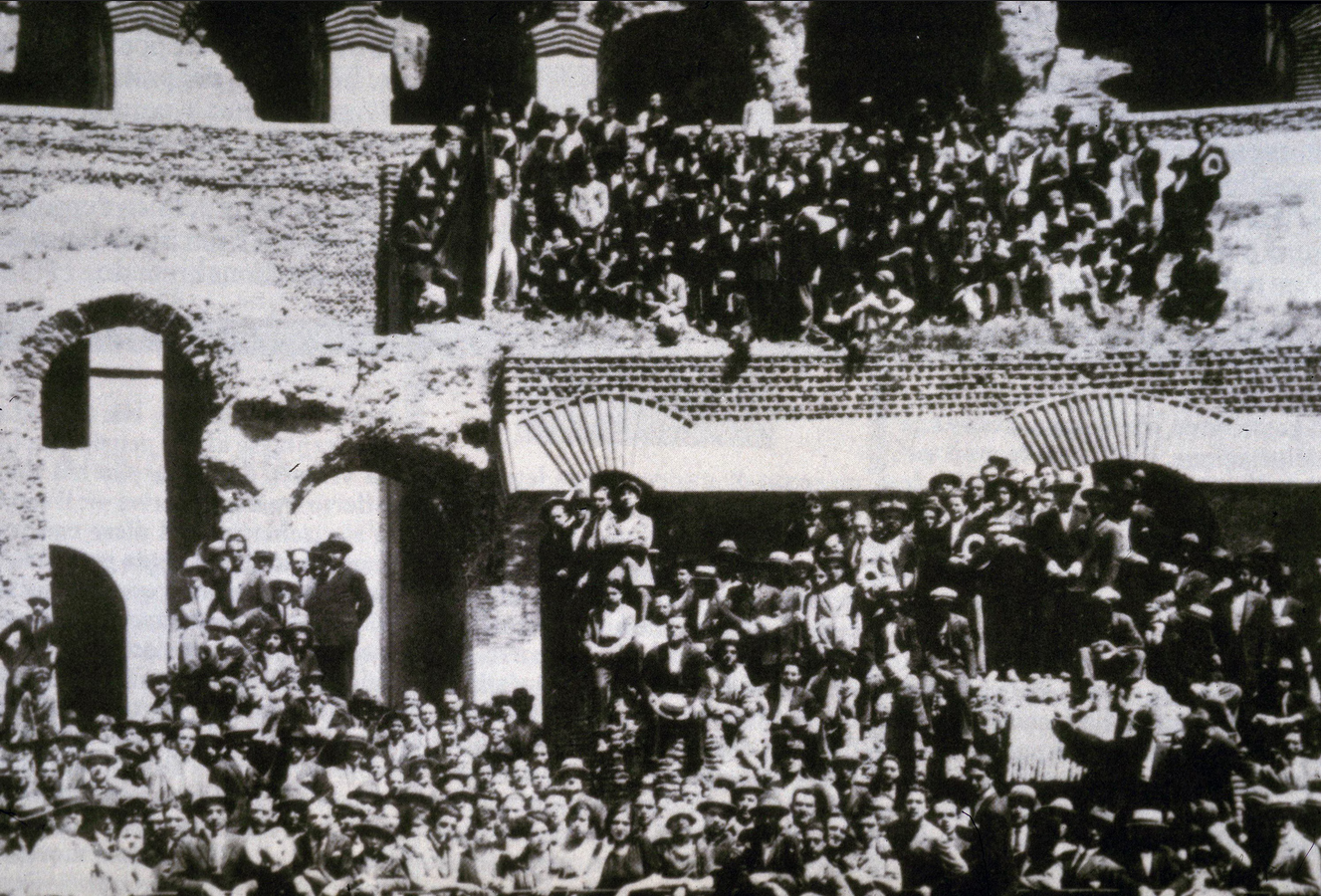
We would recall the fact that at the beginning of December, on his way to the London Conference, Mussolini broke his journey in Milan in order to visit a large metal works, where he made a speech to the workers. In this speech he demagogically emphasised the fact that he wag not born an aristocrat, but a worker, and long worked as a labourer and stonemason.
“I, like you,” he said, “earned my living by physical toil. I have been a labourer and a stonemason. These pages from my life can never be torn out. A man like myself cannot be an enemy of the proletariat. I am an enemy only to those who desire to mystify and deceive the proletariat.”
Later on he said: “My Government is strong, very strong, and there is no need for it to seek allies. I seek none; but if anybody comes to the Government with sincere intentions and with a sincere heart, I do not turn him away, even if he belongs to the Labour organisations.”
In the first period of his entry into the Government Mussolini endeavoured to influence the workers by high-sounding phrases, but his efforts were vain. One cannot attach importance: to the fact that a few State officials, out of fear of losing their jobs during the period of cutting down State expenditure, “voluntarily” offered to work on extra hour per day in order to economise the finances of the State. We have already referred to the dismissals of railwaymen and the taxation of wages. In addition to these measures there are, of course, a number of others in operation which from day to day make the proletariat feel the “benefits” of the Fascist Government. To enumerate these here is impossible, but as an example we could quote the repeal of the law of the protection of motherhood, which intensified the exploitation of women, the introduction of the eleven-hour day by the Trieste Municipality for numerous categories of labour, or the violation of the eight-hour day on the State railways. They succeeded in carrying out the latter only partially, for the indignant Fascist railwaymen retorted by seizing Naples railway station and the Government was compelled hastily to withdraw its order.
The class struggle proved stronger than the Fascist trade unions and their idea of class conciliation. Of this, not only we, but Mussolini, whose past must not be forgotten, had no doubts. He knew and now knows this as well as we. This explains the attempt to include Baldesi in the Government. We saw that this attempt failed owing to the shortsightedness of his friends. But this is only a temporary failure.
At the end of November he made a second attempt which led to Mussolini having a “friendly” interview of several hours duration with Baldesi in the beginning of December. On this occasion the plan was worked out in greater detail. He proposed to unite all the trade union organisations, the Confederation of Labour, the Catholic Unions, the Railwaymen and Seamen’s Unions, etc., etc., and the Fascist Corporations into one National Syndicate, the fundamental principles of which were to be:
(a) The recognition of the nation and the Fatherland as the basis of social life.
(b) The repudiation of the class struggle and its substitution by “emulation of ability.”
This is the pure Fascist Trade Union “programme.” Nevertheless, this plan failed, not as a result of the opposition of the leaders of the Confederation, but as a result of the opposition against Mussolini in the Fascist Party.
In reply to the article by Forinacci in the Cremona Nuova of the 9th of December, to which we referred above, Mussolini, impressed with the telegram he received in London informing him of the advantage, which had been taken by his opponents, of his three days’ absence, sent a hasty wire from London to Forinacci expressing his complete moral solidarity with the latter. For all that the programme of the unity of the trade union movement still preserves its actuality. It, however, has entered a new phase quite distinct from the previous phases. Now the unity of the trade union movement is demanded by the proletariat. This is something radically different, for the proletariat demands unity not in the name of class conciliation but in the name of the class struggle. Two weeks of Fascist rule was sufficient to make the Italian proletariat understand where its true path lay, and it is now striving to unite the revolutionary forces. This is of tremendous importance, for it will lead to the actual realisation of unity. We have seen that the Social-Democrats only two weeks ago were prepared to hand over the proletariat to Mussolini and that in the middle of December, under the pressure of the proletariat—pretending to meet its insistent wishes—they formed a “committee for the unification of the trade union movement” on the basis of “civilized” class struggle. It must not be supposed that our statement that the Social-Democrats intended to betray the Italian proletariat to Mussolini is a piece of demagogy. This is a true statement of fact. Unfortunately, we cannot within the limits of this article quote all the evidence of this in our possession. We will select a few quotations:
“We must determine our attitude to every Government on its merits. There must be no foregone conclusions.
“I willingly recognise the necessity for greater discipline in the relations between workers and employers.
“We must rectify the defects and errors of our organisations: we must not blindly repeat the stupidities of the masses.
“There must be a careful selection and only the most worthy should be selected.” (Extract from an interview with Columbina, the secretary of the Metal Workers’ Union and a prominent leader of the Confederation of Labour, published in Stampa of the 24th of November, 1922.)
“His Excellency Finzi (the Fascist Assistant Secretary of State), in his desire to bring about the pacification of the country, has planned to establish a central commission with full powers to remove all sorts of antagonisms. We cannot oppose this plan and declare that we will exert all efforts to help him in this difficult and delicate task.
“Negotiations are being conducted in this sense” (at that time only with the co-operatives.—Present writer’s comment).
“The possibility is not excluded of the negotiations conducted tor the time being only with the co-operatives being extended to all the Labour organisations…
“These (“New”) tactics must have nothing in common with the former elementary negative tactics of the class struggle which aimed at bringing pressure on capital for the sake of an illusory increase in wages.” (Extract from an interview with Bernani, Chairman of the “Red” Co-operative Union, published in Il Mondo of the 1st of December, 1922.)
The Tribuna di Ferrovieri, the central organ of the revolutionary Railwaymen’s Union, of the 1st of December, 1922, in a leading article with the comforting title of “Without Ulterior Motives,” wrote: “As we do not have to defend a particular party programme, we have no foregone conclusions, one way or another, with regard to the Government.
“If the Government cares to reckon with our demands…it will find in the railway staff experienced, capable, and technically tried collaborators.”
The reformist leaders of the “Red” Railwaymen’s Union, however, were wrong in their calculations. On the very day that the above article appeared, the railwaymen forming the Fascist Railway Corporation took possession of the Naples railway station as a protest against the Government’s abolition of the eight-hour day.
Thus, in the middle of December, the Reformist and Social-Democratic leaders were compelled to form a “Committee for the Unification of the Trade Union Movement,” which included syndicalists, republicans, and the followers of D’Annunzio (therefore, did not include Fascisti and Populists), The committee issued a manifesto emphasising the following three points:
1. The trade unions must be absolutely non-political.
2. Each trade union maintains international relation only with its kindred organisations.
3. The class struggle cannot be repudiated but it must be conducted in a “civilized” manner.
THE UNITED FRONT OF THE ITALIAN PROLETARIAT.
This manifesto was the first, and to this day, the last, issued by the notorious committee.
Only in light of the facts outlined above can one understand the great significance of the resolution of the Fourth Congress of the Comintern. The unification of the revolutionary forces of the proletariat is urgently necessary, and the proletariat itself is thirsting for it. It is necessary for the purpose of energetic counteraction, which will inevitably smash the Italian reaction and the bourgeoisie that is leading it. Mussolini hopes—perhaps he has no such hopes but is compelled to make a desperate attempt—to hinder the process of reorganisation of the revolutionary forces by the systematic persecution of the revolutionary workers. He issues decree after decree for the arrest of the revolutionary leaders of the proletariat; he is agitating in his newspapers for the application of the death sentence against those who are making use of “Moscow gold”; he declares Communist organisations to be “criminal assemblies,” while at the same time he protects, not only the Reformists in the ranks of the Confederation and the leaders of the Social-Democrats, but also those “maximalists” who are trying to put a spoke in the wheel of the decisions of the International Congress which guarantees the carrying out of the resolution of the Rome congress of the Socialist Party. Mussolini protects the latter from both the attacks of the Fascist brigands and from the revolutionary proletariat.
He, however, is mistaken in his calculations. So also are the betrayers of the proletariat from Turatti, D’Aragonna and Baldesi to Baratono and Bela who have now finally thrown off their masks. In spite of Mussolini’s raging terror, in spite of the treachery of all the traitors, the Italian proletariat will soon achieve unity—the rock against which Fascism, suffering from a thousand inherent contradictions, will shatter itself to atoms.
NOTES
1. For obvious reasons we refrain from making a more complete documentary analysis. We have been compelled to reduce even quotations to a minimum. A detailed documentary analysis will be made in a work that will soon be published.)
2. It will perhaps create surprise that we present Giolitti as a champion of the agrarians. Nevertheless, this is quite in accordance with the facts. As a matter of fact, Giolitti represented the Banka Commerziale, which was really the Deutsche Bank, which prior to the war had control over the economic life of Italy. We cannot deal with the policy of this Bank. Sufficient it is to say that it was opposed to intervention and therefore took up a hostile attitude to the industrialists. The latter not only succeeded in driving Giolitti from the Government, but also seized the hegemony from the hands of the Banka Commezialo by establishing the Banka Disconto, the share capital of which during two years increased from 15 to 315 million lira. This caused the Banka Commerziale to continue its former policy. Only after the collapse of the Discanto is a change in the policy of the Commerziaie to be observed, and this is explained by the shifting of the relation of forces due to the war. The Giolitti of 1922 is not the former Giolitti, and this must be taken into consideration in analysing the events of last year.
The ECCI published the magazine ‘Communist International’ edited by Zinoviev and Karl Radek from 1919 until 1926 irregularly in German, French, Russian, and English. Restarting in 1927 until 1934. Unlike, Inprecorr, CI contained long-form articles by the leading figures of the International as well as proceedings, statements, and notices of the Comintern. No complete run of Communist International is available in English. Both were largely published outside of Soviet territory, with Communist International printed in London, to facilitate distribution and both were major contributors to the Communist press in the U.S. Communist International and Inprecorr are an invaluable English-language source on the history of the Communist International and its sections.
PDF of full issue: https://www.marxists.org/history/international/comintern/ci/old_series/v01-n24-1923-CI-grn-riaz.pdf
 Revolution's Newsstand