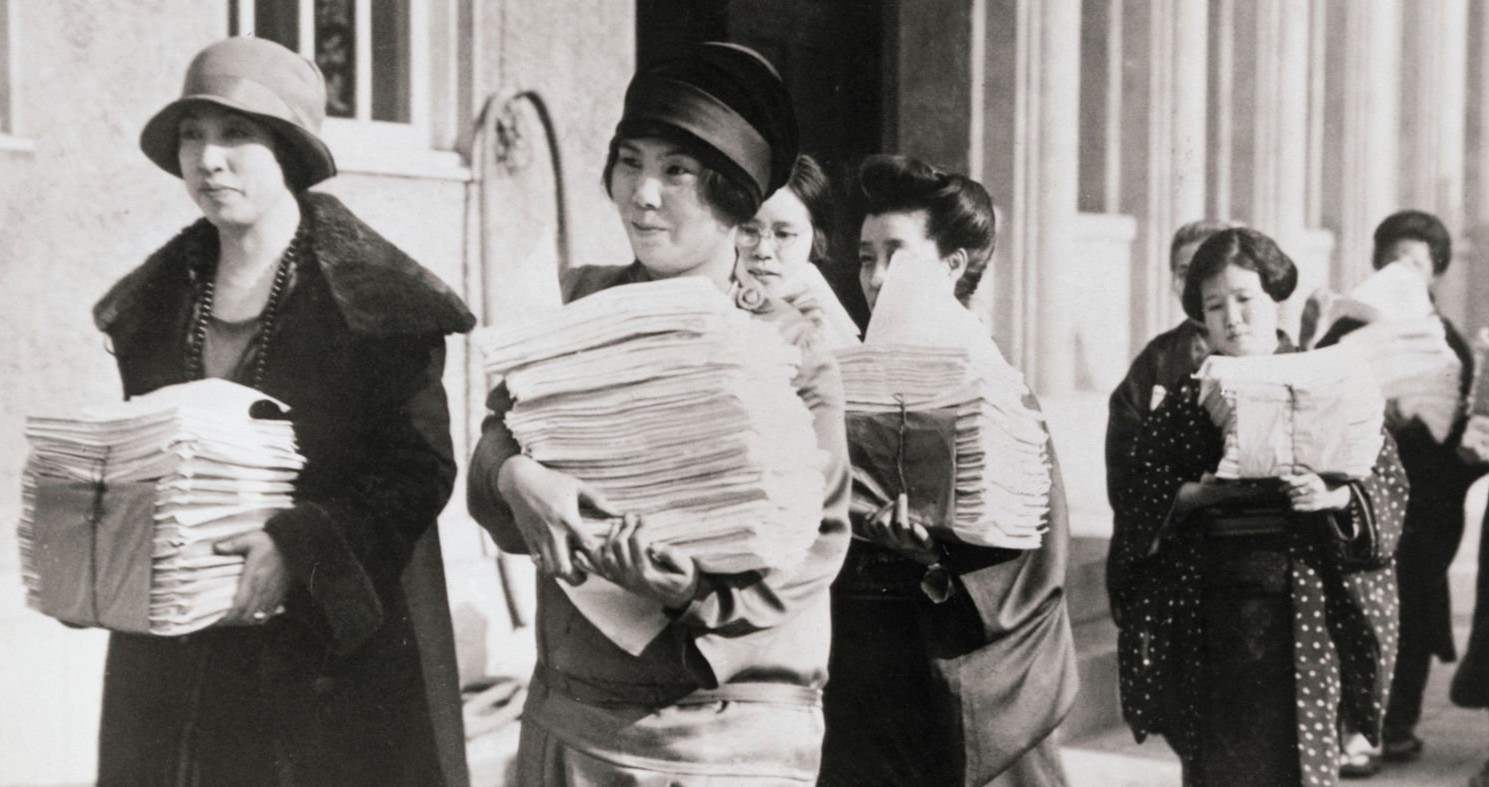
This report by Varsenika Kasparova, head of the recently formed Eastern Department of International Women’s Secretariat of the Comintern, on activity in Japan, China, Korea, and Mongolia. Kasparova was an ‘Old Bolshevik’ and exiled since 1904 in Switzerland with Lenin, whom she worked closely with. She returned in 1917 and became the lead Political Officer in the Red Army, working as Stalin’s personal secretary. After the Civil War she focused her work in the Comintern’s Women’s Secretariat while also becoming one of the leading women in U.S.S.R., a member of the Central Executive Committee of the Soviets. A Left Oppositionist early on, she would be expelled in from the Party in late 1927 and sent to internal exile. Recanting in 1935 she was released from exile, but arrested the following year. She was shot on September 11, 1941 along with many surviving figures of the Oppositions in the Medvedevsky executions. She was ‘rehabilitated’ in 1961.
‘The Activities of the Eastern Section of the International Women’s Secretariat’ by Varsenika Kasparova from International Press Correspondence. Vol. 3 No. 66. October 11, 1923.
The Eastern Section of the International Women’s Secretariat has maintained close relations with the countries of the Far East since the beginning of the year 1923. It is in receipt of direct reports on the women’s movement in the Far East, in which reports we are gratified to observe the influence of the Communist Parties. The Communist Parties take part in all conferences and sessions, and have many opportunities for exercising their influence. They lead the agitation among the women, and devote the greatest attention to the growing women’s movement. This is plainly shown in the resolutions and theses of the Parties.
Up to the present our work in the Orient has been purely informative in character. We have had to content ourselves with observing the women’s movement with the object of becoming thoroughly acquainted with it, for the movement differs economically, socially, and culturally in all the countries of the Near, Central, and Far East. But this year the International Women’s Conference was arranged under our influence, and its results have shown that our Communist Parties are already actually at work everywhere in the Far East.
We append for the information of our readers the latest reports from the various countries:
Japan.
The activity of the women’s section has been as follows: a) direction of the work done by the “Ioka Kai” (Party of Eighth of March–a socialist women’s organization);
b) organization of the working women;
c) propaganda among the women of the proletariat.
The loka Kai is nothing more nor less than the reorganized “Sekiran Kai” (Red Wave Union), and is working in the same direction. A trade union organization was recently formed among the working women, and this organization publishes a newspaper called Schokugio Fuschin (Woman in the Trade Union). In April of this year a number of women members of the Party made a propaganda journey through the copper works district of Aschio. Other women comrades lent considerable support to the strikers during the workers’ struggle against their employers at Noda. At the present time the women’s section is working at the organization of the workers occupied in the textile industry in Tokio,
Mongolia.
The women of Mongolia are the most oppressed section of the Mongolian population, the most entirely devoid of all rights. The unfavorable economic position of Mongolia takes fullest effect upon the Mongolian women. They are oppressed to such an extent that they know of nothing beyond their cattle and their Buchan (house idol). However, courageous women have been found, who have entered our union at the beginning of the year, and begun to learn reading and writing.
The cause of the movement thus beginning is that the Mongolian revolution is commencing to destroy all the traditions, opinions, customs, etc. of former times. At the present time about 40 women belong to the union; their number is increasing. It is intended to form a united women’s and youth organization, as well as sections for work among women. The fundamental work of these sections consists of inducing women to join the movement, and to provide for the revolutionary education of women.
Corea.
According to reports from the Far East, the revolutionary movement in Corea has already passed the dead point. As early as 1919 the national liberty movement, expressed by an elemental uprising, had reached its climax. The oppressed masses of the Corean people were at that time completely under the influence of the liberal elements which bound up the fate of the Corean revolution with capitalist America, England, and France. In the course of the daily struggle a gradual separation of the masses from their former “leaders” was observable. Women take a most active part in the emancipation movement of the Corean people.
At the beginning of July of this year the frightful exploitation of Corean women in the factories and workshops of the Japanese capitalists led to the strike among the Corean women workers employed in working up india-rubber in the town of Seyl. Here one factor must be especially emphasized. This strike of working women was not only supported by the Corean working men, but also morally and materially by the Japanese workers of Seyl. This strike is an additional sign of the awakening of the working women of Corea to class consciousness, and has met with the liveliest sympathy among the Corean women and men of the farthest Soviet East.
China.
The importance of the role played by working women has frequently been demonstrated in the feverish strike movements of the past year. But at the same time the conflict between men and women has developed. This conflict is to be explained by the retention of the prejudices relating to women and their inferiority, which still remain as a residue of the patriarchal state of society. The working women feel that they are suppressed and deprived of their rights by the men, and have therefore formed their own organizations here and there, so that the working women’s movement is split up. The Party must fight against this tendency, must appeal to the working men, develop solidarity between the sexes, and strive to overcome the deeply rooted prejudices concerning the inferiority of women. The first step towards union with the working women should be the establishment of schools for the children of working women, and of evening schools for women. The conditions must decide where such measures are to be taken.
The general women’s movements for obtaining the suffrage, for combatting prostitution, etc., are also of importance. These movements have developed of recent years in various towns of the different countries. But the movements are not centralized and not active. Our women comrades should take a leading part in this movement, and unite the existing organizations. The slogans for this work should be: centralization of the national women’s movement; down with the traditions and customs which enslave women; similar education for both sexes; rights of inheritance for women; equality of marriage and divorce between the sexes; protection of motherhood; assistance for working women. These slogans must be further accompanied by the national watchwords: Down with militarism! Down with imperialism! in order that the female population may be induced to join the revolutionary national movement.
International Press Correspondence, widely known as”Inprecorr” was published by the Executive Committee of the Communist International (ECCI) regularly in German and English, occasionally in many other languages, beginning in 1921 and lasting in English until 1938. Inprecorr’s role was to supply translated articles to the English-speaking press of the International from the Comintern’s different sections, as well as news and statements from the ECCI. Many ‘Daily Worker’ and ‘Communist’ articles originated in Inprecorr, and it also published articles by American comrades for use in other countries. It was published at least weekly, and often thrice weekly.
PDF of full issue: https://www.marxists.org/history/international/comintern/inprecor/1923/v03n66[42]-oct-11-Inprecor-loc.pdf
 Revolution's Newsstand