
Our comrade was murdered by the State of Utah on this day in 1915. Ralph Chaplin does his comrade, and history, proud with this telling of Joe Hill’s Chicago funeral. Deservedly, this essay has been quoted in nearly every history of the I.W.W. and biography of comrade Joseph Hillström–a journalistic classic of our movement.
‘Joe Hill’s Funeral’ by Ralph Chaplin from The International Socialist Review. Vol. 16 No. 7. January, 1916.
ON Thanksgiving day the throngs began to gather in the great auditorium hours before exercises were to take place. By 10:30 the streets were blocked for blocks in all directions; street cars could not run and all traffic was suspended. Within the hall one could almost hear the drop of a pin at all times. The casket was placed on the flower-laden, black and red draped stage, above which was hanging a hand-woven I.W.W. label (made by fellow-worker Cline in prison). So lavish had been the offerings of floral pieces from all over the city and the land, that the stage could scarcely contain them all. These were inscribed in a medley of languages. They were from English and foreign speaking locals of the I.W.W., in and out of town; from Socialist branches and local unions of the A.F. of L., from independent organizations, from anarchist groups and from dozens of individuals. Some of these wreaths and flower pieces were elaborate and costly and others were simple and plain, but all were full of the heart-deep spirit of protest and regret.
The funeral exercises were opened with the singing of Joe Hill’s wonderful song, “Workers of the World, Awaken”—members of the I.W.W. leading and the audience swelling out the chorus. This was followed by Jennie Wosczynska’s singing of the ‘Rebel Girl,’ written and composed by Joe Hill, after which came two beautiful tenor solos, one in Swedish by John Chellman and one in Italian by Ivan Rodems.
William D. Haywood introduced Judge Hilton with a short but powerful appeal, the keynote of which was, “Don’t mourn—organize.” In spite of this brave admonition, however, fellow worker Haywood’s clarion voice was strangely husky as he stood beside the silent, flower-covered casket. Judge Hilton’s lengthy and masterful presentation of the legal facts in the case and the part taken by the Mormon church in the perpetration of this ghastly and uncalled for murder, was listened to with absorbing interest by all present. And when the oration was concluded the thousands in the hall silently marched out to the strains of Chopin’s Funeral March, played by Professor Rudolf von Liebich.
The parade formation was as follows: First, a committee to help clear the streets and to follow the prearranged line of march, then the pall-bearers with the casket, followed by the flower bearers and the band. Because of the congested condition of the street, the committee and pall bearers had some difficulty in opening a passage through the crowd to the hearse, which was waiting a short distance away. After the casket had been placed in the machine the procession started its march to the elevated station. In the main body came the English-speaking branches with almost a hundred members of Local 400 and about 75 members from Rockford, then the foreign-speaking branches, followed by a veritable throng of workingmen and women over a mile in length. Had it been possible to keep the crowd uniformly four abreast the procession would have been at least three times as long. It was found necessary to go four blocks out of the scheduled line of march in order to avoid the crush around the Auditorium building.
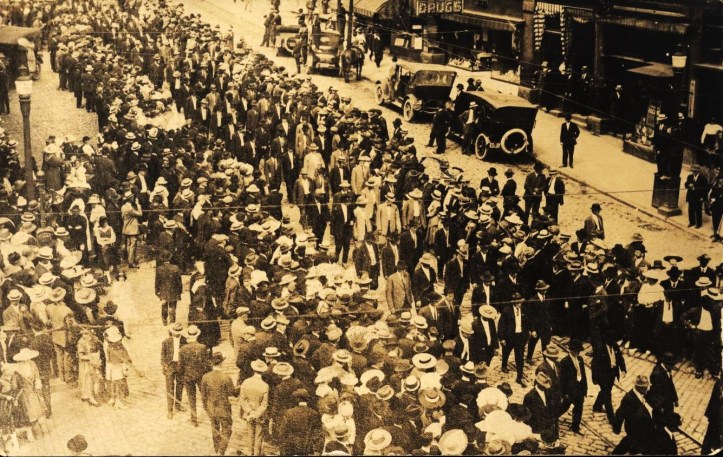
Slowly and impressively the vast throng moved through the west side streets. Windows flew open at its approach and were filled with peering faces. Porches and even roofs were blackened with people, and some of the more daring were lined up over sign- boards and on telephone and arc-light poles. The flower-bearers, with their bright colored floral pieces and wreaths tied with crimson ribbons, formed a walking garden almost a block in length. Thousands in the procession wore I.W.W. pennants on their sleeves or red ribbons worded, “Joe Hill, murdered by the authorities of the state of Utah, November the 19th, 1915,” or, “Joe Hill, I.W.W. martyr to a great cause,” “Don’t mourn—organize. Joe Hill,” and many others. The Rock ford bunch was conspicuous by reason of its great crimson silk flag with the I.W.W. label on either side and the wooden shoe above the pole. Songs were sung all along the way, chiefly Joe Hill’s, although some of the foreign-speaking workers sang revolutionary songs in their native tongues. As soon as a song would die down in one place, the same song or another would be taken up by other voices along the line. The procession took complete possession of the streets with the exception of a few policemen, photographers and moviemen until the elevated station at Van Buren and Halsted streets was reached. Here the pall-bearers, flower bearers, funeral, singing and speaking committees were to board a special train of five coaches, in order to be first at the cemetery and prepare for the oncoming crowd. At this place, however, the crush from behind was so great as to almost upset all prearranged plans. Everyone seemed determined to board the reserve train and it took a great deal of hard work on the part of the membership to see to it that things went through according to the outlined plan that alone would insure the success of the program. The situation was explained to the crowd, which was soon pacified, and from this moment all elevated and surface lines leading to Graceland cemetery were crowded to capacity for over an hour. In some cases Joe Hill’s songs were sung the entire distance.
Upon reaching the cemetery the funeral chapel was discovered to be ridiculously inadequate for the accommodation of the vast audience, and so it was decided to hold the exercises in the open air. And on the olive green slope of an evergreen-crested hill they took place. Here the casket was tenderly laid upon the earth and all the flowers and wreaths and flags were placed about it. Above—high above the casket were the evergreens and above these, a couple of tall, bare elm trees raised up into the sky their delicately etched trunks and branches. Clutched in one lofty tremulous branch, as in a hand, was one of the last summer’s empty birdnests. The sky was somewhat heavy and of a pearly gray tone. with tiny dove-colored clouds flitting across it hurriedly—somewhere. The air was warm and somewhat humid so that the trees were hung with a soft mist that caused the landscape to fade away into a distance that seemed fairly enchanted. Here Joe Hill’s songs were sung and Fellow Workers Haywood and Jim Larkin made short but stirring addresses in English, followed by Fellow Workers W. Sodergrain in Swedish, H. Martin in Russian, C. Rothfisher in Hungarian, B. Schraeger in Polish, J. Santana in Spanish, D. Mari, in Italian, Wm. Penker in German, Harry Rabinowitz, in Yiddish and J. Siemiaszko in Lithuanian. A few more songs were sung and then the body was re- moved to the little oak beamed high-roofed chapel, and placed on a bronze stand overhung with live palms and ferns. Here those assembled were given the last opportunity to view the remains of the murdered songwriter with the pale smiling face and the bruised hands folded above the four unseen purple bullet holes in his breast.
A constant stream of people poured into and out of the semi-obscurity of the tiny room, while the great crowd gathered close around outside joined in one swelling, mighty chorus of song. Each one of Joe Hill’s songs were sung over and over again, and when the great crimson silk banner of the Rockford local appeared the song of that name was struck up and sung as it was never sung before. Three ringing cheers were then given for the Social Revolution and the I.W.W. and then more songs. The singing and cheering was something the old cemetery had never witnessed before and the guards and officials were stricken with undisguised amazement at the audacity of it all. There were a couple of dozen “harness-bulls” on the job and it was funny to see them shy away from the sunburned harvest huskies of Local 400 and the brawny Swedish fellow workers from Rockford. The “bulls” were so outclassed physically and were so insignificant looking in comparison with the I.W.W. boys that it must have been painful to see them singing and cheering unmolested in an exclusive and sedate graveyard like Graceland. But the singing continued until it was quite dark and the trees and buildings blurred into gloom with only a few lights twinkling from out the shadows—and even then it continued. Finally small groups wearing carnations and ribbons walked slowly towards the station singing or humming or talking in low voices among themselves.
As no cremating could be done on a holiday a committee of five returned to the cemetery on the next day (Friday), accompanied by numerous members of the I.W.W. and friends. It was learned that the body had been stripped to the waist in order to make photographs and to take the necessary measurements and casts for a marble bust.
A few laurel and other wreaths were saved from the floral offering, in order that they might be sent to some of the local unions of the I.W.W. in different parts of the world. The I.W.W. button was removed and also the cuff-links and necktie. These are to be preserved at headquarters and, in due time, placed in a shadow-box frame with an oil portrait of our song- writer. The casket handles were also saved and will be melted up into a plate on which can be engraved, “Don’t waste time mourning for me—organize,” which plate is to be used with the portrait mentioned above.

After some little delay, the casket was wheeled through an underground passage to the crematory room, where it was to be finally fed to the flames. The interior of this crematory is finished entirely in white. The walls are of white tile and even the steel doors of the furnace are enameled white. The body was here identified for the last time and, at a word from the committeeman in charge, it was wheeled to the doors of the blast chamber, which creaked open to receive it. Within was a stone slab on a level with the doors and the casket. The whole interior was already tinted a rosy red with the fires that were soon to consume the body of our murdered songwriter. The casket was suddenly pushed out onto the center of the slab. The steel doors creaked together and the tiny room was all white once more. Only the roar of the fire-blast could be heard growing louder and louder…
In order to do all that was incumbent upon it, the committee was obliged to witness a small part at flames. The interior of this cremation. A small circular hole in the far end of the furnace was reached after traversing a dark and narrow passageway around the side of the blast room. Through this aperture the committeemen, one at a time and each with feelings all his own, viewed the flame-lashed casket containing the fine body and placid features of Joe Hill, dreamer, poet, artist, agitator, with four purple bullet holes in his young chest as punishment for the crime of being “true blue” to his class—and to himself.
The murdering of martyrs has never yet made a tyrant’s place secure, and the death orgy held by that heartless bunch of Mormon murderers on the nineteenth of November, in spite of the protests of the president and many noted men and women, and in spite of the protests of tens of thousands of working people all over the land, has done more to cement together the forces that are about to overthrow the ghoulish Capitalist system than anything that has happened in decades. The state of Utah has shot our song-writer into everlasting immortality and has shot itself into everlasting shame. Thank goodness, neither Joe Hill nor the I.W.W. will ever be found dead within the boundaries of Utah!
The International Socialist Review (ISR) was published monthly in Chicago from 1900 until 1918 by Charles H. Kerr and loyal to the Socialist Party of America. During the editorship of A.M. Simons it was largely theoretical and moderate. In 1908, Charles H. Kerr took over as editor with strong influence from Mary E Marcy. The magazine became the foremost proponent of the SP’s left wing growing to tens of thousands of subscribers. It remained revolutionary in outlook and anti-militarist during World War One. It liberally used photographs and images, with news, theory, arts and organizing in its pages. It was closed down in government repression in 1918.
Ford PDF of full issue: https://www.marxists.org/history/usa/pubs/isr/v16n07-jan-1916-ISR-gog-Princ-ocr.pdf
 Revolution's Newsstand
Thanx for this….Joe Hill should be a hero to the American people. chuq
LikeLike