No arena or work was as practically impacted by the ‘Third Period’, where questions power were placed a the center of every struggle, than the trade union movement. Here, the head of the U.S. delegation and long-time labor veteran Jack Johnstone reports on what the 4th Profintern Congress meant to U.S. Communists.
‘The 4th World Congress of the Red International’ by Jack Johnstone from Labor Unity. Vol. 2 No. 6. July, 1928.
Chairman American delegation Fourth R.I.L.U. Congress, Member of General Council R.I.L.U.
THE state of world capitalism at the opening of the fourth Red International of Labor Unions congress held in Moscow, in March and April can be briefly summarized as follows: the sharpening of capitalist contradiction marked by the strained relations between rival imperialist nations, and classes within these nations, and the continuation, upon a new basis, of the crisis in capitalist economy, emphasizing the decaying process of world capitalism, its endeavor to re-divide the world for the establishment of new markets, new spheres of influence, increasing imperialist rivalry developing in its course the creation of great armaments, new military alignments and open preparations for new imperialist wars.
The growing financial and economic power and aggressiveness of American imperialism; the progressive decay and consequent weakening of resistance of Great Britain which has been since the world war losing a dominant world position in capitalist economy; the coming forward with colonial claims by the German bourgeoisie; the sharp struggles of other imperialist nations for their “share” of the world markets; the tremendous increase in the concentration of capital; great industrial mergers which more and more openly subordinate the machinery of the government to their use, do not tend to overcome capitalist contradictions but on the contrary develop these contradictions to a more acute stage.
A World Fight
Whatever success has been achieved in capitalist stabilization has been accomplished at the expense of the working class, and world capitalism is again attempting to overcome the sharpening of these contradictions at the expense of the working class. The sham character of capitalist stabilization is rudely exposed by the continued growth of socialist economy in the Union of Socialist Soviet Republics. No better illustration can be given than the effects upon the working class the world over of the rationalization of industry. In the Soviet Union this means increases in living standards with the objective of a general seven hour day which has actually gone into effect in some industries; in the capitalist world it means wage-cuts, lengthening of the work day, and the progressive growth of that gaunt spectre of unemployment.
The similarity of the stages in the employers’ offensive against the workers, though in different countries different stages have been reached, the Congress declares indicates the necessity of closer relations between workers’ movements in the various countries. The expulsion policy of union bureaucrats in all countries shows that they do not have the workers. with them, and cannot rely on Democratic forms. A clear cut division is more evident, workers on one side, and capitalists, their governments, the socialist party leaders, on the other. The employer side is as yet the better organized, has won most of the big fights recently, and is forcing through laws to make strikes illegal in many countries. The result is wage cuts, and longer hours, and lower standards of living for workers.
The fusion of Amsterdam with capitalism finds the socialist trade union bureaucrats, allied with the t Greens and Wolls, the Purcells and Hechs, with the Thomases and MacDonalds, all of them, for peace in industry and struggle against the left wing. Their power is not the power of leaders whom the workers follow ideologically, for the left wing to base its struggle upon this false conception would be wrong. If they were entrenched as the ideological leaders of the workers, they would not have to adopt an expulsion policy and reign of terror against the workers. This fascist policy has the same base as Mussolini’s reign of terror. Democracy no longer can be used to serve their purpose; the workers no longer support them. The power of the Socialist and trade union bureaucracy, on a world scale, lies in the fact that they have the support of the capitalist governments, and as capitalism declines so will they be more and more depended upon to betray, in a greater scale than before, the cause of the workers.
The differences that rock the Amsterdam International and likewise its political reflection, the 2nd International, is not a difference over working class. policy, or the strengthening of strike struggles. The differences that appear and are so bitter, are exactly those same differences that exist between the imperialist countries they represent. That is why they cannot even agree where the headquarters of the I.F.T.U. shall be.
While the world situation since the last congress of the R.I.L.U. (1924) can be characterized by the intensification of the capitalist offensive against the workers in all countries, (imperialist, colonial and semi-colonial), by the swing of the social-democrats. and trade-union bureaucracy further to the right, the break-down of the Anglo-Russian committee for trade union unity caused by the treachery of the Purcell reformists, the degeneracy of the Kuomintang from its revolutionary nationalist program to that of accepting the imperialist program and becoming an integral part of the Chinese counter-revolutionary forces; the drive of American imperialism to strengthening its world power, toward smashing Latin-American opposition, (in Europe, the Dawes plan, etc.); the partial success of world imperialism in the formation of a united capitalist front to encircle the Soviet Union with an economic and financial boycott (America, France, England and now Germany has joined these forces) is simply a beginning of a more militant military intervention. World imperialism, trying to reach an agreement the basis of which is to act unitedly in a war against the U.S.S.R. is the most important feature of the present period.
New Proletarian Armies
On the other side of the picture, we see new proletarian forces come into being, new working classes appearing (India, China and other countries) which a few years ago were purely agrarian; in America, the industrialization of the South, which is beginning to break down the agrarian base of the negro workers, causing an important move in the direction of working-class hegemony; new and virile movements coming into being in the colonial and semi-colonial countries; the creation of the Pan-Pacific secretariat, the Latin-American secretariat, the necessity of forming five main groups of countries: 1. Central-European group: 2. Balkan countries and Hungary; 3. Latin countries, the Philippines, the Near East, and the whole of Africa, (within the R.I.L.U.); the swing to the left of the masses in imperialist countries, England, France, Germany, U.S.A., making possible a more direct application of policy and open struggle against trade union and social-democratic bureaucrats. The growing strength of the Russian trade unions, the important part they play in the building of Socialist economy, their splendid support of the British general strike, the growing sympathetic support of the rank-and-file of the trade unions for U.S.S.R.: all are indications of the developing ideological power of the R.I.L.U.
The swing of the workers to the left in its highest form is shown in the clarification of the movement upon a world scale: in China, the birth of a Communist Party and an R.I.L.U. section that was born under fire; in India, the last remnants of pacifist illusions being swept aside for militant revolutionary struggle; the crystallization of trade union forces of Latin-America into concrete organization; the growing ideological and organizational strength of the Pan-Pacific workers; the polling of over 1,000,000 Communist votes in France in the last election and 3.2 million in Germany; the growing ideological leader ship of the German Communists in the present strike of metal workers, drawing large sections of Social Democratic Workers under their leadership; in America, a definite swing of the workers to the left (miners’, textile, boot and shoe strikers, etc.), under the leadership of the left wing, while the capitalist offensive is a force driving the workers to the left. The real driving force for revolutionary activity is the growing power of the Soviet Union. Many other points could be mentioned to show that the world’s workers are now fighting upon a higher political plane with a clearer understanding of the objective of world imperialism.
Self-Criticism
The congress was severe in its criticism not only of itself as an international, but of its various sections. This criticism has been taken up by the enemies of the workers the world over, but the adherents of the R.I.L.U. must learn to answer these critics of self-criticism and tear off their hypocritical mask behind which further betrayals of the workers are being planned.
In America we have now entered a new period where employers call for greater and cheaper mass production in order to compete in the world market. This new period finds expression in the present deepening industrial crisis so that even now the opening up of seasonal work, has not caused to be disturbed to any degree the serious unemployment situation. It begins with fresh and more militant onslaught on the living standards of the workers, this coupled with the surrender policy of the trade union bureaucracy finds the labor movement in a deep crisis and unable to meet this offensive in a well directed organized resistance.
Assorted Wage Cuts
Among the unorganized unskilled workers this attack takes the form of wide-spread wage cuts, not only direct wage cuts, but also in the form of speed-up, or as in Ford’s plant, speed-up plus the laying off of old employees and the re-hiring of them at the minimum wage scale. Among the organized workers it has also taken the form of a direct attack to smash the unions, this finding its most militant expression in the miners’ lock-out. It is true that in certain sections of skilled workers no direct wage cuts have taken place, American capitalism still being in the position to bribe, through the granting of a privileged position, sections of skilled workers, but the characteristic of the period is a general offensive against the workers, in which the government is participating by the wide-spread use of injunctions, court procedure, etc., and in which the trade union bureaucrats are co-operating with the employers in an effort to outlaw strikes by legislative action as illustrated by the Watson Parker law and the proposed Federal Anti-strike law. In the development of their class collaboration policy the trade union and socialist bureaucrats in co-operation with the employers and police, are conducting a war against the interest of the workers through means of expulsions, revocation of charters, gunmen terrorism and the typical American frame-up against the fighting militants. The slugging, the arrest and frame-up of the pickets and left-wing leaders in the miners’ struggle, the drafting of the Boston police as a part of the credential committee to keep the left-wing out of the hand-picked, Zigman-Woll, “The Forward”, “Ladies Garment Workers” convention in Boston are the latest expression of this unsavory alliance.
The growing industrial depression, the general offensive against the workers, the betrayal of the A.F. of L. bureaucracy and the refusal to lead the workers in struggle, the increasing use of the state against the workers, all point to a sharpening of the class-struggle. It is therefore necessary for the left-wing to prepare its forces for more frequent and determining mass struggle. In this period of developing mass action the success of the workers in these struggles will depend upon the development of the T.U.E.L. as the leader and organizer of these struggles.
T.U.E.L. Policy
The capitalist offensive since the World War has reduced the base of the trade unions in America to that of mostly skilled and privileged workers; the U.M.W. of A. the only mass union left in a basic industry, is being systematically destroyed by the combined forces of the coal operators, the Lewis bureaucracy and the government. The swing of the trade union leaders to the right, the widening of the gap, ideologically as in living standards between the skilled and the unskilled workers, makes it impossible to depend upon either the leaders or the unions to organize and fight for the most exploited section of the working class, the unskilled, and any labor movement that leaves out of its focus this main and determining section of the working class, can be no longer used as a main base from which to conduct the struggles of the workers.
Having this in mind the T.U.E.L. while intensifying its activities in the existing trade unions, must focus its attention upon the unorganized unskilled workers, to rally the left wing forces to actually organize the workers in unorganized industries into new unions. This period which points a sharpening of the class struggle, demands a higher form of unionism not only in structure but in policy. While it can be said that the capitalist of the United States will never again enjoy such a long period of prosperity as we have just left behind, it would be equally incorrect to say that the present crisis will not be overcome. American imperialism, the most powerful the world has ever produced, has yet a tremendous reserve force. It can and will overcome the present crisis. However, the extent that this will be done at the expense of the workers depends upon the left wing forces. The close of this period should be characterized by a thorough exposure of the trade union and Socialist bureaucracy as agents of the employers, by a halting of the offensive against the workers, the winning of substantial victories by the workers, the setting up of new and higher forms of unionism that can be used as added pressure to win the workers in the old unions away from the influence and for the overthrow of the labor bureaucracy, and the establishment of a militant leadership.
Changed Emphasis
The sharp criticism directed at the left-wing in the U.S.A. by the fourth congress of the R.I.L.U. was intended to focus their attention on this new emphasis on the building of new unions, the propagation of which has always been a part of the T.U.E.L. program. But this does not mean a desertion of the old unions, or an endorsement of the dual union philosophy of the I.W.W. The left-wing will work in the old unions and the I.W.W. wherever they have a mass following and try to unify the workers in these organizations to the support of the T.U.E.L. program of action.
The vital and immediate task of the T.U.E.L. and the left wing in general is to become the organization leading the struggles to organize the unorganized, especially in mining, steel, oil, automobile, rubber, textile, chemicals, marine transport and lumber industries. Of course this is a big order, one that will test the strength and leadership of the left-wing. In all these industries definite plans of work must be drawn up and carried out around programs of concrete and immediate demands.
The Extra-Oppressed
Another point of main importance considered by the congress was the need of organizing the Negro workers, and to fight against all discrimination against the Negroes upon a world scale. In America this problem has as yet merely been a talking point, definite action must be taken by the left wing. There are two fronts in the war against the Negro, the race and the class struggle, both fronts must be fought on simultaneously and the race problem connected with that of the class struggle. In the organizing of the unorganized the struggle of the Negro workers must be intensified against race prejudice and in the organizing of new unions race equality must take place of race prejudice.
Rationalization of industry to a greater degree than ever is also utilizing women and youth in industry to reduce the standard of living of the working class as a whole. Unorganized and lacking experience they become at first an easy prey for the employers, on the other hand every strike brings out in broad relief the important part played by women and youth in the conduct and leadership of strikes.
In the drive to draw the American workers into left-wing activities, we must remember that the Negroes and the youth constitute the bulk of the native-born Americans and are among the most exploited workers in industry.
Many other major questions of world importance were discussed and programs of action drawn up, especially the struggle against Fascism, strike strategy, the struggle of the Penn-Ohio-Colorado miners; the British general strike, and the German metal workers’ strike received major attention, also strengthening of the trade unions in the colonial and semi-colonial countries, and the connecting of these struggles with the program of action of the R.I.L.U. sections in the imperialist countries, the organizing of the unemployed and the demand for their maintenance. In connection with this the congress severely criticized its sections for their organizational weakness, their organization in almost every country was much weaker than their ideological strength.
Without doubt the 4th congress set a new and higher political level than that of previous congresses, expressing in its action the developing class consciousness of the world workers, the steady growth of revolutionary unionism in the colonial and semi-colonial peoples. That it is a movement of the youth is shown in the fact that over 70% of the delegates were between the ages of 20 and 39 years. This brief and inadequate digest of the congress will be supplemented by a written report and published by the T.U.E.L. in pamphlet form covering the main reports and programs of action adopted by the congress.
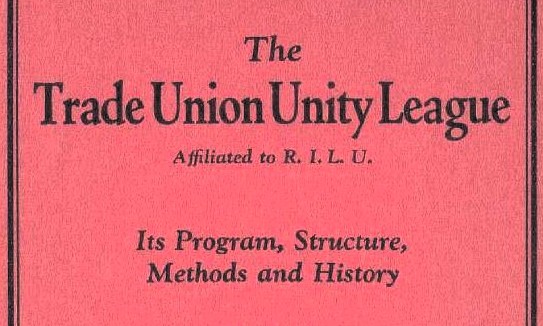
In 1924 Labor Herald was folded into Workers Monthly, an explicitly Party organ and in 1927 ‘Labor Unity’ became the organ of a now CP dominated TUEL. In 1929 and the turn towards Red Unions in the Third Period, TUEL was wound up and replaced by the Trade Union Unity League, a section of the Red International of Labor Unions (Profitern) and continued to publish Labor Unity until 1935. Labor Herald remains an important labor-orientated journal by revolutionaries in US left history and would be referenced by activists, along with TUEL, along after its heyday.
Link to PDF of full issue: https://www.marxists.org/history/usa/pubs/labor-unity/v2n06-w25-jul-1928-TUUL-labor-unity.pdf
 Revolution's Newsstand