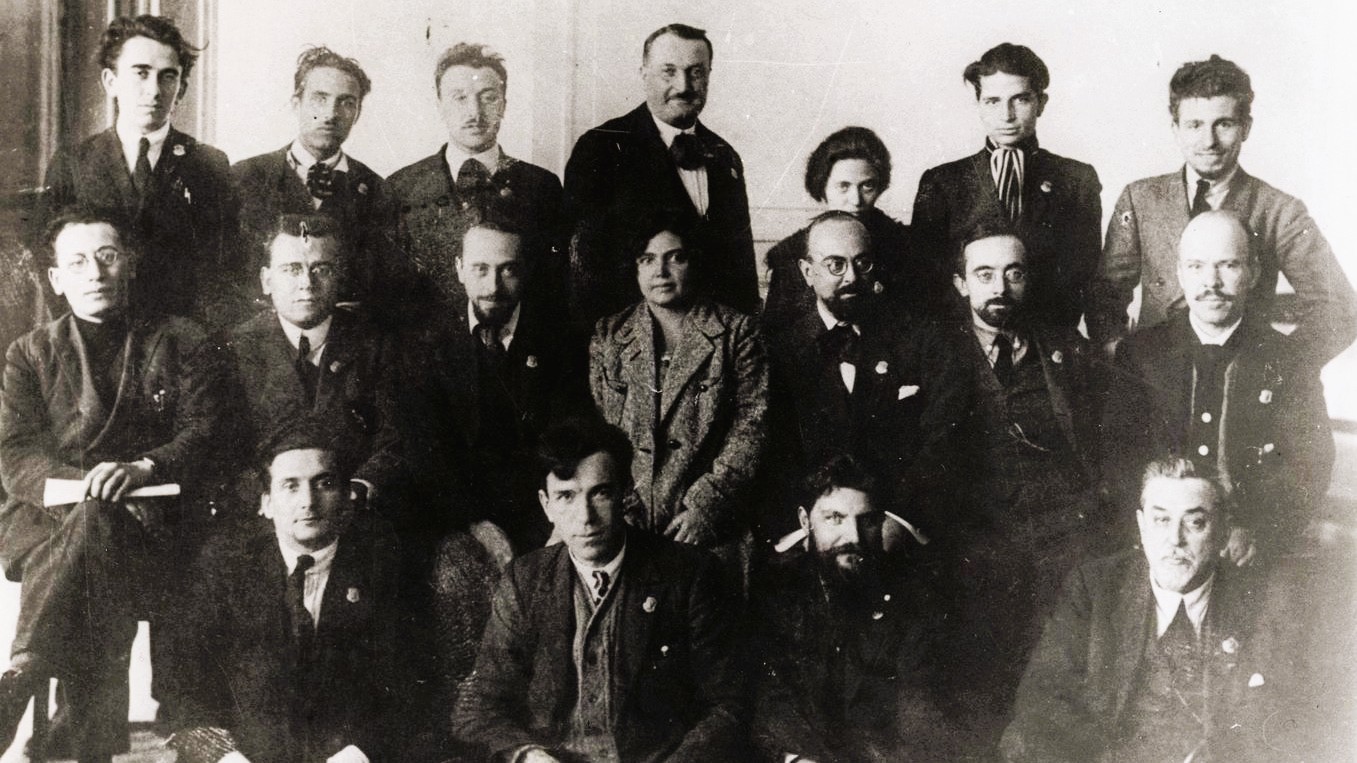
Still divided between the so-called “ultra Left’ majority under Bordiga and the pro-Comintern factions, the Italian Communist Party would go through much of the early 1920s without being able to convene due to illegality, with disputes decided at the Comintern level or left unresolved, with local and regional units pursuing their own policies. The Fifth Congress, with its focus on ‘Bolshevization’ sought to end the conflict in the Italian Party, endorsing the leadership around Gramsci’s minority.
‘The Italian Communist Party after Fifth Congress’ from Communist International. Vol. 2 No. 10. March, 1925.
Difficulties Confronting the I.C.P.
FOR the I.C.P. the interval since the Fifth Congress has been a period of unbroken growth and development. The slogans—“Closer to the masses,” and “Build up a mass party,” are now actually beginning to be put into force. The small but compact proletarian kernel that formed the basis of the I.C.P. is now continually extending and strengthening connections with the wide masses of workers. The period between the Fourth and Fifth Congresses was a time of difficult trials for the I.C.P., not only because Fascism and the most black and violent reaction had reached the height of their fury during that period, but also because the young I.C.P., although hardened in the fight with bourgeois dictatorship, had not yet finally decided on the correct road. The I.C.P. came into being at a time when the bourgeoisie had already begun its attack, and whereas under the blows of Fascism it became more compact, combative and tempered, it was only under the Comintern’s guidance that the Party grew organisationally and ideologically. At the same time, the I.C.P. lived through very difficult times; there were times when more Party members were in prison or had emigrated than were at large in Italy, when endless raids of the police and of Fascist bands destroyed whole provincial organisations, and wiped out all contact with the centre. There were also periods of disagreement in the C.C. or of divergence with the line of the E.C.C.I.
As a result of all these causes the young I.C.P. emerged all the stronger, and became tempered and experienced as is only possible in the course of struggle. However, this in no way means that the I.C.P. has already become finally moulded, or that its future path will only be one of uninterrupted growth and strength. Many difficulties still face the I.C.P., difficulties that may turn out to be the biggest and most serious of all. The whole Party has still enormous work io do in order to grow ideologically and organisationally into a real Bolshevist Party. On such a path difficulties, partial defeats or a struggle with one internal Party digression or another are unavoidable, but in summing up this short period, one cannot fail to remark with great satisfaction the considerable success that the I.C.P. can now record. Six months ago it would have been difficult to predict that the insignificant I.C.P. driven underground, and exposed to constant destruction, could have so quickly become such a serious force in the events that are now developing in Italy. It is true that the objective conditions in which the I.C.P. has to develop its activities are not the same as they were a half a year or so ago. However, with those difficulties that has stood and are still standing in the path of the I.C.P., it is only by dint of correct tactics, in learning the lessons of the past, and with a great effort of strength that it will be possible to move forward with success.
Numerical Growth and Organisation of the I.C.P.
What strikes one most after the Fifth Comintern Congress, is the rapid growth in the forces of the I.C.P., and the increase of faith in the Party on the part of the wide masses. It must not be forgotten that in spite of the decomposition of Fascism, and even in spite of the furious campaign that the bourgeois opposition press is also waging against the Fascists, the everyday work of the Italian Communists, and of the revolutionary workers, has changed but little. The bloody activities and frenzy of the Fascist bands led by provincial satraps, still goes on. Only a few weeks ago, Fascist justice sentenced to long years of imprisonment about a hundred workers, for events that happened way back in 1921. But in spite of all this, the ranks of the Communist Party are growing quickly, and would grow yet quicker if the Young I.C.P. only possessed the organisational possibilities of assimilating those proletarian elements who now stand decisively under her banner. The I.C.P. has already nearly 30,000 Party members, and the Y.C.L. about 10,000. There was a time when the total number of Communists at large in Italy was not more than six to seven thousand. This is still more significant when the fact that Fascism compelled tens of thousands of revolutionary workers to emigrate is taken into consideration. The daily Party newspaper Unita has already reached a circulation of more than 40,000, notwithstanding the fact that there have been instances of the paper being confiscated by the police three or four times during one week alone. Under such conditions a Communist Party has to make great efforts to produce a newspaper, but through its extensive contributions Unita has not only come closer to the masses, but the Communist workers themselves now take an active part in producing the paper. A large number of worker correspondents reflect the life and struggles of the masses and discuss those tactical questions that the Party places before them for their considerations. Besides the Unita, the following publications have a fairly large circulation—the weekly Stato Operaio, the T.U. organ Sindicate Rosse, and the review Ordine Nuovo. In addition to the above, weeklies are published in the most important centres. The total circulation of the Party Press is more than 100,000 copies.
Considerable progress has also been made by the Party in respect to organisation. First, great efforts had to be made to organise the illegal Party apparatus, and to teach underground methods of working to those comrades who were still unaccustomed to it. It was also necessary to learn how to combine illegal work with the use of legal possibilities, and for this purpose, to create an apparatus that would be sufficiently flexible and stable. After a more definite sub-division of functions, the actual apparatus of the Party has considerably improved.
The Party is now devoting a good deal of attention to the question of the peasantry, who play so great a role in Italy. This especially applies to the South, where huge numbers of poor and revolutionary peasants are undergoing medieval exploitation. The Agricultural Section is now developing intensive work, and the circulation of the Party weekly Il Seme, devoted to peasant questions, is increasing considerably. The Agricultural Section is now sending out a large number of organisers who are reforming or organising Peasant Unions (Lege Consadine). Besides this, in quite a number of places in the South peasant conferences have been held, at which Communist speakers have informed the delegates about the tactics of the Communist Party, and of the Peasant International. In general, a considerable livening up of peasant work in Italy can be remarked.
Re-organisation of the Party on the Basis of Factory and Workshop Nuclei.
This has been presented as one of the basic problems of the current life of the Party. If before there were comrades who did not understand, or who under-valued the importance of such re-organisation, it is now accepted by all as a necessary and urgent task of the Party. Reorganisation is being carried out everywhere, already giving positive results. This is especially felt in the great industrial centres. In Turin, for instance, the whole process of reorganisation has already been carried out, and more than 60 factory and workshop nuclei are at work; in Milan, the greatest industrial centre in Italy, the Communist Federation which not long ago only had 500 members, now has organised more than 45 nuclei in large enterprises, and the Federation embraces about 2,oco Party members; it has thus become one of the strongest.
The work of agitation and propaganda has also improved with the creation of a corresponding Department of the Central Committee. The Agitprop Department, besides control over the whole Press, has also undertaken wide mass agitation by means of publishing proclamations, brochures, etc. The Agitprop also has set itself the task of raising the Marxist and Leninist level of the Party as a whole, and the most active members in particular.
Thus, the growth of the I.C.P. can now be undoubtedly felt in all directions, whilst contact with the masses becomes closer and closer. The Party, beginning last November, after having been forced underground for two years, has again in many places been able to conduct public meetings. These meetings, arranged right on the factory premises, arouse keen interest among the workers.
The Tactics of the I.C.P.
Following the Fifth Congress of the Comintern, after a few disputable questions of internal Party life and of disagreement with the Comintern had been cleared up, the tactics of the I.C.P. have continued to give tangible results in the growth of the Party’s strength and influence. The Party, emerging from a long period of defensive positions, and underground existence, is turning now to the tactics of a wide mass movement, and rapidly becoming stronger, and spreading its influence.
During the period between the Fourth and Fifth Congresses, one of the most disputable questions between the E.C.C.I. and the C.C. of the I.C.P. was the tactical question in relation to the Italian Party. The decisions of the Fifth Congress put an end to the misunderstandings that had arisen on this field. The amalgamation of the I.C.P. with the Third Internationalists was carried out everywhere with great enthusiasm. The campaign for recruiting non-Party workers into the ranks of the Party, that was commenced at the same time, gave equally brilliant results. This was a decisive turning point on the road towards creating a mass party. The reinforced influx of revolutionary proletarians continues all the time, ever widening the ranks of the Communist Party.
The Tactics of the I.C.P. in Relation to Fascism and the Opposition.
The period after the Fifth Congress coincides with that of the commencement of a more perceptible decline of Fascism, marked by the murder of Matteotti. Immediately after the murder of Matteotti in June, the C.I. launched the watchword of a general strike for the armed struggle against Fascism. The appeal of the I.C.P. naturally was impossible of realisation in the face of the resistance of the I.S.P., the Reformist Party, and the General Confederation of Labour. But it had significance in so far as it led to an increase in the influence of the I.C.P. among the working masses. At the same time the Party strengthened its attack against Fascism and gave a wide circulation to the slogans—“Down with the murder Government,” “Disarmament of the Fascist bands and Black-shirtists,” “Arming of the workers and peasants for defence against Fascism.” When, after this, there was organised a parliamentary opposition bloc, consisting of all the Liberal-democratic groupings (together with the I.S.P. and reformists) against Fascism, the I.C.P. in order not to remain in the eves of the masses isolated in the struggle against Fascism, joined this bloc. But as soon as the anti-proletarian and counterrevolutionary character of the opposition became clear, the I.C.P. was very soon compelled to quit this bloc, in order to commence a double fight against Fascism and against the opposition.
In the C.C. report printed in the Unita, 26th of August, the I.C.P. defines its political course at the present time. In giving a detailed analysis of the economic situation of the country, with the increasing decomposition of Fascism and the present distribution of social forces, the C.C. brings out in relief the treacherous role played there by the Social-Democrats (I.S.P.) and the Reformists (Unity Socialist Party of Turatti). Defining this period as one of transition to the bourgeois-democratic sphere, the Party throws out as a special slogan for this period—Formation of special workers’ and peasants’ committees for defence and struggle against Fascism. This watchword gives a wide organisational basis for rallying the masses around the I.C.P., and a wide field for all future propaganda.
The I.C.P. has to carry on a special attack against the I.S.P. and Reformists, whose inclusion in the opposition was to guarantee the passivity of the proletariat during the period of the fall of Fascism. In the struggle with Fascism the opposition had to be supported by broad public opinion. By a sharp criticism of Fascism and by demagogic promises, the opposition tried to bring the masses over on to its side, at the same time, however, in accordance with its own plan, trying to keep them within the bounds of a legal constitutional fight against Fascism. But it was just here where the Party carried out a systematic and insistent attack against the opposition, criticising and at the same time driving them onwards. The I.CP. press untiringly denounced the passivity and the anti-proletarian, counter-revolutionary tactics of the opposition.
This systematic and successful criticism on the part of the I.C.P. which frequently drove the opposition into a cul-de-sac, not only drove to frenzy the purely bourgeois parties included in the opposition, but more especially the I.S.P. and the Reformists. The wild, but impotent malice of the opposition went to such lengths, that having used up all arguments, they spread abroad the absurd calumny that the Communists were acting in agreement with the Fascists. The Socialist Deputy, Arturo Vella, became a prominent propagandist of this absurd and clownish legend.
Proposal of the I.C.P. to the Opposition to Organise an Opposition Parliament.
The proposition made by the I.C.P. to the opposition bloc on the 21st of October, last year, was a great blow to the passive and demagogic tactics of the opposition. The proposal was to form, in contradistinction to the Fascist Parliament, a parliament of opposition, which would begin to function regularly. This would have meant dividing into two camps all State institutions, and the commencement of civil war. The opposition, naturally did not accept this proposition. For some days the whole Italian press was devoted to this proposal of the Communists, which the opposition wanted to “ignore,” but could not. After this, the opposition’s position became one of hesitation, while the sympathy for and faith in the I.C.P. grew considerably. On November 10th, just before the opening of the Fascist Parliament, the I.C.P. renewed its proposal, at the same time denouncing the whole contradictory and opportunist character of the opposition tactics. As this was just prior to the special conference of the opposition the Communist Parliamentary fraction requested that the proposal of the Communists should not be rejected before the Communist deputies delegated for that purpose had been heard at the general meeting of the opposition. This time the opposition not only turned down the offer of the Communists, but did not even give the Communists the possibility of speaking at the meeting. Then again, the whole Italian press dealt with the Communist Party’s proposals for several days.
Finally, on 12th of November, the day of opening of the Chamber of Deputies, the C.C. of the I.C.P. decided not to limit itself to passive abstention from Parliament, but to send there one deputy, who, in the name of the Communist Party would make a declaration. The question of participation or non-participation in the Fascist Parliament was the subject of a lively discussion in all the Party Press. Many comrades suggested that the Communist fraction should return to Parliament in order to continue there from within, the struggle with Fascism; others advised boycotting Parliament, and not going back there at all. The decision taken by the C.C. of the I.C.P. proved to be the most correct. Indeed, Comrade Reppossi’s speech in which he openly declared from the tribune of the Fascist Parliament that the Communist Party only sees a solution of the question in a decisive and organised armed fight with Fascism, and calls out the masses to that fight, branding the whole Parliament as a gathering of murderers, was listened to by the Fascist deputies with gnashing of teeth; but created an enormous impression throughout the country. A similar demonstration of the Communist Party at the Conference of the Opposition would but have brought out yet more clearly the tactics and position of the I.C.P. and would have strengthened her influence to a much greater degree.
The opposition, whose passive and cowardly tactics received yet a further blow by this Communist demonstration, again resorted to its old ridiculous invention–that the Communists were acting in agreement with the Fascists in order to ruin “liberal-democratic” Italy.
In this way, these tactics of double attack against Fascism and against the treacherous opposition, the denunciation of the Fascist Parliament, and the opposition “quasi-Parliament,” together with a wide propaganda and organisational setting up of workers’ and peasants’ committees, are the basic tactical platform upon which the I.C.P. is mobilising the masses for the coming struggle.
The Internal Party Situation.
The internal situation of the I.C.P. is now characterised by a full harmony in respect to the present tactics of the I.C.P. corresponding to the resolutions of the Fifth Comintern Congress. The Party has also become more ideologically compact. The “extreme left” tendencies are being outlived. Nearly all the federal conferences unanimously accepted the resolutions, confirming both the resolutions of the Fifth Congress of the Comintern in relation to the I.C.P. and also the present tactics of the I.C.P., and appealing to all comrades, and particularly Comrade Bordiga, for harmonious and disciplined work in accordance with the direction of the Comintern. In this manner, the Bolshevisation of the I.C.P. is going ahead, although there still remains a great amount of work to be done in the Marxist and Leninist education of the ever-extending ranks of the I.C.P.
The ECCI published the magazine ‘Communist International’ edited by Zinoviev and Karl Radek from 1919 until 1926 irregularly in German, French, Russian, and English. Unlike, Inprecorr, CI contained long-form articles by the leading figures of the International as well as proceedings, statements, and notices of the Comintern. No complete run of Communist International is available in English. Both were largely published outside of Soviet territory, with Communist International printed in London, to facilitate distribution and both were major contributors to the Communist press in the U.S. Communist International and Inprecorr are an invaluable English-language source on the history of the Communist International and its sections.
PDF of full issue: https://www.marxists.org/history/international/comintern/ci/new_series/v02-n10-1925-new-series-CI-riaz-orig.pdf
 Revolution's Newsstand