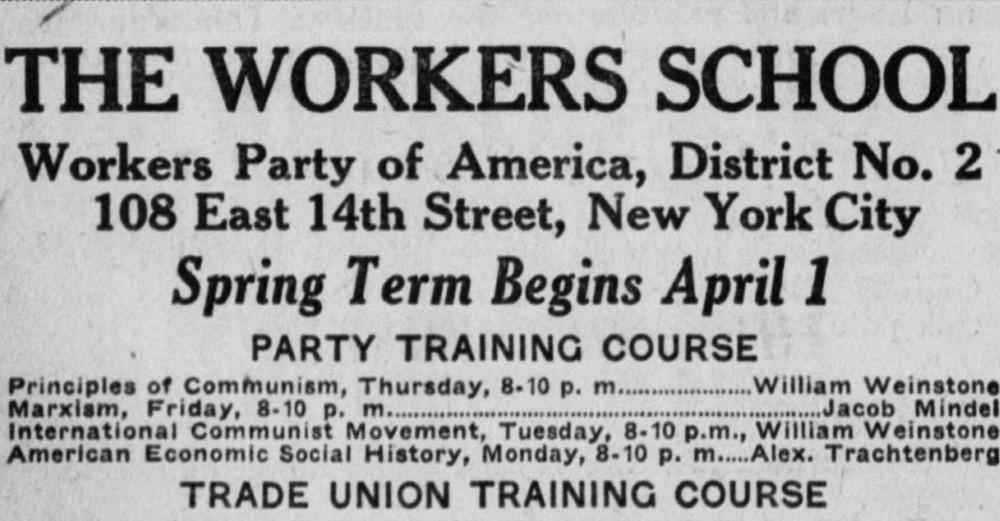
Joseph Freeman on the success of the Communist Party’s New York Workers School developed in the 1920s.
‘The New York Workers School’ by Joseph Freeman from The Daily Worker. Vol. 3 No. 14. January 28, 1926.
(The following is a report on the New York Workers’ School made by the well-known writer, Joseph Freeman, for the Russian news agency, Tass.)
NEW YORK. The largest Workers’ School in the United States is conducted by the Workers (Communist) Party. Since its establishment by the party in 1923 the school has grown steadily, until now over 1,000 workers attend its classes. The institution is known as the “Workers’ School.” Most of its classes–containing over 700 students–are held at the New York headquarters of the party. Branch classes, attended by about 300 workers, are held in other parts of the city and in nearby towns.
The students are drawn from all the important trades in and around New York, including clothing, fur, millinery, the metal trades, leather goods, textiles, teaching and clerical work. About 80 per cent of the students are members of trade unions.
The Central School.
The central school gives 21 courses. The most important of these are the party training courses, aiming to train active party members for capable leadership in trade union and other party work. One of these courses, known as the “Party Training Course,” runs for six months and is devoted to a study of Marxism, party history and problems, Leninism, and trade union work.
The Party Training Course.
This course seeks to familiarize the party membership with the origins and aims of the Communist movement, the left wing struggles in the American socialist movement, and the history of the Workers (Communist) Party The course is attended by about 150 students.
The Shop Nucleus Training Course.
The “Shop Nucleus Training Course” combines a study of Leninism with a study of party problems, and is organized to draw the entire membership into the party’s educational work.
Every shop nucleus elects one member to attend the “Shop Nucleus Training Course” at the central school. The nucleus pays his fee and exacts attendance at classes. The delegates of the shop nuclei are taught the fundamentals of party theory and work.
Nuclei and Branch Classes.
The students then return to their respective shop nuclei and teach the membership what they have learned at the central school. Questions and problems raised by the membership are, in turn, brought back to the school, where they are discussed and explained. In this way contact and exchange of ideas are maintained between the central school and the membership. About 200 shop nuclei representatives are enrolled in the “Shop Nucleus Training Course.”
Other Classes of the School.
Other courses at the school include classes in public speaking, research and a class for workers’ correspondents. There are also classes in English, and a class in Russian for party members who feel that they cannot advance in their study of Leninism without a knowledge of the Russian language.
Foreign Language Classes.
The central school conducts all its classes in English, except the Russian class. There are, however, a number of foreign-language courses given to branch classes. The Jewish members of the party give a number of courses in Yiddish. There are also courses in Finnish, German, Hungarian, Lithuanian, Italian, etc. In addition to the courses in their own language, these groups are taught English.
The Role of the English Classes.
The classes in English, both at the central school and the branch classes, are heavily attended. They are considered of the utmost importance in breaking down language barriers among the foreign-born workers. The party considers English essential to the liquidation of the foreign-language federations, with their autonomous tendencies, and the building-up of a unified, centralized party, based on shop nuclei and united by one language.
The Workers School and the Agitprop Department.
The “Workers’ School” is one of the activities of the agitprop department of the Workers’ (Communist) Party. The agitprop director for New York is at the same time director of the school. All the teachers, are party members. There are 18 teachers at the central school and an average of two teachers in the branch classes.
The School Library.
The school has a library of several hundred books, and a research department which works together with the class in research work.
Open to All Workers.
All classes at the school, except the party training courses, are open to workers who are not members of the party, but are sympathetic to Communism. There are a number of such sympathizers in the various courses, drawn chiefly from the needle trades. The students are charged a small fee except when they are on strike or unemployed.
The school is in charge of Comrade Bertram D. Wolfe, New York agitprop director.
The Daily Worker began in 1924 and was published in New York City by the Communist Party US and its predecessor organizations. Among the most long-lasting and important left publications in US history, it had a circulation of 35,000 at its peak. The Daily Worker came from The Ohio Socialist, published by the Left Wing-dominated Socialist Party of Ohio in Cleveland from 1917 to November 1919, when it became became The Toiler, paper of the Communist Labor Party. In December 1921 the above-ground Workers Party of America merged the Toiler with the paper Workers Council to found The Worker, which became The Daily Worker beginning January 13, 1924.
PDF of full issue: https://www.marxists.org/history/usa/pubs/dailyworker/1926/1926-ny/v03-n014-NY-jan-28-1926-DW-LOC.pdf
 Revolution's Newsstand