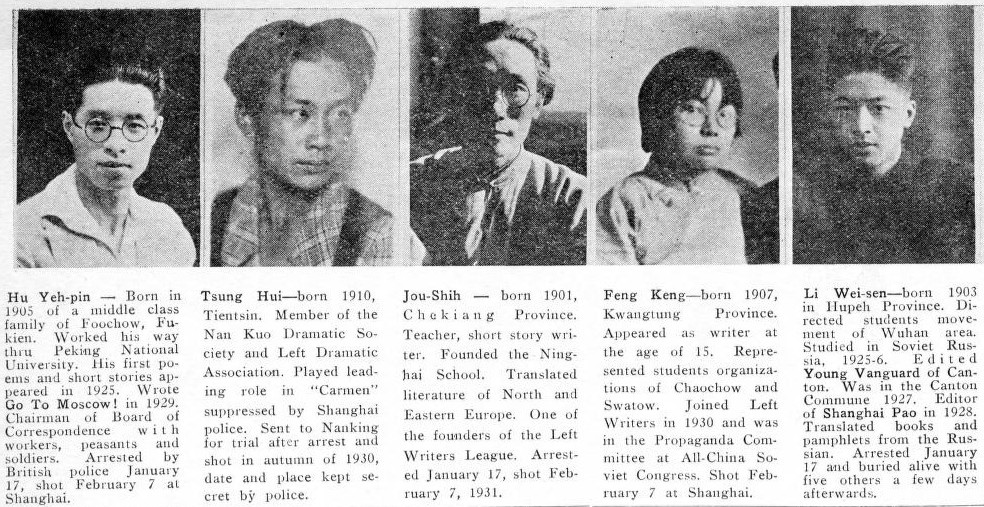
Outside repression and internal dissensions ravage the League of Left Writers in China during the First Civil War.
‘The Situation of the League of Left Writers in China’ from International Literature. No. 1. 1932.
(Letter from Shanghai)
The rapid development of the revolutionary movement in China is forcing the imperialists and the Kuomintang to an ever more brutal use of terroristic methods. The whole world knows of the murder of five of our comrades. Another has been buried alive, and many are arrested without cause. These atrocities are a hard blow for our League, although the pressure of our enemies gives direction to the work of the League.
The League made a number of errors in following the line of Li-Li-sian (one of the leaders of the “left” wing of the C.P. of China). Our organization was not clearly revolutionary; we overestimated our strength and therefore could not keep the non-revolutionary and opportunist elements out of our ranks. The increased pressure of the terror gradually eliminated these elements. Some were bribed by the Kuomintang and joined the puppet show–as we call the “literary politics” of the Kuomintang. Our forces are so weak that a number of important tasks are being fulfilled only on paper. This leads us to adopt a number of decisive measures. We fully realize the need of uniting our forces and to accomplish this, we must re-register the League members, and remove all opportunist traitors. At the same time, we will improve our organs, and strengthen our leaders in practical work. We are publishing the Literary Journal and Tsian Sao (Outpost) through which we participate in the struggles of the masses. We can proudly state that every member is not only active, but takes the initiative in practical work.
As a result of the events in Manchuria, a new wave of revolution is rising throughout China. Our League is taking an active part in the agitation and propaganda against imperialism.
Although we formerly underestimated the importance of literary creation, we now recognize it and are encouraging original work among our members. To improve the technique of original literary work, we have organized a “Commission for the study of original production” and also a “Commission for literary criticism.”
In an attempt to counteract the growth of the proletarian revolutionary movement and its influence on the masses, the Kuomintang has organized in Nanking a group called “Literature of the three principles of Sun-Yat-sen.” By spending much money on bribes to the “lumpenintelligentsia” and literary bohemians, it is making them propagandists for “national” literature. All the writers leading this movement are either spies of the Shanghai general staff or members of the executive committee of the Kuomintang. Our enemies stop at nothing to intimidate the revolutionary writers; they are trying in every way to corrupt our League from within. They deceive the masses with national fascist propaganda, issue orders to the police to close book stores and publishing houses of the proletarian writers, and spy upon all radical elements. Their organs of national literature, a weekly and monthly called Tsan Fun (Vanguard), are poor in every respect. The students and youth refuse to read them. Even moderate writers are dissatisfied with these “creations” and if it were not for the withe terror of the Kuomintang, this dissatisfaction would long ago have been expressed openly.

The “Vanguard” group, in Shanghai is supported by Chang-Kai-shek while Hu-Han-mina supports the group at Nanking which issues the Literature of the three principles of Sun-Yat-sen. Verylikely the everlasting dissensions among the various Koumintang groups will weaken their influence over the masses. Nevertheless, we must not underestimate the danger of reactionary literature. We have decided to use all legal and illegal means in determined struggle against them. With this aim in view, we have organized a “Commission of Theoretical Struggle.”
Our League has a branch in Peiping, which is the cultural center of North China. Most of the students at Peiping are of the poorer classes whereas the Shanghai students come from bourgeois-compradore families. The white terror is not as brutal as in the South and therefore the Northern branch of the League is growing rapidly (at present the branch has over 100 members).
We receive letters from Tokyo asking us to organize a branch of our League there. Thus in a short time the League will grow considerably.
SUPPRESSION OF THE REVOLUTIONARY CULTURAL MOVEMENT IN CHINA
Five writers have been arrested by the imperialistic police of the international settlement in Shanghai, delivered to the general staff of the Shanghai-Usun garrison and executed. Such acts of violence take place not only in Shanghai. Not long ago several students were beheaded in the Sichuan province for reading books on economics; the principal of the fifth public school in Shirin was sentenced to five years imprisonment, and the dean of the school to nine years and 11 months imprisonment, merely because their students had read Marxian literature.
Aiming to deal a death blow to all progressive thought and creative endeavor, the special criminal code issued by the Nanking government in February, 1931, includes, by order of the imperialists, the following articles: paragraph II, clause 2: “Anyone making use of writing, speech or drawings for purposes of propaganda against the nation will be sentenced to death or imprisoned for life.” Paragraph III: “Anyone, instigated to violate clause 2 of paragraph II, who instead of reporting the instigator to the police, himself agitates against clause 2 of paragraph II, will be sentenced to imprisonment for life.” Paragraph IV: “Anyone, advocating any doctrines other than San-Min-chu will be sentenced to imprisonment for a term of not less than five and not more than 15 years.” According to these laws all advanced thinkers and artists who revolt against the Koumintang and imperialist rule risk being imprisoned for a term of not less than five years, or even being executed.
The publication of radical books and periodicals is forbidden. Nine book shops in Shanghai were raided and closed by the Koumintang authorities merely for serving as agents for the Hua Sin Booksellers and keeping a stock of books on Leninism. Many bookshops were raided and closed in various other localities. According to information received from publishing circles many books enjoying world fame were forbidden to be translated into Chinese. Among these are such works as: Historical Materialism by Bukharin, Ten Days That Shook The World by John Reed, Plekhanov’s article on art, Mother by M. Gorky, Oil by U. Sinclair, A Week by Libedinsky, and others.
Magazines, newspapers and other periodicals are subject to repressive measures. According to the Press Law passed by the legislative body of the Nanking government on November 29, 1931, “publications that are harmful to China, the Kuomintang or the San-Min-chu, or that seek to over- throw the National Government, are prohibited.” (Paragraph IV, clause 12). Furthermore, according to paragraph 7, all publishers of newspapers or magazines must register at the Ministry of Home Affairs of the Nanking government. If. however, a publication contains matter on the Kuomintang or San-Min-chu, it must also be registered at the Central Committee of the Kuomintang. It is obvious that under such conditions the existence of Marxian periodicals is impossible. The police headquarters of the French imperialists in Shanghai prohibited over 40 different newspapers, including the following: The Illustrated Soviet, Red Marines, The Red Banner, The Revolutionary Worker, Mopr, Leninist Youth, etc. The Tayuan Times and The People’s Voice, published in the Shensi province were banned by the local militarists. The Harbin Daily News published in Harbin, was banned for printing material unfavorable to Russian emigrants—the allies of the ruling class in China. Considering the Press Law passed by the Nanking government not rigid enough, the militarists of the Uhan province demand that newspaper publishers pass a special examination by the Censor Committee, and that throughout the period of “communist suppression” all newspapers be kept under the direct control and censorship of the local government. In all the white provinces of China all information intended for publication in the press is, as a rule, submitted to strict censorship of the local government. It goes without saying that left organizations have no chance whatever of organizing public exhibitions and theatrical performances. Even foreign pictures which contain only the shadow of an idea dangerous to imperialism and the Kuomintang are prohibited. The well known American film produced by Fox Brothers, “All Quiet on the Western Front” was not allowed to be featured in Nanking and Canton. The explanation given was that “anti-militarist propaganda is undesirable at a time when the campaign against the reds is not yet over. While the “Street Angel” was being shown in one of the cinemas in Shanghai, a group of Italian sailors broke into the theatre and burnt the film “in defence” of their nation’s reputation which they claimed was being disparaged in the picture. Pudovkin’s “Storm Over Asia” has been absolutely prohibited in the foreign settlement of Shanghai. In the Chinese quarters it was shown only after a large sum had been paid to the local branch of the Kuomintang, and even then a final scene was added in which the Kuomintang banner was conspicuously displayed.
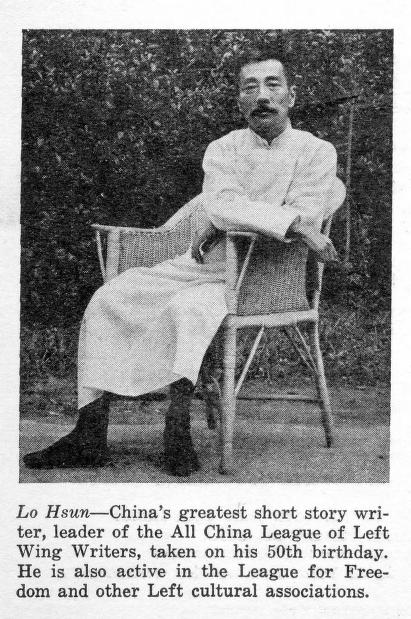
The Kuomintang does not limit its activities to featuring the national flag at the end of imperialistic films. Publishers who formerly issued radical journals are forced to print so called nationalist literature. Those who study or teach revolutionary philosophy are arrested; school masters are forced to sign obligations to the effect that revolutionary doctrines will never be taught in their schools; the Kuomintang authorities employ all means possible to encourage lectures on ancient philosophy and classical literature, hoping thus to arouse in the students respect for Confucianism. The Nanking government recently assigned 100,000 dollars for the reconstruction of the Confucian Temple in Shantung, Dai-Tsi-tao, head of the Examination Council of the Nanking government personally contributed 100,000 dollars for the erection of the Boa Hua Temple in Nanking. These facts taken together prove convincingly that the Kuomintang is making frantic attempts to befog the Chinese youth with religious and feudal ideas. Not for nothing do the imperialists and the Kuomintang fight against the left cultural movement. The unusual development of the left cultural movement and the progress of Marxism reflects the rapid growth of the revolutionary movement. During recent years the revolutionary movement has led to the organization of a League of Left Writers, a Socialist League, a Dramatic League, a League of Actors, a Society for the Investigation of Public Problems, and a Literary Research Society, all of which are concentrated in Shanghai. All these organizations united to form a Confederation of Left Cultural organizations. The League published 15 different periodicals (The Cultural Advance, Pioneer, New Ideas, etc.) which aimed at popularizing Marxism and Leninism among the wide masses of China. The practical and theoretical work of these organizations is directed against the ruling class and its San-Min-chu, and against bourgeois philosophers. It is supported in its work by the laboring masses and the students. These organizations have taken many a stand in defence of freedom of press, speech and organization.
The imperialists and the Kuomintang have come to realize that the Left Cultural Movement is a great power, and in their attempts to suppress this movement they adopt extremely harsh measures, not even hesitating at wholesale murder. At present the movement has been forced underground, but nevertheless it is making progress not only in Shanghai but also in Peking, Tientsin, Sichuan, etc. Not long ago the Society for the Investigation of Public Problems, which was organized by the more advanced students, held an illegal conference at which over 20 representatives were present (including one from Formosa). The conference published a protest against white terror and the advance of imperialists and the Kuomintang on the Red Army. Furthermore, the conference decided to oppose the National Assembly that is being called by the Nanking government, for the reason that this “National” Assembly is really a gathering of landowners, militarists and capitalists who will never permit that freedom of press and organization for which the Society is struggling.
Literature of the World Revolution/International Literature was the journal of the International Union of Revolutionary Writers, founded in 1927, that began publishing in the aftermath of 1931’s international conference of revolutionary writers held in Kharkov, Ukraine. Produced in Moscow in Russian, German, English, and French, the name changed to International Literature in 1932. In 1935 and the Popular Front, the Writers for the Defense of Culture became the sponsoring organization. It published until 1945 and hosted the most important Communist writers and critics of the time.
PDF of full issue: https://www.marxists.org/subject/art/literature/international-literature/1932-n01-IL.pdf
 Revolution's Newsstand