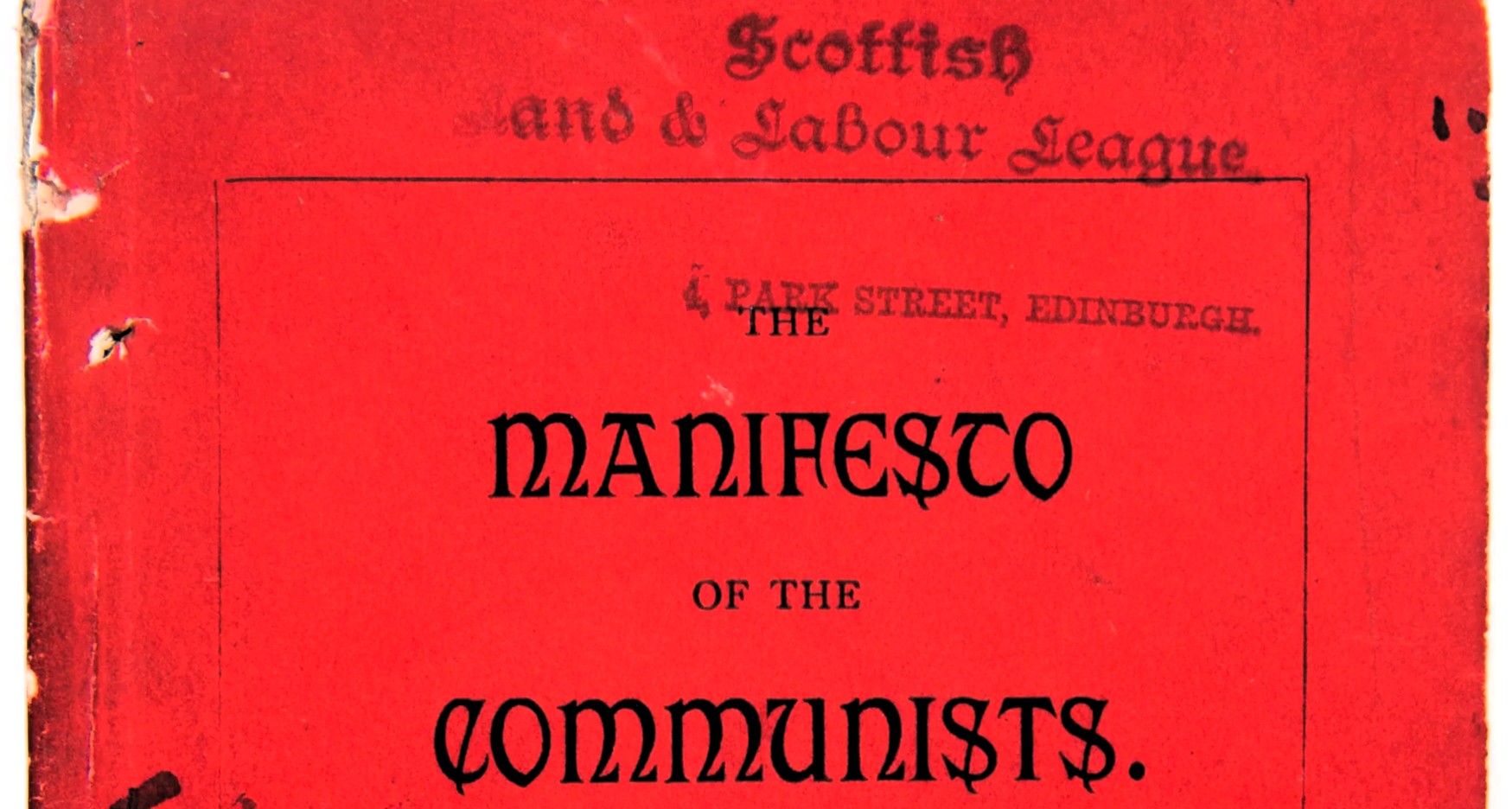
A milestone in the history of Scottish Socialism, the Land and Labour League is founded in Edinburgh in 1884. Their manifesto, printed in Albert Parson’s Alarm, below.
‘Agitate, Educate, Organize! Manifesto of the Scottish Land and Labor League’ from The Alarm (Chicago). Vol. 1 No. 6. November 8, 1884.
Being the Scottish Section of the Social-Democratic Federation.
FELLOW WORKERS: We ask you to join hands with us in spreading the principles of our league, and to work steadfastly for the attainments of its objects, which are simply these:
(1) To restore to the people the land, the primary source of wealth; and
(2) To make accessible to the workers the mechanical instruments wherewith to win from the land the raw material, and to shape it into goods for the use and enjoyment of all.”
You will say: “This is Socialism: No doubt it is. But it does not mean disorder and violence, as you are told by those who want to mislead you.
The social position of the workers, all over the world, is growing more deplorable every day, and this at a time when the Wealth of Nations,” that is, the riches of a minority of landlords and capitalists, is constantly on the increase.
This shows you that whatever profits the rich make, they make at the expense of the poor; of you, the working classes, of you, the muscle-and-sinews of the nation!
Instead of enjoying the fruits of your labor, you must leave them in the hands of those whose share in the work is as small as their share in the spoil is big. What you get out of it, in the shape of wages is no more than what is necessary to keep you alive, and hardly able to work while you are living. Not having the tools and machinery, which are indispensable today for the making of goods, you must hire yourself away like slaves to those who call these things their property.
The land in possession of your lords and the machinery in possession of your masters, brings you down to laboring, binds, to toiling, empty, mechanical hands. The more you work the surer will your wages fall, and the less will you be able to buy in the market the very goods your hands have fashioned; and the more of machinery there is invented, the more of you are thrown out as useless into the gutter. Your skill as craftsmen is fast becoming a thing of the past; your wives and children are competing with you as minders of self-acting machinery, and you are left to the merciless chances of an over-crowded labor market, helpless and hopeless Proletarians in the strictest sense of the word.
Society is thus divided into two classes; the Rich and the Poor–the Capitalists and the Workers–the Privileged and the Disinherited–the Bourgeoisie and the Proletariat.
As the one can only gain at the expense of the other, there is war between these two classes, however peaceful things may look; there is war even in the camp of each separate class, the capitalists seeking to destroy each other, and the workers being forced to fight among themselves for a living; and the waste and misery which this unhuman struggle of all against each entails, especially upon the workers, is growing unbearable to thinking men. There is no help against this in mere political jugglery between the ruling parties, who hold among them the land and the instruments of labor. The strife is a social one, and can only be settled by socialistic means and methods. If you do not want to be wholly pauperized as a class, to be lodged in workhouses, and to be driven like cattle, you must go beyond the Political Economy, whose victims you are; you must make an end of wages slavery and go in for an organization of society based on the Cooperation of all for the benefit of each.
This is what Socialism means. It will bring peace, well-being, and order, in place of anarchy, misery and strife. It will abolish classes, and consequently, class rule, class hatred and class distinction; it will make an end forever of bad housing, underfeeding and overwork, and will give every one a fair chance of a life of health, culture and happiness.
To obtain this end the one thing needful is the combination of the workers. You, who create all wealth, must learn to understand that Socialism means the change from fighting each other for life like beasts, to working together for life–like men. You must get to know each other and to agree between you that this change MUST be made, and then it will be made.
Working men and women of Scotland, come into our League and learn about these matters. They are all-important to you, for on your right understanding of them depends not only your fate and that of your children, but the fate of the coming generations of workers.
By joining our League, combine with us for freedom.
THE EXECUTIVE COUNCIL Of the Scottish Land and Labor League. Edinburgh, October, 1884.
NOTE. For membership apply to secretary, Picardy-Hall, 20 Picardy Place, where members meet for reading and discussion.
The Alarm was an extremely important paper at a momentous moment in the history of the US and international workers’ movement. The Alarm was the paper of the International Working People’s Association produced weekly in Chicago and edited by Albert Parsons. The IWPA was formed by anarchists and social revolutionists who left the Socialist Labor Party in 1883 led by Johann Most who had recently arrived in the States. The SLP was then dominated by German-speaking Lassalleans focused on electoral work, and a smaller group of Marxists largely focused on craft unions. In the immigrant slums of proletarian Chicago, neither were as appealing as the city’s Lehr-und-Wehr Vereine (Education and Defense Societies) which armed and trained themselves for the class war. With 5000 members by the mid-1880s, the IWPA quickly far outgrew the SLP, and signified the larger dominance of anarchism on radical thought in that decade. The Alarm first appeared on October 4, 1884, one of eight IWPA papers that formed, but the only one in English. Parsons was formerly the assistant-editor of the SLP’s ‘People’ newspaper and a pioneer member of the American Typographical Union. By early 1886 Alarm claimed a run of 3000, while the other Chicago IWPA papers, the daily German Arbeiter-Zeitung (Workers’ Newspaper) edited by August Spies and weeklies Der Vorbote (The Harbinger) had between 7-8000 each, while the weekly Der Fackel (The Torch) ran 12000 copies an issue. A Czech-language weekly Budoucnost (The Future) was also produced. Parsons, assisted by Lizzie Holmes and his wife Lucy Parsons, issued a militant working-class paper. The Alarm was incendiary in its language, literally. Along with openly advocating the use of force, The Alarm published bomb-making instructions. Suppressed immediately after May 4, 1886, the last issue edited by Parson was April 24. On November 5, 1887, one week before Parson’s execution, The Alarm was relaunched by Dyer Lum but only lasted half a year. Restarted again in 1888, The Alarm finally ended in February 1889. The Alarm is a crucial resource to understanding the rise of anarchism in the US and the world of Haymarket and one of the most radical eras in US working class history.
PDF of full issue: https://dds.crl.edu/item/54010
 Revolution's Newsstand