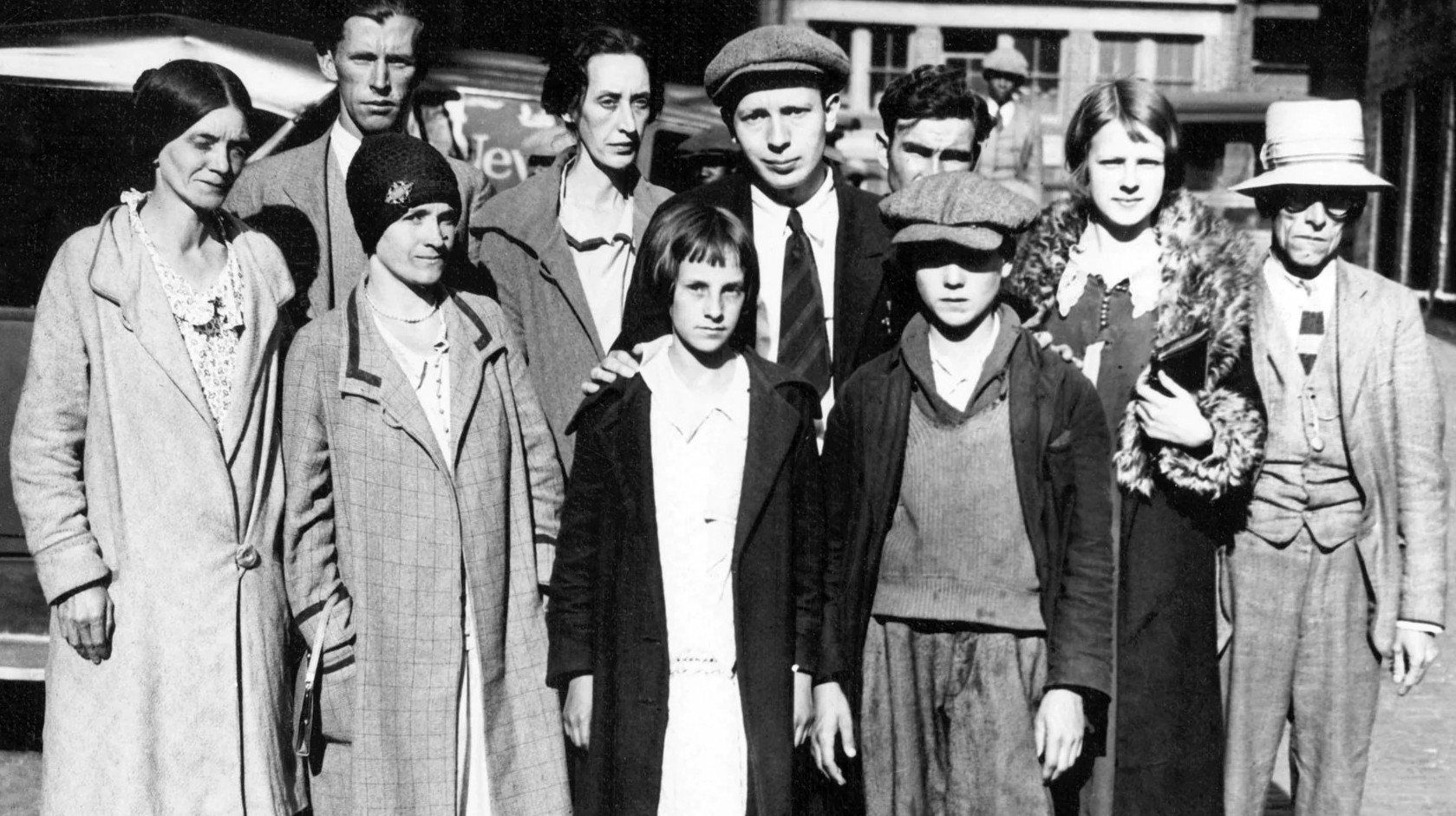
A worker-militant from North Carolina on the brutal lot of working class women in the South’s textile towns, urging organization during the Loray Mill Strike.
‘Gastonia Fighter Calls Women to Join National Textile Workers Union’ by Daisy McDonald from Working Woman. Vol. 1 No. 8. May, 1930.
I was born and raised in the western part of North Carolina where the birds sing and the wild flowers bloom, knowing nothing of hard slavery in the cotton mills until I was twenty years old. I was raised by hard working parents, knowing my father to work for fifty cents and one dollar per day to support his family.
From the time I was six years old I had to work in the field. Not being large enough to hoe corn by myself I had to help my brother in his work, he being older than myself. All country children, especially the poor farmers’ children knew their places. It is very plain to see that the farmer’s child has no chance in life, as well as the textile worker’s children, only they d get the fresh air and sunshine that the textile children do not get.
Worked for Ten Cents a Day
I worked in the field for ten cents a day after my father died to help my mother with the younger children. These miserable struggles were with us until I was fifteen years of age. I decided then that I wanted something for myself. I began cooking away from home for the wages of one dollar per week. So you see my fortune never came.
Into the Textile Mill
This kind of work I did until we moved to the textile industries, where the capitalist class said in those days that money grew on trees and the river, flowed with milk and honey. But when we arrived the bosses had already gathered all the money and the tree has produced none since, only what the boss gathers for himself.
I have been slaving almost twenty years in the textile mills and I have got less now than I had the day I entered the mills to learn the trade. I have learned several different trades in the mills, thinking I might earn a little more on one job than I could on the other. But I find out very little difference in them. It is only speed-up and stretch-out and long hours and low pay for the workers and big profits for the bosses.
Raising a Family on Ninety Cents a Day
I was married in the year of 1909. Being married one year our first baby was born. Then our struggling in life began. For we so much wanted to give our child a chance in life and see it have the things that children should have. But all in vain. For on such wages as 80 and 90 cents per day that my husband made we could not accomplish anything for ourselves or baby. So at the age of three months old my baby was left in the hands of other women and I was forced to go back in the mills to make some more profits for the bosses and misery and unhappiness for myself and baby. I could not give my baby the right attention, leaving it 11 and 12 hours a day. At the age of 15 months our baby developed pneumonia and died.
Now I am the mother of seven children. Just such conditions have existed since the first day I entered the textile mills to work in the year 1925, fourteen years after my first baby died, my youngest, child was born at the Loray Mill, Gastonia, N.C. When my baby was five weeks old the mill owners of that mill fired my husband because he only had one leg, the other being amputated three years previous to this time with tuberculosis of the bone. He being the only support of the family of seven at this time he was forced to look for a job in other mills. After looking two weeks he finally found a job for himself and me. At this time my baby was seven weeks old.
When we moved to this job at the Myars Mill, Gastonia, the superintendent would not let me go to work until I promised him that I would not go out of the mill to nurse my baby. Knowing I had to work to help support my family I was forced by the capitalist class to forsake my seven weeks’ old baby and go in the mills and stand on my feet 11 and 12 hours a day for $12 and $13.
Children Go to Mills.
Later in 1926 my oldest girl became 14 years old. Just when she should have been in school I was forced to put her in the mills to help me support the other small children, my husband and my invalid mother that I had to take care of in her old days.
Moving back to Loray Mill, Gastonia, we went to work there. To work there I had to get up in the morning at 4 o’ clock, get breakfast for the family, prepare my diner at the same time, go in the mill at 6 in the morning, work until 6 in the evening, go home get supper, do my scrubbing, washing, ironing, sewing at night and on Saturday afternoon.
On this job I made $12.90 per week and my daughter worked for 8 months. Then the automatic machinery was installed, the stretch-out system put on and about 175 hands were laid off and my daughter was one of the number. Then there was no one left to work but myself. A family of 8 to support on $12.90 a week, three children to send to school-books and supplies to buy which are very expensive in the South. House rent $1.50 a week, light bills 85 cents a week, life insurance $1.25 a week. In the winter season coal $1.75 one week, the next week, wood $2.20. All these bills to pay and groceries for eight, so you see I could not buy but very little food with what I had left of $12.90 a week.
Beal Comes South
When Fred Beal came to the South to organize a union I was very much interested and when a strike was called at the Loray Mill, Gastonia, I was very glad to help carry on the struggles of the workers and ever since the strike I have taken an active part and helped organize the National Textile Workers Union.
Workers everywhere should and must come together and carry on the struggles of the working class the world over regardless of color creed or nationality.
I want to say it is very important for women to organize along with the men, especially women with children who have to carry the burden of child bearing, rearing and all the responsibilities of herself and children. I know by self experience just what it means to women to support their family on such small wages and long hours as I have already written in my story.
Women workers must organize to the Textile Workers Union, section of the Trade Union Unity League–which fights for all workers alike, men and women–Negro and white–young and old.
The Working Woman, ‘A Paper for Working Women, Farm Women, and Working-Class Housewives,’ was first published monthly by the Communist Party USA Central Committee Women’s Department from 1929 to 1935, continuing until 1937. It was the first official English-language paper of a Socialist or Communist Party specifically for women (there had been many independent such papers). At first a newspaper and very much an exponent of ‘Third Period’ politics, it played particular attention to Black women, long invisible in the left press. In addition, the magazine covered home-life, women’s health and women’s history, trade union and unemployment struggles, Party activities, as well poems and short stories. The newspaper became a magazine in 1933, and in late 1935 it was folded into The Woman Today which sought to compete with bourgeois women’s magazines in the Popular Front era. The Woman today published until 1937. During its run editors included Isobel Walker Soule, Elinor Curtis, and Margaret Cowl among others.
PDF of full issue: https://www.marxists.org/history/usa/pubs/wt/v1n08-may-1930-WW-R7414.pdf
 Revolution's Newsstand