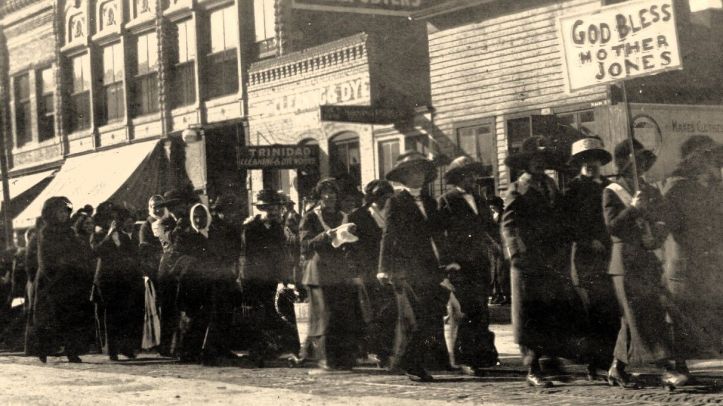
Taking the lead, the Women’s Union Labor Alliance keeps up picketing and harassing scabs even as Federal troops arrive in the Colorado strike zone in the explosive atmosphere following the Ludlow Massacre of April, 1914 during the Great Colorado Coal War.
‘New Clash Imminent’ by John Murray from Appeal to Reason. No. 978. August 29, 1914.
Trinidad, Colo. Federal troops under the command of Colonel James Lockett have driven the striking miners away from all the railroad stations in southern Colorado where non-union disembark for the coal camps. Union men are being arrested daily, but the miners’ wives are defying the military and have taken their husbands’ places on the picket line.
Members of the Women’s Union Labor Alliance, led by their president, Edith Walker, organized the Women’s Union picket squad and have met every train coming into Trinidad, in spite of the attacks made upon them by company spotters and deputy sheriffs.
Tourists heads fill every car window as the overland trains pull into Trinidad, and the eyes of the gaping crowd follow the fearless women as thy march along the platform questioning every suspicious looking stranger who they think may be on his way to the mines.
Thus far the federal soldiers on duty only stare at the women pickets, who, to make sure that there shall be no misunderstanding as to what they are doing, wear large white badges pinned across their breasts upon which are printed the words “Women’s Union Picket Squad.”
Mine Owners Get Busy.
Raging at this open defiance of what the coal operators call “Law and Order,” the daily Advertiser, mouthpiece of Rockefeller interests in Trinidad, shrieks to the United States commanding officer for help in the following front-page display, placed in a box and printed in large type:
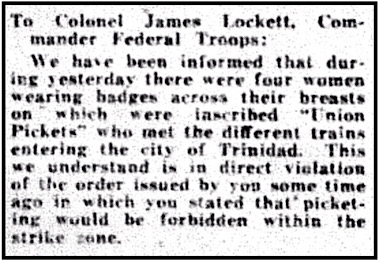
Thus far no arrests have been made by the federals, but Captain Rockwell, the officer on duty at the Santa Fe station, has warned the miners’ wives on picket that “although human,” he “must obey orders.”
The women are prepared to go to jail if the federal soldiers force the issue.
Said Mrs. Bartoloti (Virginia Bartolotti) whose husband (Giovanni/John Bartolotti) was killed in the Ludlow massacre, “the soldiers can put me and my seven children in jail if they want to, but I am going on the picket line and keep the scabs from coming in and starving us to death.”
“I shall picket, too, but my children are all gone,” declared Mrs. Petrucci, whose three little ones met their end in the flames of the historic Ludlow “death-hole.”
The foreign women as well as the men are always among the first to volunteer for dangerous service of any kind. Poles, Servians, Italians and Greeks, they have known for generations what it is to see their men go out of the house filled with strength and come home on stretchers.
The women of the picket squad frankly acknowledge that a clash between them and the federals seems inevitable. It was the women led by Mother Jones that stirred the gunmen and militia to their extreme of brutality under General Chase, and well the coal operators know that if once again the women begin to march every scab in Southern Colorado will be hunted out.
Strikers Enter Protest.
How acute the present crisis is can be seen in the text of the resolutions being passed by almost every miners’ local in the strike zone. The strikers now know that Colonel Lockett’s troopers are the most perfectly organized strikebreaking agency that ever invaded Colorado. Here is a typical set of resolutions adopted by La Veta Local Union No. 3038, U.M.W.A.:

“Whereas, On or about April 30, 1914, the federal troops arrived in the strike district. On May 11, 1914, a proclamation was issued by them forbidding the importation of workmen in the strike district to take the places of the striking miners. Since that time large numbers of non-union men have come in the district and have been given work in the mines, this with the knowledge and sanction of the federal authorities, filling the mines now operating to capacity.
“We believe except for the presence of the troops that non-union workmen would refrain from invading the district, and that ere this, the coal companies would have considered a settlement. We have for many years suffered from abuses and grievous wrongs without any redress, because of the corrupting influence of the coal operators, politically. That all of the things of which we complained, have been righted by said coal operators in the mines now operating, for the benefit of these non-union workmen, denying us the benefit of any such changes. We had great confidence in the integrity, wisdom and ability of their presence to adjust our difficulties and without question delivered to them our only means of defense and placed ourselves helpless in their charge.
“We believe that we were in a position to defend our rights and effect settlement of our wrongs before the army was brought here to assist the operators in their career of lawlessness, and deprive us of our only resources–our labor–and we believe with the immortal Lincoln, “Labor is prior to and independent of capital. Capital is but the fruit of labor, and could never have existed had labor not first existed. Labor is superior to capital, and deserves much the higher consideration.”
“Resolved, That we concur in the foregoing, and that a copy of this resolution be sent to the President of the United States for his respectful consideration.”
Mother Jones has been notified of the situation and urged to return to Colorado. She is now in New York. It is expected that she will return and bring feeling to the boiling point. The women of Colorado will not only picket the railroad stations but the camps as well.
The Appeal to Reason was among the most important and widely read left papers in the United States. With a weekly run of over 550,000 copies by 1910, it remains the largest socialist paper in US history. Founded by utopian socialist and Ruskin Colony leader Julius Wayland it was published privately in Girard, Kansas from 1895 until 1922. The paper came from the Midwestern populist tradition to become the leading national voice in support of the Socialist Party of America in 1901. A ‘popular’ paper, the Appeal was Eugene Debs main literary outlet and saw writings by Upton Sinclair, Jack London, Mary “Mother” Jones, Helen Keller and many others.
PDF of full issue: https://www.marxists.org/history/usa/pubs/appeal-to-reason/140829-appealtoreason-w978.pdf
 Revolution's Newsstand